Topics (384k) Articles (398k) Users (410) Discussions (242) Comments (383) Files (13k) New article
A wall of marginal stability is a locus in the parameter or vacuum space where the complex central charges in supersymmetry of possible decay products align in phase. The triangle inequality then becomes an equality, , permitting a BPS state to reach the threshold for decay into other BPS states. Away from such alignment, the strict triangle inequality can prohibit the decay. Supersymmetry protects the mass-charge relation of an existing short state; it does not guarantee that the state exists or remains stable everywhere in parameter space.
For an increasing sequence converging to , its absolute error is and is nonincreasing. For a decreasing sequence, the absolute error is and is also nonincreasing. This tells us that later terms cannot be worse, but does not supply a computable stopping index for a chosen tolerance.
Suppose an increasing lower approximation and a decreasing upper approximation enclose the same limit of a sequence . Their observable gap givesIf , the squeeze theorem certifies a common limit of a sequence; the midpoint has a certified absolute error at most half the gap. This is the principle behind the bisection method. In the symmetric example , , the gap is , each endpoint's exact absolute error is , and the midpoint happens to equal one exactly. The bound is valid even when such symmetry is absent.
A fixed upper bound by itself supplies less. If and for all , then and , but the last gap need not vanish. Taking and makes . A shrinking bracket or an explicit remainder formula adds information that qualitative convergence does not provide.
Dropping either condition destroys the implication. The increasing sequence has a lower bound one but no upper bound, and no finite limit of a sequence. For any real threshold , the Archimedean property gives an index , and monotonicity gives for all . Its divergence to in the extended real number line is different from convergence to a real number.
Conversely, is a bounded sequence, with , but is not a monotone sequence and has no limit of a sequence. Its subsequence at even integers is constantly one, and its subsequence at odd integers is constantly minus one. These two subsequential limits cannot both equal a single limit of a sequence. [ref]
Basic Analysis: Introduction to Real Analysis, Volume I by Jiří Lebl. §2.1, Example 2.1.5: divergence of the alternating sequence; §2.1.1, examples immediately after Definition 2.1.9: the increasing sequence n
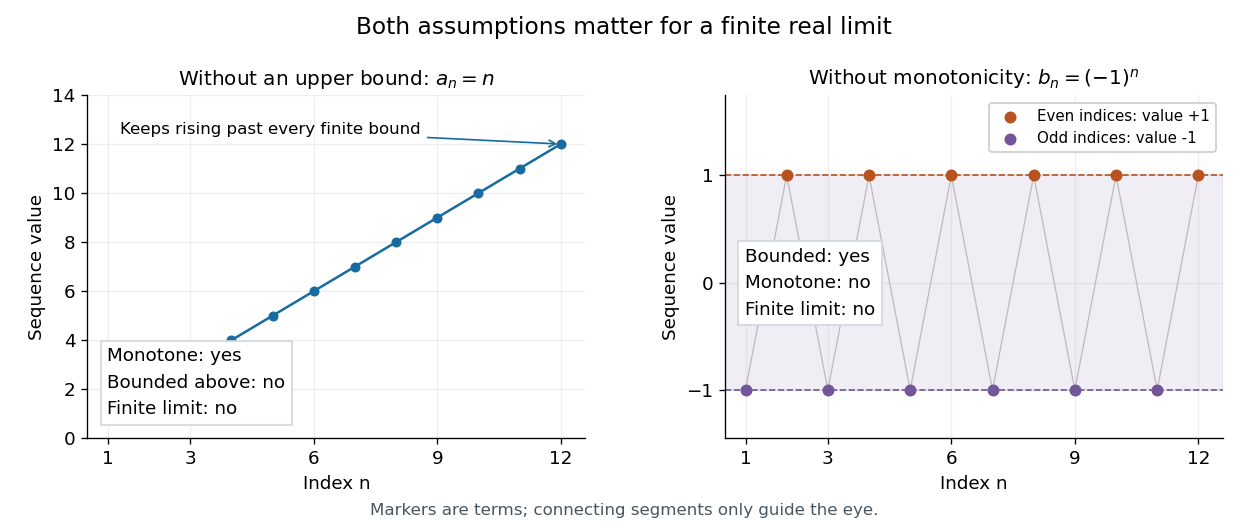
Neither monotonicity alone nor boundedness alone ensures a finite limit of a sequence
. Left: is increasing but unbounded above. Right: stays in but alternates between two distinct subsequential limits. Both plots show finitely many terms; the formulas and the arguments establish the counterexamples for all indices. Details.The ambient real numbers also matter. An original example using the floor function isEvery is a rational number, because , andThe strict lower inequality uses the irrationality of the square root of two. Hence this bounded sequence converges to in the real numbers, but has no limit of a sequence in the rational numbers. Convergence to a rational candidate would also be convergence in the real numbers, contradicting uniqueness of the limit of a sequence. The formulas give , , , : this counterexample even has a plateau. This illustrates why completeness of the real numbers matters: the rational numbers lack the least-upper-bound property needed to contain the required supremum. [ref]
The supremum of an increasing bounded sequence need not be a maximum of its set of terms. For , every term is strictly less than one; the supremum and limit of a sequence are one, but there is no maximum. Every candidate term is beaten by the next. The decreasing sequence similarly has infimum one without a minimum.
If an increasing sequence with limit of a sequence attains , it must remain there: for . The decreasing case is identical with inequalities reversed. Thus attainment of the limit of a sequence is equivalent to an eventually constant tail of a sequence for a convergent monotone sequence. The increasing sequence has both supremum and maximum one. [ref]
Basic Analysis: Introduction to Real Analysis, Volume I by Jiří Lebl. §2.1, Exercise 2.1.13: a convergent monotone sequence attaining its limit
For the two sequences in bounded monotone sequence theorem,Their directions and bounds are explicit. One is a succession of lower approximations and the other a succession of upper approximations to the same limit of a sequence. To obtain absolute error strictly below , it suffices to choose an integer , and then every works. For , the first such index is ; at the absolute error equals the tolerance.
A geometric sequence offers a faster example. The recurrence relation , gives . Thus is an increasing bounded sequence with limit of a sequence one and absolute error . For , already works, since , whereas . The bounded monotone sequence theorem guarantees both examples converge; the formulas explain their different speeds.
For a connective spectrum with , an -homology isomorphism of simply connected spaces is a weak homotopy equivalence. Its simply connected homotopy mapping cone is -acyclic. If it had a first nonzero integral homology group, the Hurewicz theorem and the bottom-degree generalized Hurewicz isomorphism would produce a nonzero -homology group. Thus the cone is integrally acyclic and the homological Whitehead theorem applies.
Bosonic exchange symmetry is the symmetric exchange statistics of identical bosons. Commuting creation operators build the symmetric bosonic Fock space; a normalized one-particle mode has occupation states for every nonnegative integer . At thermal equilibrium this symmetry leads to Bose-Einstein statistics and the Bose-Einstein distribution. Exchange symmetry itself does not require thermal equilibrium.
Two separately conserved bosonic species have two condensate fields and independent chemical potentials. A contact interaction energy density gives and in a uniform mixture. Coherent interconversion would change the conservation constraints and cannot be included while retaining independent particle-number constraints unchanged.
For a connected reductive algebraic group and a Borel subgroup , the quotient is its complete flag variety. Quotients by parabolic subgroups are partial flag varieties.
For a Borel probability measure on a compact metric space, inner regularity and outer regularity give with compact, open and . The Urysohn lemma supplies a continuous function equal to one on and zero outside , with values in . Its difference from the indicator function of is supported in and bounded by one, proving the displayed estimate. This transfers identities established for continuous test functions to measurable sets.
Maximum satisfiability asks for a truth assignment maximizing the number of true clauses of a conjunctive normal form formula. The Boolean satisfiability problem asks whether all its clauses can be made true. Binary clause indicators give an integer programming formulation, and the literal-frequency greedy approximation for MAX-SAT guarantees at least half the optimum. Counts of clauses, rather than multiplicities of repeated literals within one clause, are relevant to this objective.
Integer programming formulation of satisfiability by  Codex 0 Created 2026-10-14 Updated 2026-10-18
Encode each truth value by . A positive Boolean literal has value and its negation has value . The sum of literal values in a clause is at least one exactly when that clause is true. Thus the displayed inequalities, with objective zero, express Boolean satisfiability as a binary integer programming feasibility problem. For maximum satisfiability, introduce with and maximize . False clauses force zero indicators; true clauses permit indicators one, and maximization selects all of them. Hence the optimal objective equals the maximum number of true clauses.
A Böhm transformation is a finite composition of capture-avoiding substitutions and lambda applications to chosen auxiliary terms. It can extract a finite-address subtree of a Böhm tree as a substitution instance of the corresponding argument term.
A finite Böhm approximant is or a finite lambda term in the grammar , obtained by pruning a Böhm tree. Equivalently it is a beta-bottom normal form obtained from a beta-equivalent term by replacing subterms by ; bottom reduction contracts and to . Its interpretation in the graph model of lambda calculus is included in that of the original term.
In a one-operator closed migration process representing a finite-line switchboard, let count calls waiting for or receiving the operator's connection service and let count connected calls. At a stationary distribution, the expected drift of is , and that of is . Poisson arrivals see time averages identifies the full-state probability with . Thus the accepted arrival rate, operator throughput and completed-call rate coincide. This is a useful independent check on the product-form stationary distribution of a closed migration process.
The basic algebra of a split block with cyclic defect is a Brauer tree algebra: its simple modules are indexed by the edges of a tree, with a distinguished vertex carrying the exceptional multiplicity. For a one-edge tree of multiplicity , its basic algebra is . Its ideals form the chain of powers of , so its unique indecomposable projective is uniserial of length .
A binary block design has treatments, blocks of size , every treatment in blocks, and every distinct pair in blocks. Counting occurrences and pairs gives and . Its incidence matrix of a set system satisfies . For statistical comparison of all treatment effects one also needs connectedness; guarantees it, whereas singleton blocks with do not.
Approximate an isolated Schwarzschild black hole as emitting photon blackbody radiation from an area at Hawking temperature . The Stefan–Boltzmann law gives . Integrating gives the displayed lifetime, about years for a solar mass. Greybody factors and additional emitted species modify the coefficient; the robust large-mass scaling is , and the semiclassical calculation does not determine the final quantum-gravity endpoint.
// Target: general-relativity.bigb
For a large isolated Schwarzschild black hole with a fixed effective set of radiated species, Hawking radiation has and luminosity in natural units. Integrating gives the displayed law. A horizon-area blackbody radiation estimate gives ; greybody factors and species change it. With mass-dependent , integrate instead. The semiclassical gravity approximation fails near Planck mass, so a formal zero of the cubic law does not settle the final state.
An queue has Poisson arrivals of rate , independent exponential service times of rate , and infinitely many servers. Its occupancy is a birth-death process with birth rate and death rate in state .
Pinned article: Introduction to the OurBigBook Project
Welcome to the OurBigBook Project! Our goal is to create the perfect publishing platform for STEM subjects, and get university-level students to write the best free STEM tutorials ever.
Everyone is welcome to create an account and play with the site: ourbigbook.com/go/register. We belive that students themselves can write amazing tutorials, but teachers are welcome too. You can write about anything you want, it doesn't have to be STEM or even educational. Silly test content is very welcome and you won't be penalized in any way. Just keep it legal!
Intro to OurBigBook
. Source. We have two killer features:
- topics: topics group articles by different users with the same title, e.g. here is the topic for the "Fundamental Theorem of Calculus" ourbigbook.com/go/topic/fundamental-theorem-of-calculusArticles of different users are sorted by upvote within each article page. This feature is a bit like:
- a Wikipedia where each user can have their own version of each article
- a Q&A website like Stack Overflow, where multiple people can give their views on a given topic, and the best ones are sorted by upvote. Except you don't need to wait for someone to ask first, and any topic goes, no matter how narrow or broad
This feature makes it possible for readers to find better explanations of any topic created by other writers. And it allows writers to create an explanation in a place that readers might actually find it.
Figure 1. Screenshot of the "Derivative" topic page. View it live at: ourbigbook.com/go/topic/derivativeVideo 2. OurBigBook Web topics demo. Source. - local editing: you can store all your personal knowledge base content locally in a plaintext markup format that can be edited locally and published either:This way you can be sure that even if OurBigBook.com were to go down one day (which we have no plans to do as it is quite cheap to host!), your content will still be perfectly readable as a static site.
- to OurBigBook.com to get awesome multi-user features like topics and likes
- as HTML files to a static website, which you can host yourself for free on many external providers like GitHub Pages, and remain in full control

Figure 2. You can publish local OurBigBook lightweight markup files to either OurBigBook.com or as a static website.
Figure 3. Visual Studio Code extension installation.
Figure 5. . You can also edit articles on the Web editor without installing anything locally. Video 3. Edit locally and publish demo. Source. This shows editing OurBigBook Markup and publishing it using the Visual Studio Code extension. 
- Infinitely deep tables of contents:



All our software is open source and hosted at: github.com/ourbigbook/ourbigbook
Further documentation can be found at: docs.ourbigbook.com
Feel free to reach our to us for any help or suggestions: docs.ourbigbook.com/#contact