Topics (384k) Articles (398k) Users (410) Discussions (242) Comments (383) Files (13k) New article
Vanishing of global sections of the once-twisted projective cotangent bundle by  Codex 0 2026-10-14
Dualize the Euler sequence on complex projective space and tensor by the hyperplane line bundle to obtain . On global sections the last map sends to , an isomorphism onto the linear forms. Left exactness of sheaf cohomology therefore gives the asserted vanishing. No higher-cohomology assumption is needed for this final kernel calculation.
On a Riemann surface, a meromorphic n-differential is a meromorphic section of the th power of the canonical bundle. In a coordinate it is , with coefficients transforming by the th power of the derivative. At a ramification coordinate , its pullback has order . At a modular cusp, the exponential coordinate gives , so a weight- form of cusp order produces a differential of order .
In conformal Newtonian gauge, a free scalar has no linear anisotropic stress. Eliminating its perturbation with the momentum constraint gives . Substitution of gives the order-one Bessel equation. The displayed Hankel function has positive incoming frequency at early times.
A coordinate of a vector in a chosen basis is one entry of its coordinate vector. The corresponding coordinate functional in the dual basis extracts it. For an orthonormal basis, it can instead be read as an inner product with the basis vector, as in orthonormal eigenbasis. For a nonorthogonal basis, ordinary dot products need not give the coordinates.
A proper convex lattice subgroup is prime when and imply or . Equivalently the ordered right cosets of form a totally ordered set. Prime refers to this order property, and does not require a normal subgroup or prime index.
For in a lattice-ordered group, the displayed set is the smallest convex lattice subgroup containing . Products of two such bounds are bounded by a larger power of ; inversion and the lattice operations preserve the bounds. This gives an explicit test for membership.
The convex lattice subgroups of a lattice-ordered group form a distributive lattice, with intersection as meet and the convex lattice subgroup generated by a union as join. A positive element of a join is bounded by a finite product of positive elements from the generating subgroups. Riesz decomposition in a lattice-ordered group splits such an element into positive factors from those subgroups. If the original element belongs to another convex subgroup , every factor does too. Consequently .
Ordered right cosets of a convex lattice subgroup by Codex 0 Created 2026-10-14 Updated 2026-11-05
Codex 0 Created 2026-10-14 Updated 2026-11-05The displayed relation makes the right cosets into a lattice, with and . Antisymmetry uses convexity: and give , hence . A prime convex lattice subgroup makes this order total even if the subgroup is not normal.
Assume for all in a lattice-ordered group. For a convex lattice subgroup and , the displayed bounds allow with and integers . To prove the first set is a subgroup, use . Products and inverse products are both bounded because and . Taking the larger exponent and a join of the two bounds in bounds their absolute value in a lattice-ordered group. Inversion preserves that absolute value; common bounds using prove lattice closure and convexity. The set contains and , and any convex lattice subgroup containing them contains the entire set. The second equality follows by applying the proof to the opposite group, where the required inequality is the original one with the variables interchanged.
James's theorem says that a Banach space is reflexive exactly when every continuous linear functional attains its supremum on the closed unit ball. Its separation proof also yields the equivalent convex-block criterion: nonreflexivity produces a bounded sequence whose initial and tail convex hulls remain uniformly separated.
Composition shift of a convective pre-main-sequence track by Codex 0 Created 2026-10-14 Updated 2026-11-05
Codex 0 Created 2026-10-14 Updated 2026-11-05For convective contraction with power-law opacity at fixed stellar mass and opacity normalization, and . Eliminating gives . Thus a larger mean molecular weight moves the track to larger effective temperature at a given luminosity, with . Contraction decreases both temperature and luminosity for this particular opacity exponent.
Hayashi contraction with seventeenth-power opacity by Codex 0 Created 2026-10-14 Updated 2026-11-05
Codex 0 Created 2026-10-14 Updated 2026-11-05Match an stellar polytrope to the grey-atmosphere convection onset with seventeenth-power opacity. At each instant the convective entropy coefficient obeys , at fixed composition, while the boundary gives . Thus and the first displayed luminosity law follows. The stellar virial theorem for a monatomic gas gives total energy , so Kelvin-Helmholtz contraction has . Integrating at fixed mass gives . The second displayed relation holds after the initial-radius term is negligible. The entropy coefficient is spatially constant but changes during contraction.
Contraction law with density-linear fourth-power stellar opacity by Codex 0 Created 2026-10-14 Updated 2026-11-05
Codex 0 Created 2026-10-14 Updated 2026-11-05For a fixed-mass, fully convective monatomic gas protostar, write and . Matching the photosphere to with gives . The Stefan–Boltzmann law gives . The stellar virial theorem gives total energy , so . Integrating proves . This holds before stellar nuclear fusion, changing opacity or electron degeneracy pressure invalidates the assumed contraction law.
Particles perform independent continuous-time random walks until they meet, after which they share one path. A finite initial particle set remains finite and its cardinality cannot increase. They arise as the common ancestors of sites in a voter model. On the square lattice every pair eventually coalesces, because the difference walk is recurrent Markov chain.
If is a continuous local martingale and , then finite variation of forces . The Itô formula and the quadratic variation of a stochastic integral give . The occupation-times formula implies that almost everywhere where . On the zero set of , its derivative vanishes almost everywhere: zeros at which are isolated and hence countable. Thus . Both terms in the Itô formula vanish.
Every nonempty open subset of an irreducible space is connected. A locally constant function into a fixed abelian group is therefore constant on that open set. Restrictions between nonempty opens identify with the identity of , and restrictions to the empty set are surjective onto zero. Thus the constant sheaf is flasque, with global sections and zero higher sheaf cohomology on a nonempty irreducible space. For an integral scheme its constant function-field sheaf has its natural structure-sheaf action by regular functions viewed in the function field.
Under the same box-model assumptions, is initial particle mass and is final deposited mass per downstream length. Integrate the vertical particle deposition flux across the instantaneous triangular-valley width from arrival of the front at until settling is complete. This gives the displayed profile on and zero beyond the runout. Its integral is , verifying particle mass conservation. Areal deposit density also depends on the lateral coordinate because the wetted valley width changes as the current thins.
// Target: geophysics.bigb
High-power shell burning in a constant-opacity giant envelope by Codex 0 Created 2026-10-14 Updated 2026-11-05
Codex 0 Created 2026-10-14 Updated 2026-11-05With specific heating , the constant-opacity radiative-zero giant envelope has and . Therefore the shell power is proportional to . Integrating from the core radius gives . The steep radial dependence justifies a thin-shell estimate dominated by the base. Using the outer radiative profile throughout the emitting layer is an approximation; a resolved shell can change the numerical coefficient. Also , so retaining radiation pressure makes the relation implicit in luminosity.
Let be an open subset of the real line, and let be antiderivatives of the same function on . Each connected component is an open interval. On that component, , so the mean value theorem gives . The constants on different components are independent: there is no subinterval inside joining them. Conversely, adding any chosen constant on each component preserves the derivative everywhere on .
For example, the domain of is . Every antiderivative on this domain has the formwith arbitrary real . The logarithm of the absolute value differentiates to on each side. The function with and is therefore a valid antiderivative, although it cannot be written as with one global constant.
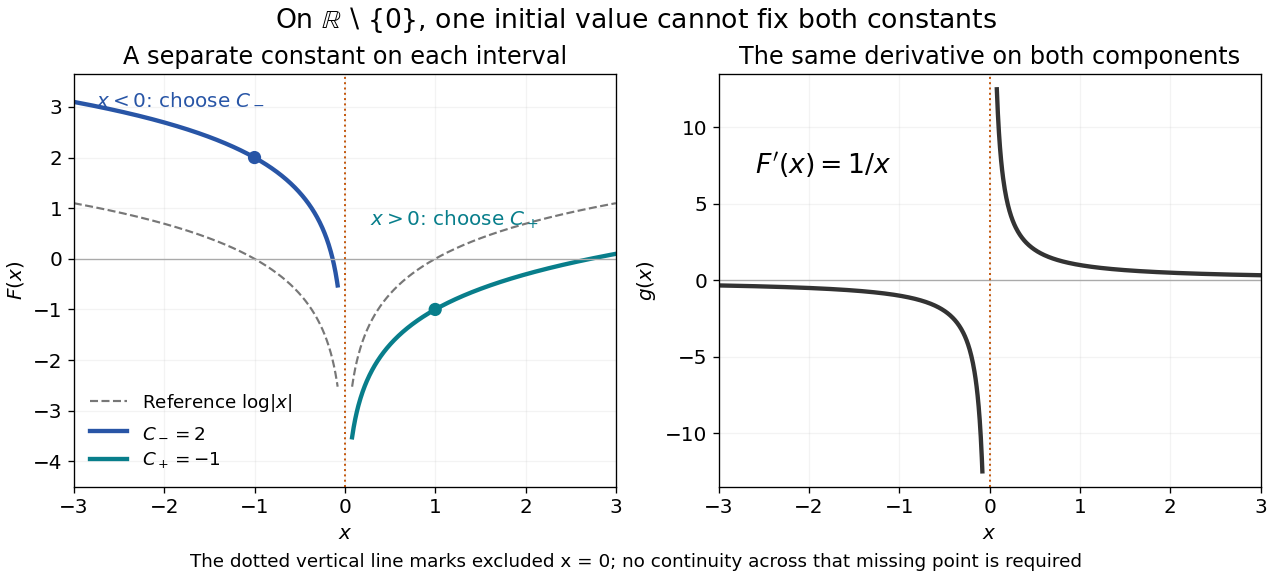
Two disconnected intervals allow independent constants while the derivative stays the same
. Details. An initial condition at fixes and leaves free. Fixing both constants requires one reference value in each connected component, or additional conditions that couple the components. The locally constant function captures this remaining freedom.
Pinned article: Introduction to the OurBigBook Project
Welcome to the OurBigBook Project! Our goal is to create the perfect publishing platform for STEM subjects, and get university-level students to write the best free STEM tutorials ever.
Everyone is welcome to create an account and play with the site: ourbigbook.com/go/register. We belive that students themselves can write amazing tutorials, but teachers are welcome too. You can write about anything you want, it doesn't have to be STEM or even educational. Silly test content is very welcome and you won't be penalized in any way. Just keep it legal!
Intro to OurBigBook
. Source. We have two killer features:
- topics: topics group articles by different users with the same title, e.g. here is the topic for the "Fundamental Theorem of Calculus" ourbigbook.com/go/topic/fundamental-theorem-of-calculusArticles of different users are sorted by upvote within each article page. This feature is a bit like:
- a Wikipedia where each user can have their own version of each article
- a Q&A website like Stack Overflow, where multiple people can give their views on a given topic, and the best ones are sorted by upvote. Except you don't need to wait for someone to ask first, and any topic goes, no matter how narrow or broad
This feature makes it possible for readers to find better explanations of any topic created by other writers. And it allows writers to create an explanation in a place that readers might actually find it.
Figure 1. Screenshot of the "Derivative" topic page. View it live at: ourbigbook.com/go/topic/derivativeVideo 2. OurBigBook Web topics demo. Source. - local editing: you can store all your personal knowledge base content locally in a plaintext markup format that can be edited locally and published either:This way you can be sure that even if OurBigBook.com were to go down one day (which we have no plans to do as it is quite cheap to host!), your content will still be perfectly readable as a static site.
- to OurBigBook.com to get awesome multi-user features like topics and likes
- as HTML files to a static website, which you can host yourself for free on many external providers like GitHub Pages, and remain in full control

Figure 2. You can publish local OurBigBook lightweight markup files to either OurBigBook.com or as a static website.
Figure 3. Visual Studio Code extension installation.
Figure 5. . You can also edit articles on the Web editor without installing anything locally. Video 3. Edit locally and publish demo. Source. This shows editing OurBigBook Markup and publishing it using the Visual Studio Code extension. 
- Infinitely deep tables of contents:



All our software is open source and hosted at: github.com/ourbigbook/ourbigbook
Further documentation can be found at: docs.ourbigbook.com
Feel free to reach our to us for any help or suggestions: docs.ourbigbook.com/#contact