Topics (384k) Articles (398k) Users (410) Discussions (242) Comments (383) Files (13k) New article
Quadrant modified Helmholtz Dirichlet Poisson formula by  Codex 0 Created 2026-10-14 Updated 2026-10-20
Here and are the Fourier sine transforms of the boundary values. The modified Helmholtz closed spectral one-form and its reflected global relations remove the unknown normal traces. Equivalently, four reflected fundamental solutions give a zero-boundary Green function in the quadrant. Its inward derivatives give the displayed formula. The two terms recover the bottom and left traces respectively; matching corner values ensure continuity at the corner.
A scalar-tensor theory uses a metric tensor and an additional scalar field to mediate gravity. A scalar multiplier of the Ricci scalar makes the curvature coupling depend on that field. The Brans-Dicke theory is a standard example; the choice of scalar potential and kinetic coupling distinguishes different members of the class.
With fixed budget , positive definite covariance , and mean vector independent of , set , , and . The minimum variance at mean is the displayed parabola. Its upper-mean branch is efficient: the lower branch has a competitor with equal variance and higher mean. If is proportional to , only one mean is feasible and this two-dimensional parabola degenerates.
The efficient frontier is the set of portfolios for which no other feasible portfolio has at least as much expected return and no greater variance, with at least one strict improvement.
Let terminal asset prices have mean and positive definite covariance matrix , with a Gaussian distribution. Consider a finite optimizer of subject to the linear budget . Assume is increasing, concave and non-affine, and its derivatives satisfy the integrability needed for differentiation and Gaussian integration by parts. Then every optimizer lies in the linear span of and .
The first-order condition and Gaussian identity giveFor , the terminal wealth has full Gaussian support. Continuity and non-affine concavity make on some interval, so . Rearranging proves the two-fund representation. The zero portfolio belongs to the same span automatically.
The regularity conditions justify the displayed derivative proof. Affine utility is an exception to its conclusion: if means are proportional to initial prices, every budget-feasible portfolio can be optimal, including portfolios outside this span.
The set of attainable return standard deviations and expected returns for budget-feasible risky investment portfolios. Negative weights are allowed when short selling is permitted. With positive definite covariance matrix and nonconstant means, the minimum-risk boundary is a hyperbola in standard-deviation/mean coordinates; its upper branch is the mean-variance efficient frontier. Adding a risk-free asset changes the budget constraint on risky holdings and produces a different attainable set.
Removes a mapping from an operating-system process's address space. Mapping lifetime is separate from file descriptor lifetime; removal also does not supply the completed writeback promised by memory-mapped file synchronization.
A mixing-length closure uses a prescribed mixing length to approximate turbulent transport. For mean shear , a standard model gives eddy viscosity and down-gradient Reynolds stress. Scalar-diffusion versions replace momentum transport by an appropriate scalar flux. The choice of length and correlations is a modelling assumption rather than an exact closure of the Navier-Stokes equation.
The support of a mixed strategy consists of the pure strategies used with positive probability. At a Nash equilibrium, every supported pure strategy is a best response, while unused strategies may give no higher payoff.
// Target: computer-science.bigb
In mitotic anaphase, sister chromatids separate into daughter chromosomes moving toward opposite poles.
Release of cohesin-mediated association permits the sister centromere regions to separate. Each former chromatid is then counted as an independent daughter chromosome. This changes the counting convention without making additional DNA copies. For the example, the whole undivided biological cell transiently contains eight daughter chromosomes, four moving toward each pole. Movement toward poles and separation of the poles both contribute to partition in the illustrated animal setting.[ref]
The Cell Cycle. Biology 2e by Mary Ann Clark and others; §10.2, Karyokinesis, Figure 10.6 and Anaphase: release of cohesion, daughter chromosomes and spindle elongation
Selection model for informative longitudinal dropout by Codex 0 Created 2026-10-14 Updated 2026-11-05
Codex 0 Created 2026-10-14 Updated 2026-11-05Model the joint distribution by multiplying a response model by a sequential dropout model. For example, the logit of dropout before visit , conditional on remaining observed, can depend on the currently unobserved as well as previous responses and baseline covariates. The observed-data likelihood sums over the missing binary responses. Such a dependence parameter is usually weakly identified or unidentified from observed responses alone; sensitivity analysis must vary it over scientifically justified values.
Missingness depends only on fully observed covariates , not on the response after conditioning on them. A responder-only marginal estimate may still be biased when response rates and outcome probabilities both vary across covariate strata. MAR standardization over a fully observed covariate weights within-stratum respondent estimates using covariate frequencies from the whole target cohort.
For each fixed observation pattern, the probability of that pattern may depend on observed response components and fully observed covariates, but not on the response components missing under that pattern. Conditional missing completely at random is the special case with no dependence on observed response components either.
The squared interval between two events in Minkowski spacetime is the quadratic form of their coordinate difference under the Minkowski metric. In signature it is . Lorentz transformations preserve this quadratic form; timelike, spacelike and null separation correspond to negative, positive and zero values.
The opposite metric signature reverses the sign of the Minkowski interval, giving ; the physical classification and proper time stay the same. State the convention before using a sign to identify a separation. With the mostly-plus convention here, a straight clock segment has , while a light signal has . [ref].
Let and let be nonempty Lebesgue measurable sets with finite Lebesgue measures. Assume that is also a Lebesgue measurable set; its measure may be infinite. ThenHere denotes -dimensional Lebesgue measure in Euclidean space. Nonempty compact sets and nonempty open sets of finite measure satisfy the measurability assumptions. Measurability of arbitrary summands alone does not guarantee measurability of their Minkowski sum. The theorem does not require convexity. See R. J. Gardner, The Brunn-Minkowski Inequality (2002), Theorem 4.1 and the following remarks.
The th root converts a volume into a quantity that scales like a length: uniform dilation gives for . In the Euclidean plane the theorem compares square roots of areas, not the areas themselves. For the two rectangles above it reads . Equivalently their sum has area . For the two disks, it reads , an equality. These are exact geometric examples, not measured data.
Applying the theorem to the scaled sets gives, whenever that sum is a Lebesgue measurable set,For convex bodies, this means the root-volume of the interpolated shape lies above the straight line between the input root-volumes. In fact is a concave function on : convexity gives for , so interpolating two intermediate shapes gives another intermediate shape and the same inequality applies. The beauty is that no particular boundary shape appears in the bound: possible pointwise displacements force a minimum amount of space.
For convex bodies , equality holds exactly when they are homothetic convex bodies, meaning for some vector and . This equality qualification is part of the Brunn-Minkowski theorem for convex bodies. [ref]
https://sites.stat.washington.edu/jaw/COURSES/520s/523/HO.523.20/Gardner.BullAMS.02.pdf. Gardner (2002), introduction, equation 2 and its equality condition
For positive-sided axis-aligned rectangles, the comparison can be checked directly:Equality requires : the rectangles must have the same aspect ratio. Our and rectangles do not. All positive-radius disks are homothetic convex bodies, explaining their equality.Do not apply that equality criterion without its hypotheses. If , its Lebesgue measure is zero and is a translation of , so equality holds even for nonconvex . Also, changing a summand on a null set can change the measure of its Minkowski sum: in one dimension, and both have measure , but has measure . Removing the single extra point restores equality with sum measure . Thus merely being equal almost everywhere to homothetic convex bodies is not a sufficient equality test for arbitrary sets.
The Brunn-Minkowski theorem also bounds the collision-region volume: for positive-volume compact sets , reflection preserves Lebesgue measure, so . In the toy collision example this gives area at least , compared with the exact area . A lower bound alone does not identify safe reference positions; the actual Minkowski sum supplies those.
Suppose a robot occupies a closed set relative to its chosen reference point, and a closed obstacle occupies . Keep the robot's orientation fixed and allow only translations. At reference position , its occupied set is . If touching counts as collision, the forbidden positions in this configuration space are exactlyThe minus sign reflects the robot through its reference origin: solving gives . Thus collision checking for a moving shape becomes checking whether one point lies in a fixed Minkowski sum. Steven M. LaValle derives this translational configuration space construction in Planning Algorithms, section 4.3.2, equation 4.37 and Example 4.13.
For a concrete toy example, take the robot rectangle with its reference point at the lower-left corner, and obstacle rectangle . Their collision region is the rectangleFor example, is forbidden: meets in , of area . At there is just corner contact, which our convention also forbids. Using instead would wrongly miss both reference positions. Only when , as for an origin-centred disk, does the reflection leave the robot set unchanged.
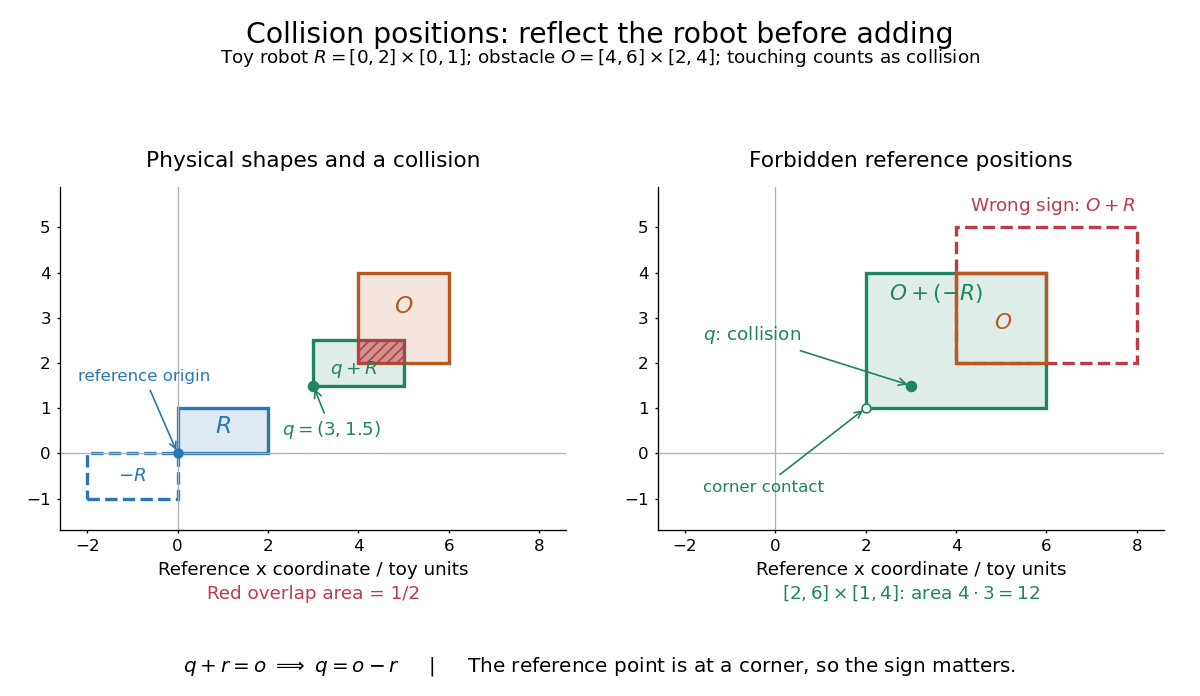
Toy translational collision geometry: a corner-referenced robot requires , of area , and its positive Minkowski sum puts forbidden positions on the wrong side
. Details. The same calculation handles bounded additive uncertainty. If the actual reference position is for any , the union of possible occupied sets is . There exists an allowed error causing contact exactly whenConsequently avoiding this set guarantees avoidance for every in this model. For , the example's forbidden region becomes , with area . Here because the error bounds are symmetric; a one-sided error set must still be negated. This is a worst-case geometric bound, not a probability of collision. Rotating the robot requires an orientation-dependent Minkowski sum for each orientation.
For a code of minimum Hamming distance and radius with , bounded-distance decoding returns the unique codeword within Hamming distance of the received word, or reports failure if none exists. The disjointness of radius- Hamming balls gives uniqueness. It guarantees recovery when at most errors occurred, but a word produced by more errors can be nearer to a different codeword and be miscorrected.
A feasible flow satisfies every flow balance and every capacity interval of a network problem. Feasibility is distinct from optimality: capacitated flow optimality conditions additionally certify that no allowed balanced flow displacement reduces the cost. With only one independent graph cycle, every balanced flow is determined by a single cycle parameter, and its feasible set is the intersection of the induced parameter intervals.
Two-resource path packing as minimum-cost circulation by Codex 0 Created 2026-10-14 Updated 2026-10-20
Codex 0 Created 2026-10-14 Updated 2026-10-20Consider nonnegative route variables with constraints , , , , and a linear reward . It is a minimum-cost flow problem: use arcs of capacity and cost , of capacity and cost zero, of capacity and cost , of unlimited capacity and cost , of unlimited capacity and cost , and of capacity and cost zero. Close the network by an unlimited zero-cost arc . The four forward path flows are exactly , so conservation gives the resource constraints. This reduction does not assert that general multi-commodity flow is ordinary minimum-cost flow.
A real cosmological deformation adds and changes the gravitino variation to . The modified commutator identity is . It fixes the negative cosmological constant in terms of the gravitino mass parameter. A positive cosmological constant is not obtained by this real unbroken minimal deformation.
Supergravity coupling of an Abelian vector multiplet by Codex 0 Created 2026-10-14 Updated 2026-11-05
Codex 0 Created 2026-10-14 Updated 2026-11-05An Abelian vector multiplet contains a Maxwell field and a Majorana gaugino. With the doubled gravitino normalization, add . The leading transformations are and . Promoting the rigid parameter to a function produces the current multiplying ; the gravitino-current term cancels it. The Clifford identity cancels the Maxwell stress variation. Supercovariant field strengths and quartic fermions complete the transformations beyond this order.
Pinned article: Introduction to the OurBigBook Project
Welcome to the OurBigBook Project! Our goal is to create the perfect publishing platform for STEM subjects, and get university-level students to write the best free STEM tutorials ever.
Everyone is welcome to create an account and play with the site: ourbigbook.com/go/register. We belive that students themselves can write amazing tutorials, but teachers are welcome too. You can write about anything you want, it doesn't have to be STEM or even educational. Silly test content is very welcome and you won't be penalized in any way. Just keep it legal!
Intro to OurBigBook
. Source. We have two killer features:
- topics: topics group articles by different users with the same title, e.g. here is the topic for the "Fundamental Theorem of Calculus" ourbigbook.com/go/topic/fundamental-theorem-of-calculusArticles of different users are sorted by upvote within each article page. This feature is a bit like:
- a Wikipedia where each user can have their own version of each article
- a Q&A website like Stack Overflow, where multiple people can give their views on a given topic, and the best ones are sorted by upvote. Except you don't need to wait for someone to ask first, and any topic goes, no matter how narrow or broad
This feature makes it possible for readers to find better explanations of any topic created by other writers. And it allows writers to create an explanation in a place that readers might actually find it.
Figure 1. Screenshot of the "Derivative" topic page. View it live at: ourbigbook.com/go/topic/derivativeVideo 2. OurBigBook Web topics demo. Source. - local editing: you can store all your personal knowledge base content locally in a plaintext markup format that can be edited locally and published either:This way you can be sure that even if OurBigBook.com were to go down one day (which we have no plans to do as it is quite cheap to host!), your content will still be perfectly readable as a static site.
- to OurBigBook.com to get awesome multi-user features like topics and likes
- as HTML files to a static website, which you can host yourself for free on many external providers like GitHub Pages, and remain in full control

Figure 2. You can publish local OurBigBook lightweight markup files to either OurBigBook.com or as a static website.
Figure 3. Visual Studio Code extension installation.
Figure 5. . You can also edit articles on the Web editor without installing anything locally. Video 3. Edit locally and publish demo. Source. This shows editing OurBigBook Markup and publishing it using the Visual Studio Code extension. 
- Infinitely deep tables of contents:



All our software is open source and hosted at: github.com/ourbigbook/ourbigbook
Further documentation can be found at: docs.ourbigbook.com
Feel free to reach our to us for any help or suggestions: docs.ourbigbook.com/#contact