Topics (384k) Articles (398k) Users (410) Discussions (242) Comments (383) Files (13k) New article
The open subsets of a topological space form a frame. Arbitrary joins are unions, finite meets are intersections, and an arbitrary meet is the interior of an intersection. A continuous map induces a frame homomorphism in the opposite direction by inverse image.
There is a natural bijection between continuous maps and frame homomorphisms . It sends to ; the inverse sends to the point . Its adjunction unit sends a point of to its open-neighbourhood membership map. The counit is represented by . Every open of is such a , and every point of a frame is uniquely evaluation at a point of . Consequently is a homeomorphism, and this is an idempotent adjunction.
A nucleus is an inflationary, idempotent, finite-meet-preserving map on a frame. Its fixed elements form a frame, whose joins are obtained by applying to ambient joins. The induced locale is a sublocale. The nuclei on a frame themselves form a frame in pointwise order; their meets are pointwise, but their joins usually are not.
A preframe is a partially ordered set with finite meets and nonempty directed joins, with finite meets distributing over directed joins. Its homomorphisms preserve these operations. Forgetting the arbitrary joins of a frame leaves a preframe.
An upward-closed subset of a frame containing , excluding and closed under finite meets is completely prime if membership of an arbitrary join implies membership of some summand. Its characteristic map is a point of a frame. Constructively the map takes values in the frame of truth values.
A subframe is a subset of a frame closed under arbitrary ambient joins and finite ambient meets, including and . The inclusion is a frame homomorphism. In contrast, the fixed elements of a nucleus on a frame usually need their own regularized joins and are not a subframe.
A clique in a simple graph is a set of vertices such that every pair of distinct members is adjacent. Equivalently, its induced subgraph is a complete graph. The surrounding graph need not itself be complete: a clique describes complete pairwise connectivity within a selected group.
Consider the original graph withThe set is a clique because all three pairs are edges. The set is not a clique: the edge is missing. A path in a graph connecting all selected vertices is therefore insufficient; every pair must have a direct edge.
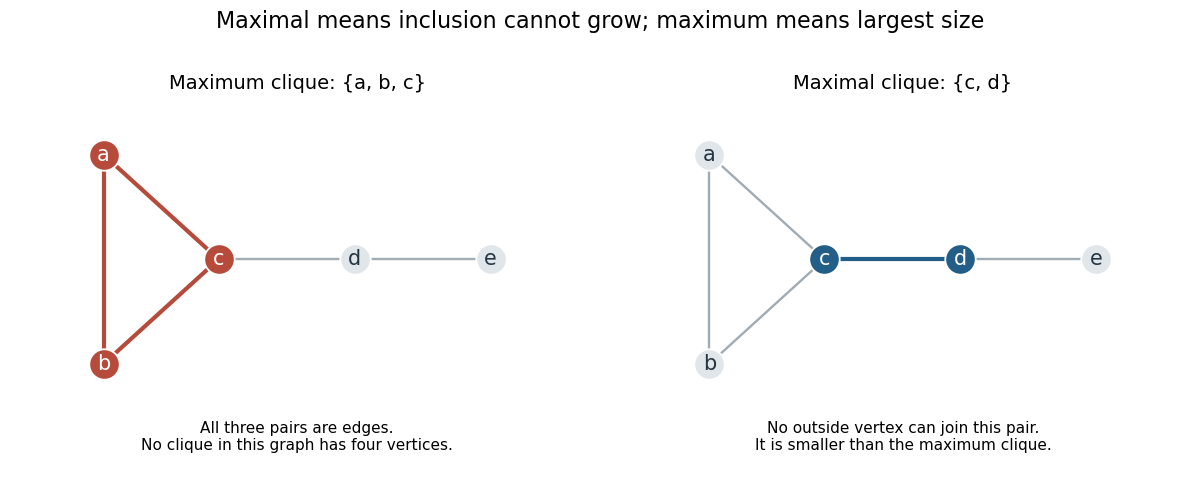
Here the clique number is . The maximum clique is , but and are also maximal cliques. This distinction is useful when an algorithm stops as soon as its current clique cannot be enlarged: that stopping condition establishes maximality, while finding the largest possible clique is a separate requirement.
A topological space is compact when every cover by members of a fixed subbase has a finite subcover. Equivalently, every family of complements of subbasic opens with the finite-intersection property has nonempty intersection.
A topological space is compact if and only if every ultrafilter on it converges to at least one point, assuming the ultrafilter lemma. No Hausdorff assumption is needed. In a compact space, the closures of the filter members have the finite intersection property, so choose a point in their intersection. Every open neighbourhood of that point belongs to the ultrafilter, since otherwise its closed complement would be a filter member. Conversely, extend the complements of a cover with no finite subcover to an ultrafilter; a limit point lies in a covering open set, contradicting the simultaneous membership of that set and its complement.
If is compact and , then is injective exactly when it is surjective. Equivalently, every nonzero point of the spectrum of is an eigenvalue. Compactness turns an approximate eigenvector sequence into a convergent eigenvector sequence.
A nondegenerate star-algebra of compact operators decomposes its Hilbert space into irreducible closed reducing subspaces, each equivalence class occurring finitely many times. Pass to its norm closure. A nonzero compact positive element supplies a finite-rank spectral projection; a minimal projection in its finite-dimensional corner has scalar corner algebra. A cyclic vector in its range generates an irreducible reducing subspace. A maximal orthogonal family exhausts the space by nondegeneracy. Infinitely many equivalent copies would give orthogonal unit vectors whose images under some compact algebra element have equal nonzero norms, contradicting compactness.
Compact L2 potential perturbation of the Dirichlet Laplacian by  Codex 0 Created 2026-10-14 Updated 2026-10-25
On a bounded open set, let be the weak solution of . The energy estimate bounds . For , put . The zero-boundary Rellich-Kondrachov compactness theorem gives compact embedding into , and Hölder's inequality gives . Hence is compact on , without a regularity assumption on the boundary. Writing makes equivalent to . The Fredholm alternative for a compact operator then identifies unique solvability with triviality of the homogeneous kernel.
Particle horizon through radiation-matter equality by Codex 0 Created 2026-10-14 Updated 2026-11-05
Codex 0 Created 2026-10-14 Updated 2026-11-05Neglecting curvature and dark energy, integration of the Friedmann equation for radiation in cosmology and pressureless matter gives the displayed comoving particle horizon. At matter-radiation equality, , this is times the radiation-only extrapolation . Its associated inverse length differs by an order-one factor from the matter-radiation equality scale .
Photon arrival from an Einstein-de Sitter particle horizon by Codex 0 Created 2026-10-14 Updated 2026-11-05
Codex 0 Created 2026-10-14 Updated 2026-11-05For an Einstein-de Sitter universe normalized by , . Its current comoving particle horizon is . A photon emitted inward at that location at covers in comoving distance by time . Equating these distances gives arrival at , a travel time of .
A comoving observer has constant comoving coordinates in a homogeneous expanding universe. Its physical separation from another comoving observer grows in proportion to the scale factor, giving relative recession governed by the Hubble parameter. Light exchanged between these observers undergoes cosmological redshift.
For the symmetric group , take the transpositions and . Products of permutations apply the rightmost factor first. ThenThe last permutation sends , , and : two swaps fail to commute by an entire three-cycle.
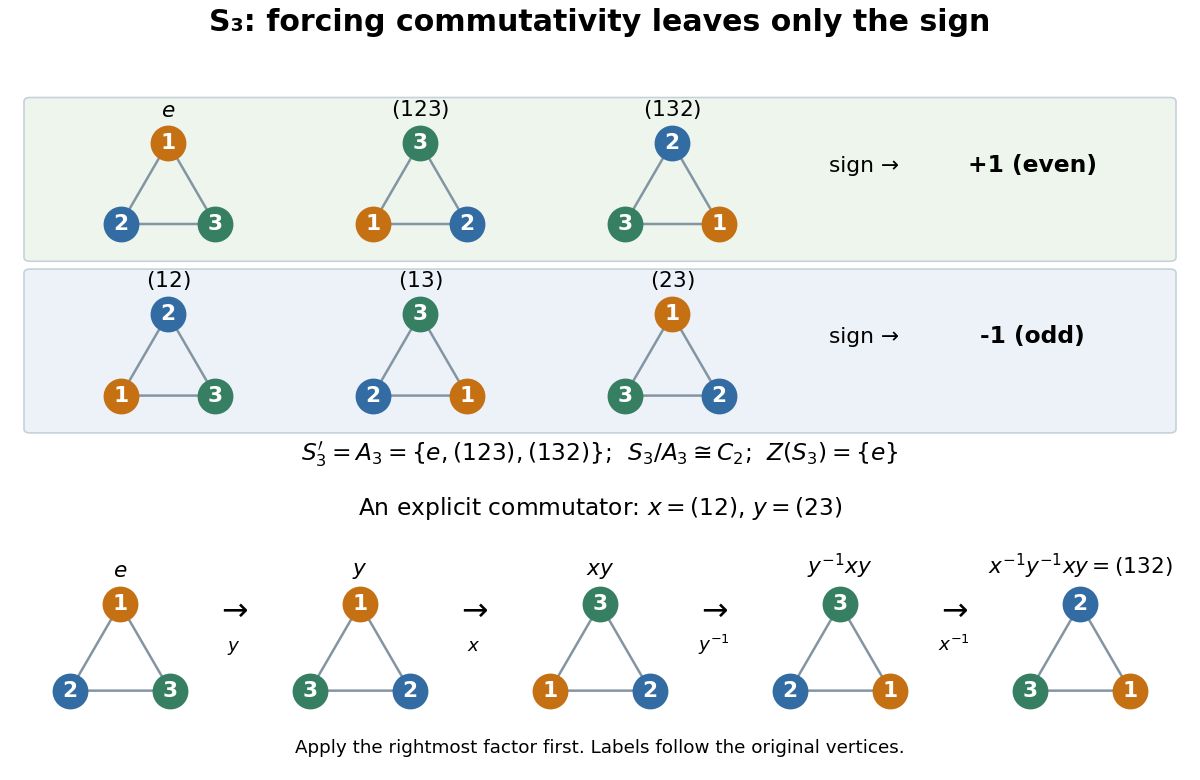
Every group commutator has sign of a permutation , so , the alternating group of even permutations. Conversely, the displayed group commutator generates . Therefore . The two cosets are the even permutations and the odd permutations, and their multiplication is just multiplication of signs:This is the first isomorphism theorem applied to the sign of a permutation. Once commutativity is forced, all three transpositions become indistinguishable, and both three-cycles become the identity element. The surviving information is exactly whether the permutation is even or odd. Compare the very different center of a group .
A comet tail is an extended structure formed from material released by a comet. Its dust tail is shaped largely by radiation pressure, while an ion tail is shaped by the solar wind and magnetic field. The cometary dust tail is the solid-grain component.
Pinned article: Introduction to the OurBigBook Project
Welcome to the OurBigBook Project! Our goal is to create the perfect publishing platform for STEM subjects, and get university-level students to write the best free STEM tutorials ever.
Everyone is welcome to create an account and play with the site: ourbigbook.com/go/register. We belive that students themselves can write amazing tutorials, but teachers are welcome too. You can write about anything you want, it doesn't have to be STEM or even educational. Silly test content is very welcome and you won't be penalized in any way. Just keep it legal!
Intro to OurBigBook
. Source. We have two killer features:
- topics: topics group articles by different users with the same title, e.g. here is the topic for the "Fundamental Theorem of Calculus" ourbigbook.com/go/topic/fundamental-theorem-of-calculusArticles of different users are sorted by upvote within each article page. This feature is a bit like:
- a Wikipedia where each user can have their own version of each article
- a Q&A website like Stack Overflow, where multiple people can give their views on a given topic, and the best ones are sorted by upvote. Except you don't need to wait for someone to ask first, and any topic goes, no matter how narrow or broad
This feature makes it possible for readers to find better explanations of any topic created by other writers. And it allows writers to create an explanation in a place that readers might actually find it.
Figure 1. Screenshot of the "Derivative" topic page. View it live at: ourbigbook.com/go/topic/derivativeVideo 2. OurBigBook Web topics demo. Source. - local editing: you can store all your personal knowledge base content locally in a plaintext markup format that can be edited locally and published either:This way you can be sure that even if OurBigBook.com were to go down one day (which we have no plans to do as it is quite cheap to host!), your content will still be perfectly readable as a static site.
- to OurBigBook.com to get awesome multi-user features like topics and likes
- as HTML files to a static website, which you can host yourself for free on many external providers like GitHub Pages, and remain in full control

Figure 2. You can publish local OurBigBook lightweight markup files to either OurBigBook.com or as a static website.
Figure 3. Visual Studio Code extension installation.
Figure 5. . You can also edit articles on the Web editor without installing anything locally. Video 3. Edit locally and publish demo. Source. This shows editing OurBigBook Markup and publishing it using the Visual Studio Code extension. 
- Infinitely deep tables of contents:




All our software is open source and hosted at: github.com/ourbigbook/ourbigbook
Further documentation can be found at: docs.ourbigbook.com
Feel free to reach our to us for any help or suggestions: docs.ourbigbook.com/#contact