Topics (384k) Articles (398k) Users (410) Discussions (242) Comments (383) Files (13k) New article
Triangulation adds fill edges to an undirected graph to make it a chordal graph. Given an elimination ordering, join all remaining neighbors of each removed vertex. The completed graph has that perfect elimination ordering. Fill edges can enlarge the cliques used for exact probabilistic graphical model inference, without changing the original probability factors; they do not assert new biological relationships.
The chemotaxis FRET assay uses Förster resonance energy transfer between fluorescent tags on CheY and CheZ to report their association. Interpreting this emission ratio as CheA activity requires the coupling between CheY phosphorylation and CheZ binding described in the experimental sources above.
Chemotaxis feedback proteins alter the internal signalling state of a chemotactic cell in response to pathway activity. In the canonical Escherichia coli system, CheR adds receptor methyl groups and CheB removes them, with CheB activity coupled to phosphorylation. Their opposing actions help restore receptor-pathway output after a persistent stimulus. This changes response sensitivity while allowing continued detection of subsequent changes in attractant concentration. [ref]
Robustness in simple biochemical networks by Naama Barkai and Stanislas Leibler. 1997, methylation-demethylation feedback architecture
The Tar receptor is an Escherichia coli chemoreceptor that detects attractant signals including aspartate. Receptor arrays regulate the kinase pathway controlling motor behaviour, while receptor methylation helps adjust sensitivity after sustained stimulation. Ligand recognition, kinase output and adaptation are different stages, so a binding measurement alone does not establish the swimming response. [ref]
UniProtKB by the UniProt Consortium. P07017, Function, Catalytic activity and Subunit structure
Receptor methylation is covalent addition of methyl groups to a receptor. In bacterial chemotaxis, reversible modification of chemoreceptor residues changes signalling sensitivity and contributes to signaling adaptation. Methylation and demethylation act on the internal response state while external ligand concentration can remain changed. This provides a biochemical memory of recent stimulation rather than removing the stimulus from the environment. [ref]
Robustness in simple biochemical networks by Naama Barkai and Stanislas Leibler. 1997, receptor modification and robust adaptation model
Shunting inhibition is suppression of another input's effect through increased synaptic conductance: opening additional ion channels lowers effective electrical resistance, reducing the voltage response to a given added electric current. When the added reversal potential equals the resting membrane potential, there can be no voltage change at rest and still be inhibition of a simultaneous input. See 1.4 Limitations of the Leaky Integrate-and-Fire Model.
Use the passive synaptic potential model below with leak , and capacitance . A sustained inward test electric current of alone gives a steady voltage increase of , so . Effective electrical resistance is and the time constant is .
Now hold a shunting conductance open with . With no test electric current, rest stays at . With the same test electric current, total conductance becomes , so the steady voltage increase is only : . Effective electrical resistance is and the time constant is . A faster response can therefore be smaller. At the original rest the shunting electric current is zero; at it is , opposing the voltage excursion.
The factor of three reduction applies to this constant-electric current, constant-conductance example. A finite pulse, conductance-driven input or spatially extended dendrite need not have the same reduction. The interesting feature is conditional action: the shunt can leave a quiet neuron's voltage unchanged yet reshape its response when another input arrives. A model that represents all inhibition as a fixed outward electric current misses this behavior.
A synaptic vesicle is a small membrane-bounded compartment in a presynaptic terminal that stores neurotransmitter for release. Fusion with the cell membrane exposes its contents to the synaptic cleft; the packet supplied by one synaptic vesicle is a quantum of release. Quantal neurotransmitter release refers to these discrete packets, rather than the release of one molecule at a time. The postsynaptic response to a packet can vary with its contents, receptors and recording conditions. See Purves and colleagues: vesicles as the source of transmitter quanta.
The useful cycle is filling, preparation for fusion, calcium-triggered exocytosis, and recovery of membrane and proteins through endocytosis for reuse. Different recovery routes occur; recycling need not preserve a particular synaptic vesicle as an identifiable container throughout. Limited availability of prepared synaptic vesicles can reduce release during repeated stimulation, while changes in synaptic release probability can also change successive responses. See Basic Neurochemistry: secretion machinery and vesicle reuse and 3.1 Synapses.
For an illustrative calculation, assume four release sites, each with one prepared synaptic vesicle, each releasing with synaptic release probability during one presynaptic action potential. Assume independent Bernoulli trials and at most one release per site. The released packet count has a binomial distribution:The probability of no release is ; at least one release has probability . An expected value of one packet does not mean that every action potential releases one packet. If each packet contributes a stipulated conductance increment and increments add, the expected value of that increment is , with zero increment on about of trials. These assumptions are a teaching model: shared calcium fluctuations, unequal sites, depletion and nonlinear receptor responses can invalidate them.
The synaptic cleft is the extracellular gap between the sending and receiving cell membranes of a chemical synapse. Released neurotransmitter crosses this gap to reach a receptor. [ref]
Neurotransmitter clearance removes released neurotransmitter from the region where it can activate receptors, through diffusion, cellular uptake or enzyme-mediated breakdown. Its routes and rates help delimit a chemical synapse's response in space and time; see the mechanisms and source under chemical synapse.
The molar electrochemical potential combines the molar chemical potential with the electrical contribution , where is the signed charge number of an ion, is the Faraday constant and is electric potential. Both terms have units . In the particle convention the corresponding expression is , with elementary charge ; multiplying it by the Avogadro constant gives the molar form. Transfer between locations at the same temperature and pressure is driven by differences in electrochemical potential. The membrane transport examples use it to distinguish neutral solute transfer from ion transfer.
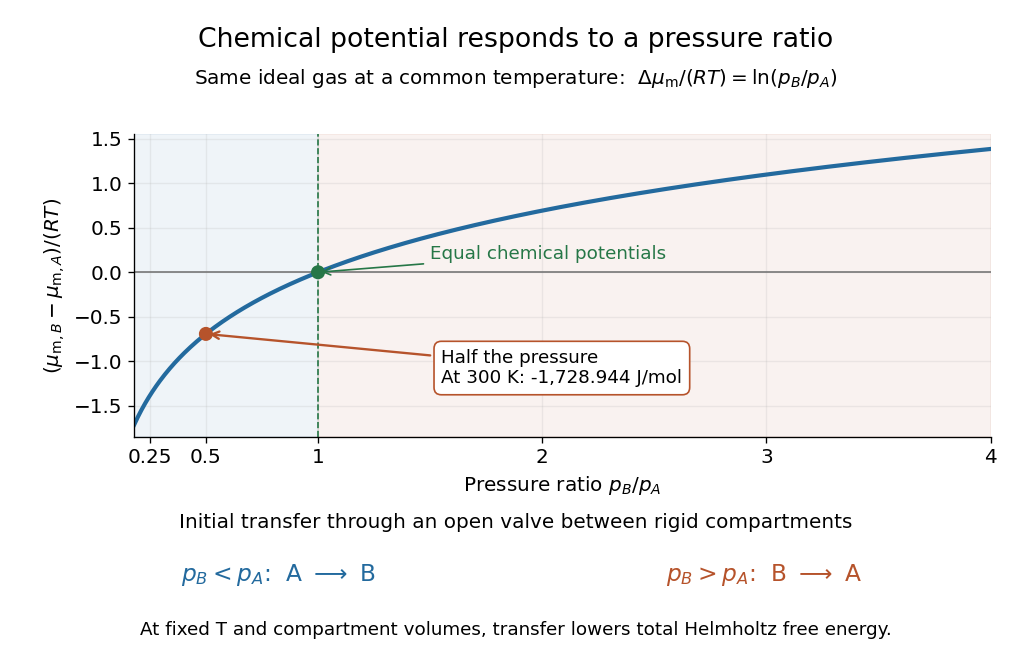
For a pure ideal gas at temperature and pressure ,where is the molar gas constant and specifies the reference pressure of the standard state. The ratio inside the natural logarithm is dimensionless. The chemical potential difference therefore depends on a ratio of pressures, not an absolute difference. See MIT 5.60, Lecture 14, page 4.
For a chemical species in an ideal gas mixture, replace by its partial pressure. More generally write using its thermodynamic activity and a consistent standard state. For an ideal dilute chemical solution, with reference concentration ; the thermodynamic activity section describes departures from this idealization.
As a computed comparison, take identical chemical species at , with and . Stipulate . ThenHalving the pressure gives the same decrement whether starting from or , provided the ideal gas approximation remains valid. This comparison uses different pressures; it is not the common-pressure reservoir setup of chemical potential equality for particle exchange. The fixed-volume example in chemical potential and Helmholtz free energy supplies an exchange experiment with unequal initial pressures.
Chemical potential equality for particle exchange by  Codex 0 Created 2026-10-14 Updated 2026-10-18
Consider two internally equilibrated reservoirs A and B at the same imposed temperature and pressure. They may have different compositions or represent different phases. Transfer a small positive amount of substance of the same chemical species from A to B, holding the other inventories fixed. To first order, their total Gibbs free energy changes byHence exchange toward lower chemical potential lowers Gibbs free energy. If transfer is allowed in both directions and the two reservoirs contain the exchangeable component, thermodynamic equilibrium requires equal chemical potentials for that component. See MIT 5.60, Lecture 14, pages 1–2.
An impermeable partition can maintain unequal chemical potentials; equality is a condition on an allowed exchange. Two pure samples of the same ideal gas already have equal chemical potentials at the same temperature and pressure. Different compositions at a common pressure can instead give different chemical potentials for one component through its thermodynamic activity.
Equality concerns the same exchangeable component in different places, not all different chemical species. For a permitted chemical reaction, the corresponding interior chemical equilibrium criterion is , with signed stoichiometric vector entries . The existing chemical equilibrium and constrained Gibbs minimization for chemical equilibrium sections develop those composition constraints.
A family of real continuous functions is a Chebyshev system exactly when every evaluation matrix at distinct points is invertible. A singular evaluation matrix supplies a nonzero coefficient vector whose function vanishes at those points; conversely, a violation of the zero bound supplies such a vector in the kernel. This also gives the existence and uniqueness of interpolation from its span.
Exponentials with distinct real exponents form a Chebyshev system on every nondegenerate real interval. For an inductive proof, multiply a candidate combination by . If it has zeros, Rolle's theorem gives at least zeros of its derivative, a combination of the exponentials with exponents , . The inductive zero bound forces all those coefficients to vanish. The remaining constant also vanishes, a contradiction.
A Chebyshev system of real continuous functions on a circle has odd dimension. If its dimension is , take cyclically ordered evaluation points and move them continuously to the next cyclic permutation without letting points collide. The evaluation determinant stays nonzero, so cannot change sign. The final cyclic row permutation multiplies it by ; consequently must be odd. For example, has dimension and the required zero bound.
Let be the roots of the Chebyshev polynomial, and let have degree at most with . Its Lagrange interpolation polynomial uses basis . For , and , so . Therefore , the last equality being interpolation of the derivative. Continuity includes and reflection proves the left-hand region.
For weighted least-squares polynomial in an orthogonal-polynomial basis with weight on , the projection of onto polynomials of degree at most is the displayed sum. Put to obtain and on . The constant coefficient is , odd coefficients vanish, and the coefficient of is . For odd the optimal polynomial can have degree .
The lowest Lambda c baryon has valence content , electric charge , isospin zero and spin angular momentum . Its light pair has antisymmetric flavour and spin zero. This is the charm analogue of the Lambda baryon.
Linear charge density is electric charge divided by length along a charged line, or locally . Its SI unit is coulombs per metre. For a uniformly charged long cylindrical conductor, it equals the total surface charge density integrated around the cylinder's circumference; it need not represent a charge literally supported on a one-dimensional line.
Pinned article: Introduction to the OurBigBook Project
Welcome to the OurBigBook Project! Our goal is to create the perfect publishing platform for STEM subjects, and get university-level students to write the best free STEM tutorials ever.
Everyone is welcome to create an account and play with the site: ourbigbook.com/go/register. We belive that students themselves can write amazing tutorials, but teachers are welcome too. You can write about anything you want, it doesn't have to be STEM or even educational. Silly test content is very welcome and you won't be penalized in any way. Just keep it legal!
Intro to OurBigBook
. Source. We have two killer features:
- topics: topics group articles by different users with the same title, e.g. here is the topic for the "Fundamental Theorem of Calculus" ourbigbook.com/go/topic/fundamental-theorem-of-calculusArticles of different users are sorted by upvote within each article page. This feature is a bit like:
- a Wikipedia where each user can have their own version of each article
- a Q&A website like Stack Overflow, where multiple people can give their views on a given topic, and the best ones are sorted by upvote. Except you don't need to wait for someone to ask first, and any topic goes, no matter how narrow or broad
This feature makes it possible for readers to find better explanations of any topic created by other writers. And it allows writers to create an explanation in a place that readers might actually find it.
Figure 1. Screenshot of the "Derivative" topic page. View it live at: ourbigbook.com/go/topic/derivativeVideo 2. OurBigBook Web topics demo. Source. - local editing: you can store all your personal knowledge base content locally in a plaintext markup format that can be edited locally and published either:This way you can be sure that even if OurBigBook.com were to go down one day (which we have no plans to do as it is quite cheap to host!), your content will still be perfectly readable as a static site.
- to OurBigBook.com to get awesome multi-user features like topics and likes
- as HTML files to a static website, which you can host yourself for free on many external providers like GitHub Pages, and remain in full control

Figure 2. You can publish local OurBigBook lightweight markup files to either OurBigBook.com or as a static website.
Figure 3. Visual Studio Code extension installation.
Figure 5. . You can also edit articles on the Web editor without installing anything locally. Video 3. Edit locally and publish demo. Source. This shows editing OurBigBook Markup and publishing it using the Visual Studio Code extension. 
- Infinitely deep tables of contents:



All our software is open source and hosted at: github.com/ourbigbook/ourbigbook
Further documentation can be found at: docs.ourbigbook.com
Feel free to reach our to us for any help or suggestions: docs.ourbigbook.com/#contact