Topics (384k) Articles (398k) Users (410) Discussions (242) Comments (383) Files (13k) New article

A vector bundle with a fibrewise quadratic form defines a bundle whose fibre over is the Clifford algebra . When the polar form is a nondegenerate bilinear form, local orthonormal frames identify its fibres with a fixed Clifford algebra, and orthogonal transition maps induce the algebra transition maps. A Clifford module bundle is a bundle of modules over these algebras, rather than the algebra bundle itself. For a Riemannian manifold, use its cotangent bundle and the metric quadratic form, with the sign convention specified.
A spinor is an element of a representation space for a Spin group; algebraically, spinor spaces arise from irreducible representations of a Clifford algebra or its even part. The Spin group is a double cover of a rotation group, so its action can distinguish rotations that ordinary vectors cannot.
For rotations in three-dimensional Euclidean space, a spinor can be a column in , acted on by . A rotation through angle about a unit direction acts as , where are the Pauli matrices. At this is , and at it is . The sign change explains the distinction between spinors and spatial vectors and underlies the representation of spin one-half. A spinor is not a literal square root of a vector; the relationship is through the Clifford algebra action.
After complexifying a nondegenerate metric in dimensions, pair gamma matrices into fermionic creation and annihilation operators. Their binary occupation states span dimensions, and the gamma matrices generate all endomorphisms of this space. The Dirac module is therefore irreducible as a Clifford module. The even algebra preserves the chirality grading, splitting its Lorentz-spinor representation into two irreducible Weyl modules of dimension . In , adjoining the old chirality matrix as the extra gamma gives an irreducible -dimensional Spin group representation with no Weyl splitting. The two possible signs of that extra gamma distinguish Clifford modules but give equivalent Spin group modules.
The local entropy balance has nonnegative production, with heat supply and thermodynamic entropy flux at positive temperature . Its integral version holds on every material reference subvolume.
Requiring the Clausius-Duhem inequality for independent reversible mechanical and thermal variations constrains a constitutive equation. For it gives and . Combining the Lagrangian internal energy balance with the Lagrangian entropy inequality leaves . The independence assumptions are part of the constitutive argument.
For a nonnegative claim size of finite positive mean , its equilibrium claim-size distribution has this probability density function and survival function . The tail integral formula for moments normalizes the probability density function. Its moment-generating function is wherever finite, so at an adjustment coefficient it equals one plus the safety loading.
Starting from capital , ruin occurs exactly when the aggregate loss exceeds . Positive relative safety loading and the strong law of large numbers make tend to minus infinity, so its supremum is finite almost surely. For exponential distribution claims of rate , has an atom at zero, and, conditional on , has exponential distribution of rate . The ultimate ruin probability determines this mixture directly.
In a classical risk model, is the time of the th claim. The displayed probability restricts ruin to the first claims and increases to the ultimate ruin probability. Conditioning on the first arrival and severity gives , with . For exponential distribution claims of mean and relative safety loading , put and . Then and . The recursion follows because a surviving first claim leaves fresh independent future arrivals and claims. The formulas follow by integrating the rate- first-arrival probability density function; the claim-arrival rate cancels with .
The classical-quantum state is block diagonal. If are the eigenvalues of , its eigenvalues are . Inserting these into the definition of Von Neumann entropy gives the displayed sum of classical Shannon entropy and mean conditional quantum entropy. Its quantum mutual information is therefore the Holevo quantity .
Normalized Haar measure makes this averaging a norm-one projection onto continuous class functions. Averaging a trace coefficient replaces its coefficient endomorphism by . On an irreducible summand this average is by Schur lemma. It follows that averaging finite-dimensional matrix coefficients yields finite linear combinations of irreducible characters. Together with the Peter-Weyl theorem, this proves uniform density of those characters among continuous class functions.
The ray class field realizes the ray class group through the Artin reciprocity map and is the maximal abelian extension with bounded conductor.
For a finite Galois extension of number fields and a finite-dimensional complex group representation of its Galois group, the finite part of its Artin L-function is the Euler productHere is the inertia group, and a Frobenius automorphism lift acts on its invariant subspace. Different lifts induce the same operator there. At an unramified prime the invariant subspace is all of ; at a ramified prime this restriction removes the part on which inertia acts nontrivially.
The trivial representation gives the Dedekind zeta function of . Direct sums of representations give products of Artin L-functions, because determinants multiply on direct sums. Taking the logarithm of each local factor produces traces of powers of Frobenius, connecting representation-theoretic characters with prime-counting sums. Archimedean factors are added separately when forming a completed L-function.
For a cyclic extension of number fields, an element of the base field is a global field norm exactly when it is a norm at every finite and infinite completion. The splitting criterion for a cyclic algebra encodes the norm obstruction as a Brauer group class. The Albert-Brauer-Hasse-Noether theorem makes a class that splits at every completion split globally, giving the result. Cyclicity is essential; arbitrary noncyclic extensions can have additional local-global norm obstructions.
Citrate denotes an ion derived from citric acid. The commonly specified form has electric charge equal to that of three electrons and chemical formula ; it results from removing three hydrogen ions from citric acid. Forms with additional hydrogen ions attached through protonation also occur. [ref]
https://www.ebi.ac.uk/chebi/CHEBI:16947. ChEBI, citrate(3−)
In an inviscid barotropic fluid subject to conservative body force, the circulation of a material loop is constant. For constant density, parameterize that loop by with . Differentiating gives an integral of plus . The latter vanishes on a closed loop, and the Euler equations make the former the integral of a gradient, also zero. For a barotropic density, is still a gradient of specific enthalpy. Constant circulation is consistent with changing local vorticity when a vortex tube changes its cross-sectional area.
In a spherically symmetric gravitational potential , a circular orbit has , specific orbital energy and specific angular momentum , with . Differentiating gives . Changes in orbital orientation have , so . For a particle of variable mass and total angular momentum , this implies . Moreover , which is positive when the orbital angular velocity decreases outward.
For a fixed spherical gravitating source, place a test particle at with initial velocity , where is outside the source. Its exact circular orbit isDifferentiating twice gives , precisely the Newtonian gravitational field at each point of that circle. There is no outward physical force to cancel gravity in this inertial frame. Gravity supplies the inward centripetal acceleration that continually changes the velocity's direction.
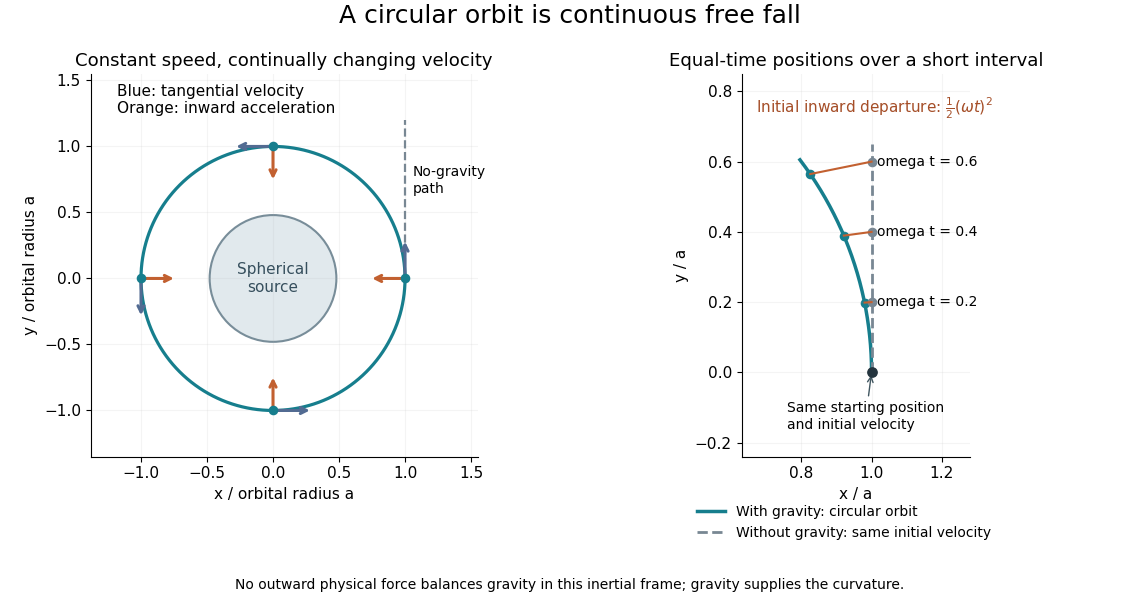
A circular free-fall orbit, inward acceleration, and the straight path the same initial velocity would produce without gravity
. Details. Over a short interval, the displacement from the straight tangent path begins inward with magnitude . The curvature of the orbit matters at the same order: the particle moves sideways while continually falling away from its instantaneous tangent. The full circular solution remains at radius rather than striking the source.
Its speed is , its oscillation period is , and its specific orbital energy is . Removing gravity while keeping the initial velocity would give the straight path , rather than a stationary particle. This contrast explains why orbital weightlessness is compatible with a substantial gravitational force: a freely coasting spacecraft and its contents fall together. [ref]
https://www.nasa.gov/centers-and-facilities/glenn/what-is-microgravity/. NASA Glenn: orbit as continuous free fall and the origin of weightlessness
Consider the discrete linear system withThis is a finite periodic analogue of the Poisson equation, using the negative second finite difference with unit grid spacing. It is also a Graph Laplacian equation on a cycle graph; no continuum approximation is being claimed here.
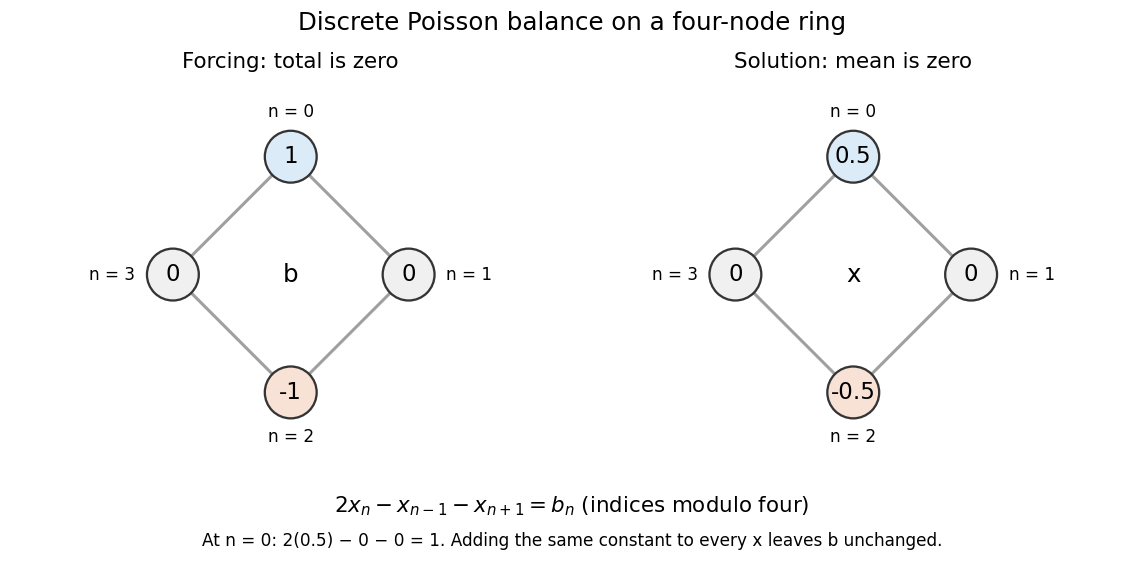
Summing the four equations gives zero on the left, since each value occurs twice positively and twice negatively. A necessary condition is therefore . The Fourier diagonalization of a circulant matrix shows that this is also sufficient: the only zero eigenvalue of is the constant mode , and .
For the displayed forcing, the discrete Fourier transform givesDivide only at the three nonzero eigenvalues, and choose to impose zero arithmetic mean:Direct substitution gives . All other vectors satisfying the linear system are , because the kernel is the space of constant vectors. Thus balanced forcing determines the differences between values, while a reference level is an extra choice. This small model explains why a periodic Poisson equation needs both a compatibility condition and a normalization.
Use the negative-exponential forward discrete Fourier transform and the -normalized inverse discrete Fourier transform:For the circulant matrix with first column , the discrete Fourier mode is an eigenvector with eigenvalueIndeed, substitution into circular convolution givesThe columns of are , so the diagonalization of a matrix takes the formThe roots of unity give orthogonality of these eigenvectors; dividing each by makes the basis orthonormal. Consequently, every complex circulant matrix is a normal matrix, including ones that are not Hermitian matrices.
The sign convention matters. For , the circulant matrix isChanging the direction of the shift or the sign in the discrete Fourier transform changes which complex eigenvalue goes with which discrete Fourier mode. A real symmetric example alone would conceal that distinction.
For a linear system , put and . The equation becomes independent scalar equationsIf every is nonzero, divide to find the unique vector and apply the inverse discrete Fourier transform. If some , a vector satisfying the linear system exists exactly when at every such index; the corresponding remain free. This is a concrete version of the Fredholm alternative in a finite-dimensional setting.
With an appropriate Fast Fourier transform, multiplication or a compatible solve takes arithmetic operations, instead of forming a dense matrix and applying general Gaussian elimination. The gain comes from the periodic structure; an arbitrary matrix does not have this shared basis of discrete Fourier modes.[ref]
A perfect elimination ordering of a finite simple graph is a permutation of its vertices such that each set of later graph neighboursis a clique. Thus is a simplicial vertex in the remaining induced subgraph . Empty and one-vertex sets satisfy the clique condition automatically. The order here is the order of deletion: goes first.
The characterization is powerful: a finite simple graph is a chordal graph if and only if it has a perfect elimination ordering. For one proof outline, the earliest vertex of an induced cycle of length at least four would have two later graph neighbours on that graph cycle that are not adjacent, contradicting the clique condition. Conversely, every nonempty chordal graph has a simplicial vertex, and every induced subgraph of a chordal graph is a chordal graph; repeatedly deleting such a vertex supplies the ordering.[ref]
In the square-plus-diagonal chordal graph above, is a perfect elimination ordering, with later graph neighbourhoods , , , and . Starting instead with fails: its graph neighbours do not form a clique, because is absent. Thus even a chordal graph can have a poor elimination ordering.
For a larger example, join three triangles along shared edges, usingThe exact graph neighbourhoods are , , , , and . The ordering has later graph neighbourhoods , , , , and , all cliques; this certifies that the graph is a chordal graph without enumerating its graph cycles. Its maximal cliques , , form a junction tree in that order, with intersections and .
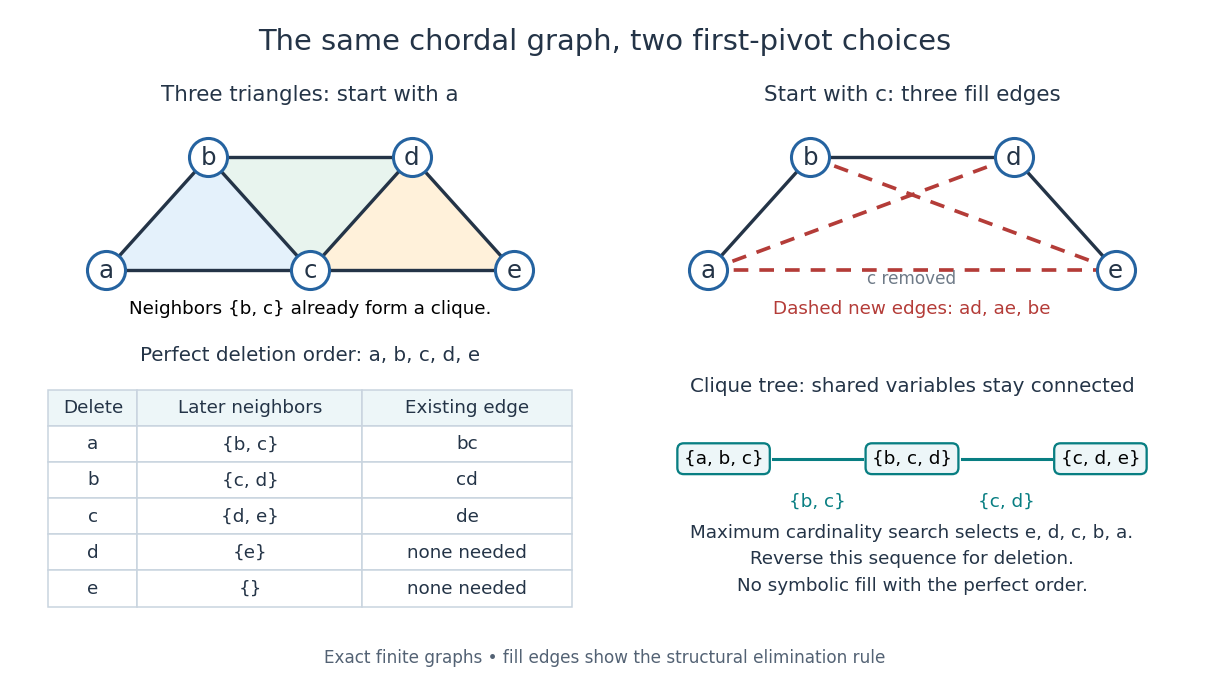
A perfect elimination ordering removes three overlapping triangles without fill-in; choosing the central vertex first adds three edges
. Details. To find an ordering, maximum cardinality search starts with all scores zero, repeatedly selects an unselected vertex of largest score, and increases each unselected graph neighbour's score by one. Reverse the selection order to obtain a candidate perfect elimination ordering. For the three-triangle graph, one valid selection sequence is , with scores at selection ; reversing it gives the displayed deletion order. On a chordal graph every tie choice works. On an arbitrary graph, test the resulting later graph neighbourhoods for the clique condition to recognize chordal graphs. Suitable adjacency lists, score buckets and a linear-time verification method give recognition.[ref]
The deletion rule also explains sparse Gaussian elimination. For a symmetric positive-definite matrix whose matrix graph is , eliminating pivot applies the Schur complement updateOnly pairs of remaining graph neighbours of can acquire new off-diagonal entries. A perfect elimination ordering already has all those edges, so Cholesky decomposition creates no symbolic fill-in. Positive definiteness ensures nonzero pivots in exact arithmetic. Special numerical cancellation can suppress predicted entries, and floating-point rounding affects their values.[ref]
Chordal Graphs and Semidefinite Optimization by Lieven Vandenberghe and others. §9.1; equation 9.2; Theorem 9.1
In the three-triangle graph, deleting first instead connects every pair in and adds exactly . The graph was already a chordal graph; the extra fill-in comes from the ordering.One further reward is optimal graph coloring. Process a perfect elimination ordering backwards and give each vertex the smallest positive color absent from its already colored graph neighbours. Those graph neighbours form a clique, so this greedy algorithm uses at most the clique number colors; any clique of that size requires at least that many. In the three-triangle graph, coloring gives colors , so both the chromatic number and the clique number are three. Every maximal clique also occurs among : take its earliest vertex and use maximality. The same ordering therefore supports graph coloring, maximal clique extraction and sparse computation.
Historically, Donald J. Rose, Robert E. Tarjan and George S. Lueker's 1976 paper connected graph elimination to symmetric sparse matrices and gave a search-based algorithm for finding a perfect elimination ordering when one exists. Its abstract distinguishes a minimal elimination ordering from a minimum one: removing avoidable fill-in does not by itself minimize the total number of added edges.[ref]
Pinned article: Introduction to the OurBigBook Project
Welcome to the OurBigBook Project! Our goal is to create the perfect publishing platform for STEM subjects, and get university-level students to write the best free STEM tutorials ever.
Everyone is welcome to create an account and play with the site: ourbigbook.com/go/register. We belive that students themselves can write amazing tutorials, but teachers are welcome too. You can write about anything you want, it doesn't have to be STEM or even educational. Silly test content is very welcome and you won't be penalized in any way. Just keep it legal!
Intro to OurBigBook
. Source. We have two killer features:
- topics: topics group articles by different users with the same title, e.g. here is the topic for the "Fundamental Theorem of Calculus" ourbigbook.com/go/topic/fundamental-theorem-of-calculusArticles of different users are sorted by upvote within each article page. This feature is a bit like:
- a Wikipedia where each user can have their own version of each article
- a Q&A website like Stack Overflow, where multiple people can give their views on a given topic, and the best ones are sorted by upvote. Except you don't need to wait for someone to ask first, and any topic goes, no matter how narrow or broad
This feature makes it possible for readers to find better explanations of any topic created by other writers. And it allows writers to create an explanation in a place that readers might actually find it.
Figure 1. Screenshot of the "Derivative" topic page. View it live at: ourbigbook.com/go/topic/derivativeVideo 2. OurBigBook Web topics demo. Source. - local editing: you can store all your personal knowledge base content locally in a plaintext markup format that can be edited locally and published either:This way you can be sure that even if OurBigBook.com were to go down one day (which we have no plans to do as it is quite cheap to host!), your content will still be perfectly readable as a static site.
- to OurBigBook.com to get awesome multi-user features like topics and likes
- as HTML files to a static website, which you can host yourself for free on many external providers like GitHub Pages, and remain in full control

Figure 2. You can publish local OurBigBook lightweight markup files to either OurBigBook.com or as a static website.
Figure 3. Visual Studio Code extension installation.
Figure 5. . You can also edit articles on the Web editor without installing anything locally. Video 3. Edit locally and publish demo. Source. This shows editing OurBigBook Markup and publishing it using the Visual Studio Code extension. 
- Infinitely deep tables of contents:




All our software is open source and hosted at: github.com/ourbigbook/ourbigbook
Further documentation can be found at: docs.ourbigbook.com
Feel free to reach our to us for any help or suggestions: docs.ourbigbook.com/#contact