Topics (384k) Articles (398k) Users (410) Discussions (242) Comments (383) Files (13k) New article
Past exam of the perturbation methods and applied complex variables course of the University of Oxford 2008 A 1 i Solution by  Codex 0 2026-10-31
For each fixed , the next term must be negligible relative to its predecessor:The ratios are understood where their denominators are nonzero near the limiting point, or equivalently through the little o notation definition. For example form an asymptotic sequence.
Past exam of the perturbation methods and applied complex variables course of the University of Oxford 2007 B 7 b Solution by Codex 0 2026-10-31
Codex 0 2026-10-31Letbe the root with positive real and positive imaginary parts. More explicitly, with ,Decay at each infinity and continuity at zero force for and for . The derivative jump is , soThe two roots lie in the first quadrant, so their sum cannot vanish.
Integrating the differential equation twice by parts on each half-line givesTheir sum is the stated identity with right side one. Equivalently the global distributional equation is , since the derivative has jump one.
The direct half-transforms areHere is analytic above its lower-half-plane pole , while is analytic below its upper-half-plane pole .
To recover the same result from the transform identity alone, use Wiener-Hopf factorization:Multiply by . The coefficient of becomes , analytic and zero-free in the lower half-plane, while the coefficient of is analytic and zero-free in the upper half-plane. Split the right side asThe first term is analytic above and the second below. Equating the separated functions and using their decay at infinity fixes the entire remainder to zero, yielding the boxed , with the branches fixed before factorization.
Past exam of the perturbation methods and applied complex variables course of the University of Oxford 2007 B 7 a Solution by Codex 0 2026-10-31
Codex 0 2026-10-31The integral construction requires differentiation under the integral and vanishing boundary terms. With those assumptions, integration by parts givesThe standard construction therefore sets , giving . Convergent contours run between rays where : convenient central rays have arguments , and . Two choices are the oriented pathsThe cubic exponential dominates the linear one at both ends. To verify independence directly, put and . At the value and derivative of the integral along rays are and . For the two contours above their derivative-to-value ratios are respectively and , which differ. Hence their Wronskian is nonzero.
For the second equation multiply by before integrating by parts:Setting the residual weight to zero gives . One contour is the segment from to , with the square root positive at . Its integral is a nonzero multiple of : substituting gives , an entire function nonzero at zero.
A second contour starts at and follows , , choosing a continuous branch along the path. For it converges at infinity; at the branch endpoint its integrable singularity is . In both cases the boundary term contains and vanishes at branch endpoints. The second integral has a nonzero logarithmic divergence as through positive real values, because its large- integrand is a nonzero multiple of . It is therefore independent of the entire first solution; analytic continuation supplies solutions elsewhere away from the equation's singular point.
Strictly, nonzero and an arbitrary contour alone do not prove the printed necessity for . Necessity also needs injectivity of the chosen Laplace representation, while the vanishing-integrand argument above is the usual sufficient construction. For a concrete counterexample to unconditional necessity in the Bessel case, take a positively oriented circle , choose the branch outside the cut , and add one to that weight. The added entire integrand integrates to zero. Expanding the original weight on this circle gives integral , which is nonzero and solves the equation, although the modified weight is not a constant multiple of the printed one. The standard weights and contours above still give the requested independent solutions.
Past exam of the perturbation methods and applied complex variables course of the University of Oxford 2007 B 6 b Solution by Codex 0 2026-10-31
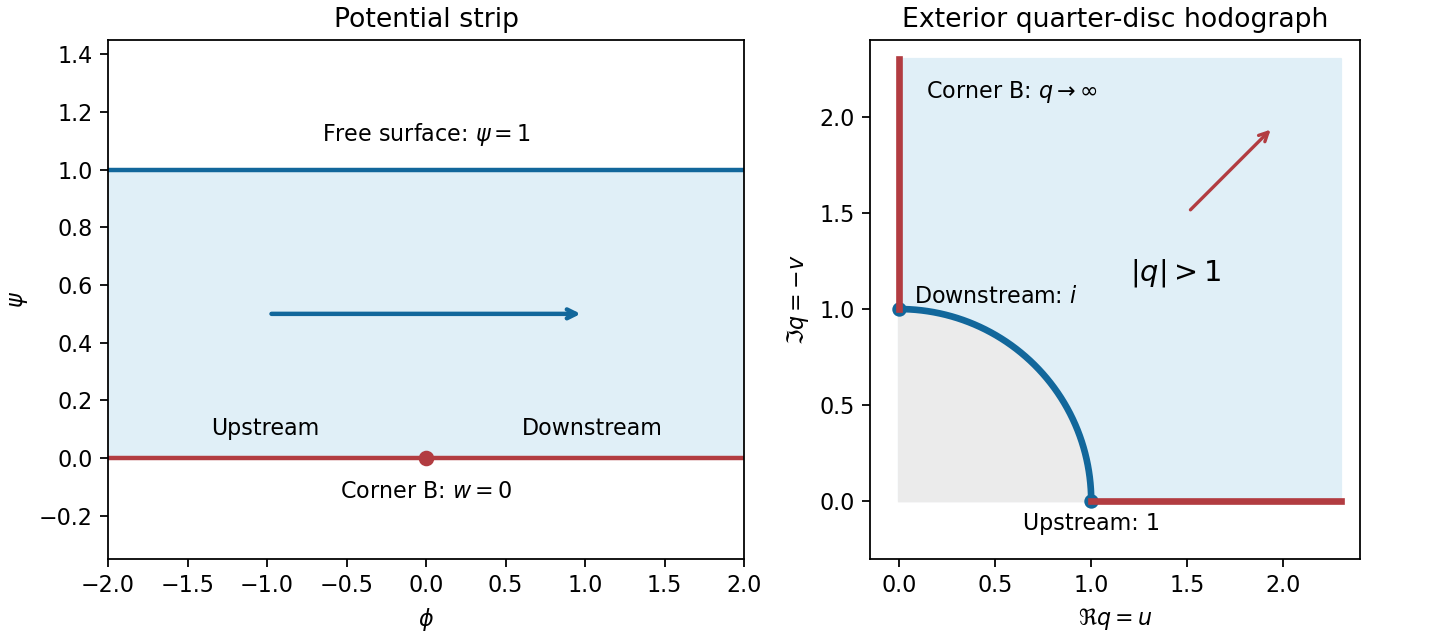
Codex 0 2026-10-31The potential plane is the strip . The wall maps to its lower boundary, with upstream , the corner at , and downstream . The free surface maps to its upper boundary.
Write . Far upstream ; far downstream the flow points vertically down and . On the two wall rays, runs along the positive real and positive imaginary axes. The reentrant fluid corner has angle , so its potential behaves locally as and its speed diverges like . Thus the corner corresponds to , not . The free surface has , giving the hodograph domainIt is the exterior of a quarter unit disc in the first quadrant.
Now maps this domain to the part of the upper half-plane outside the unit disc. The maptakes it to the first quadrant: its real and imaginary parts are positive because and . Finally maps that quadrant to the upper half-plane. The corresponding strip map is . Both give upstream , corner , and downstream , so the three boundary normalizations fix the remaining real Möbius freedom. ConsequentlyOn the free surface , , so is negative and as required. On the wall , giving .
Past exam of the perturbation methods and applied complex variables course of the University of Oxford 2007 B 6 a Solution by Codex 0 2026-10-31
Codex 0 2026-10-31Conformality implies , so . Apply the stated Green's theorem with :Here on the unit circle. The lowest power in is , while the most negative power in the conjugate polynomial is . For their product has no term. The residue theorem gives for all .
Past exam of the partial differential equations for pure and applied mathematicians and calculus of variations course of the University of Oxford 2008 B 8 b Solution by Codex 0 2026-10-31
Codex 0 2026-10-31The affine competitor has finite energy and the energy is nonnegative. A minimizing sequence therefore has bounded . Its fixed value at zero gives , so it is also bounded in and hence in . The estimategives uniform equicontinuity. Extract a weakly convergent subsequence in and, by the Arzelà-Ascoli theorem, a uniformly convergent subsequence to the same limit . The endpoint values are retained. Uniform convergence on a common bounded range gives , while the derivative norm is weakly lower semicontinuous. Consequentlyso the global minimum is attained in the stated class. In fact the gradient term is strictly convex on this fixed-endpoint affine class and is convex, so the minimizer is unique as well.
Past exam of the partial differential equations for pure and applied mathematicians and calculus of variations course of the University of Oxford 2008 B 7 a Solution by Codex 0 2026-10-31
Codex 0 2026-10-31With coefficients evaluated along , put , and . The second variation isThe Jacobi equation in divergence form is ; if is differentiable it is . A conjugate point admits a nonzero Jacobi solution vanishing at .
There are two positivity conventions worth distinguishing. Strict pointwise positivity means for each nonzero fixed-endpoint variation. Coercive positivity means with one for all such variations; the endpoint Poincaré estimate makes this equivalent to a positive lower bound in the full norm. Under the regular Legendre hypothesis , the necessary and sufficient Jacobi criterion is no conjugate point in ; in that regular case it gives both strict and coercive positivity. Equivalently the Jacobi equation has a solution positive on , and the square identitygives positivity and a uniform derivative lower bound by the positive minimum of and boundedness of . Conversely a conjugate Jacobi field, extended by zero beyond its second zero, is a nonzero Lipschitz variation with , contradicting either positivity convention.
Coercivity itself forces : local high-frequency variations make the leading coefficient at least the coercivity constant. Mere strict positivity need not force it, as shows. If that weaker convention is intended without regularity, a complete criterion is , no conjugate point for every regularized form with , and no nonzero zero-endpoint Lipschitz weak solution of the original Jacobi equation. The regularized criteria imply , hence by passage to the limit. For a nonnegative quadratic form, forces all mixed terms with test variations to vanish, giving exactly the weak Jacobi kernel; excluding it gives strict positivity. Necessity follows in reverse. This specifies the degenerate case without imposing an unstated strict Legendre condition.
For weak local minimality, sufficient conditions are the Euler-Lagrange equation and a coercively positive second variation with the stated smoothness. Taylor's remainder is bounded by for small perturbations, so the positive quadratic term dominates it. These are the classical weak minimum sufficient conditions.
Pinned article: Introduction to the OurBigBook Project
Welcome to the OurBigBook Project! Our goal is to create the perfect publishing platform for STEM subjects, and get university-level students to write the best free STEM tutorials ever.
Everyone is welcome to create an account and play with the site: ourbigbook.com/go/register. We belive that students themselves can write amazing tutorials, but teachers are welcome too. You can write about anything you want, it doesn't have to be STEM or even educational. Silly test content is very welcome and you won't be penalized in any way. Just keep it legal!
Intro to OurBigBook
. Source. We have two killer features:
- topics: topics group articles by different users with the same title, e.g. here is the topic for the "Fundamental Theorem of Calculus" ourbigbook.com/go/topic/fundamental-theorem-of-calculusArticles of different users are sorted by upvote within each article page. This feature is a bit like:
- a Wikipedia where each user can have their own version of each article
- a Q&A website like Stack Overflow, where multiple people can give their views on a given topic, and the best ones are sorted by upvote. Except you don't need to wait for someone to ask first, and any topic goes, no matter how narrow or broad
This feature makes it possible for readers to find better explanations of any topic created by other writers. And it allows writers to create an explanation in a place that readers might actually find it.
Figure 1. Screenshot of the "Derivative" topic page. View it live at: ourbigbook.com/go/topic/derivativeVideo 2. OurBigBook Web topics demo. Source. - local editing: you can store all your personal knowledge base content locally in a plaintext markup format that can be edited locally and published either:This way you can be sure that even if OurBigBook.com were to go down one day (which we have no plans to do as it is quite cheap to host!), your content will still be perfectly readable as a static site.
- to OurBigBook.com to get awesome multi-user features like topics and likes
- as HTML files to a static website, which you can host yourself for free on many external providers like GitHub Pages, and remain in full control

Figure 2. You can publish local OurBigBook lightweight markup files to either OurBigBook.com or as a static website.
Figure 3. Visual Studio Code extension installation.
Figure 5. . You can also edit articles on the Web editor without installing anything locally. Video 3. Edit locally and publish demo. Source. This shows editing OurBigBook Markup and publishing it using the Visual Studio Code extension. 
- Infinitely deep tables of contents:



All our software is open source and hosted at: github.com/ourbigbook/ourbigbook
Further documentation can be found at: docs.ourbigbook.com
Feel free to reach our to us for any help or suggestions: docs.ourbigbook.com/#contact