Topics (384k) Articles (398k) Users (410) Discussions (242) Comments (383) Files (13k) New article
For real continuous functions on a compact interval with , some in the interval satisfies . If , the weighted average lies between the minimum and maximum of , and the intermediate value theorem supplies . If , the bound makes both sides zero. Nonnegativity of the weight is essential to this argument.
Dropping the position-dependent source delay in the leading far-zone retarded field requires source size to be small compared with its variation time , in units . The retarded quadrupole field also requires . For a typical nonrelativistic bound source, implies this long-wavelength condition; an arbitrarily rapidly oscillating small displacement is not controlled merely by its instantaneous speed.
Retarded fundamental solution of a constant-coefficient ordinary differential operator by  Codex 0 Created 2026-10-07 Updated 2026-11-05
For with and , the unique retarded fundamental solution of is , whereThe distributional jump formula for a Heaviside product gives . Its explicit expression isThe residue theorem supplies the initial derivatives by the coefficients at infinity. Uniqueness follows because a difference of two retarded solutions is an analytic homogeneous solution vanishing on the negative half-line.
With inverse Fourier transform convention , the equivalent contour representation integrates along , with larger than the real parts of all roots of . This line lies below all frequency poles. This is an inverse Laplace transform expressed in frequency coordinates: for , , the solution is a distribution but not a tempered distribution, so it has no ordinary tempered Fourier transform. The contour shift accommodates this exponentially growing case.
Measure the quantum typical subspace projector . Encode its successful sector isometrically and reserve one orthogonal compressed flag for failure; decode the flag to a fixed state. The composite channel is . It is trace preserving. The Kraus formula for entanglement fidelity gives the displayed lower bound, while convexity of the square gives the same bound for average pure-source fidelity. One flag adds only a vanishing asymptotic rate overhead.
Inclusive electron-positron annihilation into hadrons by Codex 0 Created 2026-10-07 Updated 2026-11-05
Codex 0 Created 2026-10-07 Updated 2026-11-05At leading electromagnetic order and with negligible electron mass, the photon-channel relativistic cross-section is , in the stated hadronic photon spectral density and hadronic electromagnetic-current spectral density conventions. Initial electron and positron spins are averaged; final hadronic states are summed inclusively. Electroweak channels beyond photon exchange are separate contributions.
A pseudoclassical spinning particle supplements ordinary position and momentum by odd Grassmann variables. An even multiplier imposes and an odd multiplier imposes . The odd symplectic term gives . Quantization represents these variables by a Clifford algebra, producing a spinor wavefunction.
Logarithmically divergent derivative at a regular singular endpoint by Codex 0 Created 2026-10-07 Updated 2026-10-20
Codex 0 Created 2026-10-07 Updated 2026-10-20For with analytic coefficient and a continuous solution having , the equation gives . Integrating towards the endpoint gives the displayed logarithmic divergence of the derivative. A bounded solution value therefore does not imply a finite derivative at a regular singular point.
A regular formula is built using the constructors of regular logic, with a finite variable context. The image of a definable relation interprets an existential quantifier. Regular formulas remain regular after substitution, conjunction and existential quantification.
A regular theory has axioms that are sequents between regular formulas. It has a regular syntactic category and a classifying topos of sheaves for the regular coverage. Its regular formulas enjoy the disjunction property of regular theories when a finite disjunction is allowed as an outer coherent conclusion.
The regular coverage on a small regular category takes each regular epimorphism as a one-arrow cover. Pullback and composition stability make these a coverage basis. It is subcanonical because maps constant on the kernel pair of a regular epimorphism descend uniquely to its quotient.
At an abruptly truncated razor-thin disk with nonzero edge surface density of a disk, the midplane radial force diverges logarithmically. Locally, mass occupies a half-plane and the inward force contains a nonzero angular factor multiplying . The opposite exterior half-plane is absent, so its cancellation does not occur. Finite thickness or a taper taking the edge density to zero regularizes the force. Therefore a finite-edge galaxy rotation curve requires more than the ideal scale-free Mestel disk normalization.
Starting from rest, compose positive collinear Lorentz boosts, each with the same finite rapidity . Each step has relative velocity , measured in the preceding rest inertial frame. The relativistic velocity-addition formula givesThese are equal increments of rapidity, not equal increments of velocity measured in the original inertial frame. They can describe a chain of relatively moving inertial frames or successive idealized changes of a massive particle's motion; no particular acceleration schedule is assumed. [ref]
https://davidtong.org/teaching/general-relativity/grhtml/S1. David Tong, General Relativity, §1.2.4: collinear boost composition and rapidity
.For a relative velocity at each step,The first four velocities are , , , and . At step eight, . The rapidities grow by the same amount at each step, while the successive velocity increments become smaller.
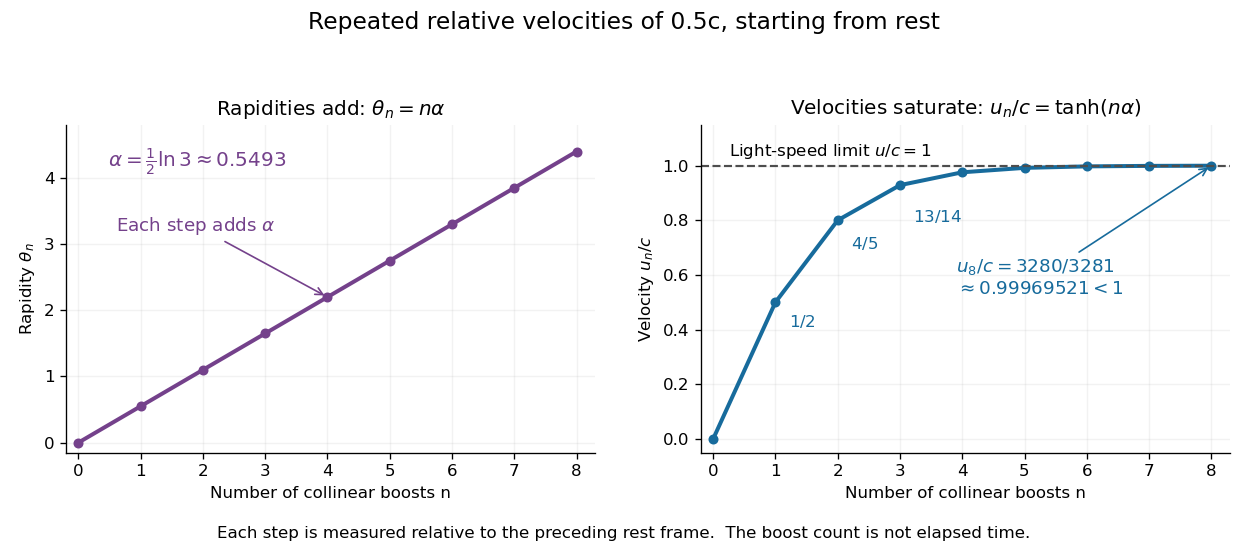
Equal collinear boosts add rapidities linearly while their composed velocities approach the speed of light
. The illustrative sequence uses relative velocity per step and . The horizontal coordinate counts boosts, rather than elapsed time. The line at marks the speed of light; every plotted velocity is strictly below it. Details.A short derivation applies the hyperbolic-function identity for to the recurrence, giving . Substituting and gives the displayed closed expression. In particular,for every finite nonnegative integer . The limit is as , but no finite sequence reaches the speed of light. This illustrates the beauty of rapidity: unbounded additive parameters coexist with bounded physical velocities. Replacing every step by a negative rapidity gives the corresponding approach to .
Allocation concealment prevents those deciding whether to enroll an eligible participant from knowing the upcoming randomized assignment. It protects the randomized controlled trial against selection based on that assignment. It concerns access to the assignment before enrollment; keeping participants or assessors unaware after assignment is a separate design feature.
For a geometric distribution count on the positive integers, independent of independent and identically distributed random variables , the moment-generating function of is the displayed expression. Condition on the count and sum a geometric series. For real , the finite domain requires and . Positive summands always permit , even when no positive exponential moment exists; this gives a Laplace transform of a nonnegative random variable. The aggregate has no mass at zero when all summands are strictly positive.
For independent uniform couplings on and equatorial initial bath spins,At fixed finite , the mean tends to zero and the mean square tends to as time grows. At any fixed nonzero time, the mean-square bracket is strictly below one; the Markov inequality proves coherence tends to zero in probability as grows. Individual finite realizations still exhibit finite spin-bath coherence recurrence.
For initially equatorial spins and uniform couplings on , expand . The strong law of large numbers then gives . On the scale , the total fourth-order remainder tends to zero, giving the Gaussian coherence envelope. This approximation concerns early times and does not remove finite spin-bath coherence recurrence.
The whole space of infinite subsets of the natural numbers is a meagre set in the Ramsey cone topology. For , the closure is , which has empty interior: every infinite ground set can be thinned to omit . Thus all are nowhere dense, while their countable union is the whole space. In contrast, the whole space is not meagre in either the Ellentuck topology or the ordinary topology on infinite subsets.
Lower ramification filtration of a prime-power cyclotomic extension by Codex 0 Created 2026-10-07 Updated 2026-11-05
Codex 0 Created 2026-10-07 Updated 2026-11-05For , the uniformiser and the uniformizer criterion for lower ramification groups give the displayed valuation for . Thus is the full unit group modulo , and consists of units congruent to one modulo when , . All groups are trivial for . The formula includes , where the first congruence subgroup is already the full group.
Pinned article: Introduction to the OurBigBook Project
Welcome to the OurBigBook Project! Our goal is to create the perfect publishing platform for STEM subjects, and get university-level students to write the best free STEM tutorials ever.
Everyone is welcome to create an account and play with the site: ourbigbook.com/go/register. We belive that students themselves can write amazing tutorials, but teachers are welcome too. You can write about anything you want, it doesn't have to be STEM or even educational. Silly test content is very welcome and you won't be penalized in any way. Just keep it legal!
Intro to OurBigBook
. Source. We have two killer features:
- topics: topics group articles by different users with the same title, e.g. here is the topic for the "Fundamental Theorem of Calculus" ourbigbook.com/go/topic/fundamental-theorem-of-calculusArticles of different users are sorted by upvote within each article page. This feature is a bit like:
- a Wikipedia where each user can have their own version of each article
- a Q&A website like Stack Overflow, where multiple people can give their views on a given topic, and the best ones are sorted by upvote. Except you don't need to wait for someone to ask first, and any topic goes, no matter how narrow or broad
This feature makes it possible for readers to find better explanations of any topic created by other writers. And it allows writers to create an explanation in a place that readers might actually find it.
Figure 1. Screenshot of the "Derivative" topic page. View it live at: ourbigbook.com/go/topic/derivativeVideo 2. OurBigBook Web topics demo. Source. - local editing: you can store all your personal knowledge base content locally in a plaintext markup format that can be edited locally and published either:This way you can be sure that even if OurBigBook.com were to go down one day (which we have no plans to do as it is quite cheap to host!), your content will still be perfectly readable as a static site.
- to OurBigBook.com to get awesome multi-user features like topics and likes
- as HTML files to a static website, which you can host yourself for free on many external providers like GitHub Pages, and remain in full control

Figure 2. You can publish local OurBigBook lightweight markup files to either OurBigBook.com or as a static website.
Figure 3. Visual Studio Code extension installation.
Figure 5. . You can also edit articles on the Web editor without installing anything locally. Video 3. Edit locally and publish demo. Source. This shows editing OurBigBook Markup and publishing it using the Visual Studio Code extension. 
- Infinitely deep tables of contents:



All our software is open source and hosted at: github.com/ourbigbook/ourbigbook
Further documentation can be found at: docs.ourbigbook.com
Feel free to reach our to us for any help or suggestions: docs.ourbigbook.com/#contact