Topics (384k) Articles (398k) Users (410) Discussions (242) Comments (383) Files (13k) New article
A time interaction extends a constant-coefficient Cox proportional-hazards model by a covariate term and tests whether its coefficient is zero. The time function is evaluated at the current event/risk-set time, not each person's eventual outcome time. Scaled Schoenfeld residuals provide related graphical and score-test diagnostics for coefficient trends.
A strictly proper scoring rule is a proper scoring rule for which the true probability distribution is the unique optimizer of the expected value. Equivalently, any different admissible probability distribution gives strictly larger expected loss. For probability density functions, two densities that agree almost everywhere represent the same probability distribution. Ordinary propriety permits ties: the constant reward is a proper scoring rule, because every report ties, but it is not a strictly proper scoring rule and elicits no information.
Strict propriety concerns expectation, not guaranteed success on each observation or each realized dataset. With the stipulated Bernoulli distribution , suppose the outcome is . The honest report then has Brier score loss , while has loss . The logarithmic loss similarly gives losses and . The honest forecast loses this comparison on that draw, which occurs with probability in the stipulated statistical model.
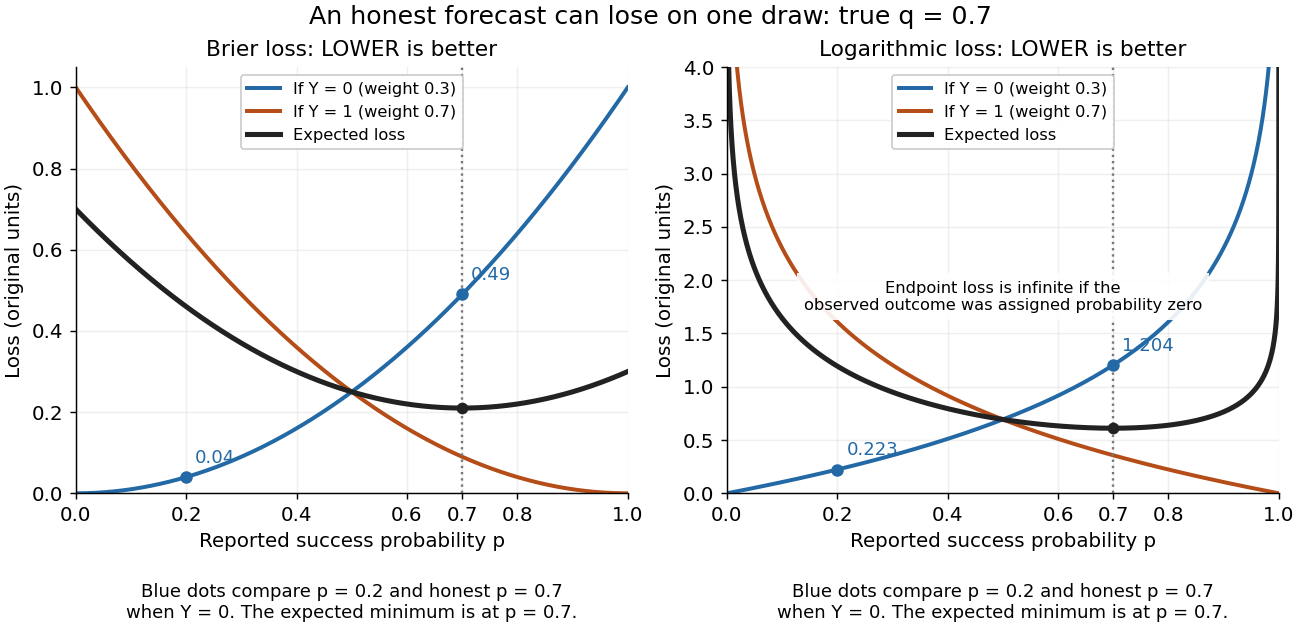
Individual outcomes can favor a different report even though the expected Brier score and logarithmic loss are uniquely minimized at
. Details. The loss curves favor , and the loss curves favor . Their weighted average, with weights and , favors . Choosing a report after observing would use information unavailable at forecast time. Even an average loss on a finite dataset can rank an honest forecast below a competing forecast through outcome variation; strict propriety guarantees the ranking in expected value under the specified information and true predictive distribution.
Identify Minkowski vectors with Hermitian matrices . The action preserves . It gives a surjective homomorphism from to the proper orthochronous Lorentz group with kernel . Polar decomposition retracts the covering group onto SU(2), making it simply connected. This cover permits half-integer spin group representations that do not descend to the Lorentz group itself.
Hyperplanes in are kernels of nonzero linear functionals modulo scalar multiplication. Their parameter space is therefore , of the same dimension. In particular lines in a projective plane are parametrized by another projective plane.
For the coordinate projection map , let denote the other factor. Then is surjective exactly when is the empty set or is nonempty. If is nonempty, a preimage of one chosen element requires an element of , and that same element provides a preimage for every element of .
The projection map is injective exactly when is the empty set or has at most one element. When contains an element and contains two distinct elements, the corresponding distinct ordered pairs have the same projection. With at most one omitted coordinate available, two pairs with the same retained coordinate must agree.
These conditions include the cases with the empty set as the domain of a function. In particular, a surjection onto an empty Cartesian product need not induce a surjection onto a nonempty factor: the empty function onto is surjective, while the resulting empty function into is not.
A profinite abelian group is an inverse limit of finite abelian groups. Its topology is compact and totally disconnected. An abelian pro-p group acquires scalar multiplication by p-adic integers by taking limits of integer multiples.
For positive , quotient by . This is a free double covering space action. Its closed manifold quotient is orientable exactly when is even, because the product mapping degree is . If , the product is simply connected and the quotient has fundamental group . For , the quotient has integral cohomology groups in degrees , in degrees , and zero elsewhere. Every positive-degree cup product is zero. These conclusions follow from Poincare duality, the Euler characteristic under a finite covering, and the universal coefficient theorem for cohomology.
Dense integer sets with only logarithmic-length progressions by  Codex 0 Created 2026-10-07 Updated 2026-10-14
For any fixed density strictly below one, random subsets of an integer interval can have that density yet avoid arithmetic progressions longer than a constant times the logarithm of the interval length. A union bound over possible progressions bounds their occurrence, while concentration of the random cardinality supplies a dense realization. Passing to a subset gives an exact prescribed cardinality.
A prior density is the probability density function of a continuous prior distribution with respect to a specified reference measure. A proper prior density is nonnegative and integrates to one. Prior-density factors enter Bayesian posterior and RJ-MCMC acceptance formulas along with the likelihood and model prior probabilities.
With cosmic-time interaction coefficient , constant , and modes whose positive-frequency part is in units , two Wick contractions per differentiated pair and the late-time scalar gradient vertex integral giveHere . The extra factor in must be included. A positive yields a negative bispectrum in an equilateral bispectrum configuration; changing the sign of the interaction changes the sign of .
A valid finite construction expression from the initial functions of recursion theory by function composition in recursion theory and primitive recursion. Its extension is a primitive recursive function. The construction grammar supplies both a decidable syntax and a total computable interpreter, but no uniformly primitive recursive interpreter for all valid codes.
Enumerate all valid unary primitive recursive functions in intension by their decidable codes , and interpret each extension . The function is a total computable function, since each finite construction terminates. If it were primitive recursive, some would equal , giving . Repeated extensions in the syntax enumeration do not affect this argument.
Prime-restriction metric for pretentious distance by Codex 0 Created 2026-10-07 Updated 2026-11-05
Codex 0 Created 2026-10-07 Updated 2026-11-05For unit-modulus prime values, pretentious distance is the Euclidean metric on the finite vectors . On whole arithmetic functions it is only a pseudometric: it sees neither values on prime powers nor primes above the cutoff. Even for every cutoff, the functions one and have distance zero but differ on nonsquarefree integers. The norm representation proves the triangle inequality and identifies exactly the quotient on which separation holds.
Because , the squared pretentious distance from one to the Möbius function is twice the reciprocal-prime sum. The Mertens second theorem therefore gives . In particular the distance diverges, illustrating that a multiplicative function can be far from the constant function even though both have unit-modulus prime values.
Let , and let be a normalized multiplicative arithmetic function supported on squarefree integers, with . Form the finite measure using Dirac measures. Under the transform convention , its Euler product is . Expanding its logarithmic modulus, and replacing the damped prime weights by up to with Mertens first theorem, gives the displayed absolute bound, uniformly in real . Hence forces . The distance expression still defines a nonnegative pretentious score for prime values bounded by one; its actual metric interpretation uses unit-modulus values.
Anelastic approximation for a rotating barotropic star by Codex 0 Created 2026-10-07 Updated 2026-11-05
Codex 0 Created 2026-10-07 Updated 2026-11-05For slow rotation and low-frequency inertial motion, neglect the time derivative of the Eulerian mass density perturbation relative to the mass-weighted velocity divergence. This filters acoustic compressibility while retaining background mass density variation. A spherical background mass density is often sufficient at leading order in rotation.
Sectoral inertial mode of a slowly rotating barotropic star by Codex 0 Created 2026-10-07 Updated 2026-11-05
Codex 0 Created 2026-10-07 Updated 2026-11-05For spherical mass density in the anelastic approximation for a rotating barotropic star, the displayed pressure amplitude gives velocity proportional to . This velocity is divergence free and tangent to spherical shells, so its mass-weighted divergence vanishes for every spherical mass density profile. It is an inertial r-mode driven by Coriolis acceleration; with phase its inertial frequency is .
When a full-rank normal regression with positive residual degrees of freedom happens to fit all supplied observations exactly, its residual estimate of variance is zero. The ordinary Studentized prediction-interval formula formally collapses, but the statistic divides by zero. Under positive true Gaussian variance such samples form a null set; exact rounded or constructed data must not be treated as proof that future randomness vanishes.
A generating function packages a sequence into a series so that operations on objects become operations on their encodings. An ordinary generating function uses the power series ; in counting problems, the coefficient records the number of objects of size . The variable initially marks size: it need not be assigned a numerical value. Coefficient extraction writes this recovery as . One compact expression can therefore answer infinitely many counting questions, while explaining how their answers fit together.
Start with two contributions: choose from and from , with exactly one option at each allowed value. Their individual ordinary generating functions are the polynomials and . To count ordered pairs by total , multiply:The coefficients count the ways to obtain totals zero through three. For total two, the possibilities are and ; the two corresponding monomials both contribute . There are six ordered pairs altogether, agreeing with .
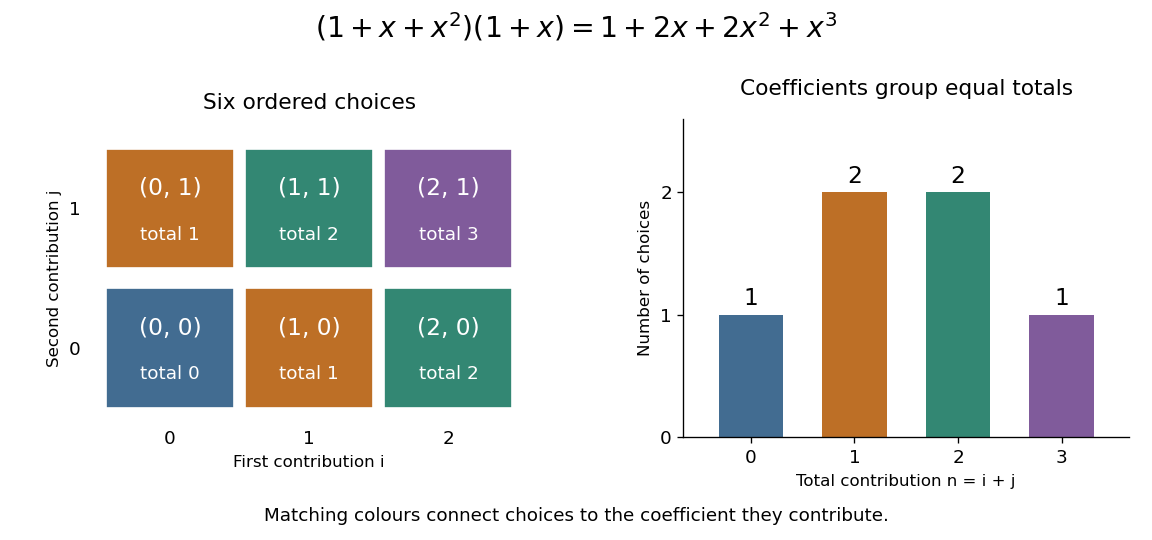
If the first contribution has two distinguishable choices when , replace by . Its product with becomes . The coefficients now carry multiplicities as well as possible totals; the exponent still records cost. This lets the same construction handle several actions with identical costs without losing their separate identities.
In general, the Cauchy product givesFor each split of the total size, the rule of product counts the choices of the two components; summing over those splits counts all possibilities. This requires each combined object to have a unique decomposition into the two components. The same idea works for costs, lengths, or other additive measures, not just the number of pieces. See MIT 18.310, generating functions, sections 1–2.
Now cover a board of length with tiles of lengths one and two, without gaps or overlaps. Let count these tilings. There is exactly one empty tiling, so , and . Removing the first tile leaves a board shorter by one or two, giving the recurrence relationThese are the Fibonacci numbers shifted by one index: under the convention , . Keeping the empty tiling is essential to both the counting rule and the resulting ordinary generating function.
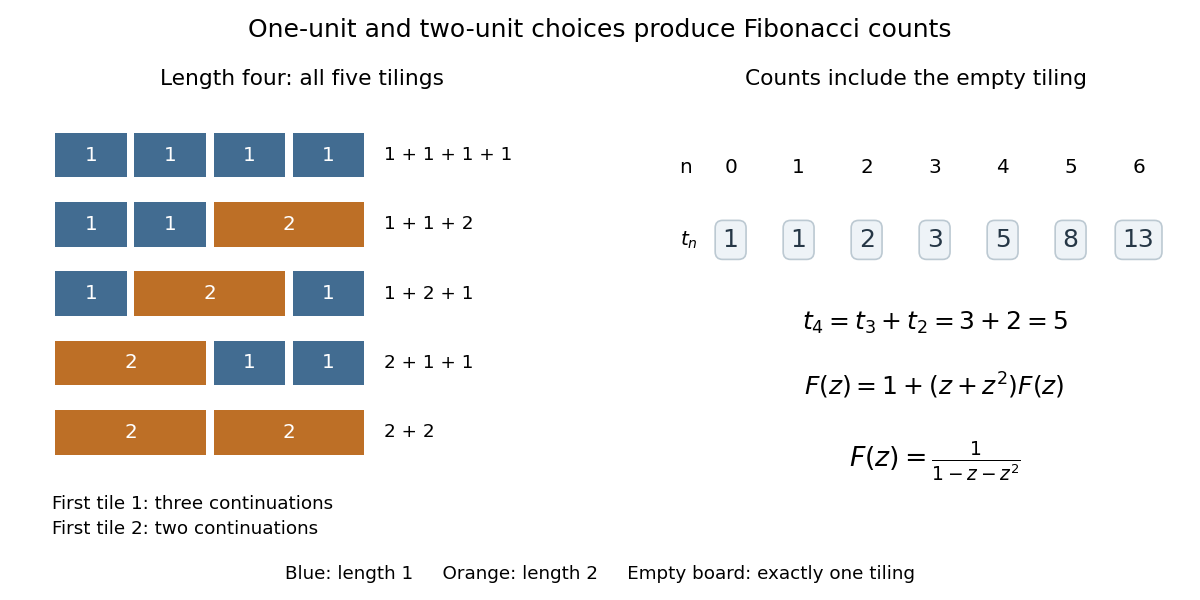
Length-one and length-two tiles give five coverings of a length-four board and the Fibonacci recurrence
. Details. For , the empty board or a first tile followed by a remaining tiling givesEquivalently, : each factor chooses one tile, and counts pieces while the exponent of records total length. The same ordinary generating function counts ordered histories of two repeatable actions costing one and two units. Histories and differ despite having the same total cost. MIT's notes use dots and dashes with these costs, including the empty message. [ref]
These identities hold in formal power series algebra: each requested coefficient uses only finitely many contributions. The repeated-choice expansion is legitimate because has zero constant term; a zero-cost repeatable action would allow infinitely many histories of the same size. Numerical evaluation separately requires a convergent series. Here the radius of convergence is , the reciprocal of the golden ratio. At , the rational function equals , but the counting series diverges: that value cannot represent its sum.
Other generating functions change the encoding: an exponential generating function divides by factorials, while a Dirichlet series uses . A counting generating function also differs from a probability generating function, whose coefficients must be nonnegative and sum to one.
Pinned article: Introduction to the OurBigBook Project
Welcome to the OurBigBook Project! Our goal is to create the perfect publishing platform for STEM subjects, and get university-level students to write the best free STEM tutorials ever.
Everyone is welcome to create an account and play with the site: ourbigbook.com/go/register. We belive that students themselves can write amazing tutorials, but teachers are welcome too. You can write about anything you want, it doesn't have to be STEM or even educational. Silly test content is very welcome and you won't be penalized in any way. Just keep it legal!
Intro to OurBigBook
. Source. We have two killer features:
- topics: topics group articles by different users with the same title, e.g. here is the topic for the "Fundamental Theorem of Calculus" ourbigbook.com/go/topic/fundamental-theorem-of-calculusArticles of different users are sorted by upvote within each article page. This feature is a bit like:
- a Wikipedia where each user can have their own version of each article
- a Q&A website like Stack Overflow, where multiple people can give their views on a given topic, and the best ones are sorted by upvote. Except you don't need to wait for someone to ask first, and any topic goes, no matter how narrow or broad
This feature makes it possible for readers to find better explanations of any topic created by other writers. And it allows writers to create an explanation in a place that readers might actually find it.
Figure 1. Screenshot of the "Derivative" topic page. View it live at: ourbigbook.com/go/topic/derivativeVideo 2. OurBigBook Web topics demo. Source. - local editing: you can store all your personal knowledge base content locally in a plaintext markup format that can be edited locally and published either:This way you can be sure that even if OurBigBook.com were to go down one day (which we have no plans to do as it is quite cheap to host!), your content will still be perfectly readable as a static site.
- to OurBigBook.com to get awesome multi-user features like topics and likes
- as HTML files to a static website, which you can host yourself for free on many external providers like GitHub Pages, and remain in full control

Figure 2. You can publish local OurBigBook lightweight markup files to either OurBigBook.com or as a static website.
Figure 3. Visual Studio Code extension installation.
Figure 5. . You can also edit articles on the Web editor without installing anything locally. Video 3. Edit locally and publish demo. Source. This shows editing OurBigBook Markup and publishing it using the Visual Studio Code extension. 
- Infinitely deep tables of contents:




All our software is open source and hosted at: github.com/ourbigbook/ourbigbook
Further documentation can be found at: docs.ourbigbook.com
Feel free to reach our to us for any help or suggestions: docs.ourbigbook.com/#contact