Topics (384k) Articles (398k) Users (410) Discussions (242) Comments (383) Files (13k) New article
For finite sets of points and geometric curves , a point-curve incidence is a pair with . The incidence count is . Bounds in incidence geometry exploit restrictions on how curves can meet points, rather than treating the incidence relation as an arbitrary bipartite graph.
For a finite planar point set , its distinct-distance set is . It includes zero for nonempty . Its cardinality measures how many different distances the configuration determines. Ordered point pairs can be grouped according to their distance, which relates the problem to incidences between points and curves.
Relative to a finite point set, an ordinary line is a line containing exactly two points of that set. It is an exact-richness condition, not a count of unordered pairs alone: a line with three points contains three point pairs but is not ordinary. Point-line duality turns ordinary lines into intersections incident to exactly two dual lines.
Vacuum prescription for inflationary in-in integrals by  Codex 0 Created 2026-10-06 Updated 2026-10-14
The Gaussian Bunch-Davies vacuum is selected by tilting the early endpoint to for integrands with . They then decay at the early boundary. The complex-conjugate integrand requires the opposite tilt. Ordered contractions and their contour must be conjugated together.
Subtract a smoothed image signal and add a scaled residual: . The Fourier multiplier is bounded by . This enhances apparent contrast but also amplifies noise; it is not a stable exact inverse of heat image smoothing.
The formal shock-filter equation steepens transitions around inflection boundaries. It is a Hamilton–Jacobi-type transport mechanism rather than positive diffusion. Combining it with controlled forward image smoothing limits noise amplification.
The Beltrami-Klein model realizes the hyperbolic plane inside an open Euclidean disk, with geodesics given by straight chords. Its metric differs from the Euclidean metric, and angles are generally distorted. The straight chords make geodesic convexity especially easy to see.
An absolute hydrodynamic instability makes the response to a localized impulse grow at a fixed spatial point in a specified frame. This differs from convective hydrodynamic instability, which amplifies a moving wave packet while its response decays at fixed positions. For analytic dispersion relations, the relevant absolute frequency is associated with an accessible zero-group velocity saddle, with the spatial-branch selection checked rather than assumed for an arbitrary dispersion relation.
A convective hydrodynamic instability amplifies an advected localized disturbance while its amplitude decays at any fixed position. The distinction from absolute hydrodynamic instability depends on the observation frame.
On a ray , a localized wave packet is governed by a physically selected saddle point satisfying in its analytic dispersion relation. The exponent's real growth is . The fixed-frame case gives the absolute growth rate. This ray formulation makes the frame dependence of convective hydrodynamic instability explicit.
For the linear complex Ginzburg-Landau equation with real and positive real diffusion coefficient scaled to one, the maximum temporal growth rate is and the absolute growth rate is . For , is stable, has convective hydrodynamic instability, and has absolute hydrodynamic instability. Both equality boundaries are marginal in exponential rate.
For a constant reference density, fluid perturbation kinetic energy is proportional to under the displayed inner product. An adjoint operator for perturbation evolution must be defined relative to this inner product, including boundary conditions and the projection onto incompressible flow.
For an incompressible parallel flow with base velocity and perturbation proportional to , divergence of the linearized momentum equations gives . At a no-slip boundary condition, streamwise momentum gives . The equation encodes how base shear generates perturbation fluid pressure.
A high-Reynolds number long-wave mode near a wall has a viscous layer of thickness , an order-one region following the base profile, and a pressure-decay region of thickness . The lower Airy function solution fixes velocity displacement and fluid pressure. The middle Rayleigh equation for inviscid shear flow transports these to the outer constant-velocity region. Matching its decaying pressure produces an Airy wall-layer matching determinant. For order-one amplitudes, constant leading middle pressure requires ; the distinguished balance gives .
Baroclinic instability converts potential energy of a stratified sheared basic flow into growing disturbances. In the Eady model, coupled Boundary Rossby waves provide a useful mechanism: their induced velocities displace boundary buoyancy anomalies, and suitable wavelengths permit phase locking. A single neutral boundary wave does not by itself imply exponential instability.
For a wave with zonal phase velocity in a basic shear , a critical level is a height at which . The Doppler-shifted material frequency then vanishes. This means equality of the laboratory velocities; the and terms cancel in the wave frame. It does not mean . A semi-infinite Eady edge wave with zero interior potential vorticity anomaly can remain regular through its steering height.
A critical layer is a region where the leading wave phase speed coincides with the local shear-flow velocity and an outer approximation degenerates. Small viscosity or other corrections must then be retained on a distinguished transverse scale. The width depends on the order of vanishing of and on the governing mode equation; simple-shear and stationary-profile layers have different balances.
The astronomical horizon is the great circle where the horizontal plane through the observer intersects the celestial sphere. It is perpendicular to the local vertical, so every direction on the astronomical horizon has altitude and zenith distance . In the local horizontal coordinate system, it consists of the unit vectors satisfying . This geometric reference remains defined when buildings or mountains hide it; a visible skyline is not a calibration of zero altitude.
Three boundaries must be distinguished. The astronomical horizon fixes the angular reference. Terrain supplies a site-dependent boundary with apparent altitude that changes with azimuth. Atmospheric refraction changes the apparent direction of incoming light, and can also change the apparent distant boundary. A point source clears an opaque terrain boundary only if when both are expressed in the same apparent horizontal coordinate system; this clearance condition does not guarantee visibility through clouds or bright sky. In the synthetic diagram, a source with geometric altitude and an imposed illustrative upward correction remains behind a boundary. The chosen is an algebraic illustration, not a fitted atmospheric prediction.
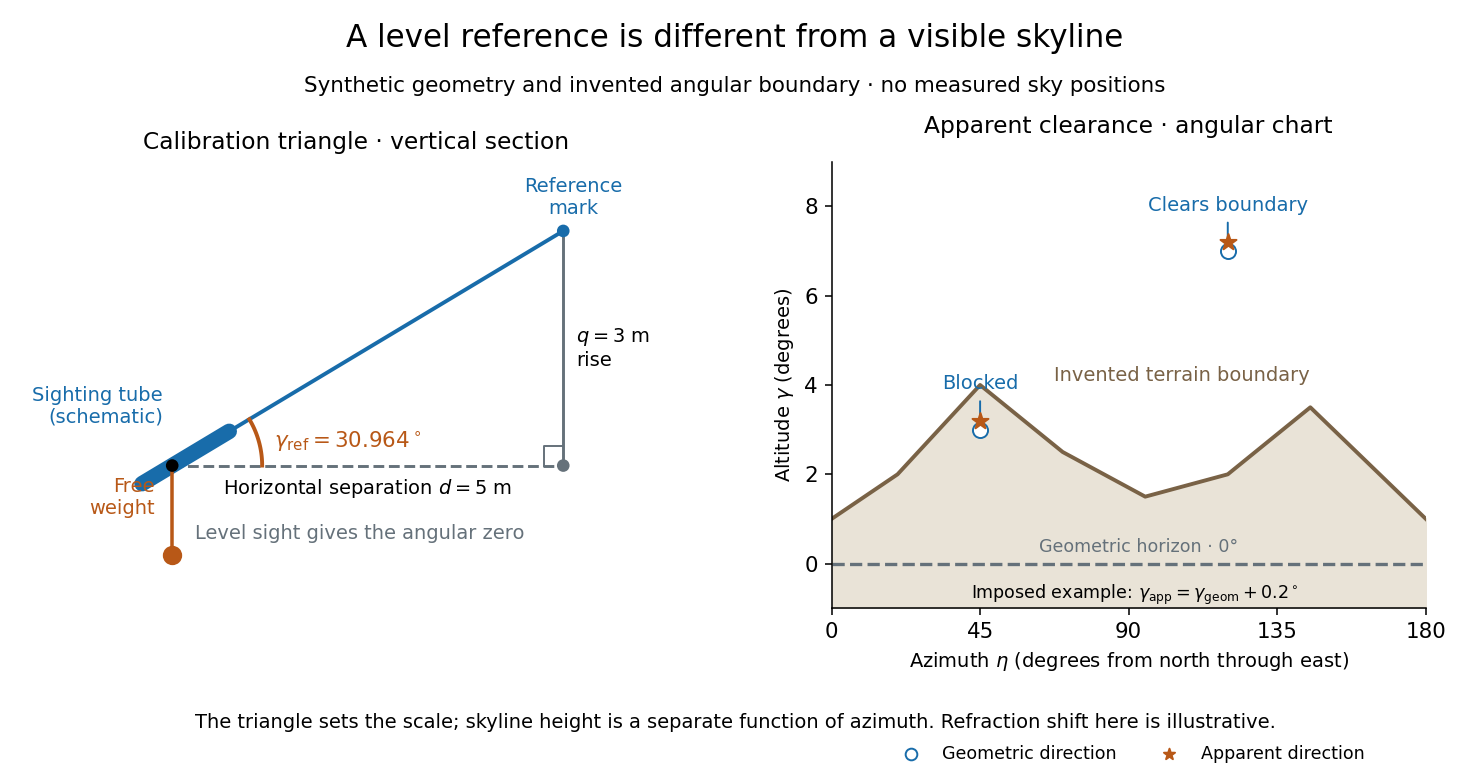
Synthetic calibration triangle and invented terrain boundary; angular zero, apparent altitude and geometric horizon are separate
. Details. Even an unobstructed sea boundary need not coincide with the astronomical horizon. On a spherical Earth of radius , an observer at height sees the unrefracted tangent to the surface at a downward angle satisfying . The right-angle tangent triangle supplies this relation; the visible boundary then has altitude . With illustrative and , , before atmospheric refraction. Raising the eye therefore changes the visible boundary without redefining the horizontal plane.
The US Naval Observatory's rise/set definitions explicitly distinguish the geometric reference from apparent contact with a visible disk: the standard Sun calculation puts its centre below the horizontal plane, combining an average radius with of atmospheric refraction. An angular minute is in the minute and second of arc convention. This is an operational average under stated conditions, rather than a universal zero of altitude. The same source identifies weather, local topography and observer height as limits on predicted rise/set time. An observation log should therefore retain the level reference, site and eye height, terrain profile, observation time, and whether each reported altitude is geometric or apparent. [ref]
https://aa.usno.navy.mil/faq/RST_defs. US Naval Observatory: Rise, set and twilight definitions, geometric horizon and observational limitations
. Pinned article: Introduction to the OurBigBook Project
Welcome to the OurBigBook Project! Our goal is to create the perfect publishing platform for STEM subjects, and get university-level students to write the best free STEM tutorials ever.
Everyone is welcome to create an account and play with the site: ourbigbook.com/go/register. We belive that students themselves can write amazing tutorials, but teachers are welcome too. You can write about anything you want, it doesn't have to be STEM or even educational. Silly test content is very welcome and you won't be penalized in any way. Just keep it legal!
Intro to OurBigBook
. Source. We have two killer features:
- topics: topics group articles by different users with the same title, e.g. here is the topic for the "Fundamental Theorem of Calculus" ourbigbook.com/go/topic/fundamental-theorem-of-calculusArticles of different users are sorted by upvote within each article page. This feature is a bit like:
- a Wikipedia where each user can have their own version of each article
- a Q&A website like Stack Overflow, where multiple people can give their views on a given topic, and the best ones are sorted by upvote. Except you don't need to wait for someone to ask first, and any topic goes, no matter how narrow or broad
This feature makes it possible for readers to find better explanations of any topic created by other writers. And it allows writers to create an explanation in a place that readers might actually find it.
Figure 1. Screenshot of the "Derivative" topic page. View it live at: ourbigbook.com/go/topic/derivativeVideo 2. OurBigBook Web topics demo. Source. - local editing: you can store all your personal knowledge base content locally in a plaintext markup format that can be edited locally and published either:This way you can be sure that even if OurBigBook.com were to go down one day (which we have no plans to do as it is quite cheap to host!), your content will still be perfectly readable as a static site.
- to OurBigBook.com to get awesome multi-user features like topics and likes
- as HTML files to a static website, which you can host yourself for free on many external providers like GitHub Pages, and remain in full control

Figure 2. You can publish local OurBigBook lightweight markup files to either OurBigBook.com or as a static website.
Figure 3. Visual Studio Code extension installation.
Figure 5. . You can also edit articles on the Web editor without installing anything locally. Video 3. Edit locally and publish demo. Source. This shows editing OurBigBook Markup and publishing it using the Visual Studio Code extension. 
- Infinitely deep tables of contents:



All our software is open source and hosted at: github.com/ourbigbook/ourbigbook
Further documentation can be found at: docs.ourbigbook.com
Feel free to reach our to us for any help or suggestions: docs.ourbigbook.com/#contact