Topics (384k) Articles (398k) Users (410) Discussions (242) Comments (383) Files (13k) New article
The zenith is the point on the celestial sphere in the direction of the observer's local upward vertical. In the horizontal coordinate system, its unit vector is and its altitude is . The zenith belongs to the observer's site; it is not generally the north celestial pole, whose altitude depends on geographical latitude. A direction's zenith distance is its nonnegative angle from the zenith, so . A direction of altitude therefore has zenith distance . [ref]
https://www.astro.uvic.ca/~tatum/celmechs/celm6.pdf. Jeremy Tatum: Celestial mechanics, section 6.2, zenith and complementary zenith distance
.At the zenith, every value of azimuth produces . There is no horizontal component to identify a bearing: cannot provide a geometrically meaningful azimuth, even if software returns a number. This coordinate singularity is a defect of the angular description; the viewing direction itself remains regular. The same ambiguity occurs at the opposite downward vertical. Near the zenith, two directions at fixed altitude separated by a small azimuth increment have separation to first order, with angles in radians. At altitude , a azimuth increment spans only about on that small arc. An optical telescope can consequently require a large bearing change for a small change of pointing near the zenith; working with unit vectors avoids inventing a preferred bearing at the singular point.
Altitude , also called elevation angle, is the signed angle from the astronomical horizon to a viewing direction, measured in the vertical plane containing that direction and the zenith. Its range is : positive altitude is above the horizontal plane, zero altitude lies on the astronomical horizon, and points to the zenith. Altitude measures direction, rather than a Euclidean distance or a height in metres. In the local horizontal coordinate system, ; the dot product makes the sign unambiguous even for directions below the astronomical horizon.
A concrete motivating observation is the Exploratorium Teacher Institute's Height Sight activity. Its inclinometer uses a sighting tube fixed to a card and an angular scale, with a string and small weight hanging from the scale's pivot. A partner reads where the freely hanging string meets the scale. Sighting a level target should give a readout near zero; sighting a taller target gives an angular height. The activity asks the observer to move closer and farther: the closer position gives the larger angle. The interpretation is that the readout measures the tube's tilt relative to the gravity reference, while converting that angle to a physical height also requires distance and eye height. The activity also extends the inclinometer to sky observations. [ref]
https://www.exploratorium.edu/snacks/height-sight. Exploratorium Teacher Institute: Height Sight, construction, level check and distance-dependent angular observations
.The following calibration and sky sequence is a proposed extension, with no claimed observing dataset. First establish two reference marks at the same height with a water level, rather than assuming that a sloping floor or distant ridge is horizontal. Keep the inclinometer in a vertical plane, sight between the marks, wait for the weight to settle, and read the zero several times. Next sight a mark whose independently measured rise above the tube and horizontal separation are known; a right triangle predicts . A synthetic , gives . Checking both zero and this nonzero angle can reveal a wrongly attached tube or a scale read from the wrong end. Use level separation, not distance along inclined ground.
If the scale's indicated altitude is , estimate its additive zero from the level sight, then obtain apparent altitude . For synthetic readings and , the corrected altitude is , close to the calibration prediction. Declaring illustrative readout bounds of for each reading gives a conservative combined bound of on ; these bounds are assumptions, not measured performance. Repeatability tests the variation between readings, whereas a persistent zero offset remains a systematic measurement error. Include uncertainty in the reference rise and separation before judging agreement.
At a fixed site, sight a recognizable star, record the observation time, corrected altitude and north-through-east azimuth, and repeat over a short interval. Record the terrain boundary at the same azimuth separately from the gravity-defined zero. The fixed-direction model in horizontal coordinate system predicts changing angular readouts as the Earth rotates; this is a prospective test, rather than a fabricated measurement curve. Keep the tube aligned, the string free of contact and shielded from wind, the eye at the same reference position, and repeat the level check afterward. Timestamp each sight so genuine sky motion is not mistaken for poor repeatability. An optical telescope with an angular readout can replace the sighting tube, but its mounting still needs an independently established level and angular zero.
The corrected instrument reads apparent altitude, including atmospheric refraction. Under ordinary conditions atmospheric refraction raises a low direction, so if is the upward angular correction, . Subtracting the instrument zero does not subtract . Record site height, temperature and pressure if applying a refraction model: these are explicit observer inputs in the US Naval Observatory's NOVAS software. A coarse inclinometer may be unable to resolve the correction, and a local weather reading alone does not determine every atmospheric layer. [ref]
https://aa.usno.navy.mil/downloads/Circular_180C_C.pdf. US Naval Observatory: NOVAS C3.0 user's guide, observer inputs and equ2hor refraction options
.Azimuth is the angle about the local vertical measured in the astronomical horizon. A common convention increases eastward from north; some astronomical formulae use westward from north. The convention changes the sign in the hour angle transformation.
For a spherical Earth, geographical latitude is the angle of the local vertical above the equatorial plane. It equals the altitude of the north celestial pole in the northern hemisphere. Precision astrometry distinguishes geodetic and astronomical latitude.
The Tor functor is the homology of a tensor product of modules with a free resolution: for a free resolution of . It measures the failure of tensoring to preserve exact sequences. For a commutative ring, one may resolve either argument; the double complex of the two resolutions proves that both computations agree.
A succession of bigraded pages with . In the cohomological convention, the differential has bidegree . A filtered complex produces such successive approximations to its cohomology.
Monomial containment in an ideal of coordinate powers by  Codex 0 Created 2026-10-06 Updated 2026-11-05
For integers , every monomial of total degree is divisible by some . If any the ideal is the whole ring. Otherwise a monomial avoiding all these divisibilities would have total degree at most , a contradiction. The sharper least degree containing every monomial is when all .
Compactification of a heterotic string on a Calabi-Yau threefold with a consistent holomorphic vector bundle. Suitable bundle and geometry choices preserve four-dimensional N=1 supersymmetry and generate chiral matter from internal Dirac zero modes. The index controls net chirality. In the standard embedding, the net generation index is half the internal Euler characteristic, up to chirality orientation conventions.
A heteroclinic cycle is a closed chain of invariant states joined by heteroclinic orbits. For three equilibrium points , the connections can run . The cycle consists of those connections and their limiting equilibria; it is not a single periodic orbit completing a circuit in finite time.
Nearby trajectories can spend long intervals close to one equilibrium before switching to the next. In convection-amplitude models this can describe successive convection roll switching. Whether trajectories remain near the chain depends on both local expansion and contraction rates and on the global connections. An invasion growth rate at one roll state alone does not establish an attracting cycle.
Invariant coordinate planes or other symmetries can preserve connections that an unrestricted perturbation would break. Consequently existence, robustness and attraction are separate questions.
Helium-4 is the stable helium isotope with two protons and two neutrons; its nucleus is an alpha particle. Its strong binding makes it the principal neutron-containing product of primordial Big Bang nucleosynthesis.
A principal function obeys the Hamilton-Jacobi equation . A complete solution generates canonical momentum components and local canonical coordinates constant along motion. For a time-independent Hamiltonian, reduces the equation to . Additive separation of yields conserved separation constants, subject to local regularity and independence.
A one-dimensional particle with admits conserved time-translation, dilation and special-conformal charges. Their Poisson brackets form the sl2R Lie algebra. The homogeneity of the inverse-square potential is what allows the symmetry.
A dynamical system on a symplectic manifold whose vector field is generated by a Hamiltonian. In canonical variables it obeys Hamilton's equations.
A quantity conserved to leading order when a parameter varies slowly compared with the natural motion period. The action variable of a regular periodic Hamiltonian orbit is a standard example, as explained by adiabatic invariance of the action.
For a known finite set , prepare the uniform superposition state and implement its reflection operator . If exactly basis states in are marked, the same two-dimensional Grover rotation angle argument uses phase queries. Preparation and reflection are known operations with no calls to the unknown predicate. Their gate cost must be accounted for separately. The success guarantee requires , and choosing the optimal iteration number uses a known .
For a permutation of an -element set and a known marked output subset of size , exactly inputs have marked outputs. The uniform quantum superposition thus has good probability , independent of which permutation the oracle represents. This allows a known-angle amplitude amplification schedule without counting unknown preimages.
When a ground state exists, its ground-state degeneracy is the dimension of the ground-state subspace:Here is the identity operator, and the kernel of a linear map is taken within the operator domain of the Hamiltonian operator . The count concerns linearly independent energy eigenstates, rather than every normalized quantum superposition or every choice of global phase. Even a single energy eigenspace contains infinitely many representing vectors; its dimension measures independent freedom. Ground-state degeneracy is the lowest-energy instance of degenerate energy levels.
For an exact finite model with energy unit , let the Hamiltonian operator be the diagonal matrixIts ground-state energy is zero and : the first two coordinate unit vectors span the ground-state subspace. Every normalized , with , is a ground state, including . Its energy measurement is certain to return zero, even though a measurement distinguishing from need not have a definite outcome. Under the unchanged Hamiltonian operator, this quantum superposition is a stationary state because both components acquire the same global phase.
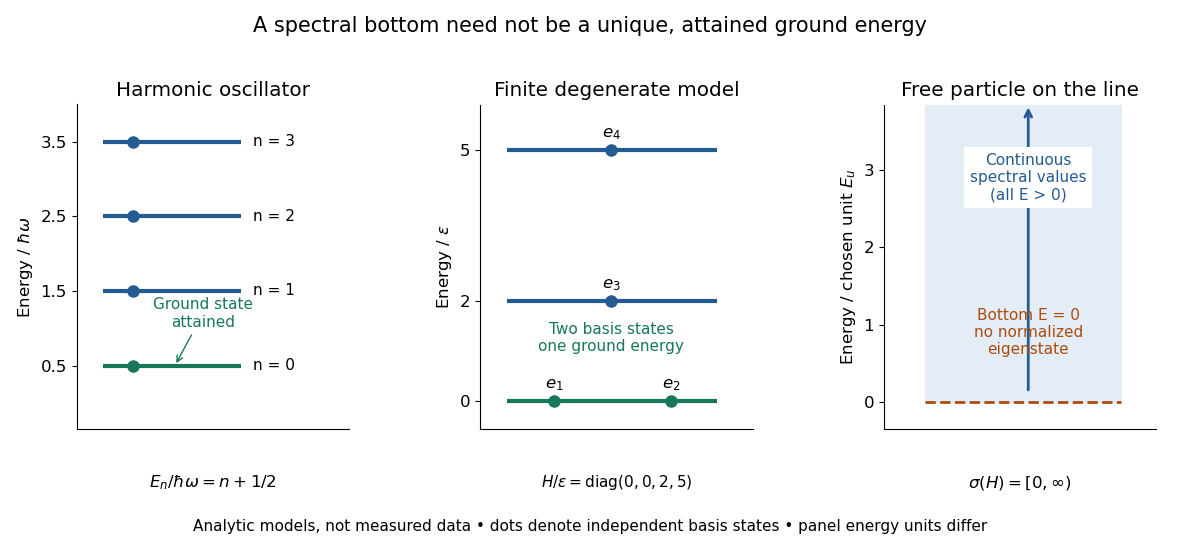
Attained ground energies, ground-state degeneracy, and an unattained spectral bottom
. Exact analytic models, not measured data. The quantum harmonic oscillator has an attained ground-state energy. The finite diagonal matrix has two independent ground states at one energy eigenvalue. The whole-line free particle has continuous spectrum beginning at zero and no normalizable zero-energy energy eigenstate; the shaded interval denotes spectral values, not a collection of normalized energy eigenstates. Each panel uses its own stated energy unit. Details.Ground-state degeneracy matters when an interaction selects or splits previously equal energy eigenvalues. In the finite model, adding with gives the formerly lowest pair the distinct energies , leaving a unique ground state. This direct calculation illustrates why degenerate perturbation theory first examines the perturbation inside the whole ground-state subspace.
A classical continuous-symmetry model can instead have a manifold of minimizing configurations, such as the sphere of orientations of a Néel state in an isotropic Heisenberg antiferromagnet. That geometric description does not by itself count the dimension of a finite quantum ground-state subspace.
The ground-state subspace is the eigenspace of a Hamiltonian operator at its lowest eigenvalue . A computational history state construction can have many valid quantum witnesses, hence a degenerate ground space. Perturbation bounds must optimize on this entire subspace, rather than on a chosen basis of ground states.
For , , , this kernel satisfies . A real-linear change of complex coordinate reduces its derivation to the Cauchy-Green operator; the determinant changes sign at the unit circle. For the operator becomes a real directional transport equation, whose characteristic singularity requires limiting prescriptions. The kernel has at zero and at infinity.
Axisymmetric radiation carries no axial angular momentum by Codex 0 Created 2026-10-06 Updated 2026-10-14
Codex 0 Created 2026-10-06 Updated 2026-10-14An exact axial Killing vector field makes Komar angular momentum independent of the surrounding vacuum surface. Therefore gravitational waves in a configuration with exact axisymmetry carry no net angular momentum about that symmetry axis, although they can carry energy. This is specific to axial angular momentum; it is not an absence of radiation.
Pinned article: Introduction to the OurBigBook Project
Welcome to the OurBigBook Project! Our goal is to create the perfect publishing platform for STEM subjects, and get university-level students to write the best free STEM tutorials ever.
Everyone is welcome to create an account and play with the site: ourbigbook.com/go/register. We belive that students themselves can write amazing tutorials, but teachers are welcome too. You can write about anything you want, it doesn't have to be STEM or even educational. Silly test content is very welcome and you won't be penalized in any way. Just keep it legal!
Intro to OurBigBook
. Source. We have two killer features:
- topics: topics group articles by different users with the same title, e.g. here is the topic for the "Fundamental Theorem of Calculus" ourbigbook.com/go/topic/fundamental-theorem-of-calculusArticles of different users are sorted by upvote within each article page. This feature is a bit like:
- a Wikipedia where each user can have their own version of each article
- a Q&A website like Stack Overflow, where multiple people can give their views on a given topic, and the best ones are sorted by upvote. Except you don't need to wait for someone to ask first, and any topic goes, no matter how narrow or broad
This feature makes it possible for readers to find better explanations of any topic created by other writers. And it allows writers to create an explanation in a place that readers might actually find it.
Figure 1. Screenshot of the "Derivative" topic page. View it live at: ourbigbook.com/go/topic/derivativeVideo 2. OurBigBook Web topics demo. Source. - local editing: you can store all your personal knowledge base content locally in a plaintext markup format that can be edited locally and published either:This way you can be sure that even if OurBigBook.com were to go down one day (which we have no plans to do as it is quite cheap to host!), your content will still be perfectly readable as a static site.
- to OurBigBook.com to get awesome multi-user features like topics and likes
- as HTML files to a static website, which you can host yourself for free on many external providers like GitHub Pages, and remain in full control

Figure 2. You can publish local OurBigBook lightweight markup files to either OurBigBook.com or as a static website.
Figure 3. Visual Studio Code extension installation.
Figure 5. . You can also edit articles on the Web editor without installing anything locally. Video 3. Edit locally and publish demo. Source. This shows editing OurBigBook Markup and publishing it using the Visual Studio Code extension. 
- Infinitely deep tables of contents:



All our software is open source and hosted at: github.com/ourbigbook/ourbigbook
Further documentation can be found at: docs.ourbigbook.com
Feel free to reach our to us for any help or suggestions: docs.ourbigbook.com/#contact