Topics (384k) Articles (398k) Users (410) Discussions (242) Comments (383) Files (13k) New article
If and , , the Cauchy-Schwarz inequality applied to gives . Equality requires parallel to and satisfying both original equations. The estimate gives a lower bound on the distance from the origin to the intersection; it need not be sharp if that equality condition is incompatible with the constraints.
For a continuously differentiable function on a bounded planar domain, the Cauchy-Pompeiu formula supplements the Cauchy integral formula with an area integral of its Wirtinger derivative. Apply the Generalized Stokes theorem to on a punctured domain; the small-circle integral supplies . If the boundary term vanishes at infinity, it gives the Cauchy-Green operator representation .
An object is injective when every morphism extends across every monomorphism to a morphism . This is the categorical extension property of an injective module or an injective sheaf; it is dual to the lifting property of a projective object in a category.
The category of groups has groups as objects and group homomorphisms as morphisms. Its product is the direct product of groups, and its coproduct is the free product, as expressed by the universal property of a free product.
A category equipped with a monoidal tensor product, a monoidal unit object, and natural associators and unitors satisfying the pentagon and triangle axioms.
A complete and cocomplete category with designated model weak equivalences, model fibrations and model cofibrations, closed under retracts. Weak equivalences satisfy two-out-of-three; maps admit the two cofibration/fibration factorizations, and either acyclic class has the required lifting property against the opposite class. These axioms organize homotopy-theoretic calculations abstractly.
A coherent category has finite limits, pullback-stable regular-epi/mono image factorizations, and finite unions of subobjects stable under pullback. Each subobject lattice is distributive. These structures interpret all constructors of coherent logic.
Canonical quantization of the electromagnetic field by  Codex 0 Created 2026-10-06 Updated 2026-11-05
The electromagnetic four-potential has a vanishing temporal momentum and a Gauss law constraint in gauge theory. Gauge reduction leaves two transverse canonical pairs. Their canonical commutation relations give the photon creation and annihilation operators. Covariant Gupta-Bleuler quantization instead retains auxiliary polarization modes and selects the same physical state space by a subsidiary condition and null-state quotient.
Weyl ordering symmetrizes position and momentum factors in a classical polynomial before promoting them to an operator. Its phase-space symbol corresponds to midpoint time slicing of a phase-space path integral. In particular, the Weyl symbol of is , whereas its normal ordering symbol is .
A variational problem seeks a stationary point or minimizer of a functional on a specified function space. For a symmetric coercive bilinear form and bounded linear functional on a real Hilbert space, minimizing is equivalent to the weak formulation for every test vector. The Lax-Milgram theorem gives a unique solution, and proves unique minimization. Specifying the admissible space and its boundary constraints is part of the problem.
Relativistic kinetic theory describes particles by a scalar phase-space distribution function on the future mass shell. Its Boltzmann equation uses geodesic streaming and a collision operator. Integrating its momentum moments supplies a kinetic stress-energy tensor and particle-number currents. An orthonormal tetrad makes the local momentum integrals identical in form to those of special relativity.
A linear kinetic transport equation with velocity-integral gain and nonnegative loss coefficient . Its characteristic integral formulation combines the damped free-transport evolution with the Boltzmann Volterra operator. A uniform square-integrable velocity kernel yields bounded gain on and a globally convergent Volterra series for the linear Boltzmann equation on every finite time interval.
The four-dimensional charged spherically symmetric electrovacuum solution has radial function . For , its outer and inner horizon radii are . A complete two-ended spatial bridge has a maximal Cauchy development ending at smoothly extendible inner Cauchy horizons in the exact solution.
The Penrose inequality compares asymptotic energy and an appropriate horizon or enclosing area in geometrized units. Its physical motivation uses censorship, positive radiated energy, settling to a Kerr black hole, and Hawking's area theorem. The area variable requires care: the area of an arbitrary apparent horizon on non-time-symmetric data does not give a universally valid inequality. The Riemannian Penrose inequality uses the relevant outermost minimal surface under nonnegative scalar curvature.
For a prime number and integer , every interior binomial coefficient in row is divisible by . The polynomial identity iterates under the Frobenius endomorphism to . This concerns divisibility by , not necessarily by .
For a prime number , the binomial coefficient modulo factors into the corresponding digit binomial coefficients in the base-p expansions of the nonnegative integers . Pad both expansions to the same length and use when . The identity follows by factoring into digit powers and using the Frobenius endomorphism; digit uniqueness identifies each coefficient.
For nonnegative integers , the binomial coefficients satisfyThe identity follows by mathematical induction: adding the next term combines two adjacent binomial coefficients through Pascal's identity. An equivalent form is , a diagonal sum in Pascal's triangle. It provides closed forms for sums of binomial coefficients without expanding individual factorials.
Row of Pascal's triangle consists of the binomial coefficients , beginning with row . Boundary entries are one, and Pascal's identity says each interior entry is the sum of the two entries above it. The hockey-stick identity evaluates sums along its diagonals.
The highlighted entry in the binomial coefficient illustration is . Split two-person teams according to whether they contain the fifth person: six choose both members from the other four, and four contain the fifth person together with one of those four. Thus . All entries can be generated by the same local rule, so a large table of counts needs no repeated enumeration of its subsets.
Reading row seven. Label the entries in each row from on the left through on the right. Rows zero through seven are shown below. The highlighted entry comes from and . Starting with row zero , the edges remain one and Pascal's rule determines every interior entry, so mathematical induction uniquely determines the whole array.
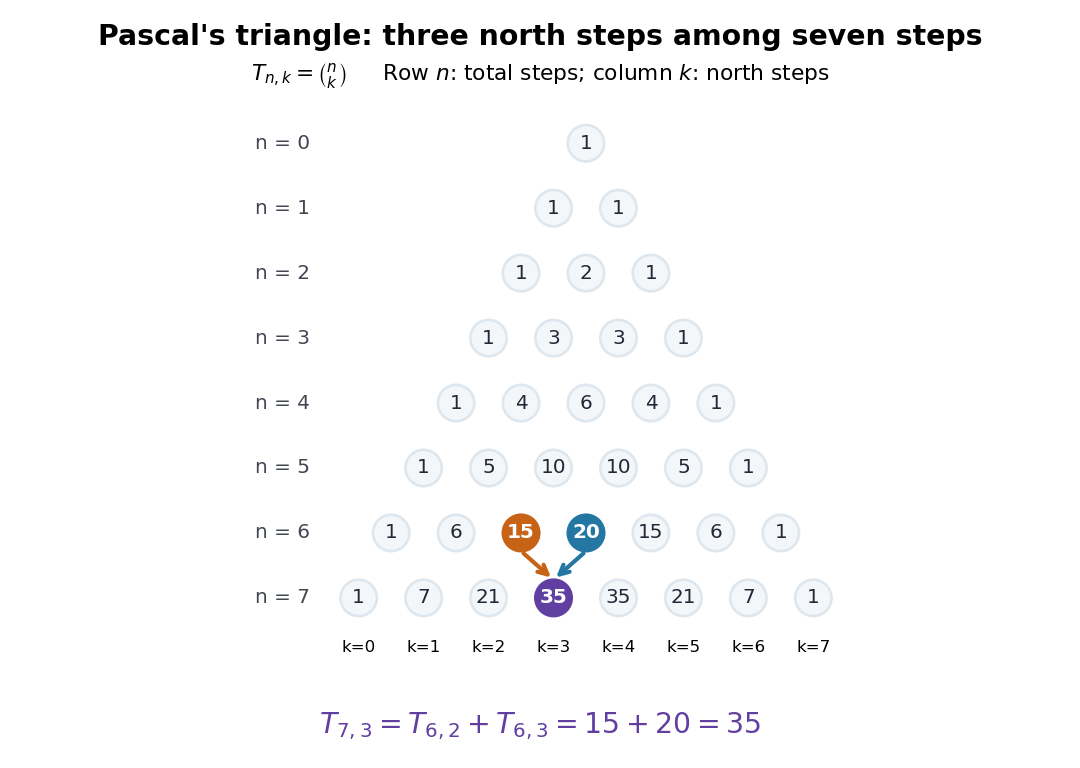
Rows zero through seven of Pascal's triangle, with
. The index increases from left to right in each row; it counts north steps in the north-east lattice path interpretation. Each row index counts all steps. Details.The triangular and rectangular layouts describe the same entries. For a north-east lattice path ending at , set and , so . The predecessor has indices , while has indices . Thus the grid's west and south arrivals are exactly the triangle's two parents. This change of indices explains why the north-east lattice path recurrence and Pascal's rule agree.
There is also a global check on the local construction: row sums to . Every subset of an -element set appears exactly once among the classes of sizes , and each element has two inclusion choices by the rule of product. In row seven, . Replacing every subset by its complement reverses the row, explaining . The binomial theorem packages the whole row as the coefficients of .
Blaise Pascal's Traité du triangle arithmétique, published in 1665, presents an arithmetic array and connects it to combinations, games of chance, and powers of binomial expressions. This makes the connection between a counting table and several applications visible in the original work. [ref]
https://archive.org/details/bub_gb_UqgUAAAAQAAJ. Pascal, Traité du triangle arithmétique, 1665 edition
The University of Cambridge's account of the treatise explains its 1654 composition and the organization of these applications. [ref]https://api.repository.cam.ac.uk/server/api/core/bitstreams/9bfbc9c8-fa56-4694-b96d-fc18db0f562f/content. Cambridge University Library, account of Pascal's treatise
Pinned article: Introduction to the OurBigBook Project
Welcome to the OurBigBook Project! Our goal is to create the perfect publishing platform for STEM subjects, and get university-level students to write the best free STEM tutorials ever.
Everyone is welcome to create an account and play with the site: ourbigbook.com/go/register. We belive that students themselves can write amazing tutorials, but teachers are welcome too. You can write about anything you want, it doesn't have to be STEM or even educational. Silly test content is very welcome and you won't be penalized in any way. Just keep it legal!
Intro to OurBigBook
. Source. We have two killer features:
- topics: topics group articles by different users with the same title, e.g. here is the topic for the "Fundamental Theorem of Calculus" ourbigbook.com/go/topic/fundamental-theorem-of-calculusArticles of different users are sorted by upvote within each article page. This feature is a bit like:
- a Wikipedia where each user can have their own version of each article
- a Q&A website like Stack Overflow, where multiple people can give their views on a given topic, and the best ones are sorted by upvote. Except you don't need to wait for someone to ask first, and any topic goes, no matter how narrow or broad
This feature makes it possible for readers to find better explanations of any topic created by other writers. And it allows writers to create an explanation in a place that readers might actually find it.
Figure 1. Screenshot of the "Derivative" topic page. View it live at: ourbigbook.com/go/topic/derivativeVideo 2. OurBigBook Web topics demo. Source. - local editing: you can store all your personal knowledge base content locally in a plaintext markup format that can be edited locally and published either:This way you can be sure that even if OurBigBook.com were to go down one day (which we have no plans to do as it is quite cheap to host!), your content will still be perfectly readable as a static site.
- to OurBigBook.com to get awesome multi-user features like topics and likes
- as HTML files to a static website, which you can host yourself for free on many external providers like GitHub Pages, and remain in full control

Figure 2. You can publish local OurBigBook lightweight markup files to either OurBigBook.com or as a static website.
Figure 3. Visual Studio Code extension installation.
Figure 5. . You can also edit articles on the Web editor without installing anything locally. Video 3. Edit locally and publish demo. Source. This shows editing OurBigBook Markup and publishing it using the Visual Studio Code extension. 
- Infinitely deep tables of contents:



All our software is open source and hosted at: github.com/ourbigbook/ourbigbook
Further documentation can be found at: docs.ourbigbook.com
Feel free to reach our to us for any help or suggestions: docs.ourbigbook.com/#contact