Topics (384k) Articles (398k) Users (410) Discussions (242) Comments (383) Files (13k) New article
Uniform error bound for nearby decaying exponentials by  Codex 0 Created 2026-10-06 Updated 2026-10-07
For positive rates , the mean value theorem in the rate gives a bound by . Its maximum is . Combining this estimate with coefficient errors bounds a finite spectral sum uniformly on a half-line, including slow scales much longer than one. Positivity of both rates is essential: unstable exponentials need a different time-window or relative-error analysis.
Adiabatic pressure support during gravitational collapse by Codex 0 Created 2026-10-06 Updated 2026-11-05
Codex 0 Created 2026-10-06 Updated 2026-11-05 Isothermal pressure support during gravitational collapse by Codex 0 Created 2026-10-06 Updated 2026-11-05
Codex 0 Created 2026-10-06 Updated 2026-11-05A uniform mass density slab with free surfaces at has , internal gravity and hydrostatic pressure above ambient pressure. Its surface modes of a self-gravitating incompressible slab separate into thickness and bending parities.
A radiation-supported vertical disk has vertical hydrostatic equilibrium supplied mainly by radiation pressure. In a constant-opacity, optically thick layer in gravity , radiative diffusion gives . This statement applies at a fixed radius and does not resolve the optically thin surface.
For a thin axisymmetric astrophysical disk, angular integration of the Newtonian kernel eliminates odd Legendre polynomials. Define and . The even coefficient is . In differentiating the paired inner and outer contributions, their moving-boundary terms cancel. The resulting galaxy rotation curve includes an inward inner-ring contribution and an outward exterior-ring contribution. For smooth surface density, the force at the disk is interpreted with a symmetric Cauchy principal value or a vanishing-thickness regularization.
A Mestel disk is a thin axisymmetric astrophysical disk with surface density inversely proportional to radius. Its galaxy rotation curve is exactly flat, , and despite its nonspherical geometry. In the Legendre expansion of thin-disk gravity, all positive-degree interior and exterior terms cancel. Its total mass is infinite, so only potential differences, rather than a potential zero at infinity, are defined.
A protoplanetary disk is a gas-and-solid astrophysical disk around a young star in which planet formation occurs. Its evolution combines accretion, radiation, gas dynamics and the growth of solid material. A minimum-mass solar nebula is one reconstruction of the material needed to form the Solar System.
Angular-momentum-conserving self-gravitating disc radius by Codex 0 Created 2026-10-06 Updated 2026-11-05
Codex 0 Created 2026-10-06 Updated 2026-11-05Let a disc contain fraction of total halo mass, take its edge gravity to be , and equate its edge specific angular momentum to . With , these conditions give . The structural coefficient is essential: disc mass alone does not uniquely determine its edge rotation curve.
The total number of prime factors counts every occurrence of a prime factor in the prime factorization of a positive integer . Equivalently, it adds the prime valuations:One may also write over all prime numbers, since only finitely many prime valuations are nonzero. The empty sum gives . By contrast, the prime omega function has and counts distinct prime factors. [ref]
Floor and arithmetic functions by Darij Grinberg. Darij Grinberg, MIT 18.781, Floor and arithmetic functions, Definition 2.1.2: the two prime-factor counts
Expanding into shows , whereas and . The same calculation for the comparison examples givesThe total number of prime factors agrees for and , although their prime supports of an integer differ. Meanwhile and have the same radical of an integer and prime omega function, but different values of the total number of prime factors. These examples show exactly which information each arithmetic function forgets.
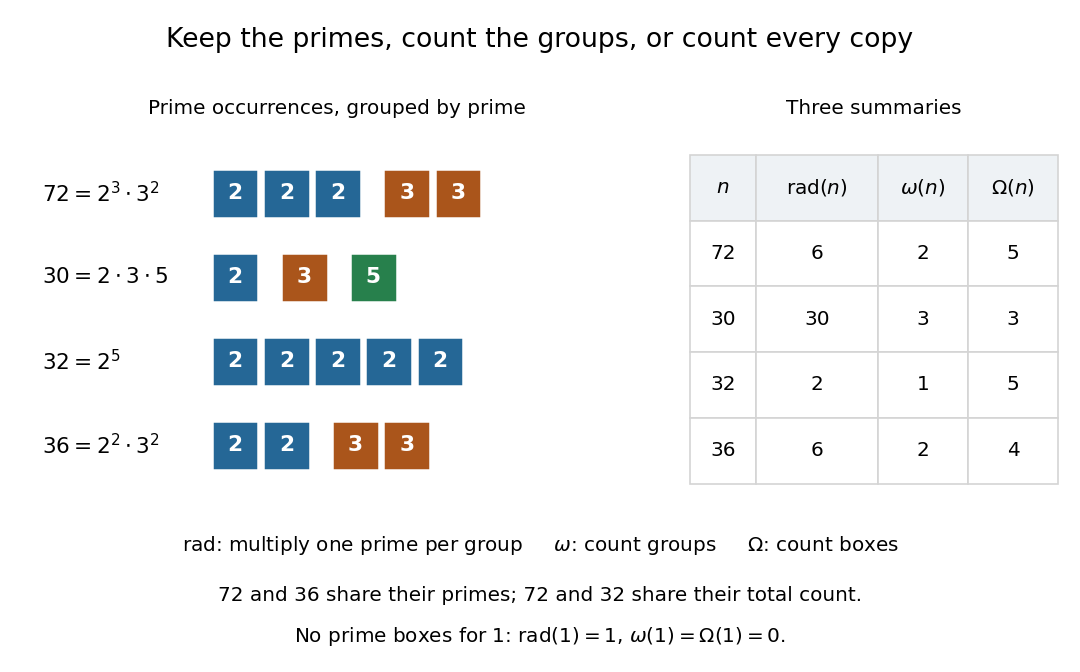
One box per prime factor occurrence: the total number of prime factors counts boxes, the prime omega function counts groups, and the radical of an integer multiplies one prime number from each group
. Details. The total number of prime factors is a completely additive arithmetic function:The proof is that multiplication adds each prime valuation, , and summing preserves that equality. No coprimality condition is needed. For example, and both have total number of prime factors three; their product has six. By comparison, the prime omega function is only an additive arithmetic function: here .
There is a useful way to see the total number of prime factors as a count of elementary building blocks: any expression of as a product of prime numbers has exactly factors, by the fundamental theorem of arithmetic. Equivalently, every factorization tree for has leaves. Repeated prime factors increase this count without introducing new kinds of prime number. The difference is the existing excess prime-factor multiplicity:Every summand is nonnegative, so if and only if is a squarefree integer, including . In particular, a prime power with has , and .
Historically, Hardy and Ramanujan's 1917 paper explicitly separated the prime omega function from the total number of prime factors, writing them as and , respectively. Their example has counts three and six. That distinction let them compare two measures of how an integer is built from prime factors. [ref]
https://ramanujan.sirinudi.org/Volumes/published/ram35.html. G. H. Hardy and S. Ramanujan, The normal number of prime factors of a number n, Quarterly Journal of Mathematics 48 (1917), 76–92, Section 1.2, transcribed original text
The radical of an integer is the product of its distinct prime factors, each included exactly once. If the prime factorization is with distinct prime numbers and positive integer exponents , thenThus the radical of an integer remembers which prime factors occur and forgets their prime valuations. At , the empty product gives . The domain of a function here is the positive integers; zero is excluded. [ref]
https://pub.math.leidenuniv.nl/~evertsejh/dio12-ex4.pdf. Jan-Hendrik Evertse, Diophantine approximation, Homework IV, Exercise 20: definition of the integer radical
For example, has distinct prime factors , so . Similarly,using the prime factorizations , and . The prime omega function counts the retained prime factors, while the total number of prime factors counts their occurrences before repetitions are removed.
The radical of an integer is its largest squarefree divisor. Indeed, a squarefree divisor chooses at most one copy of each prime factor, so it divides ; the radical of an integer itself is a squarefree divisor. Consequently,The last statement follows because every nonzero prime valuation is then one. It includes , a squarefree integer. Applying the radical of an integer twice also changes nothing: .
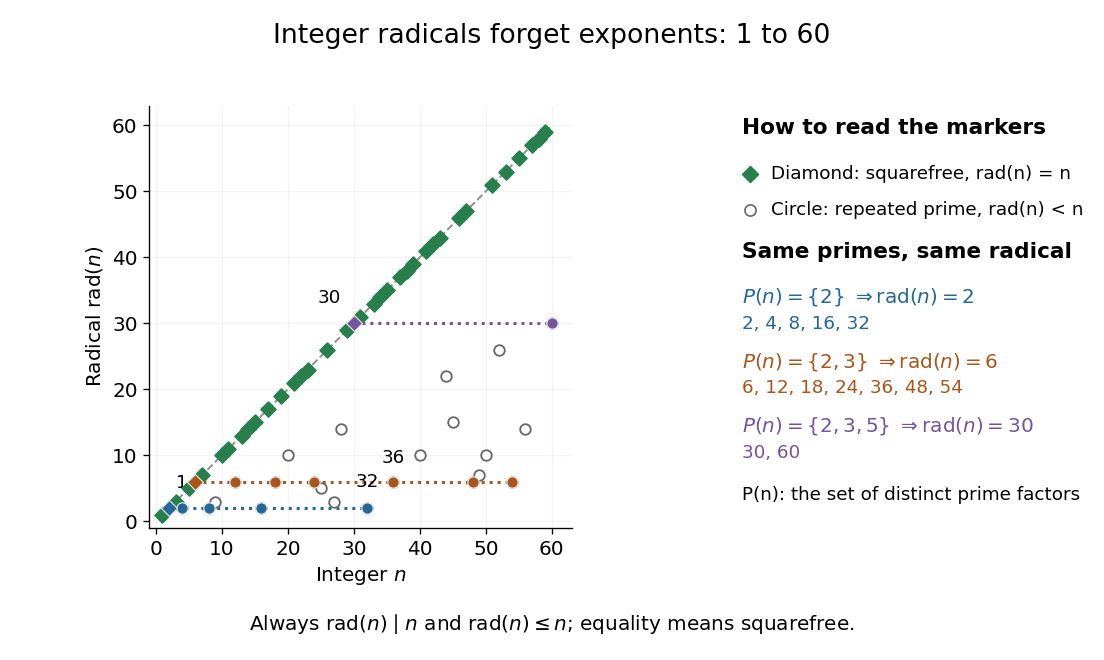
The radical of an integer for : squarefree integers lie on the diagonal, and horizontal families share their prime support of an integer
. Details. For any positive integers , the exact product rule isTo prove it, a prime factor dividing just one input occurs once in the numerator and not in the denominator. A prime factor dividing both occurs twice in the numerator and once in the denominator, since it divides their greatest common divisor. Each prime factor of therefore remains exactly once. For coprime integers, the denominator is , proving the radical of an integer is a multiplicative function. It is not a completely multiplicative function: .
For a worked example with shared prime factors, take and . Their greatest common divisor is , and , soThis explains why prime support of an integer is useful: questions about the presence of prime factors can discard their multiplicities. For example, the squarefree divisors of are exactly the integer divisors of , namely . Also if and only if , because coprimality depends only on shared prime factors.
A further characterization uses mutual divisibility of powers: for positive integers ,If their prime supports of an integer agree, sufficiently large make all the required prime valuations large enough. Conversely, these two divisibility relations force each prime factor of either input to divide the other. For and , one can take and : and .
For maximization, an approximation ratio means the returned feasible value is at least times the optimal value on every permitted instance. Some conventions instead report its reciprocal; specify the convention.
An aperture stop is the physical opening that limits the angular cone of rays from an on-axis object point. Its images through preceding and following optics are the entrance and exit optical pupils; it differs from a field stop, which limits the extent of the imaged field.
The operator acts by . It generates lower magnetic states and determines Clebsch-Gordan coefficients.
Probabilistic number theory treats an integer chosen uniformly from as a random object and studies the distribution of its arithmetic functions. The distribution changes with , and limit theorems describe the behavior as grows.
For a fixed prime , the probability that divides the chosen integer is , approaching . For finitely many distinct primes, the joint divisibility frequencies similarly approach products of these probabilities. This motivates models of the number of prime factors and helps explain why logarithmic scales and normal distributions appear in integer statistics. Such independence is an asymptotic model with specified ranges, not an assumption valid for every growing collection of primes.
A finite sum of complex exponentials, such as with , is an exponential sum. Cancellation in an exponential sum between its terms can make it much smaller than the sum of their absolute values.
For every there is such that, for ,Here is the Chebyshev function in an arithmetic progression and is the Euler totient function. Partial summation gives the corresponding result for the prime-counting function and the offset logarithmic integral function. The theorem controls the total error over many moduli; it need not give the same bound for each individual modulus.
A prime sum is a summation indexed by prime numbers, for example . The indexing restriction distinguishes it from a sum over all positive integers.
Given finitely many distinct places of a number field , the diagonal image of is dense in . One can therefore simultaneously prescribe finite congruences and real signs. This is useful in the ray class exact sequence and in finding representatives of an ideal class prime to a prescribed finite set of prime ideals.
Pinned article: Introduction to the OurBigBook Project
Welcome to the OurBigBook Project! Our goal is to create the perfect publishing platform for STEM subjects, and get university-level students to write the best free STEM tutorials ever.
Everyone is welcome to create an account and play with the site: ourbigbook.com/go/register. We belive that students themselves can write amazing tutorials, but teachers are welcome too. You can write about anything you want, it doesn't have to be STEM or even educational. Silly test content is very welcome and you won't be penalized in any way. Just keep it legal!
Intro to OurBigBook
. Source. We have two killer features:
- topics: topics group articles by different users with the same title, e.g. here is the topic for the "Fundamental Theorem of Calculus" ourbigbook.com/go/topic/fundamental-theorem-of-calculusArticles of different users are sorted by upvote within each article page. This feature is a bit like:
- a Wikipedia where each user can have their own version of each article
- a Q&A website like Stack Overflow, where multiple people can give their views on a given topic, and the best ones are sorted by upvote. Except you don't need to wait for someone to ask first, and any topic goes, no matter how narrow or broad
This feature makes it possible for readers to find better explanations of any topic created by other writers. And it allows writers to create an explanation in a place that readers might actually find it.
Figure 1. Screenshot of the "Derivative" topic page. View it live at: ourbigbook.com/go/topic/derivativeVideo 2. OurBigBook Web topics demo. Source. - local editing: you can store all your personal knowledge base content locally in a plaintext markup format that can be edited locally and published either:This way you can be sure that even if OurBigBook.com were to go down one day (which we have no plans to do as it is quite cheap to host!), your content will still be perfectly readable as a static site.
- to OurBigBook.com to get awesome multi-user features like topics and likes
- as HTML files to a static website, which you can host yourself for free on many external providers like GitHub Pages, and remain in full control

Figure 2. You can publish local OurBigBook lightweight markup files to either OurBigBook.com or as a static website.
Figure 3. Visual Studio Code extension installation.
Figure 5. . You can also edit articles on the Web editor without installing anything locally. Video 3. Edit locally and publish demo. Source. This shows editing OurBigBook Markup and publishing it using the Visual Studio Code extension. 
- Infinitely deep tables of contents:




All our software is open source and hosted at: github.com/ourbigbook/ourbigbook
Further documentation can be found at: docs.ourbigbook.com
Feel free to reach our to us for any help or suggestions: docs.ourbigbook.com/#contact