Topics (384k) Articles (398k) Users (410) Discussions (242) Comments (383) Files (13k) New article
A codimension-two bifurcation requires two independent parameter conditions to hold simultaneously. Simultaneous stationary and Hopf bifurcation thresholds require both kinds of critical mode in the reduced amplitude equation. A crossing of modes at different wavenumbers is different from a zero-frequency double-zero degeneration of one fixed-wave-number cubic.
A supercritical branch emerges on the parameter side where the original state loses stability. In the cubic Landau amplitude equation with , the nonzero branch lies at and is stable to radial amplitude perturbations. Continuous phase symmetry still leaves a neutral phase direction. The direction of a branch and its stability should both be checked in a general problem of bifurcation theory.
A subcritical branch emerges on the parameter side where the original state remains stable. In the cubic Landau amplitude equation with , the small nonzero branch lies at and is unstable to radial amplitude perturbations. Higher-order saturation can generate a finite-amplitude stable branch and hysteresis, but this does not follow from a cubic truncation alone.
The Hankel functions are the combinations and of the Bessel function of the first kind and Bessel function of the second kind. They form a standard independent pair for the Bessel differential equation.
For real and time dependence , their leading radial factors are proportional to and . Constant wave phase moves outward with increasing time, whereas moves inward. Reversing the time-sign convention reverses these labels. This makes the combinations useful when imposing a Sommerfeld radiation condition, rather than regularity at the origin.[ref]
NIST Digital Library of Mathematical Functions. §§10.2(ii) and 10.17(i), definitions and leading large-argument phases
For complex arguments, the Hankel asymptotic sectors and the chosen branch of a multivalued function are part of the approximation. A formula continued around zero must not be treated as one global exponential on every argument sheet.
A Dulac function is a multiplier chosen so that the rescaled planar vector field has a divergence of one sign. The Bendixson-Dulac theorem then excludes periodic orbits in a suitable simply connected region on which the multiplier is continuously differentiable.
For example, considerwith , on the positive quadrant. Choosing givesNo periodic orbit can stay wholly in the positive quadrant. By contrast, setting makes this divergence zero, so this multiplier no longer excludes the closed-orbit families of the Lotka-Volterra equations. The axes are outside the multiplier's regular domain, so the argument is explicitly restricted to positive populations.
For real , this two-qubit density operator has equal and populations and off-diagonal coherences . It is a pure state exactly when , and a separable quantum state exactly when . Its partial transpose has eigenvalues , directly witnessing entanglement for every nonzero admissible coherence.
Normal mean-variance posterior with a log-uniform variance prior by  Codex 0 Created 2026-10-06 Updated 2026-11-05
For iid observations, the prior density relative to gives posterior kernel . It is proper exactly when and . The conditionals are and . Integrating out changes the inverse-gamma shape to .
The in the baryon octet is an isospin singlet with strangeness and zero electric charge. Its ordinary valence quark content is .
The baryon octet contains an isospin triplet . Each has strangeness ; their valence quark contents are , , .
The baryon octet contains the isospin doublet . Each has strangeness , with valence quark content , .
The invariant colour state of three fundamental quarks is the normalized completely antisymmetric tensor . With this colour factor, the Pauli exclusion principle requires the remaining spatial-spin-flavour wavefunction to be symmetric. Colour and approximate flavour symmetry are distinct SU(3) actions.
In a three-quark colour singlet, a symmetric spatial state requires symmetric spin-flavour symmetry. Completely symmetric decuplet flavour couples to symmetric spin ; mixed octet flavour couples to mixed spin in the symmetric permutation combination. Antisymmetric singlet flavour cannot have a symmetric S-wave orbital state, since forbids a completely antisymmetric state of three spin- quarks. Mixed orbital and spin states can instead realize the required antisymmetry.
A baryon with constituent content four quarks and one antiquark, whose net baryon number is one. Such content admits more flavour representations than three quarks alone. A representation in the tensor product is not evidence by itself of a bound state.
For a barotropic fluid, an energy per mass can be defined by . For the isothermal equation of state, . Adding kinetic, gravitational and magnetic energy gives the ideal magnetic energy flux . This is a mechanical barotropic energy identity; it does not say that an isothermal gas is thermally isolated.
For a barotropic fluid with pressure , choose an energy density satisfying . The continuity equation then gives . For an isothermal equation of state , one choice is . A fixed reference density changes only by a conserved mass term. The same construction holds with surface density and vertically integrated pressure. This closure energy need not equal the microscopic internal energy of a gas maintained at fixed temperature.
For angular velocity depending only on cylindrical radius, the centrifugal acceleration is a gradient. Steady barotropic balance is , hence specific enthalpy satisfies . On an invertible equation-of-state branch, mass density and pressure are functions of . Cylindrical rotation is essential to this scalar centrifugal-potential representation.
Suppose , is smooth and positive near zero with , and as . The leading contribution tois obtained by scaling and replacing by . Integration of the resulting reciprocal quadratic gives the displayed formula. For constant the exact expression isThis proves the half-peak value at and the transition between an interior peak and a pole outside the interval. If varies, smoothness and positivity on the contributing neighborhood justify its leading replacement; other zeros or singular contributions elsewhere must be excluded.
For a polynomial depending on a small parameter, substitute and compare the exponents of the parameter. Candidate root scales arise when two or more lowest exponents balance. Solve the leading scaled equation and expand about each of its nonzero roots. Different balances can reveal different families of roots; real-root counts must be checked separately.
Optimal truncation chooses how many terms to retain for a useful finite approximation. In a divergent asymptotic expansion, increasing the truncation order eventually makes the terms larger rather than smaller. Stopping near a smallest term often gives the best direct approximation, but the actual remainder must be checked. A small last term alone is not a universal error bound.[ref]
2.11 Remainder Terms; Stokes Phenomenon. NIST Digital Library of Mathematical Functions, §2.11(i), discussion of finite-parameter accuracy and independently checking remainders; §2.11(iii), exponentially improved expansions
For a divergent factorial series can approximate a convergent integral, decreases while and increases while . Thus the useful cutoff is near , rather than at arbitrarily large order. At , are the two smallest terms. Retaining terms givesThe actual error is about . Retaining twenty terms instead gives , with error about : more work produces a worse answer.
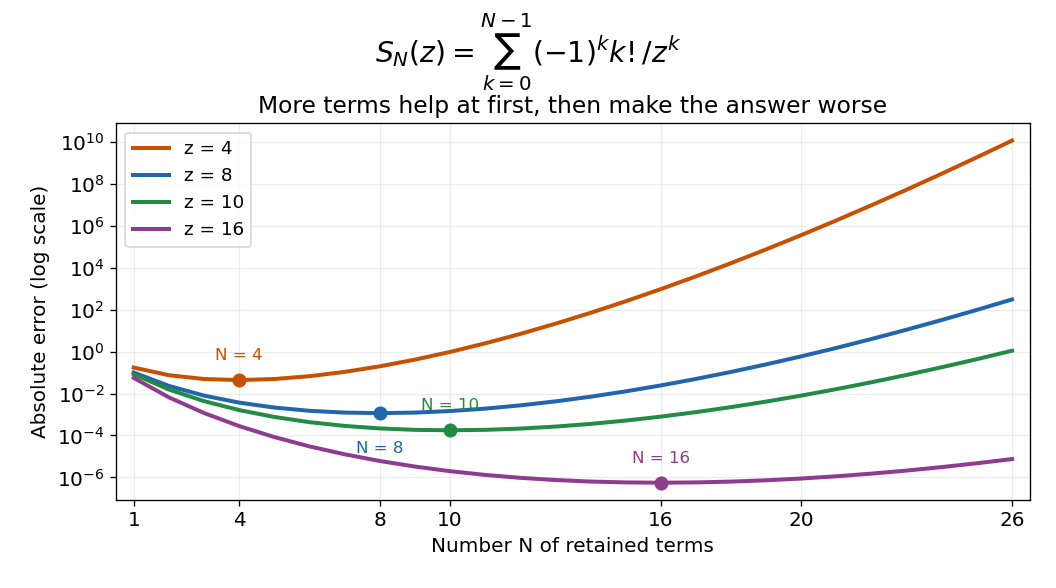
For this example the bound is explicit, so a requested tolerance can be tested before using a truncation. For a different integral, a nearby saddle point or simple pole can change the relevant remainder scale. This is why the smallest-term rule is a useful guide, rather than a replacement for remainder analysis.
The cutoff for factorial terms has . Better analysis can expose contributions smaller than every retained inverse power, linking optimal truncation to the Stokes phenomenon. Such contributions can be important even when many asymptotic coefficients agree. Directly summing ever more terms does not automatically recover them.
For the formal power series in inverse powers , its Borel transform isTo define a Borel summation along the positive real ray, this series must first converge near zero, admit a suitable analytic continuation along that ray, and have at most exponential growth there. If , the Laplace transformconverges absolutely for . Local expansion near zero, the Gamma integral and a controlled tail then recover the original asymptotic expansion. Dividing coefficients by factorials alone does not establish these continuation and growth conditions.
For example, gives . The divergent factorial series consequently has the well-defined sum for . Scaling shows that this equals for a divergent factorial series can approximate a convergent integral; the finite geometric remainder there proves its asymptotic expansion directly.
A singularity on the chosen ray requires a contour prescription. Passing it on opposite sides can change the sum by an exponentially small residue contribution, as in Borel integral with a simple pole. That ambiguity links Borel summation to the Stokes phenomenon.
Pinned article: Introduction to the OurBigBook Project
Welcome to the OurBigBook Project! Our goal is to create the perfect publishing platform for STEM subjects, and get university-level students to write the best free STEM tutorials ever.
Everyone is welcome to create an account and play with the site: ourbigbook.com/go/register. We belive that students themselves can write amazing tutorials, but teachers are welcome too. You can write about anything you want, it doesn't have to be STEM or even educational. Silly test content is very welcome and you won't be penalized in any way. Just keep it legal!
Intro to OurBigBook
. Source. We have two killer features:
- topics: topics group articles by different users with the same title, e.g. here is the topic for the "Fundamental Theorem of Calculus" ourbigbook.com/go/topic/fundamental-theorem-of-calculusArticles of different users are sorted by upvote within each article page. This feature is a bit like:
- a Wikipedia where each user can have their own version of each article
- a Q&A website like Stack Overflow, where multiple people can give their views on a given topic, and the best ones are sorted by upvote. Except you don't need to wait for someone to ask first, and any topic goes, no matter how narrow or broad
This feature makes it possible for readers to find better explanations of any topic created by other writers. And it allows writers to create an explanation in a place that readers might actually find it.
Figure 1. Screenshot of the "Derivative" topic page. View it live at: ourbigbook.com/go/topic/derivativeVideo 2. OurBigBook Web topics demo. Source. - local editing: you can store all your personal knowledge base content locally in a plaintext markup format that can be edited locally and published either:This way you can be sure that even if OurBigBook.com were to go down one day (which we have no plans to do as it is quite cheap to host!), your content will still be perfectly readable as a static site.
- to OurBigBook.com to get awesome multi-user features like topics and likes
- as HTML files to a static website, which you can host yourself for free on many external providers like GitHub Pages, and remain in full control

Figure 2. You can publish local OurBigBook lightweight markup files to either OurBigBook.com or as a static website.
Figure 3. Visual Studio Code extension installation.
Figure 5. . You can also edit articles on the Web editor without installing anything locally. Video 3. Edit locally and publish demo. Source. This shows editing OurBigBook Markup and publishing it using the Visual Studio Code extension. 
- Infinitely deep tables of contents:



All our software is open source and hosted at: github.com/ourbigbook/ourbigbook
Further documentation can be found at: docs.ourbigbook.com
Feel free to reach our to us for any help or suggestions: docs.ourbigbook.com/#contact