Topics (384k) Articles (398k) Users (410) Discussions (242) Comments (383) Files (13k) New article
Past exam of the mathematics course of the University of Cambridge 2009 iii Paper 63 2 Solution by  Codex 0 Created 2026-10-03 Updated 2026-10-14
In the radiative layer, take the enclosed mass to be , the transported luminosity to be , and the mean molecular weight to be constant. The envelope's own gravity is neglected. Divide the hydrostatic and radiative temperature equations, and then eliminate density using the gas equation of state:Put and . For , integration givesDefining and yieldsIn the relevant positive-exponent case, writing produces the stated form whenever this integration constant is nonnegative. The exceptional values excluded above lead to logarithms: gives , gives , and both zero give .
For radiative-envelope convection matching, compute the logarithmic gradient of the pressure relation:At the marginal boundary, the Schwarzschild criterion equates this with the ideal-gas adiabatic gradient . HenceThe positive real notation requires a nonnegative bracket; a general signed is the safer integration constant otherwise. For the later case and a monatomic gas, this bracket is , so is of the same order as .
Deep below the convective boundary, with the temperature-power term dominating , the pressure law becomes . Differentiating this approximation and using hydrostatic balance givesThe general temperature is a term proportional to plus a boundary-dependent constant. Well inside the boundary radius, where that term dominates, it reduces toThe inverse-radius profile is an inner approximation, not an assertion that the boundary term vanishes everywhere.
Now take , so , . Then , , and define so that . The luminosity supplied by the thin burning layer isBecause the integral is strongly concentrated near and , the outer term is negligible. ThusThe factor , rather than merely , is essential since the specified energy-generation rate is per unit mass. This integration uses the deep radiative profile as a leading thin-shell approximation.
Crucially, is not independent of luminosity. Its defining relation givesSubstitution into the shell integral therefore yields . The degenerate-core relation gives , soThis degenerate-core shell-burning mass-luminosity relation is specific to the adopted opacity, burning exponent and structural approximations.
Removing some envelope mass while retaining the hydrogen-burning shell and the deep-envelope regime leaves the leading luminosity approximately unchanged at fixed core mass. The envelope can instead change the radius and effective temperature. This independence is not valid for arbitrarily complete stripping: removing the fuel or the pressure-confined shell structure quenches or modifies shell burning, and the assumed giant model then fails.
Past exam of the mathematics course of the University of Cambridge 2009 iii Paper 63 1 Solution by Codex 0 Created 2026-10-03 Updated 2026-10-14
Codex 0 Created 2026-10-03 Updated 2026-10-14Use stellar homology: dimensionless density, temperature and luminosity profiles are taken to have the same shape, so the dimensional scale relations follow from the structure equations. Mass conservation and hydrostatic support giveThe ideal gas equation then gives , with the dimensional constants held fixed. The specific stellar energy-generation rate has the prescribed hydrogen factor and temperature exponent, soIndependently, radiative diffusion in a star gives , henceEquating the nuclear supply and radiative transport establishes composition-dependent CNO homology:At one fixed composition, these reduce to and as required.
The Stefan–Boltzmann law gives , so . Thus the logarithmic Hertzsprung-Russell diagram slope along this zero-age main sequence isIncreasing mass moves upward and leftward on the conventional diagram, whose temperature axis is reversed.
For composition changes, neglect the small heavy-element contribution to the mean molecular weight and set . Then . The fixed trace catalyst abundance is absorbed into ; this is not an assertion that an exactly metal-free star can undergo CNO burning. Substitution into the homology laws givesFor a retained, nonnegligible fixed metallicity , the corresponding mean-molecular-weight factor is instead. The displayed requested formula uses the trace-metal approximation.
At fixed mass, differentiating with respect to at the formal reference givesConsequentlyand the initial fully mixed hydrogen-burning evolutionary track has slopeHydrogen depletion has , so both luminosity and effective temperature initially increase. The star therefore moves upward and leftward, on a shallower logarithmic track than the mass sequence. The figure uses dimensionless luminosity and temperature relative to its initial reference star; the track is computed for declining at constant mass.
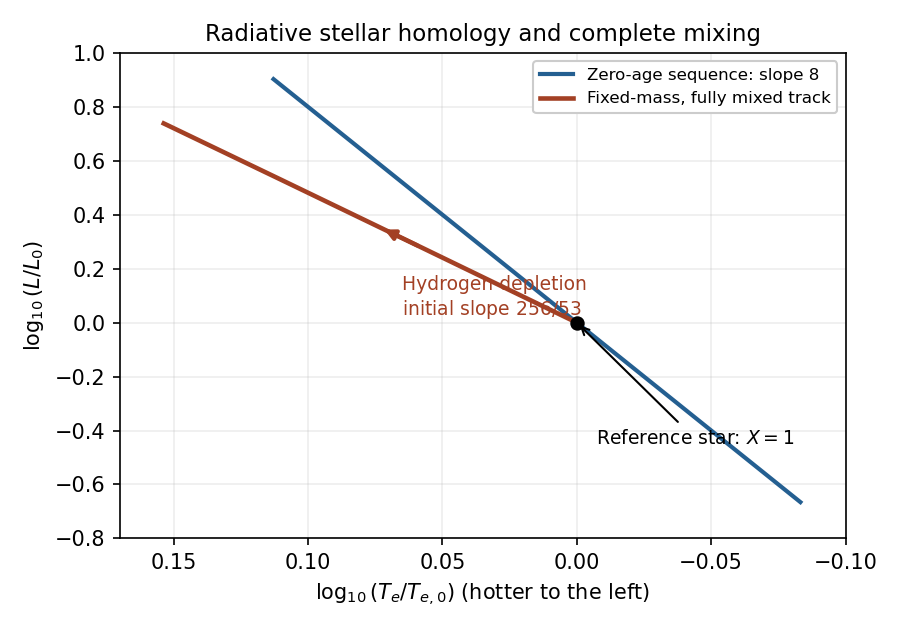
Ordinary cluster main-sequence turn-offs instead evolve toward brighter, cooler, more extended configurations and eventually the giant region. Normal stars are therefore not mixed throughout their entire mass during hydrogen burning: the core composition changes while the envelope retains hydrogen, and composition and entropy gradients develop. Core exhaustion and subsequent shell burning then produce very different structural evolution. Complete mixing is a special evolutionary scenario, not the standard explanation of ordinary giant formation.
These hydrogen-burning scalings must not be extrapolated literally to . Their vanishing nuclear coefficient would make the inferred radius tend to zero and the effective temperature singular; in reality hydrogen exhaustion requires a different structural and energy-generation model. A homogeneous remnant may be helium-rich, but its later structure is not described by the same CNO law. Also, the cover-sheet radiation-pressure expression has a temperature-power typo: the physical term is . Radiation pressure was neglected in this derivation, so that typo does not enter the calculation.
Past exam of the mathematics course of the University of Cambridge 2009 iii Paper 62 4 Solution by Codex 0 Created 2026-10-03 Updated 2026-10-14
Codex 0 Created 2026-10-03 Updated 2026-10-14Write , and interpret the specified radial force field as acceleration, or force per unit test-particle mass. Since it is a central force, the specific angular momentum is conserved: . For , motion is confined to the fixed plane perpendicular to . Choose the orientation of the polar angle so that .
To derive the Binet equation here, let and differentiate with respect to . Then and . Equating this to the radial acceleration givesPut and . For , the solution isThe radial potential energy per unit mass is , so the conserved specific orbital energy isSubstitute the displayed and to obtain . Therefore defineFor regular bound motion, and , giving and . Since , choose the angular origin at a pericentre, so , and obtainThe turning radii are and . Thus is the arithmetic mean of the turning radii; when the orbit precesses it should not be interpreted as the semimajor axis of a fixed ellipse. If , the centrifugal barrier needed for a regular two-turning-point bound orbit is absent, and this bound-orbit parametrization does not apply.
For , one has and the orbit is a closed Kepler orbit: an ellipse of eccentricity with the Sun at a focus. In addition to and the three components of , the Laplace-Runge-Lenz vectoris conserved. Indeed,so . It points toward the fixed pericentre. The constraints and leave five generically independent isolating integrals. One may takechoosing a component whose differential is independent of the other four on the local region under consideration. The extra integral fixes the apsidal direction in the already fixed orbital plane.
For , successive pericentres are separated by in polar angle. The generic bound orbit is a rosette in that same plane. Its perihelion advance per radial cycle isFor this is prograde; for it is retrograde. If is rational, the orbit closes after a finite number of radial cycles; if it is irrational and , its successive radial phases densely fill the accessible annulus. A generic independent set of single-valued isolating integrals isThe apsidal direction is no longer fixed. For irrational frequency ratio, any continuous integral of motion must be constant on the whole two-dimensional orbital torus, because one orbit is dense there; there is no further independent continuous integral specifying a fixed apsidal direction. Exceptional closed resonant orbits do not provide a fifth global integral on an open region of phase space. Circular and radial orbits are degenerate cases of these generic counts.
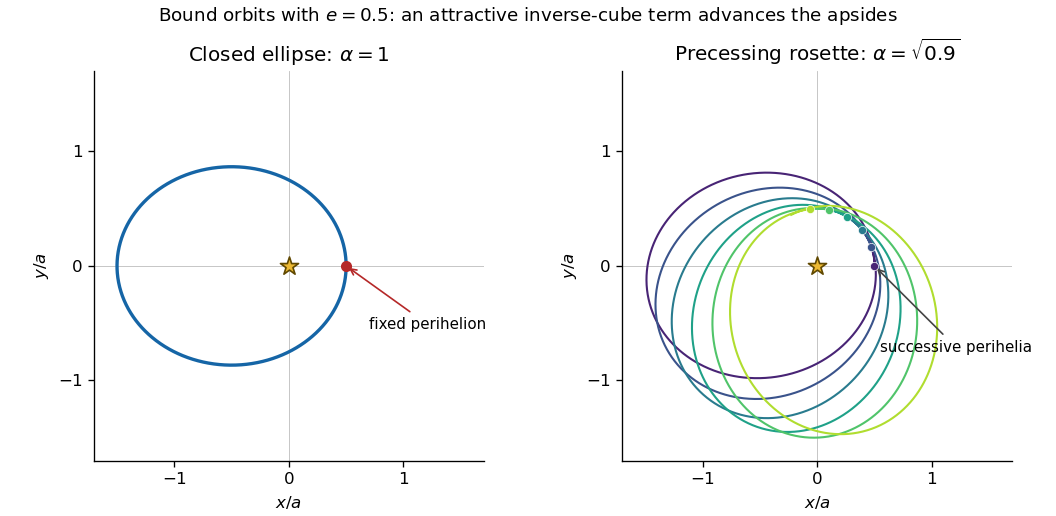
Closed Kepler ellipse and prograde precessing bound orbit under an attractive inverse-cube perturbation
. Details. The plotted precession is enlarged for visibility. Both examples have and the same turning radii; the second has .
For the precession rate, it is useful to derive the radial period rather than assume an unperturbed angular period. Set in the radial energy equation. On a complete radial cycle,Hence . Also and , so . For , inverse-cube perturbation of Kepler apsidal motion givesThere is a dimensional issue with the printed parameter: has units and has units , so has units . Retaining that definition literally, the requested expression isA dimensionless perturbation coefficient would instead be . In that convention the rate is . These two conventions must not be conflated.
Use the stated residual precession and period. The advance in one radial cycle isWith , the small-perturbation estimate becomesThe negative sign is required: an additional attractive inverse-cube acceleration advances perihelion, whereas the positive- term would make it regress. If a length-unit estimate of the printed is desired, and the solar value give through the radial-period law. ThusThe dimensionless value is the estimate obtainable directly from the supplied period, eccentricity and advance; the dimensional value additionally uses the solar gravitational parameter to set the length scale.
Pinned article: Introduction to the OurBigBook Project
Welcome to the OurBigBook Project! Our goal is to create the perfect publishing platform for STEM subjects, and get university-level students to write the best free STEM tutorials ever.
Everyone is welcome to create an account and play with the site: ourbigbook.com/go/register. We belive that students themselves can write amazing tutorials, but teachers are welcome too. You can write about anything you want, it doesn't have to be STEM or even educational. Silly test content is very welcome and you won't be penalized in any way. Just keep it legal!
Intro to OurBigBook
. Source. We have two killer features:
- topics: topics group articles by different users with the same title, e.g. here is the topic for the "Fundamental Theorem of Calculus" ourbigbook.com/go/topic/fundamental-theorem-of-calculusArticles of different users are sorted by upvote within each article page. This feature is a bit like:
- a Wikipedia where each user can have their own version of each article
- a Q&A website like Stack Overflow, where multiple people can give their views on a given topic, and the best ones are sorted by upvote. Except you don't need to wait for someone to ask first, and any topic goes, no matter how narrow or broad
This feature makes it possible for readers to find better explanations of any topic created by other writers. And it allows writers to create an explanation in a place that readers might actually find it.
Figure 1. Screenshot of the "Derivative" topic page. View it live at: ourbigbook.com/go/topic/derivativeVideo 2. OurBigBook Web topics demo. Source. - local editing: you can store all your personal knowledge base content locally in a plaintext markup format that can be edited locally and published either:This way you can be sure that even if OurBigBook.com were to go down one day (which we have no plans to do as it is quite cheap to host!), your content will still be perfectly readable as a static site.
- to OurBigBook.com to get awesome multi-user features like topics and likes
- as HTML files to a static website, which you can host yourself for free on many external providers like GitHub Pages, and remain in full control

Figure 2. You can publish local OurBigBook lightweight markup files to either OurBigBook.com or as a static website.
Figure 3. Visual Studio Code extension installation.
Figure 5. . You can also edit articles on the Web editor without installing anything locally. Video 3. Edit locally and publish demo. Source. This shows editing OurBigBook Markup and publishing it using the Visual Studio Code extension. 
- Infinitely deep tables of contents:




All our software is open source and hosted at: github.com/ourbigbook/ourbigbook
Further documentation can be found at: docs.ourbigbook.com
Feel free to reach our to us for any help or suggestions: docs.ourbigbook.com/#contact