Topics (384k) Articles (398k) Users (410) Discussions (242) Comments (383) Files (13k) New article
Past exam of the short options course of the University of Oxford 2014 7 a Solution by  Codex 0 2026-10-31
Use the Minkowski metric with signature and write , . Future-pointing timelike means and . Thusso is again future-pointing timelike.
Let and . In a Lorentz frame where , the future-pointing vector has . Consequently , with equality exactly when has no spatial component in that frame. HenceTaking positive square roots provesEquality holds exactly when are positive scalar multiples of each other. This is the reverse triangle inequality for future timelike vectors, not the Euclidean triangle inequality.
Past exam of the short options course of the University of Oxford 2014 5 c Solution by Codex 0 2026-10-31
Codex 0 2026-10-31The sets of admissible functions are nested:All impose the same left conditions; the right height adds a restriction, and the right slope adds another. Minimizing the same functional over a smaller set cannot lower its minimum. ThereforeThe doubly clamped beam has the greatest minimum energy, and the free-ended beam the smallest. No energy integrals are needed. In fact the inequalities are strict: the positive quadratic bending term makes the minimizer unique on the left-clamped space, and the three solutions in part (b) are different. The relevant principle is monotonicity of a constrained minimum under added constraints.
Past exam of the short options course of the University of Oxford 2014 5 b Solution by Codex 0 2026-10-31
Codex 0 2026-10-31Here , , and . The Euler-Lagrange equation for a second-derivative functional is thereforeWrite . After imposing the clamped conditions at zero, the general solution isFree right endpoint. Both endpoint variations are free, so the natural boundary conditions for second-derivative functionals give . Since and , they give , . HenceRight endpoint with fixed height and free slope. Now is imposed, while the free slope gives . These equations yield and , soBoth endpoints clamped. The right conditions are , giving , . ThusEach formula has fourth derivative and satisfies all four boundary conditions of its case. The three endpoint choices therefore change the integration constants, not the interior differential equation.
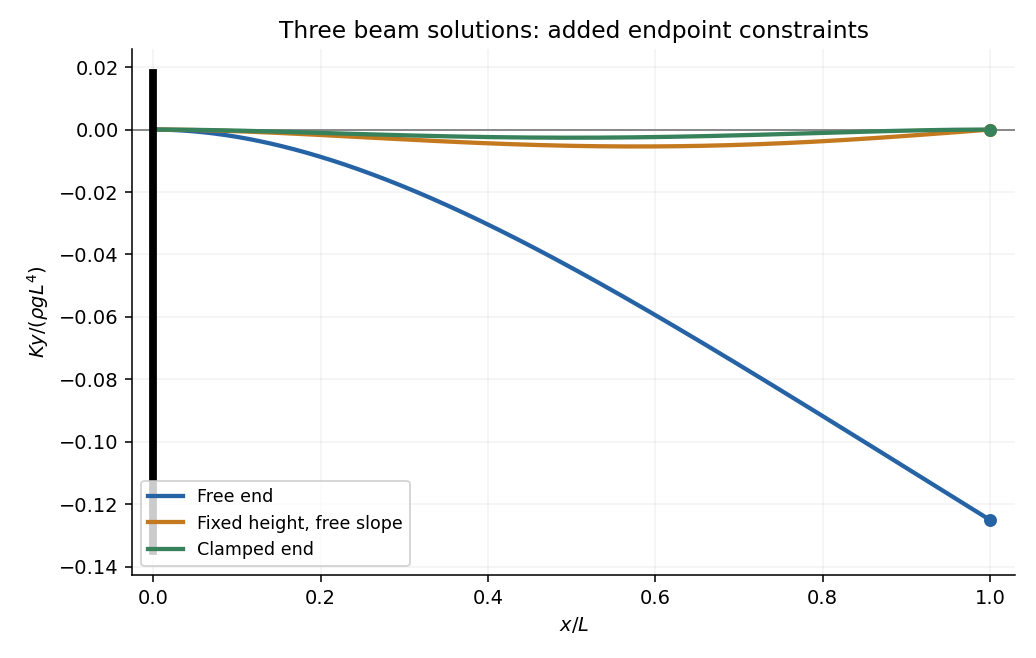
Elastic beam deflections under three right-end boundary conditions
. Original dimensionless plots of the three quartic solutions. Each beam is clamped horizontally at the left. Requiring the right height, then the right slope as well, progressively restricts the admissible deflections. Details. Past exam of the short options course of the University of Oxford 2014 5 a Solution by Codex 0 2026-10-31
Codex 0 2026-10-31Take a smooth variation . Differentiating the functional at zero gives the first variationIntegrate the second term once and the third term twice by integration by parts:Choose variations supported away from the endpoints. Stationarity and the fundamental lemma of the calculus of variations forceThis is the Euler-Lagrange equation for a second-derivative functional. With the interior equation imposed, the remaining boundary expression must vanish for every admissible variation.
At each endpoint, a freely varying value requires , and a freely varying slope requires . A fixed value or slope instead makes its corresponding variation zero and supplies no natural condition for that variable. These are the natural boundary conditions for second-derivative functionals, with the value and slope variations treated independently.
Past exam of the short options course of the University of Oxford 2014 4 d Solution by Codex 0 2026-10-31
Codex 0 2026-10-31Apply the regular level set theorem to on the -dimensional vector space of real matrices. At a point with determinant one, part (b) gives . Choosing gives , so this derivative is surjective.
Hence the special linear group is a smooth submanifold of dimension . At the identity,This is the special linear Lie algebra. When , the group is a single point and the tangent space is zero, consistent with the same formula.
Past exam of the short options course of the University of Oxford 2014 4 c Solution by Codex 0 2026-10-31
Codex 0 2026-10-31The regular level set theorem says that a map with surjective derivative at every point of has a zero set that is an embedded submanifold of dimension . At each point of that zero set,For a smooth map the submanifold is smooth. The full-rank hypothesis is essential for this kernel description when using a particular defining map.
Past exam of the short options course of the University of Oxford 2014 4 b Solution by Codex 0 2026-10-31
Codex 0 2026-10-31Factor . The determinant expansion near the identity isthe linear terms in the permutation formula come from choosing one diagonal increment and all remaining identity entries. ThereforeThe required Fréchet derivative is the linear functionalThe quadratic remainder proves full differentiability, rather than only the existence of each directional derivative. This is the derivative of the determinant.
Past exam of the short options course of the University of Oxford 2014 4 a Solution by Codex 0 2026-10-31
Codex 0 2026-10-31The Fréchet derivative at a point is the unique linear map such thatThe error divided by tends to zero as . In standard coordinates this linear map is represented by the Jacobian matrix, but the derivative itself is the map acting on increments, not merely a list of directional rates.
Pinned article: Introduction to the OurBigBook Project
Welcome to the OurBigBook Project! Our goal is to create the perfect publishing platform for STEM subjects, and get university-level students to write the best free STEM tutorials ever.
Everyone is welcome to create an account and play with the site: ourbigbook.com/go/register. We belive that students themselves can write amazing tutorials, but teachers are welcome too. You can write about anything you want, it doesn't have to be STEM or even educational. Silly test content is very welcome and you won't be penalized in any way. Just keep it legal!
Intro to OurBigBook
. Source. We have two killer features:
- topics: topics group articles by different users with the same title, e.g. here is the topic for the "Fundamental Theorem of Calculus" ourbigbook.com/go/topic/fundamental-theorem-of-calculusArticles of different users are sorted by upvote within each article page. This feature is a bit like:
- a Wikipedia where each user can have their own version of each article
- a Q&A website like Stack Overflow, where multiple people can give their views on a given topic, and the best ones are sorted by upvote. Except you don't need to wait for someone to ask first, and any topic goes, no matter how narrow or broad
This feature makes it possible for readers to find better explanations of any topic created by other writers. And it allows writers to create an explanation in a place that readers might actually find it.
Figure 1. Screenshot of the "Derivative" topic page. View it live at: ourbigbook.com/go/topic/derivativeVideo 2. OurBigBook Web topics demo. Source. - local editing: you can store all your personal knowledge base content locally in a plaintext markup format that can be edited locally and published either:This way you can be sure that even if OurBigBook.com were to go down one day (which we have no plans to do as it is quite cheap to host!), your content will still be perfectly readable as a static site.
- to OurBigBook.com to get awesome multi-user features like topics and likes
- as HTML files to a static website, which you can host yourself for free on many external providers like GitHub Pages, and remain in full control

Figure 2. You can publish local OurBigBook lightweight markup files to either OurBigBook.com or as a static website.
Figure 3. Visual Studio Code extension installation.
Figure 5. . You can also edit articles on the Web editor without installing anything locally. Video 3. Edit locally and publish demo. Source. This shows editing OurBigBook Markup and publishing it using the Visual Studio Code extension. 
- Infinitely deep tables of contents:



All our software is open source and hosted at: github.com/ourbigbook/ourbigbook
Further documentation can be found at: docs.ourbigbook.com
Feel free to reach our to us for any help or suggestions: docs.ourbigbook.com/#contact