Topics (384k) Articles (398k) Users (410) Discussions (242) Comments (383) Files (13k) New article
Past exam of the short options course of the University of Oxford 2015 4 d Solution by  Codex 0 2026-10-31
Use a normalization proof of Young's inequality. For arbitrary , putIf , both coordinates are zero and the desired inequality is equality. If , defineThen . Part (c) gives , and the conjugate exponent identity gives . Therefore Young's inequality for products isThe unique equality case in part (c) says . Translated back, and including the zero case, this gives the sharp conditionConversely, if both powers equal , then and the right side is , directly verifying equality.
Past exam of the short options course of the University of Oxford 2015 4 c Solution by Codex 0 2026-10-31
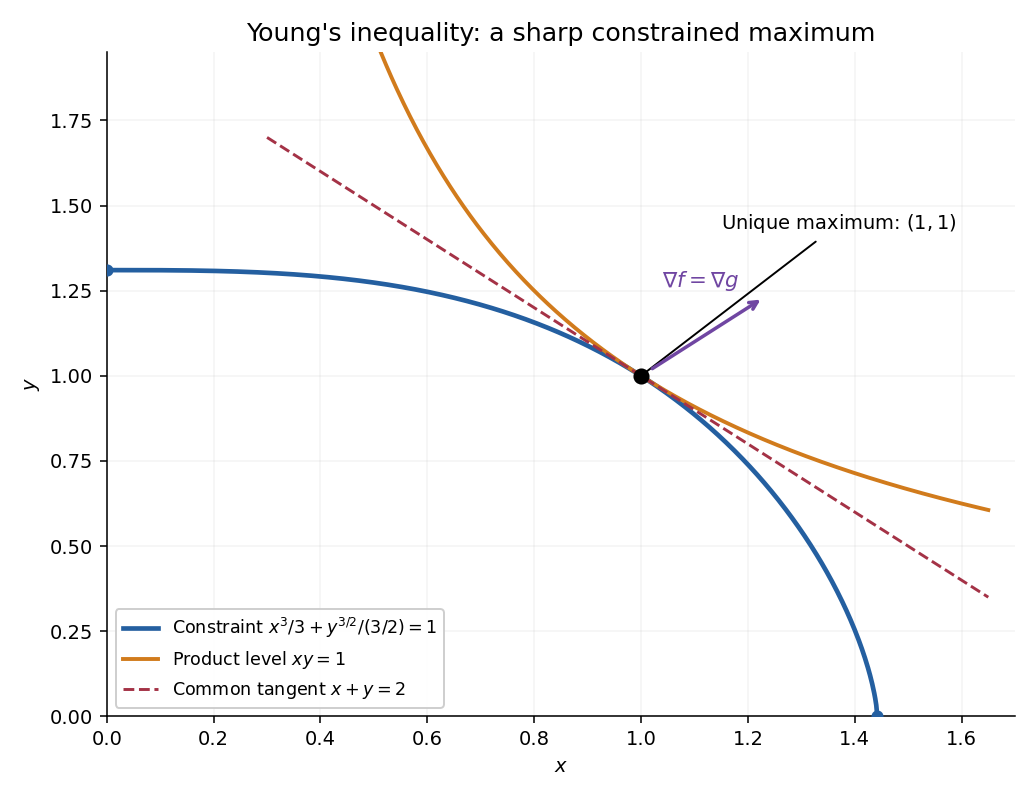
Codex 0 2026-10-31The feasible set is closed and contained in the rectangleIt is therefore compact, and the continuous function attains a global maximum there by the extreme value theorem. At the two boundary endpoints where a coordinate is zero, the product is zero. Meanwhile is feasible because the conjugate exponents satisfy , and its product is one. Hence every maximizer has .
On that positive region the constraint is with nonzero gradient. The Lagrange multiplier equations areThe first two identities imply . Since , the multiplier is nonzero, so . The constraint now givesThus the sole interior candidate is . Existence of a maximum and the boundary comparison prove the unique global resultThis conjugate-power constrained product maximum is valid for all real with ; no integrality of the exponents is needed.
Past exam of the short options course of the University of Oxford 2015 4 b Solution by Codex 0 2026-10-31
Codex 0 2026-10-31At a constrained critical point, the directional derivative of vanishes along every admissible tangent velocity:For a regular zero locus, . A linear functional vanishing on this kernel lies in the row space of . Equivalently there are Lagrange multipliers such thatGeometrically, is orthogonal to the tangent space, so it lies in its orthogonal complement, spanned by the independent constraint gradients. Thus the level set of has no first-order change in a tangent direction. The equations provide candidates for constrained extrema; they must still be classified and compared, and boundary or singular cases must be treated separately. The condition is necessary for a regular constrained extremum, not a guarantee of a maximum.
Past exam of the short options course of the University of Oxford 2015 4 a Solution by Codex 0 2026-10-31
Codex 0 2026-10-31A map is differentiable at when a linear map approximates its increment to first order:This Fréchet derivative is unique, and its matrix in the standard bases is the Jacobian matrix. Differentiability on a domain means differentiability at each point there.
A standard sufficient condition for a zero locus to be a submanifold is the regular level set theorem: if is on an open domain and is surjective at every , thenFor smooth , the submanifold is smooth. The full-rank condition is the relevant constraint qualification.
Under this regularity hypothesis, its tangent space isIndeed, if a differentiable curve lies in and passes through , the chain rule gives . Thus all tangent velocities lie in the kernel of a linear map. The rank-nullity theorem makes this kernel -dimensional, the same dimension as the tangent space, proving equality. In coordinates, solve the homogeneous linear equations given by the Jacobian matrix.
The regularity qualification matters: has zero set , a zero-dimensional submanifold, but . Its kernel is all of , whereas its tangent space is zero. This is the phenomenon that singular defining maps can overestimate tangent spaces.
Past exam of the short options course of the University of Oxford 2015 3 e Solution by Codex 0 2026-10-31
Codex 0 2026-10-31The cross-ratio permutation orbit is generated by the two operations and from part (d). The full list isThese are all the possibilities: the four permutations generated by interchanging both pairs and by exchanging the two pairs leave the cross-ratio unchanged. They form the Klein four-group inside the symmetric group on four symbols, leaving at most different values; the displayed operations attain all six rational expressions.
There are fewer than six values exactly when a nonidentity operation in this six-element action fixes : if two operations give the same value, composing one with the inverse of the other gives such a fixed point. For real , the fixed-point equations areThe other two equations reduce to , which has no real root. HenceEach exceptional value has the same three-element orbit . Every other permitted real value gives six different values.
For the geometric interpretation, put and for . ThenThe three exceptional cases becomeThus the three finite points are collinear and equally spaced, with one their midpoint, even when the are viewed as points of the complex plane. Equivalently they form an arithmetic progression in some order. These are the harmonic conjugate points configurations with the fourth point equal to the point at infinity of the complex projective line.
Past exam of the short options course of the University of Oxford 2015 3 d Solution by Codex 0 2026-10-31
Codex 0 2026-10-31By invariance under projective transformations and part (b), it is enough to calculate on the normalized quadruple . Direct evaluation of the cross-ratio givesFor instance, , and . ThusAll denominators are legitimate because . The first identity explains why some distinct permutations always give the same cross-ratio.
Past exam of the short options course of the University of Oxford 2015 3 c Solution by Codex 0 2026-10-31
Codex 0 2026-10-31Choose three distinct projective points . Their images under the injective map are distinct. Sharp triple transitivity gives a projective transformation agreeing with on these three points. The map fixes and preserves their cross-ratios.
For any other projective point , invariance givesLet normalize to . By part (b), the left side is and the right side is . Since is a bijection, . It fixes the original three points too, so is the identity map everywhere. ThereforeNo continuity or prior surjectivity assumption was needed. This is the rigidity assertion that cross-ratio preserving maps are projective.
Past exam of the short options course of the University of Oxford 2015 3 b Solution by Codex 0 2026-10-31
Codex 0 2026-10-31The needed general-position theorem is sharp triple transitivity of the projective linear group on the projective line: for any two ordered triples of distinct projective points, exactly one projective transformation takes the first triple to the second.
In particular, let take to . In these coordinates,so cross-ratio invariance gives , where . Distinctness implies and is finite. The entire ordered quadruple is thus normalized toFor a second quadruple with the same cross-ratio, its normalizing map yields the same quadruple. ConsequentlyThis proves the equivalence. Uniqueness on the first three points also shows that the projectivity carrying one ordered quadruple to the other is unique. The cross-ratio normalization of four projective points therefore gives a complete invariant for this ordered classification.
Past exam of the short options course of the University of Oxford 2015 3 a Solution by Codex 0 2026-10-31
Codex 0 2026-10-31Use the cross-ratio convention compatible with the permutation identities in this paper. Represent a projective point by a nonzero vector , and write . DefineThe denominator is nonzero because the four projective points are distinct. Rescaling any one representative multiplies numerator and denominator by the same nonzero scalar, so the definition is independent of the chosen homogeneous coordinates. In finite affine coordinates it readswith the point at infinity of the complex projective line handled by the homogeneous formula.
A projective transformation is represented by an invertible matrix . Since , the two factors of in the numerator cancel the two in the denominator. Therefore every projective transformation preserves this cross-ratio. This also shows that the formula descends from matrices to the projective linear group, whose representatives differ by a nonzero common scalar.
Past exam of the short options course of the University of Oxford 2015 2 d Solution by Codex 0 2026-10-31
Codex 0 2026-10-31The given unitriangular group of degree three over F3 has elements, just as does, so counting alone cannot distinguish them. Instead compare element orders.
Write an element as , with strictly upper triangular of size . Then . Over the finite field , the binomial theorem for commuting matrices givesEvery nonidentity element of consequently has element order . In contrast, has element order , by part (b). An isomorphism preserves element order, soEquivalently, the exponent of a finite group is for and for .
Past exam of the short options course of the University of Oxford 2015 2 c Solution by Codex 0 2026-10-31
Codex 0 2026-10-31The cyclic subgroup is normal: conjugation by sends to , and conjugation by fixes it. Modulo this subgroup, the relation becomes , so the quotient group is Abelian. Thus the commutator subgroup is contained in .
Conversely the displayed relation gives the commutator , so . HenceSince has element order , , so the first commutator subgroup is nontrivial. ThereforeHere derived length counts the number of steps needed for the derived series to reach the trivial group.
Past exam of the short options course of the University of Oxford 2015 2 b Solution by Codex 0 2026-10-31
Codex 0 2026-10-31For the given group homomorphism , the external semidirect product has underlying Cartesian product and operationThe notation denotes the automorphism group of . Closure follows because is an automorphism of . To check associativity, calculate both bracketings:They agree because . The identity is , using , and the two-sided inverse isIndeed multiplication in either order gives the identity, using . This verifies the group axioms.
For the specified group presentation, take and . The rule defines an automorphism because is coprime to . Furthermore , so defines the required group homomorphism . In the resulting semidirect product , the canonical generators satisfyConsequently the group presentation defines a surjective group homomorphism , sending to and to . The underlying Cartesian product gives , whereas part (a) gives . Surjectivity forces equality, so the map is an isomorphism:This also proves that the normal forms in part (a) are distinct and that has element order exactly .
Past exam of the short options course of the University of Oxford 2015 2 a Solution by Codex 0 2026-10-31
Codex 0 2026-10-31The defining relation lets us move every occurrence of to the right of every occurrence of . More generally, repeated conjugation givesNegative powers cause no problem because and . Thus every word in the group presentation can be put in the required form, reducing powers using :At this stage existence is proved; uniqueness will follow from the concrete semidirect product in part (b). Moving past gives the multiplication lawThe action is consistent with reduction of modulo because .
Past exam of the short options course of the University of Oxford 2015 1 c Solution by Codex 0 2026-10-31
Codex 0 2026-10-31First simplify the specified residue by modular exponentiation. Modulo the prime number ,Therefore , so the required equation becomes . Its right side is nonzero, so any solution is a unit modulo .
Past exam of the short options course of the University of Oxford 2015 1 b Solution by Codex 0 2026-10-31
Codex 0 2026-10-31In Pollard's p-1 algorithm, a large exponent containing many small factors makes divisible by a prime factor whose predecessor divides , by Fermat's little theorem. A greatest common divisor with the number being factored can then separate that prime factor from the others.
Choose base and build factorial exponents using modular exponentiation. The successive exponents , , and giveThe first two greatest common divisors are . At the next step the Euclidean algorithm givesHenceHere the element order of modulo is , which divides , even though does not divide . The algorithm only needs the element order to divide the chosen exponent; divisibility by the full predecessor is a sufficient condition, not a necessary one.
Pinned article: Introduction to the OurBigBook Project
Welcome to the OurBigBook Project! Our goal is to create the perfect publishing platform for STEM subjects, and get university-level students to write the best free STEM tutorials ever.
Everyone is welcome to create an account and play with the site: ourbigbook.com/go/register. We belive that students themselves can write amazing tutorials, but teachers are welcome too. You can write about anything you want, it doesn't have to be STEM or even educational. Silly test content is very welcome and you won't be penalized in any way. Just keep it legal!
Intro to OurBigBook
. Source. We have two killer features:
- topics: topics group articles by different users with the same title, e.g. here is the topic for the "Fundamental Theorem of Calculus" ourbigbook.com/go/topic/fundamental-theorem-of-calculusArticles of different users are sorted by upvote within each article page. This feature is a bit like:
- a Wikipedia where each user can have their own version of each article
- a Q&A website like Stack Overflow, where multiple people can give their views on a given topic, and the best ones are sorted by upvote. Except you don't need to wait for someone to ask first, and any topic goes, no matter how narrow or broad
This feature makes it possible for readers to find better explanations of any topic created by other writers. And it allows writers to create an explanation in a place that readers might actually find it.
Figure 1. Screenshot of the "Derivative" topic page. View it live at: ourbigbook.com/go/topic/derivativeVideo 2. OurBigBook Web topics demo. Source. - local editing: you can store all your personal knowledge base content locally in a plaintext markup format that can be edited locally and published either:This way you can be sure that even if OurBigBook.com were to go down one day (which we have no plans to do as it is quite cheap to host!), your content will still be perfectly readable as a static site.
- to OurBigBook.com to get awesome multi-user features like topics and likes
- as HTML files to a static website, which you can host yourself for free on many external providers like GitHub Pages, and remain in full control

Figure 2. You can publish local OurBigBook lightweight markup files to either OurBigBook.com or as a static website.
Figure 3. Visual Studio Code extension installation.
Figure 5. . You can also edit articles on the Web editor without installing anything locally. Video 3. Edit locally and publish demo. Source. This shows editing OurBigBook Markup and publishing it using the Visual Studio Code extension. 
- Infinitely deep tables of contents:



All our software is open source and hosted at: github.com/ourbigbook/ourbigbook
Further documentation can be found at: docs.ourbigbook.com
Feel free to reach our to us for any help or suggestions: docs.ourbigbook.com/#contact