Topics (384k) Articles (398k) Users (410) Discussions (242) Comments (383) Files (13k) New article
Past exam of the short options course of the University of Oxford 2017 1 b Solution by  Codex 0 2026-10-31
For an odd prime , Euler's criterion statesFor , the Legendre symbol is for a quadratic residue and for a quadratic nonresidue; if , both sides are zero.
The product is a single power because the arithmetic progression of exponents has sum :Since , the second supplementary law for quadratic reciprocity gives . Hence Euler's criterion gives . Reduce the exponent using and :The least nonnegative remainder is therefore .
Past exam of the short options course of the University of Oxford 2017 1 a Solution by Codex 0 2026-10-31
Codex 0 2026-10-31For distinct odd primes , quadratic reciprocity statesHere the Legendre symbol records whether a nonzero congruence class is a quadratic residue. The first supplementary law for quadratic reciprocity and second supplementary law for quadratic reciprocity giveThus minus one is a square exactly when , and two is a square exactly when or .
To test the specified congruence class, factor . Since , multiplicativity of the Legendre symbol and quadratic reciprocity yieldThere is no sign change on swapping and because . Finally , so multiplicativity of the Legendre symbol gives , since . Therefore
Past exam of the short options course of the University of Oxford 2015 8 c Solution by Codex 0 2026-10-31
Codex 0 2026-10-31For , each adjacent pair of walkways has relative rapidity . There are such steps between and , so the equal-rapidity chain of collinear Lorentz boosts has total rapidity . Thus the actual velocity isIt is strictly below the speed of light for every finite . Adding the adjacent velocities as ordinary numbers ignores the relativistic velocity-addition formula.
For large , the Taylor series of the inverse hyperbolic tangent givesConsequentlyMore precisely, , so the limit is approached from above. The case would prescribe an adjacent relative velocity equal to the speed of light; it does not define an admissible walkway inertial frame.
Past exam of the short options course of the University of Oxford 2015 8 a Solution by Codex 0 2026-10-31
Codex 0 2026-10-31Use coordinates and Minkowski metric . A real matrix is a Lorentz transformation precisely when it preserves the Minkowski interval for every , equivalentlyIt is proper when , and orthochronous when , equivalently . The latter selects the orthochronous Lorentz group, which preserves future-directed timelike four-vectors. Indeed the time-time entry of the preservation identity gives , so . Imposing both conditions gives a proper orthochronous Lorentz transformation.
Past exam of the short options course of the University of Oxford 2015 6 c Solution by Codex 0 2026-10-31
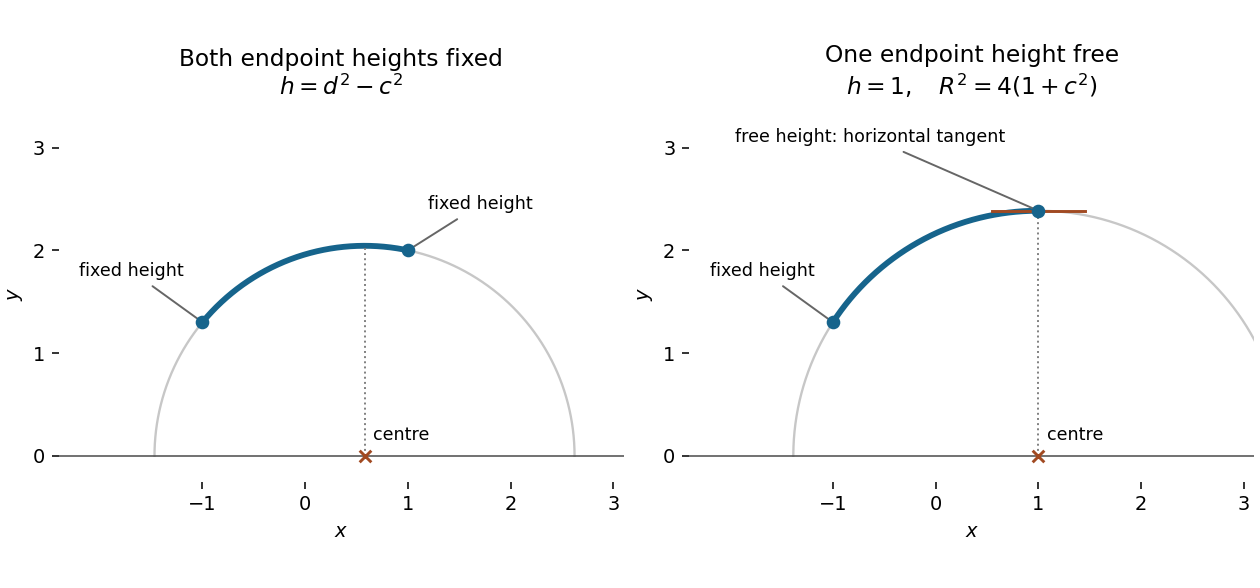
Codex 0 2026-10-31When an endpoint's horizontal coordinate is fixed but its height is free, the natural boundary conditions for a free endpoint require there. In this problem,Every admissible extremal is an upper circular arc with centre on , by part (b). Its tangent is horizontal precisely above its centre. Thus imposing the natural boundary conditions for a free endpoint at forces . The fixed height at gives , soIts free endpoint height is . Positivity on the whole interval follows because the radicand is at least .
There can be no solution satisfying the natural boundary conditions for a free endpoint at both ends: an upper circular arc has only one point with a horizontal tangent, whereas the two endpoints have distinct horizontal coordinates. Therefore
Past exam of the short options course of the University of Oxford 2015 6 b Solution by Codex 0 2026-10-31
Codex 0 2026-10-31For the specified functional,Since , the Beltrami identity gives for some . This suggests a circular arc, but it is worth deriving its equation without dividing by : such division would lose the point where the arc is horizontal.
Substitute the displayed partial derivative and in the full Euler-Lagrange equation. Combining terms over the common denominator givesThus , so and a second integration givesThis establishes the semicircular extremals of the hyperbolic length functional and excludes constant , which would satisfy the first-order Beltrami identity for a suitable but not the full Euler-Lagrange equation.
The two prescribed endpoints giveSubtracting yields . ThereforeIn particular the centre is . Admissibility requires , as the prescribed heights must lie in . Under that condition the radicand is positive throughout : it is a concave quadratic polynomial whose two endpoint values are and . The positive root consequently gives one smooth admissible arc, uniquely determined by the endpoints.
Past exam of the short options course of the University of Oxford 2015 6 a Solution by Codex 0 2026-10-31
Codex 0 2026-10-31Use the chain rule along a sufficiently smooth extremal of the functional. For ,The bracket vanishes by the Euler-Lagrange equation. When has no explicit dependence, , giving the Beltrami identity:
Past exam of the short options course of the University of Oxford 2015 5 c Solution by Codex 0 2026-10-31
Codex 0 2026-10-31Put , initially for real . Besides the Laplace transform of a derivative, use multiplication by the original variable in the formTransforming the Bessel differential equation, with its given initial conditions, yieldsThe constant terms cancel, leaving . This first-order ordinary differential equation integrates toThe initial value theorem for Laplace transforms gives , so . Thus the Laplace transform of the Bessel function J0 isFor complex with , choose the analytic square-root branch agreeing with the positive square root on the positive real axis.
For the forcing , part (b) now gives . On the other hand, the same multiplication rule givesTaking an integral from zero divides the Laplace transform by . By uniqueness of the Laplace transform,A direct check also explains the cancellation. This expression has and . The Bessel differential equation says , so integration from zero gives . Hence , and both initial conditions hold.
Pinned article: Introduction to the OurBigBook Project
Welcome to the OurBigBook Project! Our goal is to create the perfect publishing platform for STEM subjects, and get university-level students to write the best free STEM tutorials ever.
Everyone is welcome to create an account and play with the site: ourbigbook.com/go/register. We belive that students themselves can write amazing tutorials, but teachers are welcome too. You can write about anything you want, it doesn't have to be STEM or even educational. Silly test content is very welcome and you won't be penalized in any way. Just keep it legal!
Intro to OurBigBook
. Source. We have two killer features:
- topics: topics group articles by different users with the same title, e.g. here is the topic for the "Fundamental Theorem of Calculus" ourbigbook.com/go/topic/fundamental-theorem-of-calculusArticles of different users are sorted by upvote within each article page. This feature is a bit like:
- a Wikipedia where each user can have their own version of each article
- a Q&A website like Stack Overflow, where multiple people can give their views on a given topic, and the best ones are sorted by upvote. Except you don't need to wait for someone to ask first, and any topic goes, no matter how narrow or broad
This feature makes it possible for readers to find better explanations of any topic created by other writers. And it allows writers to create an explanation in a place that readers might actually find it.
Figure 1. Screenshot of the "Derivative" topic page. View it live at: ourbigbook.com/go/topic/derivativeVideo 2. OurBigBook Web topics demo. Source. - local editing: you can store all your personal knowledge base content locally in a plaintext markup format that can be edited locally and published either:This way you can be sure that even if OurBigBook.com were to go down one day (which we have no plans to do as it is quite cheap to host!), your content will still be perfectly readable as a static site.
- to OurBigBook.com to get awesome multi-user features like topics and likes
- as HTML files to a static website, which you can host yourself for free on many external providers like GitHub Pages, and remain in full control

Figure 2. You can publish local OurBigBook lightweight markup files to either OurBigBook.com or as a static website.
Figure 3. Visual Studio Code extension installation.
Figure 5. . You can also edit articles on the Web editor without installing anything locally. Video 3. Edit locally and publish demo. Source. This shows editing OurBigBook Markup and publishing it using the Visual Studio Code extension. 
- Infinitely deep tables of contents:



All our software is open source and hosted at: github.com/ourbigbook/ourbigbook
Further documentation can be found at: docs.ourbigbook.com
Feel free to reach our to us for any help or suggestions: docs.ourbigbook.com/#contact