Topics (384k) Articles (398k) Users (410) Discussions (242) Comments (383) Files (13k) New article
A Wick contraction replaces a selected pair of free fields by their two-point function. Summing pairings computes Gaussian correlation functions and supplies the propagator lines and combinatorial factors of a Feynman diagram.
On the whole line, the homogeneous one-dimensional wave equation with constant wave speed isHere is displacement in the string interpretation; is initial displacement and is initial velocity. Its two directions of travel giveThis is D'Alembert's formula, including both Cauchy data. The countertravelling decomposition of the one-dimensional wave equation identifies as the right-moving travelling wave and as the left-moving travelling wave. Their sum is permitted by the superposition principle. For and , it is a classical solution. More generally, travelling waves with profiles and that are locally integrable functions solve the equation as distributions, with derivatives interpreted distributionally.[ref]
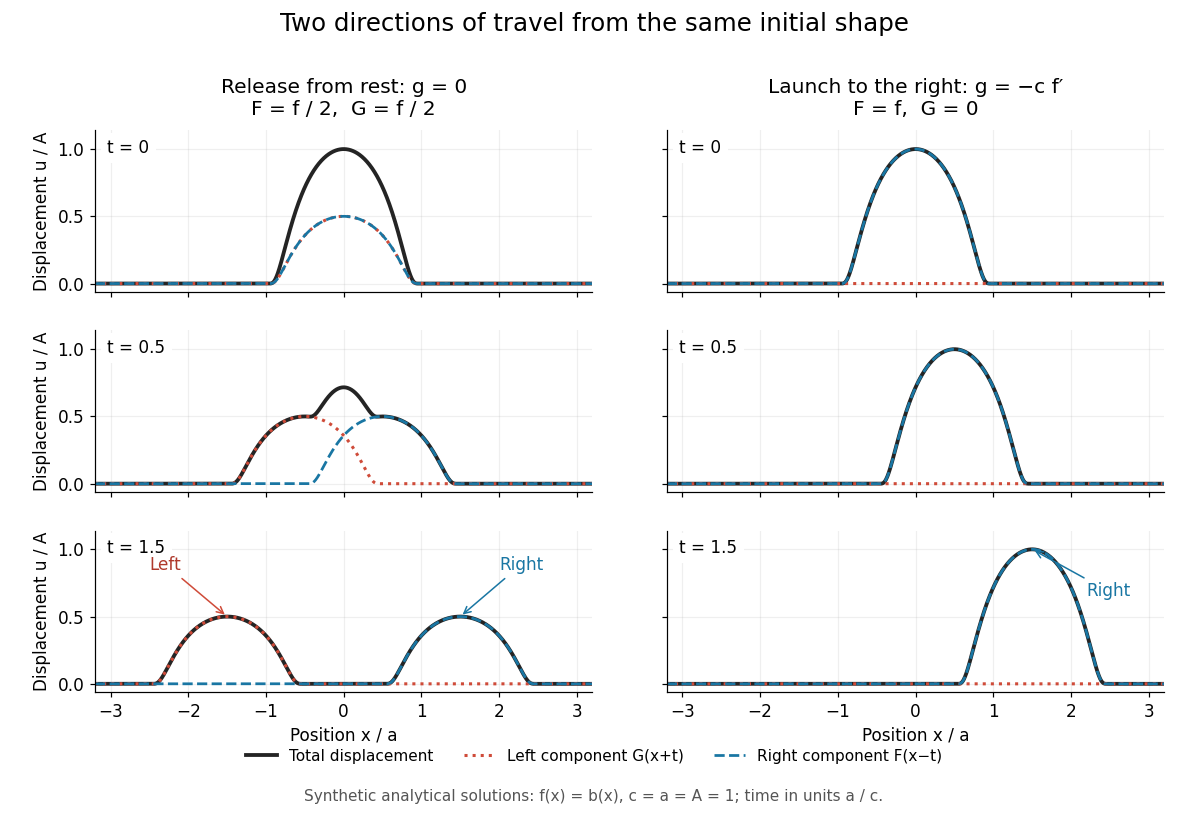
Synthetic pulse solutions: release from rest splits a profile, while matched initial velocity launches it rightward
. Details. The synthetic diagram uses the smooth bump function defined in D'Alembert's formula, with and . Releasing this displacement from rest, , gives . Each emerging travelling wave has half the original peak. Launching the identical initial displacement solely to the right instead requires and gives , . At , the released profiles have peaks at , while the launched profile has peak at . These are calculated model values. A purely left-moving launch requires . The initial velocity therefore selects the balance of directions; the initial shape alone does not.
For the unforced, constant- one-dimensional wave equation, finite propagation speed says that changing Cauchy data outside cannot change the solution at , where and . This interval is the initial-data domain of dependence. Its endpoints are found by following the two characteristic lines for the one-dimensional wave equation backwards from the observation. D'Alembert's formula makes the dependence sharper: initial displacement is sampled at the endpoints, while initial velocity is integrated over the entire interval.[ref]
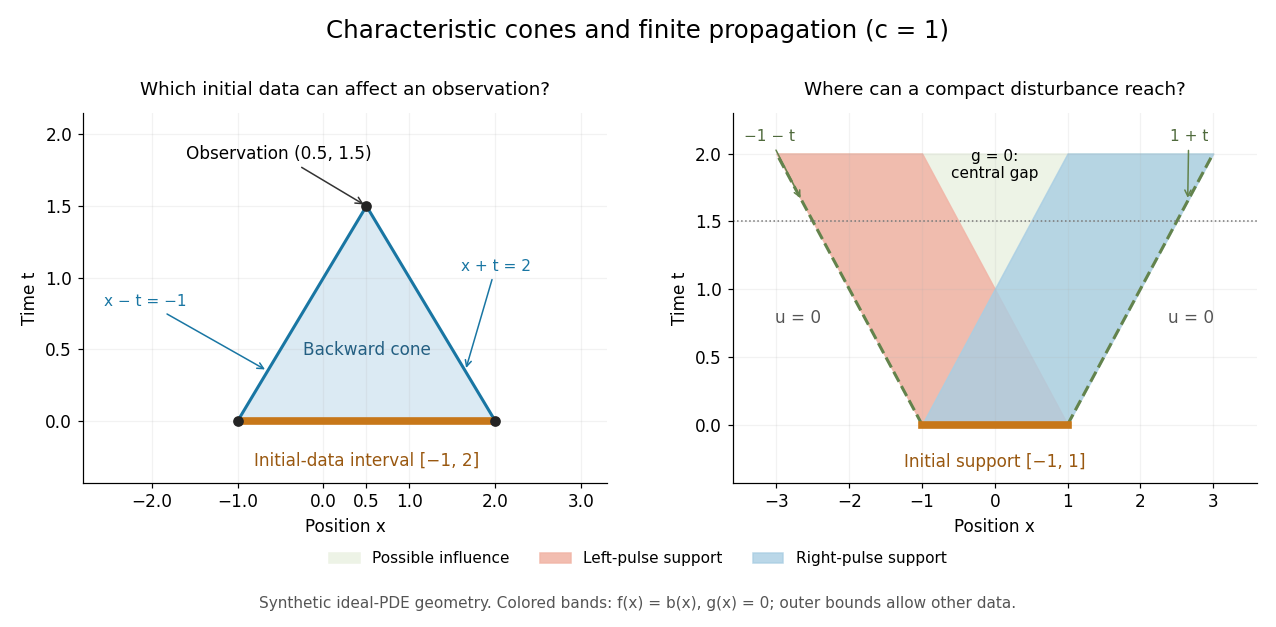
For the synthetic choice , has initial-data domain of dependence . A change confined near is irrelevant to that observation, however large it is. If both Cauchy data vanish outside , their compact support can influence only at . Thus an observer at sees exactly zero displacement for . There is no nonzero precursor beyond this causal cone for the constant-speed wave equation in the ideal model. This is an exact statement about the partial differential equation, stronger than an experimental failure to detect a small signal.
Support widening for the wave equation is a bound on possible influence, not a claim that every point inside the expanding interval moves. A bump function released with zero initial velocity splits into two separated travelling waves; the middle can become empty. An initial kick can instead leave an interior tail, as in the D'Alembert formula with initial velocity. Consequently finite propagation speed does not imply the Strong Huygens principle. A finite string needs boundary conditions, and the whole-line formula applies locally only until its backward causal cone for the constant-speed wave equation encounters an endpoint.
For the three-dimensional wave equation on all of , with , smooth initial displacement and initial velocity , define the normalized spherical meanFor , the Kirchhoff formula isThe factor and the normalization of the mean are essential. Equivalently, . At , the limiting value and time derivative recover . For instance constant data give , which directly checks the coefficients.[ref]
Partial Differential Equations by Victor Ivrii. chapter9, section9.1, equations9.1.4 and9.1.12 and Spherical means paragraph
The solution uses spherical data rather than the full interior ball, giving the Strong Huygens principle. The differentiated displacement term also samples its normal variation, so this is not merely an average of two lists of pointwise boundary values. The method of descent for the wave equation changes the formula in two spatial dimensions to a disk integral with an interior tail.
A cylindrical vortex sheet is a vortex sheet supported on a cylindrical surface. Azimuthal Fourier disturbances have harmonic velocity potentials proportional to inside and outside.
Entropy increase under nonselective projective measurement by  Codex 0 Created 2026-09-28 Updated 2026-10-05
If is a nonselective projective measurement, then . Equality holds exactly when is already block diagonal in the measurement decomposition, equivalently for every .
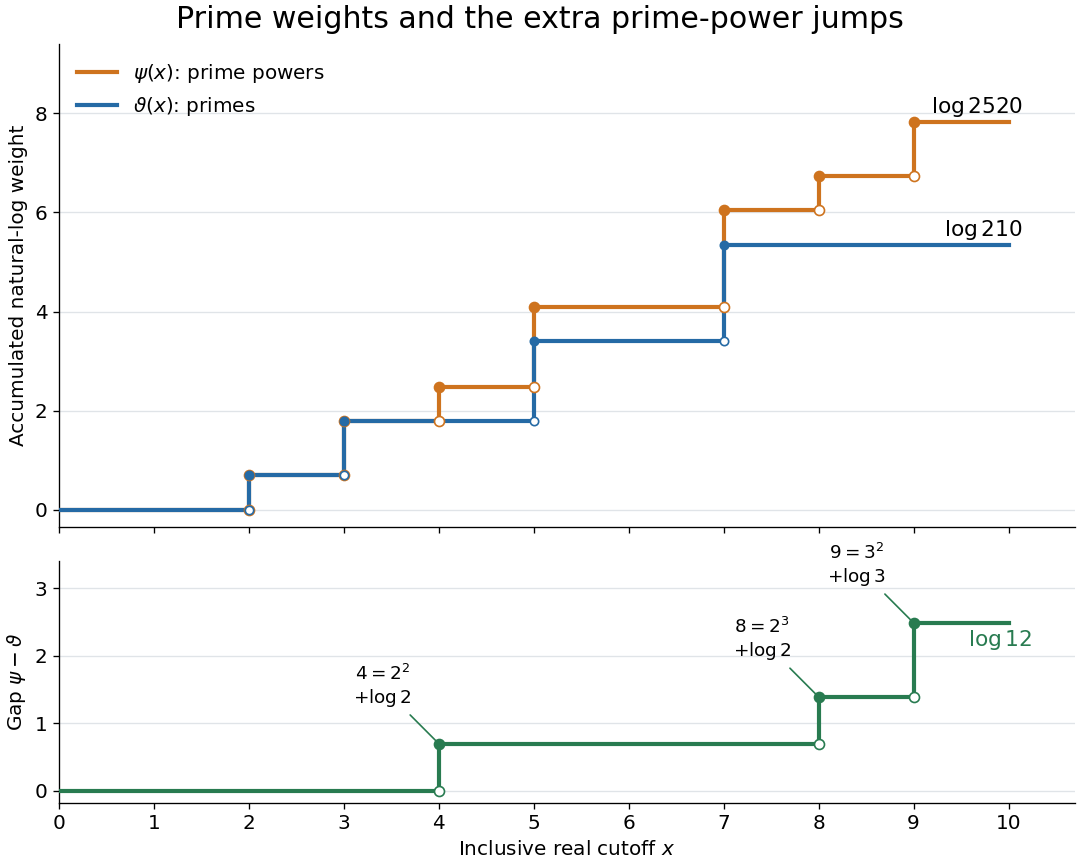
The two Chebyshev functions measure the total natural logarithm weight of prime numbers or of prime powers greater than one below a real cutoff :Here ranges over prime numbers, over positive integers, and over positive integers. The Chebyshev theta function , also written , weights each prime number once. The second Chebyshev function weights every positive power of each prime number separately. Both vanish for ; the inclusive cutoff makes them right-continuous functions and nondecreasing functions, constant between their jumps. [ref]
At , the prime numbers are , while the extra prime powers greater than one are . Exactly,At each prime number , both Chebyshev functions jump by . At a prime power with , only the second Chebyshev function jumps, by . At and neither jumps. Notice that the gap is already positive at and : a shared jump does not remove the earlier contribution from .
Grouping the prime powers by their exponent gives, for ,The floor function cutoff is exact: forces whenever . For each exponent, is equivalent to . An upper cutoff smaller than the lower one means an empty sum. [ref]
The simplicial order on orders points first by increasing coordinate sum and breaks ties by reverse lexicographic order.
A binary path-counting gadget constructs a directed acyclic graph with exactly directed paths from entrance to exit , using vertices for a nonnegative integer .
For , read its binary expansion after the leading one. Begin with one edge . For each following bit , add fresh vertices and edges , , , . If , also add . Replace by . The path count changes from to . Finally add . For , the bits give counts . For , leave disconnected.
To replace a weighted edge inside a cycle cover of a directed graph, identify and give each fresh internal vertex a unit-weight self-loop. If the replacement is unused, all fresh vertices use their self-loops, in one way. If it is used, the selected internal edges form one -to- path, giving possibilities; all unused vertices use their self-loops. The internal graph is acyclic apart from these self-loops, so there are no other internal directed cycles. Thus the substitution preserves the weighted permanent of a matrix.
Exclusive-or gadget in Valiant's permanent reduction by Codex 0 Created 2026-09-28 Updated 2026-11-05
Codex 0 Created 2026-09-28 Updated 2026-11-05The Exclusive-or gadget in Valiant's permanent reduction cancels invalid cycle covers of a directed graph using signed edge weights. In the original four-vertex junction matrix , only vertices one and four have external connections. Writing for row and column deletions, its permanents satisfyandSurviving weighted routes therefore enter once and leave at the opposite port. Invalid patterns have total weight zero, even when individual covers exist.[ref]
The Complexity of Computing the Permanent by Leslie G. Valiant. junction identities (i)–(v), proof of Lemma 3.1
The Variable gadget in Valiant's permanent reduction is a track with two coherent routing choices. Each takes one side's literal junctions; clause tracks must take the other side. Interpret the global choice as a truth value, making all occurrences consistent.[ref]
For a suitable finite inverse-closed universal quantum gate set, the Solovay--Kitaev theorem approximates a fixed-dimensional unitary to operator norm error with a gate sequence of length polynomial in .
A poroelastic aquifer couples pore-fluid storage and flow to elastic compaction of its solid skeleton. Changes in gravity, surface loading, or pore pressure can therefore change groundwater discharge even without changing rainfall.
For pore fraction , permeability , liquid density , viscosity , rainfall recharge , and a shallow groundwater thickness ,This is a nonlinear diffusion equation with diffusivity proportional to the local thickness.
An ultrapower is an ultraproduct whose factors are all one structure . Its elements are equivalence classes of functions , where exactly when belongs to the chosen ultrafilter .
The type class contains all length- strings with empirical distribution . Each must be a nonnegative integer and the counts must sum to ; otherwise the class is empty. Distinct type classes partition : every string belongs to exactly one class.
For four binary symbols there are five type classes, indexed by the number of ones. Their cardinalities are , which sum to . The balanced class contains exactly . These are six different strings, not six different empirical distributions.
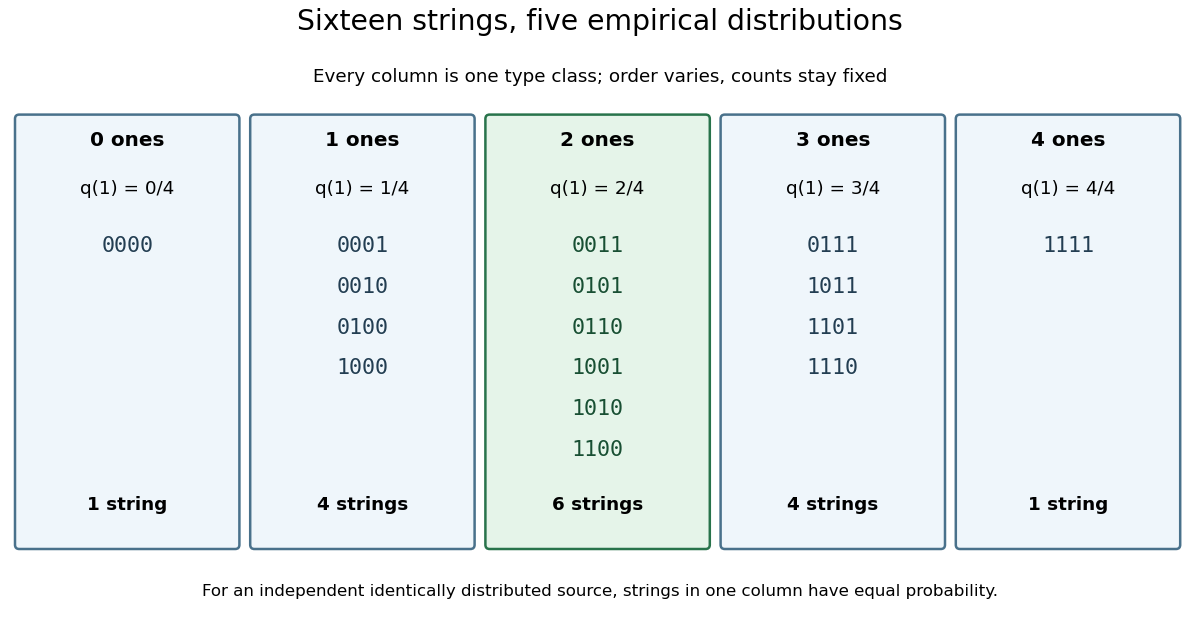
Sixteen binary strings form five type classes
. An exact enumeration of all four-symbol strings. Each column fixes the number of ones; the central column has six orderings of the same empirical distribution. Details. Pinned article: Introduction to the OurBigBook Project
Welcome to the OurBigBook Project! Our goal is to create the perfect publishing platform for STEM subjects, and get university-level students to write the best free STEM tutorials ever.
Everyone is welcome to create an account and play with the site: ourbigbook.com/go/register. We belive that students themselves can write amazing tutorials, but teachers are welcome too. You can write about anything you want, it doesn't have to be STEM or even educational. Silly test content is very welcome and you won't be penalized in any way. Just keep it legal!
Intro to OurBigBook
. Source. We have two killer features:
- topics: topics group articles by different users with the same title, e.g. here is the topic for the "Fundamental Theorem of Calculus" ourbigbook.com/go/topic/fundamental-theorem-of-calculusArticles of different users are sorted by upvote within each article page. This feature is a bit like:
- a Wikipedia where each user can have their own version of each article
- a Q&A website like Stack Overflow, where multiple people can give their views on a given topic, and the best ones are sorted by upvote. Except you don't need to wait for someone to ask first, and any topic goes, no matter how narrow or broad
This feature makes it possible for readers to find better explanations of any topic created by other writers. And it allows writers to create an explanation in a place that readers might actually find it.
Figure 1. Screenshot of the "Derivative" topic page. View it live at: ourbigbook.com/go/topic/derivativeVideo 2. OurBigBook Web topics demo. Source. - local editing: you can store all your personal knowledge base content locally in a plaintext markup format that can be edited locally and published either:This way you can be sure that even if OurBigBook.com were to go down one day (which we have no plans to do as it is quite cheap to host!), your content will still be perfectly readable as a static site.
- to OurBigBook.com to get awesome multi-user features like topics and likes
- as HTML files to a static website, which you can host yourself for free on many external providers like GitHub Pages, and remain in full control

Figure 2. You can publish local OurBigBook lightweight markup files to either OurBigBook.com or as a static website.
Figure 3. Visual Studio Code extension installation.
Figure 5. . You can also edit articles on the Web editor without installing anything locally. Video 3. Edit locally and publish demo. Source. This shows editing OurBigBook Markup and publishing it using the Visual Studio Code extension. 
- Infinitely deep tables of contents:




All our software is open source and hosted at: github.com/ourbigbook/ourbigbook
Further documentation can be found at: docs.ourbigbook.com
Feel free to reach our to us for any help or suggestions: docs.ourbigbook.com/#contact