Topics (384k) Articles (398k) Users (410) Discussions (242) Comments (383) Files (13k) New article
An SQCD meson is the gauge-invariant chiral bilinear . It transforms under both flavor groups and parametrizes mesonic directions of the vacuum moduli space.
For parameters and , the Scaled inverse chi-squared distribution is the law ofThe inverse change of variables gives its normalized densityIt is an Inverse-gamma distribution with shape and scale . The label is a scale parameter, not the variance of .
Its mean is for , and its variance is for . Below those respective thresholds the positive moments diverge. For example, gives mean three and variance nine.
This is a conjugate prior for the unknown variance of a Normal distribution with known mean . With prior parameters and independent observations, the posterior has and . Multiplying prior and likelihood adds their powers and inverse-variance exponents, which proves the update. An unknown estimated mean requires a separate model and changes the update.
At fixed temperature and pressure, an interior reacting equilibrium minimizes Gibbs free energy under the constraints imposed by stoichiometry. Each independent reversible reaction then has zero actual Gibbs energy of reaction,This is not a requirement that the standard Gibbs energy of reaction vanish.
Using dimensionless thermodynamic activities , define the reaction quotient . The relationtherefore givesThe equilibrium constant is dimensionless because each activity is measured relative to its declared standard state. In general even though the actual equilibrium Gibbs energy of reaction is zero. [ref]
These equations determine an equilibrium composition within the model. They do not supply the reaction rate or guarantee rapid equilibration; that requires the chemical kinetics.
The second Chebyshev function is the partial sum of the Von Mangoldt function up to a real cutoff :For example, , , and . At the jump has size ; between and no new prime power greater than one enters the sum. In contrast, the Chebyshev theta function stays at .
There is also an exact connection with the least common multiple. For , each prime number occurs to the highest exponent for which , both in that least common multiple and in the accumulated Von Mangoldt function weights. ThusThis explains the value at : the least common multiple is . The Chebyshev theta function instead gives the natural logarithm of the primorial . The additional prime powers retain the highest required multiplicities.
Why is this useful for the distribution of prime numbers? The Prime number theorem has the equivalent formswhere is the prime-counting function and denotes asymptotic equivalence. Thus an arithmetic function defined using prime factorization has average weight tending to one over long initial intervals of the positive integers. These are substantive asymptotic equivalences, not consequences of the definitions or the Von Mangoldt divisor identity alone. [ref]
The elementary reason the two Chebyshev functions have the same leading behavior is that their difference is small compared with . Every additional prime power has base , and for each such prime number its total extra weight is at most . There are at most such bases, soThis transfers to , or conversely, once either is established. Partial summation then relates the Chebyshev theta function to the prime-counting function. The estimate controls the extra prime powers; proving the leading value itself is the harder Prime number theorem problem.
The Aharonov-Casher effect is the electromagnetic dual in which a magnetic moment or flux acquires a phase by encircling electric charge.
The Aharonov-Bohm effect is the phase acquired when a charge encircles magnetic flux , even when the magnetic field vanishes along the charge's path.
In the magnetic Aharonov-Bohm effect, a coherent electron wave takes two routes around inaccessible magnetic flux. Recombination converts their relative wave phase into displaced interference fringes. In 1959, Yakir Aharonov and David Bohm proposed a shielded solenoid geometry and identified the obstruction to removing the magnetic vector potential throughout the accessible region.[ref]
Significance of Electromagnetic Potentials in the Quantum Theory by Yakir Aharonov and David Bohm. 1959, §2, pp. 486–487, Fig. 2 and reflecting-barrier discussion
Use International System of Units, electric charge , and magnetic minimal coupling . Let run from the same source to the same detector point . The oriented closed curve follows and then backwards. For a static magnetic vector potential, the magnetic contribution to the relative wave phase isHere is the oriented magnetic flux through a spanning surface. Equal or calibrated nonmagnetic propagation phases are assumed. For an electron, , where is the elementary charge; reversing reverses the sign. The observable is the gauge-invariant holonomy , rather than a unique local value of the magnetic vector potential.
The accessible region is a multiply connected region: cannot contract to a point without entering the excluded flux region. Stokes theorem does not set the line integral to zero, because a spanning surface must cross that excluded region, where the magnetic field need not vanish. There is real magnetic flux in the apparatus; only the accessible paths are idealized as free of the magnetic field. The exterior of a finite straight solenoid also permits routes around its ends, so its exact topology and leakage differ from those of an infinite solenoid or an excluded solid torus.
An explicit model makes the obstruction visible. Outside an infinite flux tube of radius , choose cylindrical coordinates andIts curl vanishes there, but a loop with winding number has . Locally ; the angular coordinate changes by on a circuit. For generic , that candidate gauge removal changes the wave function's single-valued boundary condition. On a simply connected region, a smooth static magnetic vector potential with zero curl instead has a globally defined scalar primitive and is a pure gauge potential. Thus local zero magnetic field and globally removable magnetic vector potential are different conditions.
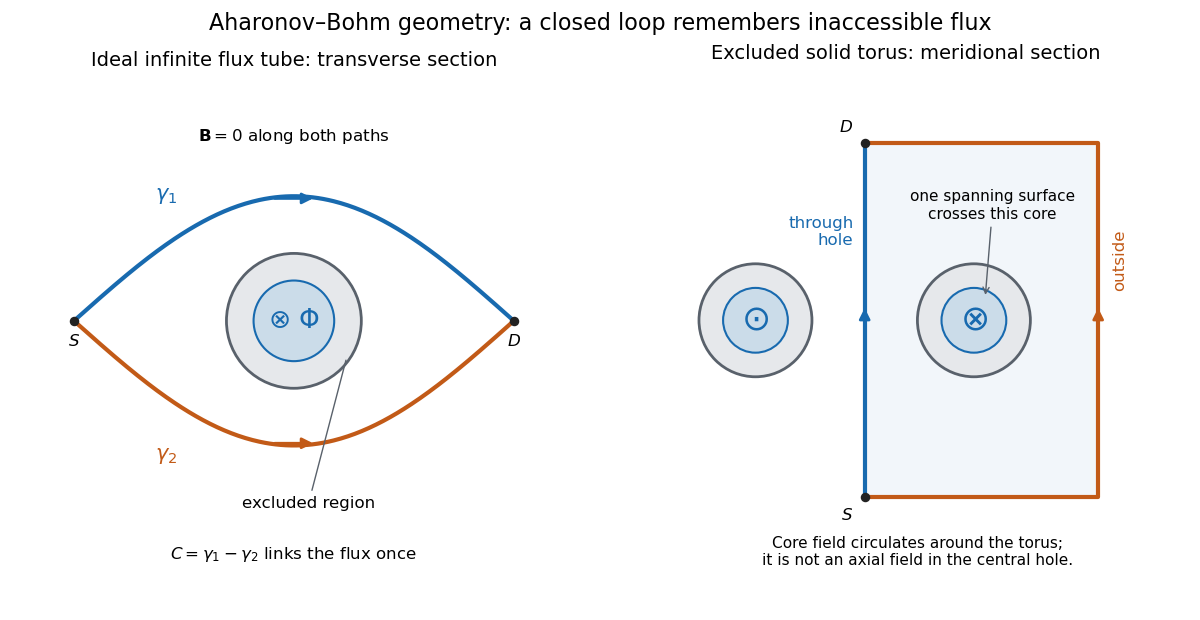
Two accessible paths can link inaccessible magnetic flux
. Original functional geometry. Left: a cross-section of an ideal infinite flux tube; traverses the blue route forwards and the orange route backwards. Right: a meridional section of an excluded solid torus; the magnetic field circulates inside its core, with opposite signs through the section. One route passes through the central hole and the other outside the torus. The drawn linking surface intersects one core section. Paths denote coherent alternatives, not measured trajectories; shielding thicknesses and beam optics are schematic. Source. Details.For an original interference example, take mutually coherent scalar amplitudes with constant individual intensities and an imposed carrier phase , as in off-axis holography. ThenThe interference fringe spacing is . An electron enclosing has , shifting maxima by for this orientation. Increasing the magnetic flux by changes by and restores the same pattern: the electron Aharonov-Bohm effect has magnetic flux quantum . This uses , the Planck constant. It does not require the source's magnetic flux to vary continuously during a single exposure.
For , , the extrema are , , and the interferometric visibility is . A fixed Aharonov-Bohm phase translates these fringes without changing their contrast. Averaging unresolved fluctuating phases can reduce the contrast; a darkened pattern alone cannot identify enclosed magnetic flux. These formulas assume coherence, indistinguishable alternatives and stable beam envelopes.
The appeal of the Aharonov-Bohm effect is that a local Lorentz force calculation along either ideal path misses information carried by their global arrangement. It gives a physical example of holonomy and supplies the encircling phase used in Chern--Simons flux attachment. This alone does not establish intrinsic topological order. The static comparison also matters: changing magnetic flux can induce an electric field, so a time-dependent experiment requires the scalar-potential contribution as well as the displayed spatial line integral.
Over , characteristic vectors satisfy . Parity restrictions on sizes and intersections therefore become diagonal and off-diagonal conditions on a Gram matrix, allowing rank and linear-independence arguments.
A linear multistep method has order exactly whenfor , with the right side interpreted as zero for , and the identity first fails at .
If a chain complex of finitely generated free abelian groups has zero homology after tensoring with for every prime , then its integral homology vanishes. The universal coefficient theorem for homology detects a free summand modulo every prime and detects a nonzero finite summand modulo any prime dividing its order.
Over the principal ideal domain , Smith normal form decomposes a chain complex of finitely generated free modules into direct sums of one-term complexes and two-term complexesThe one-term summands record free homology, the summands with record cyclic torsion, and those with are acyclic.
The Brauer group of a field consists of Morita equivalence classes of central simple -algebras. Multiplication is induced by tensor product, the identity is , and the inverse of is the class of the opposite algebra .
The tensor product over of two central simple -algebras is central simple. After extending scalars to an algebraic closure, both factors and their tensor product become full matrix algebras; faithful flatness then descends simplicity and the center.
Every finite-dimensional semisimple algebra is a finite product of matrix algebras over division algebras. In particular, every central simple algebra over is isomorphic to for a finite-dimensional central division algebra over . The integer and the isomorphism class of are unique.
Indeed, decompose the right regular module of a finite-dimensional semisimple algebra aswhere the are pairwise nonisomorphic simple modules. The Schur lemma makes a division ring and gives for . Left multiplication identifiesConversely, the column module over is simple and the regular module is a direct sum of copies of it, so finite products of such matrix rings are semisimple. The simple-module decomposition also proves uniqueness up to permuting the factors.
A Cavendish torsion balance is a torsion balance arranged to measure gravitational torque from nearby source masses. Its suspended horizontal rod rotates about a vertical fiber. In the linear elastic regime, a twist angle , measured from the fiber's untwisted orientation, gives a restoring torque , where is the torsion constant. The minus sign is essential: the fiber resists the twist. Under an approximately constant gravitational torque, the rotational equation using moment of inertia and angular acceleration isAt equilibrium, the two torques balance. The angle is a displacement from the fiber's reference orientation, not the largest excursion during an oscillation. [ref]
https://www.phys.uconn.edu/~hamilton/phys258/N/cav.pdf. University of Connecticut, The Cavendish Experiment, pp. 2–3: restoring torque and equilibrium deflection
For the toy parameters in the Cavendish experiment, the predicted equilibrium twist isHere , consistent with using a small geometric displacement in the toy model, but not an estimate of its total measurement error. Reversing the source positions ideally takes the equilibrium angle from to : the magnitude of the change is . A stable zero offset then cancels in the difference. A real reading may track a reflected light spot; the law of reflection doubles a mirror's rotation in the outgoing beam, so the spot's angular change must not be confused with the rod's angle. [ref]
https://sciencedemonstrations.fas.harvard.edu/presentations/cavendish-experiment. Harvard Natural Sciences Lecture Demonstrations, Cavendish Experiment: mirror readout and source reversal
How can the fiber's torsion constant be found without already knowing the gravitational force? Measure the oscillation period and calculate the moment of inertia. For the same toy rod, neglecting its mass and treating both test masses as point masses, . With the source torque absent or treated as constant, let be a small departure from equilibrium. Neglect damping and any change of gravitational torque with angle. The rotational equation becomes simple harmonic motion:Here is the angular amplitude, specifies the initial phase, and is the angular frequency. A softer fiber gives a larger equilibrium twist but also a longer oscillation period: greater sensitivity costs observation time. An undamped oscillation does not settle at equilibrium; damping is needed for settling. [ref]
https://www.phys.uconn.edu/~hamilton/phys258/N/cav.pdf. University of Connecticut, The Cavendish Experiment, p. 3, equation (7): period calibration neglecting damping
The toy moment of inertia and undamped oscillation period areTiming this oscillation period would recover the assumed torsion constant. The units check explains the result: torque divided by torsion constant is an angle in radians, and has units of time squared when radians are treated as dimensionless in SI.
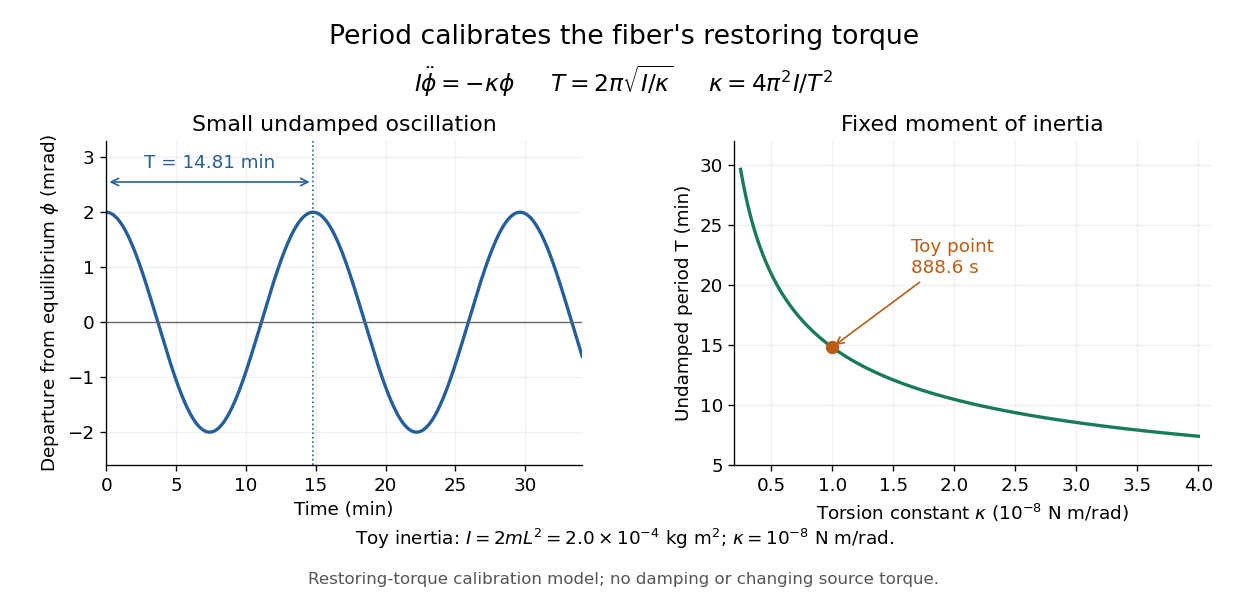
Undamped small torsional oscillations calibrate the restoring torque: a softer fiber has a longer period
. Details. Combining the equilibrium twist with the period calibration, the two-near-pair model would infer the gravitational constant asThe test mass cancels in the second expression because it enters both the gravitational torque and the toy moment of inertia. If the measured quantity is the magnitude of the change between opposite source positions, use . Substituting the toy twist and oscillation period returns the input ; it is a consistency check, not independent experimental evidence.
The sensitivity of a Cavendish torsion balance also explains its practical difficulty. Air motion can exert unwanted torque; unequal temperatures can drive that motion. Cavendish discusses this effect on p. 471 and describes observing from outside a closed room to avoid disturbing the instrument. [ref]
https://www.infinitoteatrodelcosmo.it/wp-content/uploads/2021/07/cavendish-1997-xxi-experiments-to-determine-the-density-of-the-earth.pdf. Cavendish (1798), original paper, p. 471: temperature-driven air currents and remote observation
Mechanical vibrations can excite the same slow oscillations used to calibrate the torsion constant, while changes in the fiber or source separations alter the inferred force. Precision therefore depends on resolving the equilibrium angle, calibrating the full suspended moment of inertia and torsion constant, and modeling the actual source geometry. The two-near-pair model omits opposite-source attraction, rod contributions, finite-size effects, damping, and the variation of gravitational torque as the rod turns. [ref]https://sciencedemonstrations.fas.harvard.edu/presentations/cavendish-experiment. Harvard Cavendish demonstration: sensitivity, settling, and separation-dependent measurement
Analytic Goursat problem for a Klein--Gordon equation by  Codex 0 Created 2026-09-28 Updated 2026-10-05
In null coordinates, the characteristic boundary problemis a Volterra integral equation. Compatible analytic boundary data determine a unique analytic solution.
A Cauchy random variable is a random variable having a Cauchy distribution. For a standard Cauchy random variable ,
Finite-limit-and-colimit preserving endofunctor of sets by Codex 0 Created 2026-09-28 Updated 2026-10-05
Codex 0 Created 2026-09-28 Updated 2026-10-05An endofunctor preserving finite limits and finite colimits has a unique natural monomorphism . It also preserves countable coproducts. If some is not surjective, the extra element determines a countably complete nonprincipal ultrafilter on .
The category is the full subcategory on bounded metric spaces. It has finite products: the terminal space is a singleton and
Pinned article: Introduction to the OurBigBook Project
Welcome to the OurBigBook Project! Our goal is to create the perfect publishing platform for STEM subjects, and get university-level students to write the best free STEM tutorials ever.
Everyone is welcome to create an account and play with the site: ourbigbook.com/go/register. We belive that students themselves can write amazing tutorials, but teachers are welcome too. You can write about anything you want, it doesn't have to be STEM or even educational. Silly test content is very welcome and you won't be penalized in any way. Just keep it legal!
Intro to OurBigBook
. Source. We have two killer features:
- topics: topics group articles by different users with the same title, e.g. here is the topic for the "Fundamental Theorem of Calculus" ourbigbook.com/go/topic/fundamental-theorem-of-calculusArticles of different users are sorted by upvote within each article page. This feature is a bit like:
- a Wikipedia where each user can have their own version of each article
- a Q&A website like Stack Overflow, where multiple people can give their views on a given topic, and the best ones are sorted by upvote. Except you don't need to wait for someone to ask first, and any topic goes, no matter how narrow or broad
This feature makes it possible for readers to find better explanations of any topic created by other writers. And it allows writers to create an explanation in a place that readers might actually find it.
Figure 1. Screenshot of the "Derivative" topic page. View it live at: ourbigbook.com/go/topic/derivativeVideo 2. OurBigBook Web topics demo. Source. - local editing: you can store all your personal knowledge base content locally in a plaintext markup format that can be edited locally and published either:This way you can be sure that even if OurBigBook.com were to go down one day (which we have no plans to do as it is quite cheap to host!), your content will still be perfectly readable as a static site.
- to OurBigBook.com to get awesome multi-user features like topics and likes
- as HTML files to a static website, which you can host yourself for free on many external providers like GitHub Pages, and remain in full control

Figure 2. You can publish local OurBigBook lightweight markup files to either OurBigBook.com or as a static website.
Figure 3. Visual Studio Code extension installation.
Figure 5. . You can also edit articles on the Web editor without installing anything locally. Video 3. Edit locally and publish demo. Source. This shows editing OurBigBook Markup and publishing it using the Visual Studio Code extension. 
- Infinitely deep tables of contents:




All our software is open source and hosted at: github.com/ourbigbook/ourbigbook
Further documentation can be found at: docs.ourbigbook.com
Feel free to reach our to us for any help or suggestions: docs.ourbigbook.com/#contact