Topics (384k) Articles (398k) Users (410) Discussions (242) Comments (383) Files (13k) New article

A Robin boundary condition prescribes a linear combination of a function and its outward normal derivative on the boundary.
A vanishing boundary condition sets a specified boundary quantity to zero. The quantity must be named: zero boundary value is a homogeneous Dirichlet boundary condition, while zero outward normal derivative is a homogeneous Neumann boundary condition. These are different restrictions.
Which boundary terms disappear under integration by parts depends on the operator and the permitted test functions. For a second-order weak problem, zero test-function trace eliminates . A fourth-order problem can also involve derivative traces, so a zero value alone does not remove every boundary term. On , vanishes at both endpoints but has nonzero endpoint first derivatives; the clamped boundary condition would require those slopes to vanish as well.
For outside the Mandelbrot set, evaluate the dynamical Böttcher coordinate at the critical value:This parameter Böttcher map is a conformal isomorphism from the complement of the Mandelbrot set to the exterior unit disc, proving that the Mandelbrot set is full and connected.
The escape-rate Green function isIt vanishes on the filled Julia set, is positive and harmonic on the basin of infinity, satisfies , and equals near infinity and by continuation throughout the basin.
Complex Bott periodicity gives
Let be the tautological bundle on . One sign convention for the Bott element iswhere is the rank-one trivial vector bundle. It has rank zero, and its Chern character has degree-two term , a generator up to sign. Choosing the dual line bundle reverses that sign.
The -fold reduced external product in topological K-theory gives a generator ofThis product uses the smash product of different sphere factors. It is distinct from taking exterior powers of a vector bundle over one fixed base. Multiplication by the Bott element realizes Bott periodicity.[ref]
A down-set is a family such that and imply . It is the complement of an up-set within the same Boolean lattice.
This is the downward-closed Boolean-lattice case of upper and lower sets.
An up-set is upward closed under inclusion: if belongs and , then belongs. This is the Boolean-lattice case of upper and lower sets.
Bondi--Hoyle--Lyttleton accretion is gravitational capture by a compact object moving through a gas. In the pressureless supersonic limit, ballistic streamlines focus into a downstream wake.
Randomly oriented binary angular-momentum vectors are uniform in . After identifying with , their normalized inclination density on is .
Number conservation under the displacement from Lagrangian coordinates to Eulerian coordinates givesThe added one is the linear matter-density response of the coordinate Jacobian.
A cardinal is 1-strong when it is the critical point of an elementary embedding into a transitive model satisfying .
The Beta function obeysThese identities follow immediately from the beta-gamma identity and the Gamma function recurrence.
A posterior probability is the probability assigned to an event by the posterior distribution after conditioning on the observed data.
A Bayes factor measures how data change the relative support for two specified statistical models. Write for their Bayesian model evidence and define the direction explicitly:For positive finite , a value above one favors over ; a value below one favors over . Reversing the comparison gives , the opposite direction used in some formulas below.
For mutually exclusive, exhaustive with positive prior probabilities, divide their two Bayes' theorem formulas. Their common data normalizer cancels, leavingThe Bayes factor therefore multiplies prior odds into posterior odds. It is evidence conditional on the specified statistical models and their within-model prior distributions; it is not . Model prior probabilities supply a separate input.[ref]
Bayes Factors by Robert E. Kass and Adrian E. Raftery. Kass and Raftery, Bayes Factors (1995), section 3.1, p. 776: posterior odds, prior odds, and direction of the Bayes factor
For an original stipulated example, consider ten independent and identically distributed Bernoulli trials, with heads as success. Compare with , both fixed before seeing the data. Take to be one particular ordered sequence containing eight heads and two tails. The likelihood function under either point model is , soIf , the prior odds for against are . Hence the posterior odds are , andEqual model prior probabilities would instead give . The same Bayes factor can thus accompany different posterior probabilities. These statements condition on the two-model comparison; they do not establish that either statistical model describes a real coin.
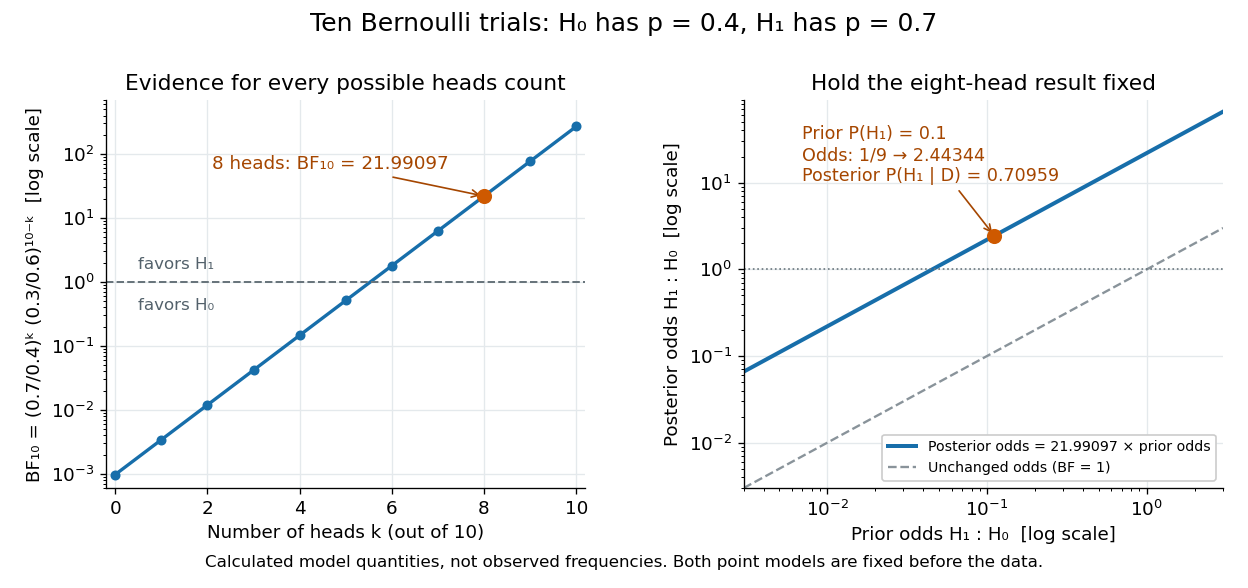
Using the heads count instead of the ordered sequence changes the sample space. The binomial distribution assigns it mass . The same binomial coefficient multiplies both models' Bayesian model evidence and cancels in their Bayes factor. Mixing an ordered-sequence numerator with a count denominator would introduce an erroneous factor of .
Fix the candidate statistical models, their parameter prior distributions, and model prior probabilities before using the current data for this update. The Bayes factor is useful because it separates evidence from model prior odds, but it still depends on the parameter prior distributions. An improper prior has an arbitrary multiplicative normalization: multiplying its kernel by multiplies its formal marginal likelihood by , even if the within-model posterior distribution is normalizable. Without a separately justified convention, the ordinary Bayes factor is then undefined up to arbitrary constants.[ref]
Bayes Factors by Robert E. Kass and Adrian E. Raftery. Kass and Raftery, Bayes Factors (1995), sections 5.2–5.3, pp. 782–783: prior sensitivity and undefined multiplicative constants
Pinned article: Introduction to the OurBigBook Project
Welcome to the OurBigBook Project! Our goal is to create the perfect publishing platform for STEM subjects, and get university-level students to write the best free STEM tutorials ever.
Everyone is welcome to create an account and play with the site: ourbigbook.com/go/register. We belive that students themselves can write amazing tutorials, but teachers are welcome too. You can write about anything you want, it doesn't have to be STEM or even educational. Silly test content is very welcome and you won't be penalized in any way. Just keep it legal!
Intro to OurBigBook
. Source. We have two killer features:
- topics: topics group articles by different users with the same title, e.g. here is the topic for the "Fundamental Theorem of Calculus" ourbigbook.com/go/topic/fundamental-theorem-of-calculusArticles of different users are sorted by upvote within each article page. This feature is a bit like:
- a Wikipedia where each user can have their own version of each article
- a Q&A website like Stack Overflow, where multiple people can give their views on a given topic, and the best ones are sorted by upvote. Except you don't need to wait for someone to ask first, and any topic goes, no matter how narrow or broad
This feature makes it possible for readers to find better explanations of any topic created by other writers. And it allows writers to create an explanation in a place that readers might actually find it.
Figure 1. Screenshot of the "Derivative" topic page. View it live at: ourbigbook.com/go/topic/derivativeVideo 2. OurBigBook Web topics demo. Source. - local editing: you can store all your personal knowledge base content locally in a plaintext markup format that can be edited locally and published either:This way you can be sure that even if OurBigBook.com were to go down one day (which we have no plans to do as it is quite cheap to host!), your content will still be perfectly readable as a static site.
- to OurBigBook.com to get awesome multi-user features like topics and likes
- as HTML files to a static website, which you can host yourself for free on many external providers like GitHub Pages, and remain in full control

Figure 2. You can publish local OurBigBook lightweight markup files to either OurBigBook.com or as a static website.
Figure 3. Visual Studio Code extension installation.
Figure 5. . You can also edit articles on the Web editor without installing anything locally. Video 3. Edit locally and publish demo. Source. This shows editing OurBigBook Markup and publishing it using the Visual Studio Code extension. 
- Infinitely deep tables of contents:



All our software is open source and hosted at: github.com/ourbigbook/ourbigbook
Further documentation can be found at: docs.ourbigbook.com
Feel free to reach our to us for any help or suggestions: docs.ourbigbook.com/#contact