Topics (384k) Articles (398k) Users (410) Discussions (242) Comments (383) Files (13k) New article

Let be the image of all additive second differencesIf a subspace satisfies , then the restriction of to the inverse image of every coset of is a Freiman homomorphism.
A map is a Freiman -homomorphism whenimplies the corresponding equality between the . It is a Freiman -isomorphism when it is bijective and the converse implication also holds.
Every finitely generated free group is a residually finite group. For , the ping-pong lemma embeds it into , and reduction modulo a prime in an integral matrix group separates each nonidentity element in a finite quotient.
Suppose nontrivial groups act on a set and there are disjoint nonempty subsets such that every nonidentity element of maps into , while every nonidentity element of maps into . Assume at least one factor has at least three elements. Then the subgroup generated by and is their free product. The cardinality hypothesis excludes the counterexample in which acts by swapping and . Versions allowing both factors to have order two need an additional separation hypothesis.
Let , and let be a uniform set family of -element subsets of . If distinct members have at most possible intersection sizes, then the Ray-Chaudhuri–Wilson theorem givesFor , let be the allowed intersection sizes and use, over the rational numbers, the intersection polynomialsTheir evaluation on the family's characteristic vectors of sets is diagonal with nonzero diagonal, so they are linearly independent. The low-degree evaluation rank on a uniform layer bounds the space of their restrictions by . If , the bound follows directly from .[ref]
On t-designs by Dijen K. Ray-Chaudhuri and Richard M. Wilson. Theorem3, printed pages741–742
A proportional frailty model has conditional hazard . Its conditional survival function is , so its population survival function is the Laplace transform of the frailty distribution evaluated at .
For an additive character of a non-Archimedean local field ,For the character induced from the standard character of , this annihilator is the inverse different.
The Fermi constant is the coefficient conventionally used for the low-energy charged-current weak interaction. Tree-level exchange of a boson gives .
The finite satisfiability problem asks whether a first-order sentence has a finite model. It is computably enumerable because finite structures and their truth relations can be searched effectively.
Let be commutative rings. If is Noetherian, is a finitely generated algebra over , and is a finitely generated module over , then is a finitely generated algebra over .[ref]
Choose algebra generators for over and module generators for over . Express every as a -linear combination of the . Let be the -subalgebra generated by the finitely many coefficients in these expressions. The -module contains one and is stable under multiplication by every , so . Thus is finite as a -module.
The Hilbert basis theorem makes Noetherian. Hence its submodule is finitely generated over . Combining those module generators with the finite algebra generators of gives finitely many algebra generators for over .
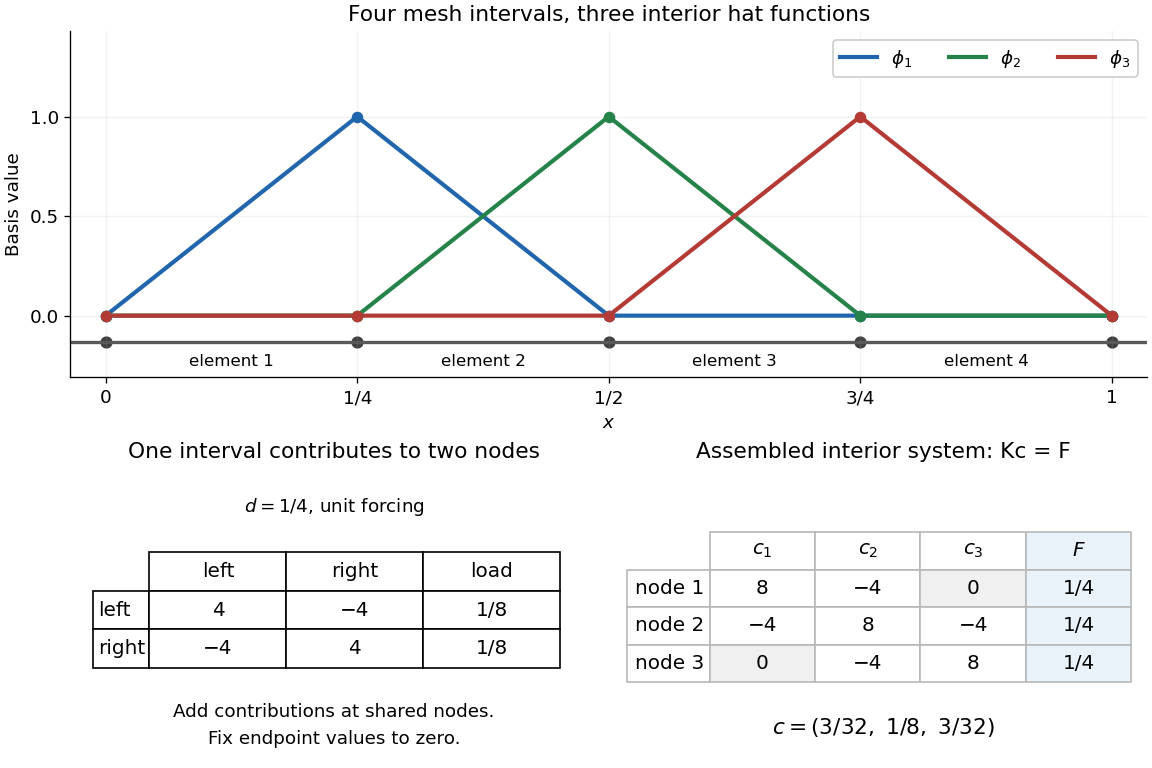
A piecewise-linear hat function is a continuous piecewise linear function that selects one node of a finite element mesh: it is one there and zero at every other node. For an interior node , its exact formula on a possibly nonuniform mesh isIts support of a function is . It rises on the left interval and falls on the right, producing its hat-shaped graph. The interior hat functions form a basis of the continuous conforming finite element space with homogeneous Dirichlet boundary conditions. Chen's author notes define this nodal basis and illustrate it in one and two dimensions.[ref]
https://webapps.math.uci.edu/~chenlong/226/Ch2FEM.pdf. Chen, Introduction to Finite Element Methods, §3.1, pp. 5–6 and Figure 5: nodal hat basis
The nodal property makes the coefficients directly readable: if , then . Unlike the global Lagrange cardinal polynomials, each of these functions is confined to two neighboring elements.For example, with , the middle hat function is on , on , and zero elsewhere. Hence , while and . The finite element solution of the one-dimensional Poisson equation therefore has .
Local assembly makes this locality computational. On an element of length , the two local basis functions are and . For the Poisson equation with unit forcing, their local stiffness matrix and load vector areAdd these four matrix entries and two loads to the rows and columns belonging to the element's endpoints, then impose the prescribed boundary values. An interior node receives contributions from its two neighboring elements. Writing and giveswith off-diagonal entries included only for interior neighbors. On a uniform mesh these reduce to , and . Nonadjacent hat functions have no derivative overlap of positive length, so all distant entries vanish. This produces a sparse matrix with only three diagonals: the global coupling is built entirely from local two-node interactions.
A one-dimensional Cubic Hermite finite element represents a cubic polynomial on by its value and first derivative at each endpoint. Put and . Its four reference shape functions areThe interpolating polynomial isThus , , and . The factors convert reference-coordinate derivatives to physical derivatives. These conditions determine the cubic uniquely: a difference with zero endpoint values and slopes would have two double roots, impossible for a nonzero cubic.
Sharing both value and slope between adjacent intervals produces globally piecewise cubics in Sobolev space . With the required endpoint constraints, they form a conforming finite element space for fourth-order variational problems, such as a bending problem whose energy contains . Ordinary continuous piecewise-linear elements have slope jumps and do not have this conformity.
For a well-posed linear initial-value problem and a consistent finite-difference approximation, stability is equivalent to convergence.
The method of lines discretizes space in a time-dependent partial differential equation while leaving time continuous, producing a finite system of ordinary differential equations.
A discrete elliptic operator satisfies a discrete maximum principle when a grid function with nonnegative discrete Laplacian cannot have a positive interior maximum unless it is constant. It yields uniqueness and max-norm stability estimates for Dirichlet finite-difference problems.
With homogeneous Dirichlet boundary conditions, centered differences turn one-dimensional diffusion into a symmetric negative-definite matrix and constant advection into a skew-symmetric matrix. Their sum dissipates the discrete Euclidean norm, giving mesh-uniform energy stability for every fixed advection coefficient.
Fourier stability analysis transforms a translation-invariant finite-difference scheme into scalar or matrix recurrences indexed by wavenumber. The Parseval identity then converts uniform multiplier bounds into discrete -norm bounds.
Pinned article: Introduction to the OurBigBook Project
Welcome to the OurBigBook Project! Our goal is to create the perfect publishing platform for STEM subjects, and get university-level students to write the best free STEM tutorials ever.
Everyone is welcome to create an account and play with the site: ourbigbook.com/go/register. We belive that students themselves can write amazing tutorials, but teachers are welcome too. You can write about anything you want, it doesn't have to be STEM or even educational. Silly test content is very welcome and you won't be penalized in any way. Just keep it legal!
Intro to OurBigBook
. Source. We have two killer features:
- topics: topics group articles by different users with the same title, e.g. here is the topic for the "Fundamental Theorem of Calculus" ourbigbook.com/go/topic/fundamental-theorem-of-calculusArticles of different users are sorted by upvote within each article page. This feature is a bit like:
- a Wikipedia where each user can have their own version of each article
- a Q&A website like Stack Overflow, where multiple people can give their views on a given topic, and the best ones are sorted by upvote. Except you don't need to wait for someone to ask first, and any topic goes, no matter how narrow or broad
This feature makes it possible for readers to find better explanations of any topic created by other writers. And it allows writers to create an explanation in a place that readers might actually find it.
Figure 1. Screenshot of the "Derivative" topic page. View it live at: ourbigbook.com/go/topic/derivativeVideo 2. OurBigBook Web topics demo. Source. - local editing: you can store all your personal knowledge base content locally in a plaintext markup format that can be edited locally and published either:This way you can be sure that even if OurBigBook.com were to go down one day (which we have no plans to do as it is quite cheap to host!), your content will still be perfectly readable as a static site.
- to OurBigBook.com to get awesome multi-user features like topics and likes
- as HTML files to a static website, which you can host yourself for free on many external providers like GitHub Pages, and remain in full control

Figure 2. You can publish local OurBigBook lightweight markup files to either OurBigBook.com or as a static website.
Figure 3. Visual Studio Code extension installation.
Figure 5. . You can also edit articles on the Web editor without installing anything locally. Video 3. Edit locally and publish demo. Source. This shows editing OurBigBook Markup and publishing it using the Visual Studio Code extension. 
- Infinitely deep tables of contents:



All our software is open source and hosted at: github.com/ourbigbook/ourbigbook
Further documentation can be found at: docs.ourbigbook.com
Feel free to reach our to us for any help or suggestions: docs.ourbigbook.com/#contact