Topics (384k) Articles (398k) Users (410) Discussions (242) Comments (383) Files (13k) New article
An inner product space is a real or complex vector space equipped with a positive-definite inner product. Over the real numbers the form is symmetric and bilinear; over the complex numbers it is conjugate symmetric and sesquilinear. It defines the norm . The Cauchy-Schwarz inequality proves the triangle inequality for this norm. A complete inner product space is a Hilbert space; every finite-dimensional inner product space is complete.
For vectors , the binary inner product is the bilinear formIts value is the parity of the coordinates at which both vectors are one. For example, , whereas because in the finite field .
The terminology does not impose the positive definiteness axiom of a real or complex inner product. A nonzero vector can have zero self-pairing, as the second example shows. The form is nevertheless a nondegenerate bilinear form: a nonzero coordinate of is detected by pairing with the corresponding standard basis vector. This pairing defines orthogonality and dual codes in coding theory.
A dot product measures how much two Euclidean vectors point along each other. This article uses real Euclidean vectors in , with the usual Cartesian basis: multiply matching coordinates and add,The result is a scalar, while is the Euclidean norm. This real convention has no complex conjugation; for vectors over the complex numbers, use the convention specified in inner product.
For two nonzero Euclidean vectors, the same dot product records their angle through the cosine:Here is an inverse trigonometric function. The Cauchy-Schwarz inequality guarantees that the normalized ratio lies in . The zero vector has dot product zero with every vector, but its angle is undefined: the ratio would divide by zero. To outline the geometric identity, expand and compare with the law of cosines.[ref]
Take and . Their Euclidean norms are and , andThe unit vector selects the horizontal direction. The scalar projection says how far reaches along that direction; its vector projection is . Thus splits into an aligned part and an orthogonal projection residual.
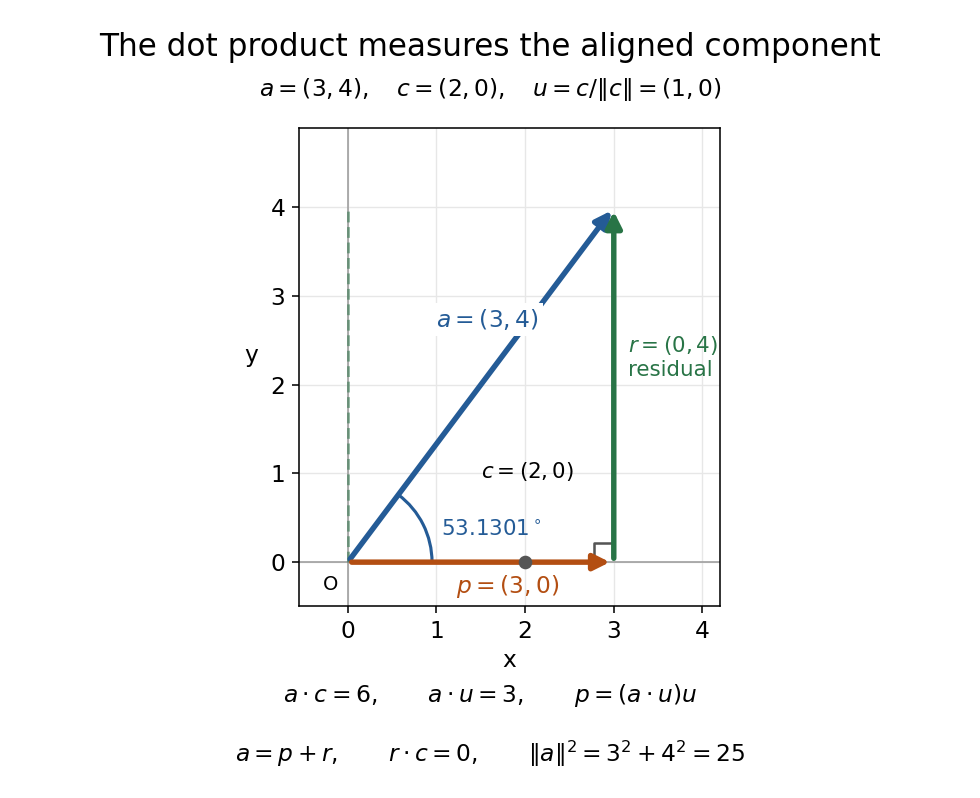
The vector projection of onto the horizontal line is ; the orthogonal projection residual is and the angle is
. Details. For , the dot product proves orthogonality; both Euclidean norms are . For , : the scalar projection onto is , because reaches against that chosen direction. Its angle with is .
Keeping fixed and choosing of Euclidean norm gives . At angles , the dot products are . Positive values mean partial alignment, zero means orthogonality, and negative values mean a component against the other direction.
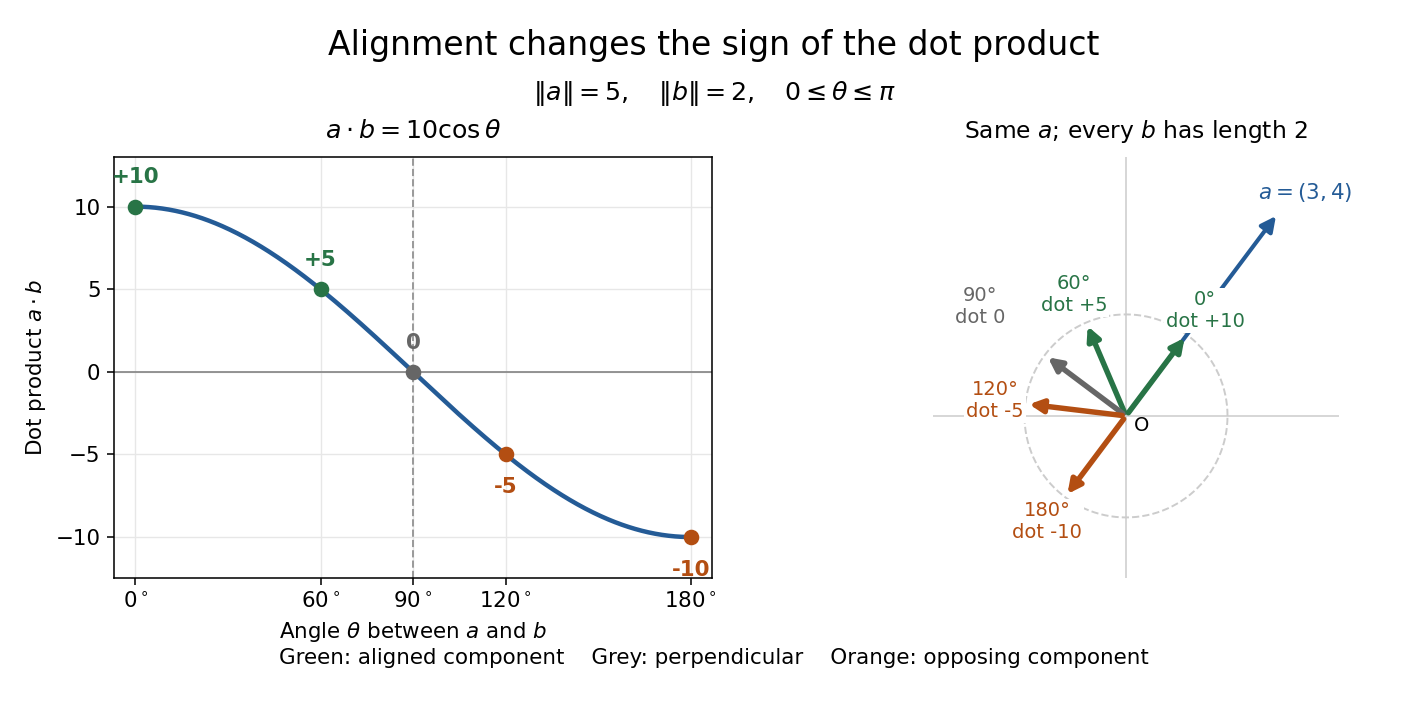
With Euclidean norms and , the dot product follows ; equal-length arrows show positive, zero, and negative alignment with
. Details. For probability mass functions and convex weights , information entropy satisfiesThis follows from the concavity of .
For a discrete random variable with a finite or countable alphabet and probability mass function , define . Its min-entropy, using base-two logarithms, isThe unit is the bit. This is the smallest information content of any possible outcome: it records the easiest outcome to predict, whereas Shannon entropy averages information content over all outcomes. A normalized countable probability mass function has an attained positive maximum, so is finite even when Shannon entropy is infinite. Outcomes of zero probability cannot minimize the surprise and are omitted from the minimum; including extra impossible symbols changes neither quantity.[ref]
https://www.cs.cornell.edu/courses/cs6830/2009fa/lecnotes.pdf. Pass and shelat, A Course in Cryptography, Section 8.3.2, Definition 148.1
Suppose someone knows the probability mass function but receives no observation correlated with , and must name exactly one outcome. Naming succeeds with probability , so naming a most likely outcome is optimal:Tied maxima give equally good guesses. Randomizing independently among guesses cannot improve success: if the guess has probability mass function , its success probability is . This is the simplest instance of maximum a posteriori decoding. The identity gives min-entropy an operational meaning: bits means every single guess succeeds with probability at most , under these information assumptions.[ref]
https://arxiv.org/html/0807.1338. König, Renner and Schaffner, The operational meaning of min- and max-entropy, Section I.3.1, equation (18) and the no-side-information case
For an exact analytical example on symbols , compare the two probability mass functionsUnder , each possible outcome has information content bits; under , has information content bit and each other outcome has bits. Consequently their Shannon entropies agree exactly,but and bits. A best single guess therefore succeeds with probability under and under . The same average surprise can hide a factor of two in immediate predictability. The zero entry in contributes zero to Shannon entropy, using .

For the discrete uniform distribution on possible outcomes, bits and the best single guess succeeds with probability . A certain outcome has and success probability one. Thus min-entropy is useful when a common outcome could defeat an attempt to make outputs unpredictable, even if rare alternatives raise Shannon entropy.
For cryptography, this unconditional calculation alone does not certify security: an observer might know already. If a report reveals a uniform four-outcome source, its unconditional min-entropy remains bits but guessing after the report succeeds with probability one. For finite classical reports, the appropriate success calculation uses conditional probabilities and maximum a posteriori decoding:The conditional entropy instead averages remaining surprise. A security argument must specify the observer's information and the protocol's required guarantee; neither unconditional min-entropy nor Shannon entropy supplies those assumptions.
For target density and proposal density , the importance weight is the density ratio wherever the target is supported.
A horoball in the hyperbolic plane is a region bounded by a horocycle. In the upper-half-plane model, a horoball based at infinity is a Euclidean half-plane ; quotients by parabolic isometries give cusp neighborhoods.
The homotopy fiber of over consists of pairs where is a path from to . It replaces an ordinary fiber by a homotopy-invariant construction.
The relative chain complex is , and its homology is the relative homology . A pair produces a long exact sequence for the triple.
For ,Writing as two contractible hemispheres whose intersection deformation retracts to gives the calculation inductively through the Mayer–Vietoris theorem.
For a closed manifold with an orientation and dimension , its integral intersection form is the symmetric bilinear form onobtained by pairing complementary middle-dimensional homology classes. Under Poincare duality, it is the cup product pairingon degree- integral cohomology modulo its torsion subgroup. The even degree makes the pairing symmetric; integral duality makes it a unimodular intersection pairing. When representatives are transverse oriented submanifolds, the same value is the signed count of their intersection points.
The intersection form of a 4-manifold is the case . On the Complex projective plane its matrix is , whereas on the factor spheres give .
For a compact manifold with boundary, the perfect intersection pairing pairs absolute and relative homology, with ; the induced absolute self-pairing can be degenerate. For instance the core sphere in generates but has self-intersection zero.
The first homology group is the group of one-dimensional cycles modulo boundaries. For a path-connected space it is the abelianization of the fundamental group.
For an open set , the space consists of all holomorphic functions on . Its standard topology is locally uniform convergence, equivalently the compact-open topology defined by the seminorms for compact .
Multiplier relation for three distinct fixed points of a quadratic rational map by  Codex 0 2026-09-28
If a quadratic rational map has three distinct fixed points with multipliers , then for . Otherwise the two corresponding indices already sum to one, contradicting the nonzero third index.
If in , in , and , thenIndeed, split the difference into the weak pairing with and a term bounded by the Holder inequality using .
The Hodge Laplacian acts on differential forms bywhere is the exterior derivative and its codifferential. On a compact oriented Riemannian manifold without boundary, Hodge integration by parts in arbitrary degree givesConsequently a harmonic differential form is both a closed differential form and a coclosed differential form on such a manifold. On a manifold with boundary, the same calculation has boundary terms unless compatible boundary conditions remove them.
On scalar functions, this nonnegative sign convention gives when the Laplace-Beltrami operator is defined as . Stating the convention prevents a sign ambiguity when comparing geometric and analytical formulas.
The Hodge star extends complex-linearly to complex differential forms. With the Hermitian pointwise inner product, it is characterized byOn a Hermitian manifold it maps forms of type to forms of type .
Hodge star on middle-degree differential forms is conformally invariant by Codex 0 Created 2026-09-28 Updated 2026-10-03
Codex 0 Created 2026-09-28 Updated 2026-10-03 Pinned article: Introduction to the OurBigBook Project
Welcome to the OurBigBook Project! Our goal is to create the perfect publishing platform for STEM subjects, and get university-level students to write the best free STEM tutorials ever.
Everyone is welcome to create an account and play with the site: ourbigbook.com/go/register. We belive that students themselves can write amazing tutorials, but teachers are welcome too. You can write about anything you want, it doesn't have to be STEM or even educational. Silly test content is very welcome and you won't be penalized in any way. Just keep it legal!
Intro to OurBigBook
. Source. We have two killer features:
- topics: topics group articles by different users with the same title, e.g. here is the topic for the "Fundamental Theorem of Calculus" ourbigbook.com/go/topic/fundamental-theorem-of-calculusArticles of different users are sorted by upvote within each article page. This feature is a bit like:
- a Wikipedia where each user can have their own version of each article
- a Q&A website like Stack Overflow, where multiple people can give their views on a given topic, and the best ones are sorted by upvote. Except you don't need to wait for someone to ask first, and any topic goes, no matter how narrow or broad
This feature makes it possible for readers to find better explanations of any topic created by other writers. And it allows writers to create an explanation in a place that readers might actually find it.
Figure 1. Screenshot of the "Derivative" topic page. View it live at: ourbigbook.com/go/topic/derivativeVideo 2. OurBigBook Web topics demo. Source. - local editing: you can store all your personal knowledge base content locally in a plaintext markup format that can be edited locally and published either:This way you can be sure that even if OurBigBook.com were to go down one day (which we have no plans to do as it is quite cheap to host!), your content will still be perfectly readable as a static site.
- to OurBigBook.com to get awesome multi-user features like topics and likes
- as HTML files to a static website, which you can host yourself for free on many external providers like GitHub Pages, and remain in full control

Figure 2. You can publish local OurBigBook lightweight markup files to either OurBigBook.com or as a static website.
Figure 3. Visual Studio Code extension installation.
Figure 5. . You can also edit articles on the Web editor without installing anything locally. Video 3. Edit locally and publish demo. Source. This shows editing OurBigBook Markup and publishing it using the Visual Studio Code extension. 
- Infinitely deep tables of contents:




All our software is open source and hosted at: github.com/ourbigbook/ourbigbook
Further documentation can be found at: docs.ourbigbook.com
Feel free to reach our to us for any help or suggestions: docs.ourbigbook.com/#contact