Topics (384k) Articles (398k) Users (410) Discussions (242) Comments (383) Files (13k) New article

A Jacobi field is the infinitesimal connecting vector between neighboring members of a one-parameter family of geodesics. It satisfies the geodesic-deviation equation along the reference geodesic.
A positive operator-valued measure is a family of positive operators satisfying . Each is called an effect and determines a probability for input density operator . The effects need not be orthogonal projections or commute. This permits measurements with more outcomes than the dimension of the Hilbert space, such as the trine qubit POVM. Coupling to a quantum ancilla and measuring the larger system supplies a physical route to generalized measurements. [ref]
https://www.preskill.caltech.edu/ph229/notes/chap3.pdf. Preskill, Quantum Information, §§3.1.2–3.1.4
.For an elementary unsharp example on a qubit, takeOn the eigenstate , ; at they are and . At the outcome is a fair coin independent of the input, and at these effects specify a sharp projective measurement. Choosing specifies one quantum instrument, but for outcome-dependent unitary operators has the same effects and different state updates. Thus POVM does not determine the post-measurement state.
For and , let be a positive decaying solution of . Thensatisfies , and is a traveling-wave solution of the Generalized Korteweg–De Vries equation.
For sufficiently smooth real solutions of the Generalized Korteweg–De Vries equation with enough decay to remove boundary terms, the mass and energyare constant in time. To check mass conservation, multiply the equation by and use integration by parts. The linear term gives , and the nonlinear term is a total derivative proportional to .
For energy conservation, put . Differentiating the energy functional givesbecause . Extending these identities to rougher solution classes requires the corresponding approximation and local well-posedness theory; the displayed computation is the smooth-decay argument.
A Gaussian path integral over a bosonic field with quadratic operator produces a factor proportional to . When depends on background fields, this functional determinant contributes to their quantum effective action.
The Skyrme model is a nonlinear sigma model for an -valued field supplemented by a four-derivative term that evades Derrick collapse. Its topological degree is baryon number, and finite-energy solitons are Skyrmions.
A flat connection has vanishing curvature. On a simply connected patch it is gauge equivalent to the zero connection, because the parallel-transport equation has path-independent solutions.
A critical coupling is a coupling value at which a gap equation first admits a massless solution. Tuning through it can separate symmetric gapped and symmetry-broken phases.
For real and , the change of variables in the defining improper integral for the Gamma function givesThe improper integral converges absolutely: near zero its absolute integrand behaves like , and at infinity the exponential function overcomes every fixed power.[ref]
For real and , the integrands are , , and , with total areas , , and . The third integrand is taller and has six times the area of the first, although the exponential function makes each tail decay.
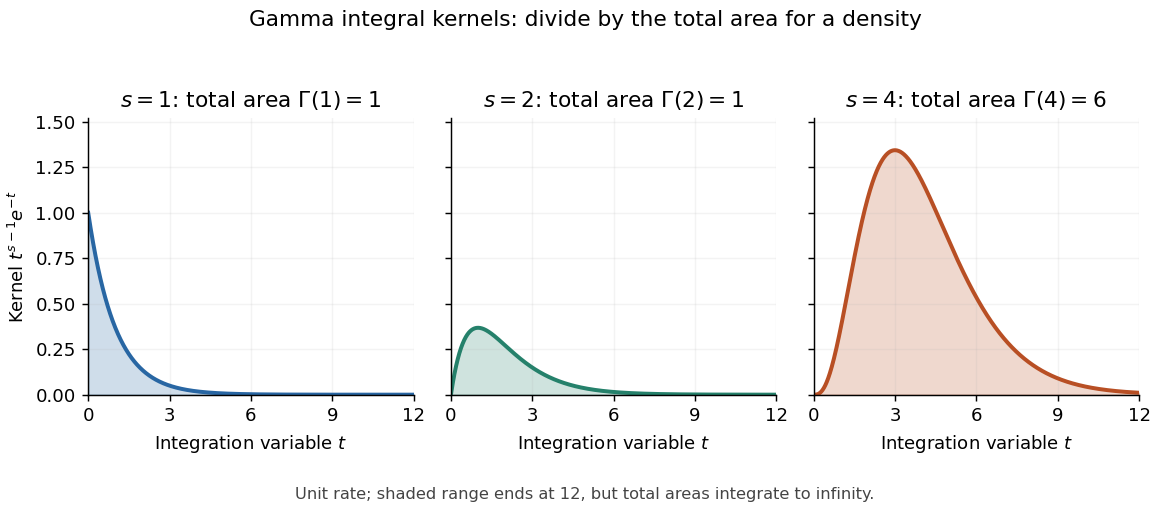
Gamma integral kernels for shapes 1, 2, and 4 have total areas 1, 1, and 6 before probability normalization
. Details. For real , the kernel becomes the probability density function of a Gamma distribution with shape and unit rate only after division by its normalizing constant . In particular, the shape-four probability density function is . More generally, the Gamma integral verifies that integrates to one for shape and rate .
For the half-integer evaluation, the change of variables reduces the Gamma integral to the Gaussian integral:Consequently, for real ,
A flat galaxy rotation curve has approximately constant circular speed over a radial interval. Under spherical symmetry it implies and mass density .
In a spherical potential, the circular speed satisfiesIt measures the gravitational field even when the system itself is not supported by circular motion.
Galactic chemical evolution follows the production, transport, dilution, locking, and loss of chemical elements as stars form and die and gas enters or leaves a galaxy.
Stellar feedback is the transfer of energy, momentum, mass, and newly formed elements from stars to surrounding matter through radiation, winds, supernovae, and cosmic rays.
For treatment history , observed history , and final potential outcome , sequential exchangeability requiresat every treatment time. Together with consistency of potential outcomes and positivity in causal inference, it identifies longitudinal effects by G-computation.
A projection map from a Cartesian product selects specified coordinates. For the coordinate indexed by ,For example, forgets the second component of an ordered pair.
The product topology makes each coordinate projection map a continuous map. In the two-factor case , surjectivity depends on whether the omitted factor has an element, subject to the empty-set cases for Cartesian projections. For an arbitrary infinite family, simultaneous existence of the other coordinates can also involve the axiom of choice.
A regular singular point is a singularity at which solutions of a linear differential equation have at worst controlled power and logarithmic behavior after a Frobenius reduction.
Suppose every derivative on takes at most values. Then restricts to a Freiman homomorphism on a set of density at least . The proof bounds the second-difference image by and chooses a random subspace avoiding its nonzero elements.
Pinned article: Introduction to the OurBigBook Project
Welcome to the OurBigBook Project! Our goal is to create the perfect publishing platform for STEM subjects, and get university-level students to write the best free STEM tutorials ever.
Everyone is welcome to create an account and play with the site: ourbigbook.com/go/register. We belive that students themselves can write amazing tutorials, but teachers are welcome too. You can write about anything you want, it doesn't have to be STEM or even educational. Silly test content is very welcome and you won't be penalized in any way. Just keep it legal!
Intro to OurBigBook
. Source. We have two killer features:
- topics: topics group articles by different users with the same title, e.g. here is the topic for the "Fundamental Theorem of Calculus" ourbigbook.com/go/topic/fundamental-theorem-of-calculusArticles of different users are sorted by upvote within each article page. This feature is a bit like:
- a Wikipedia where each user can have their own version of each article
- a Q&A website like Stack Overflow, where multiple people can give their views on a given topic, and the best ones are sorted by upvote. Except you don't need to wait for someone to ask first, and any topic goes, no matter how narrow or broad
This feature makes it possible for readers to find better explanations of any topic created by other writers. And it allows writers to create an explanation in a place that readers might actually find it.
Figure 1. Screenshot of the "Derivative" topic page. View it live at: ourbigbook.com/go/topic/derivativeVideo 2. OurBigBook Web topics demo. Source. - local editing: you can store all your personal knowledge base content locally in a plaintext markup format that can be edited locally and published either:This way you can be sure that even if OurBigBook.com were to go down one day (which we have no plans to do as it is quite cheap to host!), your content will still be perfectly readable as a static site.
- to OurBigBook.com to get awesome multi-user features like topics and likes
- as HTML files to a static website, which you can host yourself for free on many external providers like GitHub Pages, and remain in full control

Figure 2. You can publish local OurBigBook lightweight markup files to either OurBigBook.com or as a static website.
Figure 3. Visual Studio Code extension installation.
Figure 5. . You can also edit articles on the Web editor without installing anything locally. Video 3. Edit locally and publish demo. Source. This shows editing OurBigBook Markup and publishing it using the Visual Studio Code extension. 
- Infinitely deep tables of contents:



All our software is open source and hosted at: github.com/ourbigbook/ourbigbook
Further documentation can be found at: docs.ourbigbook.com
Feel free to reach our to us for any help or suggestions: docs.ourbigbook.com/#contact