Entropy density of a photon gas
ID: entropy-density-of-a-photon-gas

The entropy density of a photon gas is its entropy per physical volume, . For homogeneous equilibrium vacuum radiation with two states of electromagnetic polarization and zero photon chemical potential,The first equality is the entropy density at zero chemical potential, obtained from the thermodynamic Euler relation with internal energy . The second uses the photon gas equation of state, and . If an independently constrained photon number gives a nonzero chemical potential, the general entropy density is and need not hold. This distinction explains why the absence of a conserved number matters for entropy as well as for the spectral shape. [ref]
https://davidtong.org/teaching/statistical-physics/statmechhtml/S4#S4.SS4. David Tong, Statistical Physics, §4.4: Gibbs free energy and the thermodynamic Euler relation
A short first law of thermodynamics check, for neighboring equilibrium states with , isThe thermodynamic Euler relation fixes the additive normalization. Equivalently, this radiation entropy tends to zero with temperature at fixed volume; no contribution from the containing walls is included. Interpreting as transferred heat and as boundary work requires a reversible thermodynamic process. For a reversible thermodynamic process that is also an adiabatic process, there is no entropy production or entropy exchange, soAn irreversible adiabatic process can produce entropy even without heat exchange, so the word adiabatic alone is insufficient to infer .
For an analytic example, expand an initially equilibrated photon gas reversibly from to , keeping only the same two photon states of electromagnetic polarization. Its temperature halves, its energy density becomes , its entropy density of a photon gas becomes , and its total entropy stays . The internal energy halves rather than remaining fixed: the missing half leaves as work against radiation pressure,This is a stipulated reversible radiation model, not a report of a piston experiment. Maintaining a real cavity along this path requires controlling wall heat exchange and including the wall heat capacity in any actual apparatus balance.
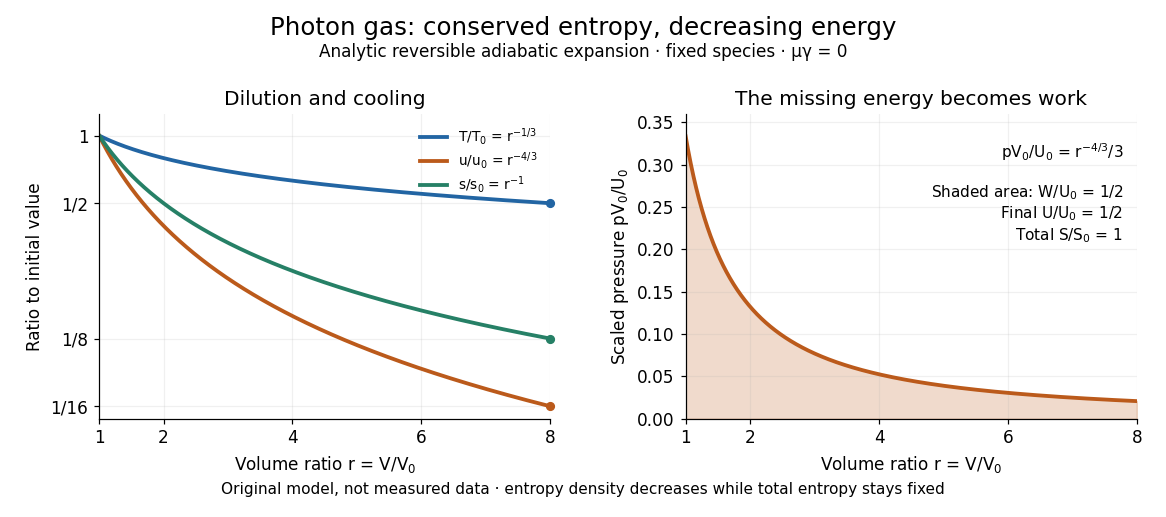

For a computed scale at stipulated , . Combining this with the photon number density givesThis is the total equilibrium radiation entropy divided by its mean photon number, not a separately assigned entropy carried by each labeled particle. During the ideal expansion, and is fixed, so the mean number also stays constant. This follows from the path; it was not imposed as the independent number constraint used to establish chemical potential.
The beautiful connection is that expansion lowers each typical photon energy and dilutes the radiation in just the proportions needed to retain its equilibrium spectral shape and total entropy. For the cosmic microwave background, homogeneous expansion of the universe has physical volume proportional to the cube of the scale factor; fixed-species cosmological entropy conservation therefore gives . This describes preservation of an already established Planck photon distribution and connects the FIRAS spectral observation in photon gas to an entropy prediction; FIRAS did not perform a direct entropy measurement. When other equilibrated species disappear and transfer energy into radiation, use the effective number of relativistic entropy degrees of freedom, : the conserved quantity for the combined sector is , under the corresponding equilibrium and no-entropy production assumptions. A changing species population, separate decoupled sectors or entropy production requires an appropriate entropy balance rather than the pure photon gas formula. [ref]
https://davidtong.org/teaching/cosmology/cosmohtml/S2#S2.SS5.SSS2. David Tong, Cosmology, §2.5.2: entropy conservation and heating when relativistic species disappear
New to topics? Read the docs here!