Solvation thermodynamic balance
ID: solvation-thermodynamic-balance

At fixed temperature and pressure, compare fully specified initial and final states usingThe entropy change is for the whole selected system, including both solute and solvent. Dispersing a solute can increase accessible arrangements while orienting nearby solvent molecules restricts others. One picture of an ordered hydration shell cannot determine the sign of the total entropy change. A negative Gibbs free energy change favors the specified process; it does not determine its reaction rate.[ref]
An illustrative enthalpy accounting path separates solute constituents, reorganizes the solvent, and establishes their interactions:This is a chosen decomposition between compatible states, not a measured sequence. If a gaseous-ion-to-chemical solution solvation term already includes solvent reorganization, do not add that reorganization a second time. Lattice enthalpy from solution calorimetry gives the alternative Hess's law route that combines lattice separation with the complete hydration of ions term.[ref]
11.1 The Dissolution Process. Chemistry 2e by Paul Flowers and others; “The Formation of Solutions”, Figure 11.4
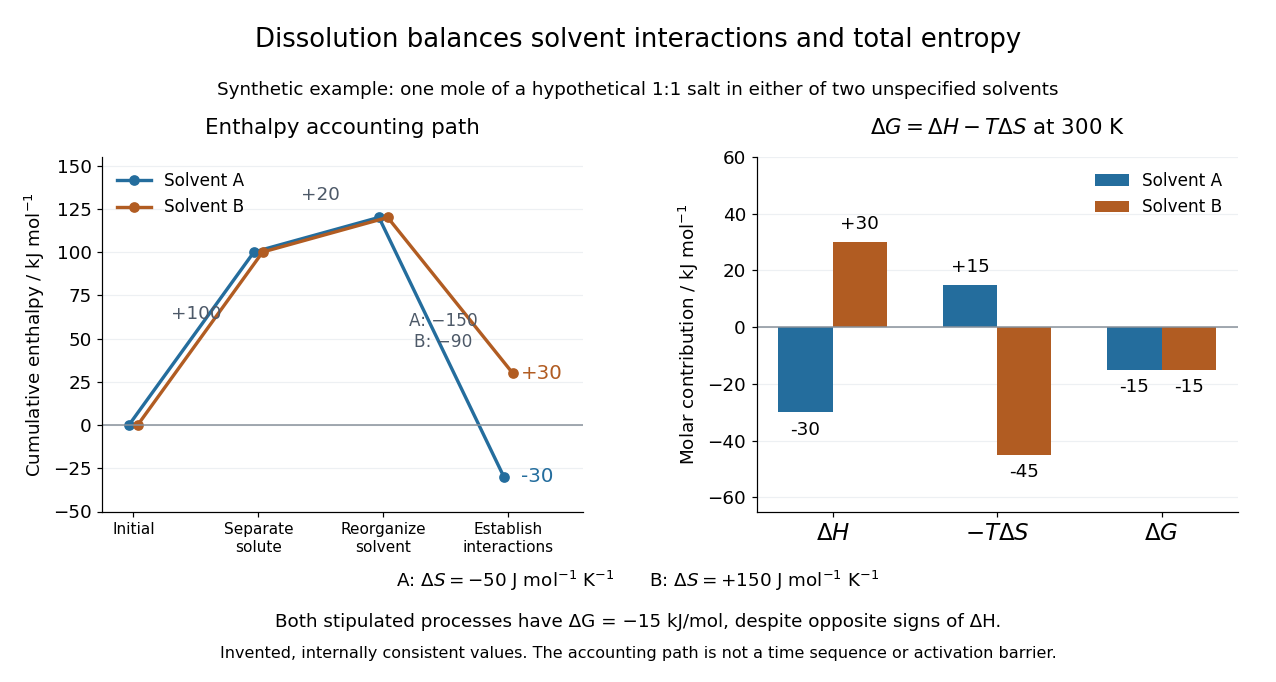
Synthetic dissolution bookkeeping: solvent interactions change the enthalpy balance, while total entropy also enters the Gibbs free energy
. Original stipulated model for one mole of a hypothetical 1:1 salt at , with two unspecified solvents. No plotted value is a measurement or a claim about a named chemical substance. The accounting path is not a reaction coordinate or an activation energy. Details.
The invented inputs are for separation and for solvent reorganization, in . Interaction terms of in solvent A and in solvent B give and . Stipulated total entropy changes of and give and at . Both selected processes therefore have . This deliberately constructed comparison shows why the signs of the enthalpy and Gibbs free energy changes need not agree; it does not predict either solvent's solubility.
For incremental dissolution at a particular composition, the relevant chemical potential difference also depends on thermodynamic activities. At chemical equilibrium that driving difference vanishes. A quoted standard Gibbs free energy change and the finite change between arbitrary mixtures answer different questions; use compatible standard states and the reaction quotient when discussing solubility.
The motivating calorimetry experiment is especially instructive. A weighed potassium chloride sample dissolves in a known amount of water in a platinum-lined, shielded calorimeter; a quartz-oscillator thermometer and measured electrical heating provide the readouts. Electrical calibration before and after the reaction, comparison with a resistance thermometer, and checks on residual water and particle size constrain errors. The inspected authored article reports positive enthalpy of solution at for the specified dilution, despite complete dissolution. This is a combined enthalpy balance, not an isolated solvation free energy or direct single-ion hydration of ions measurement. Shield tracking and final concentration matter; the existing lattice enthalpy from solution calorimetry discussion gives the numerical result and the conversion limits.[ref]
The Enthalpy of Solution of SRM 1655 (KCl) in H2O by Marthada V. Kilday. Abstract, §§3–4 and conclusion; inspected indexed authored text, direct PMC access challenged
New to topics? Read the docs here!