
Robust statistics Created 2026-09-24 Updated 2026-10-18
Robust statistics studies procedures whose behavior remains controlled under outliers and deviations from an assumed model.
Stationary axisymmetric spacetime Created 2026-09-24 Updated 2026-09-24
A stationary axisymmetric spacetime has commuting stationary and axial Killing vector fields, with the axial field having closed spacelike orbits.
Static spacetime Created 2026-09-24 Updated 2026-09-24
A static spacetime has a timelike Killing vector that is hypersurface orthogonal. Coordinates adapted to it can be chosen with no time-space cross terms.
Strictly stationary spacetime Created 2026-09-24 Updated 2026-10-06
Nonstationary oscillatory integral Created 2026-09-24 Updated 2026-10-03
If the phase derivative has no zero on the support of a smooth amplitude, repeated integration by parts makes the oscillatory integral decay faster than any prescribed inverse power, subject to corresponding decay and regularity of the amplitude.
One-dimensional stationary-phase formula Created 2026-09-24 Updated 2026-09-24
Nondegenerate stationary point of a phase Created 2026-09-24 Updated 2026-10-05
A stationary point of a smooth phase is nondegenerate when its Hessian matrix at is an invertible matrix. In one dimension, this condition is .
Macrostate Created 2026-09-24 Updated 2026-10-14
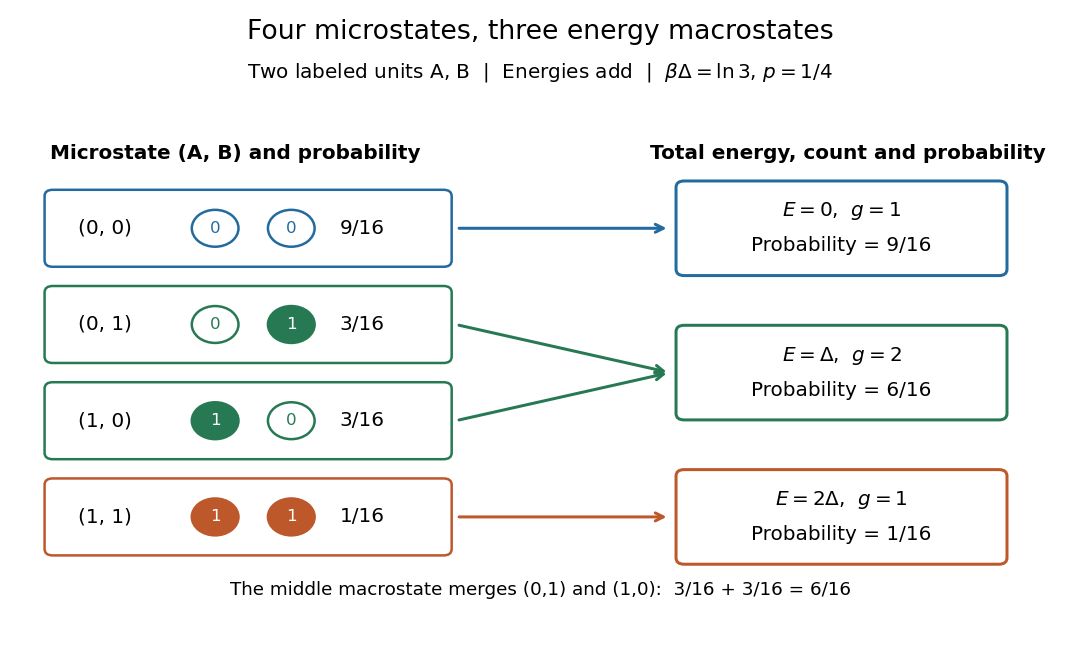
A macrostate groups microstates sharing prescribed coarse data. The grouping depends on what is retained: here retain only total energy. For the two distinguishable two-level systems, the macrostates have state degeneracies . Although two units are not macroscopic in size, they make this loss of information visible: knowing does not tell us which unit is excited.
At inverse temperature , each unit's excited-state probability is . Their independence gives microstate probabilities in the order above. Adding within each macrostate givesThe total expected value of energy is therefore , matching two units each with expected value of energy . Equal state degeneracies would give the wrong answer: macrostate probabilities combine counting with the Boltzmann factor. At very high positive temperature, all four microstates become equally likely, but these three macrostate probabilities approach .

Microstate Created 2026-09-24 Updated 2026-10-14
A microstate is a complete microscopic specification within the chosen model. For two distinguishable, noninteracting two-level systems, label the units and their states , with energies and . The four microstates arewith total energies . Distinguishability matters: and describe different assignments to the labeled units. Noninteraction matters too: their energies add without an extra coupling term.
For a classical particle model, a microstate can instead be a point in phase space, specifying every position and momentum. In the quantum canonical ensemble, the sum uses energy eigenstates; a general quantum state may also contain quantum coherence, which an energy label alone does not specify.
Degeneracy factor Created 2026-09-24 Updated 2026-10-18
A degeneracy factor counts the distinct microscopic states that share the same macroscopic quantum numbers or energy.
Standard Model fermion Created 2026-09-24 Updated 2026-09-24
A Standard Model generation contains left-handed quark and lepton doublets and right-handed up-quark, down-quark and charged-lepton singlets. A right-handed neutrino may be added as a gauge singlet.
Electroweak interaction Created 2026-09-24 Updated 2026-10-18
The electroweak interaction is the gauge theory that unifies the weak and electromagnetic interactions.
An instructive tension motivates the unification: the photon is massless, while the W boson and Z boson are massive; electromagnetic interaction and weak interaction also have different observed low-energy strengths and chiral couplings. A gauge theory can relate their interactions while the Higgs field gives different masses after electroweak symmetry breaking. The resulting theory predicts relationships between processes, not merely a common name for observed phenomena.
Its useful organizing principle is the combination of weak isospin and hypercharge. The surviving electromagnetic generator is in the convention used here. The photon and Z boson are different mixtures of neutral gauge fields, while the charged current uses the charged combinations. The electroweak doublet gauge-boson mass matrix explains why one neutral mixture stays massless. At low energies, a massive W boson propagator instead produces the approximate Fermi interaction, withHere is the gauge coupling and the Higgs doublet vacuum expectation value. The inverse squared mediator mass suppresses low-energy weak rates. Unification does not require setting equal to the electromagnetic coupling : their relation is .
A striking experimental consequence is a neutral current in addition to the familiar charged current. The Gargamelle experiment tests this extra channel through visible charged secondaries, with a background problem fundamentally different from directly identifying a Z boson. The muon-neutrino electron recoil spectrum shows how the same Weinberg angle enters another process quantitatively.
Nonlinear sigma model Created 2026-09-24 Updated 2026-09-24
A nonlinear sigma model has fields valued in a curved target space such as a vacuum manifold . Its leading action is quadratic in spacetime derivatives but nonlinear in any unconstrained coordinates used for the target.
Goldstone theorem Created 2026-09-24 Updated 2026-10-18
In a local quantum field theory obeying special relativity, with a positive physical state space, a conserved continuous internal global symmetry in field theory and a selected Lorentz-invariant ground state, a broken generator requires a massless Goldstone boson. For , there are symmetry-required Goldstone bosons in this setting; additional accidental massless excitations are possible. Jeffrey Goldstone's institutional biography identifies his work with Abdus Salam and Steven Weinberg on the zero-mass theorem.[ref]
Jeffrey Goldstone by MIT Department of Physics. Biographical Sketch, paragraph 2: spontaneously broken relativistic field theories and the zero-mass theorem
The Goldstone directions in the scalar mass matrix give a short classical proof at a smooth minimum. The quantum argument uses a conserved current and a scalar local operator whose expectation changes under the broken generator. The Ward identity for the current–local operator correlation function then has a nonzero contact term. After a Fourier transform, its divergence remains nonzero as four-momentum tends to zero. Lorentz invariance forces the vector–scalar correlator to have the form , so must have a pole at . The spectral representation associates that pole with a physical zero-mass excitation. A properly regulated spatial integral of the conserved current implements the broken generator; a well-defined global charge acting on the broken ground state cannot simply be assumed.
The hypotheses explain the boundaries of the result. A discrete symmetry has no infinitesimal generator and need not give a Goldstone boson. A gauge redundancy does not supply the physical global generator assumed here. In nonrelativistic matter the type-B Goldstone boson shows why one cannot universally count one independent mode per broken generator. Long-wavelength fluctuations can also prevent an assumed broken state from existing, as in the Mermin-Wagner theorem.
Vacuum manifold Created 2026-09-24 Updated 2026-10-07
The vacuum manifold is the space of field configurations that minimize the energy. If a group acts transitively and a chosen vacuum has stabilizer , its connected component is the homogeneous space .
Isotropic tensor integral Created 2026-09-24 Updated 2026-09-24
A rotationally invariant rank-two tensor is a scalar multiple of ; taking its trace determines the scalar.
Spectral radius formula Created 2026-09-24 Updated 2026-10-14
Mantle convection Created 2026-09-24 Updated 2026-10-05
Mantle convection is the slow buoyancy-driven motion of a rocky planetary mantle. On geological timescales the solid mantle behaves as a highly viscous Newtonian fluid to first approximation.
Largest prime factor Created 2026-09-24 Updated 2026-10-03
S-smooth number Created 2026-09-24 Updated 2026-10-14
For a finite set of primes, an integer is -smooth when every prime dividing it belongs to . Bounding the largest prime factor is equivalent to restricting the integer to be -smooth for a suitable finite .
There are unlisted articles, also show them or only show them.