
Past exam of the mathematics course of the University of Cambridge 2009 ii Paper 3 15D i Solution Created 2026-09-24 Updated 2026-10-14
Mass conservation in the Zeldovich approximation gives . Expanding the trajectory Jacobian determinant to first order therefore yields . At the same order, andThe last equality uses and the vector calculus .
Split the gravitational potential into its homogeneous-background and perturbed parts. The background has . For the perturbation, Poisson equation and irrotationality givewith a harmonic or uniform-acceleration contribution set to zero by the perturbation boundary conditions. Its divergence is , as required. Insert this and the pressure gradient into . The background acceleration cancels using , leavingTake minus the comoving divergence, and expand . Since acts on a Fourier mode by , each mode satisfiesHere the expansion coordinate is comoving; confusing it with the physical coordinate would lose the factor .
Past exam of the mathematics course of the University of Cambridge 2009 ii Paper 3 14E iii Solution Created 2026-09-24 Updated 2026-10-14
When , define the Hamiltonian functionThen and , so . At the Hessian of is , a strict nondegenerate minimum; at it is , a strict maximum. Small regular level curves around either point are closed curves, and the vector field is nonzero on them. Motion around each curve therefore returns after a finite period, proving the existence of periodic orbits and classifying both equilibria as center equilibria.
The separatrix level is , consisting of and . The two arcs of this ellipse run from the lower saddle equilibrium to the upper one, while the vertical segment runs from the upper saddle to the lower one. They enclose the two families of periodic orbits, as shown in the last panel of the phase portrait. Outside the loops, regular levels are unbounded.
For the divergence of the original vector field is exactly . If a periodic orbit existed, uniqueness of trajectories would make it a simple closed curve, tangent everywhere to the vector field. The flux across its boundary would be zero, whereas the divergence theorem would give times its positive enclosed area. This contradiction is the Bendixson-Dulac criterion. Hence .
Past exam of the mathematics course of the University of Cambridge 2009 ii Paper 3 14E ii Solution Created 2026-09-24 Updated 2026-10-14
Set and , and include for the extended center manifold. The equations near becomeThe stable direction has eigenvalue and the center directions are . Choose a symmetry-preserving center manifold , even in , containing the equilibrium line . Its invariance equation isWrite . At degree two, , so . At degree three, , so . ConsequentlyWith this is , the supercritical pitchfork bifurcation. For , is attracting; for it becomes a saddle equilibrium and two attracting branches appear, consistent with the exact .
For , the vertical invariant line flows from towards between those points. The two off-axis stable equilibria lie below the horizontal axis, one in each invariant half-plane and . For , these stable equilibria have merged into the stable node , while remains a saddle equilibrium. Filled green points mark attracting equilibria, green rings mark centers, and red crosses mark saddle equilibria. The plotted arrows and nullclines show the corresponding phase portraits; a focus can become a node within the first parameter range without changing the pitchfork classification.
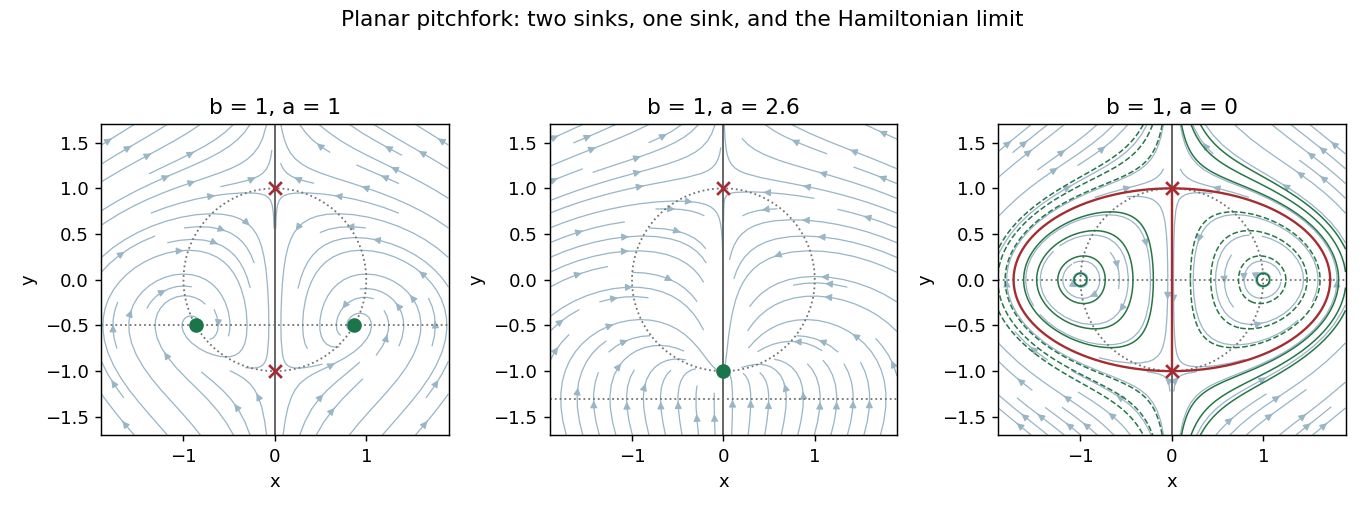
Phase portraits of the planar pitchfork system before collision, after collision, and in its Hamiltonian limit
. Details. 
Past exam of the mathematics course of the University of Cambridge 2009 ii Paper 3 14E i Solution Created 2026-09-24 Updated 2026-10-14
Put . The two fixed points on the invariant line are and . There are also when . At equality they coalesce with .
The Jacobian matrix isAt its eigenvalues are and , so it is always a saddle equilibrium. At they are and , so it is a saddle equilibrium for and a stable node for , with a zero eigenvalue at .
At the characteristic equation is , givingFor these points are stable spirals; for they are stable nodes. At the double negative eigenvalue has only one independent eigenvector, so these are improper stable nodes. When they are center equilibria, as established in part (iii). Thus the collision at changes both the number and stability of fixed points; it is the bifurcation classified below.
Past exam of the mathematics course of the University of Cambridge 2009 ii Paper 3 12F c Solution Created 2026-09-24 Updated 2026-10-14
Take , , and . These satisfy the stated connectedness and disjointness conditions. If polynomials converged uniformly to on , convergence of the contour integrals would implya contradiction to the Cauchy integral theorem. Thus boundedness of this permits the obstruction excluded in part (b).
Past exam of the mathematics course of the University of Cambridge 2009 ii Paper 3 12F b Solution Created 2026-09-24 Updated 2026-10-14
A compact set has exactly one unbounded complementary component, since its complement contains the outside of a sufficiently large disk. The connected, unbounded open set , being disjoint from , lies in that component. In particular belongs to the unbounded component.
Fill all bounded components of to obtain the polynomial hull . It is a compact set with connected complement, and . Therefore is holomorphic on a neighborhood of . The Runge approximation theorem gives polynomials converging uniformly to this function on , hence on . This proves the requested uniform polynomial approximation on , even when itself has holes. If is empty, the assertion is vacuous.
Past exam of the mathematics course of the University of Cambridge 2009 ii Paper 3 12F a Solution Created 2026-09-24 Updated 2026-10-14
The polynomial form of the Runge approximation theorem says: if is compact, is connected, and is holomorphic on a neighborhood of , then for every there is a polynomial with . Choosing errors tending to zero gives a uniformly convergent sequence of polynomials. Equivalently, on an open domain with connected complement in the Riemann sphere, every holomorphic function is the compact-uniform limit of polynomials. The connected-complement hypothesis excludes enclosed holes containing poles of the function being approximated.
Past exam of the mathematics course of the University of Cambridge 2009 ii Paper 3 10D b Solution Created 2026-09-24 Updated 2026-10-14
Use the uniform-density configuration as a trial configuration for the white dwarf. Write , with the numerical coefficient suppressed by the approximate equation of state. Its particle density is , and the nonrelativistic degeneracy pressure has kinetic-energy density . HenceFor uniform density , so integration of the shell energy givesBoth constants are positive and independent of . Differentiating gives its unique stationary radius . The second derivative there is , and this is the global minimum since at zero and at infinity. ThusThe uniform-density approximation is used for this energy estimate; it does not require a spatially constant pressure to satisfy the exact hydrostatic equilibrium equation.
Past exam of the mathematics course of the University of Cambridge 2009 ii Paper 3 10D a Solution Created 2026-09-24 Updated 2026-10-14
Assemble the star by adding spherical shells. A shell of mass at radius has gravitational potential energy relative to infinity, givingMultiplication of the hydrostatic equilibrium equation by and integration by parts givesFor an isolated star with negligible surface pressure, . Using , the virial theorem becomes . If a nonzero external pressure is present, the surface term must be retained: . Thus the printed zero-surface-term identity implicitly assumes an isolated star.
Past exam of the mathematics course of the University of Cambridge 2009 ii Paper 2 8B ii Solution Created 2026-09-24 Updated 2026-10-14
Splitting the exponential into the half-plane where it decays givesTheir singularities at zero are removable. The first function is analytic above the real axis and the second below it; their exponential terms are bounded in those respective half-planes, giving the required decay. Their difference on the real axis is the prescribed jump. Moreover their sum there is , agreeing with the Sokhotski–Plemelj formula and the transform computed above.
For uniqueness in the class with continuous boundary values, subtract two solutions. The zero jump glues their differences into an entire function, tending to zero at infinity. Liouville's theorem makes it zero. Thus these are the unique solutions of the Riemann-Hilbert problem with the stated decay.
Past exam of the mathematics course of the University of Cambridge 2009 ii Paper 2 8B i Solution Created 2026-09-24 Updated 2026-10-14
Use the sign convention in the question: the Hilbert transform kernel is , the negative of another common convention. A contour indentation at the origin givesFor close the contour in the upper half-plane; for close it below. Thus the transform of is for . Since , integration of this multiplier identity, justified first with an Abel regularization, yieldsThe value at zero also follows directly from .
Past exam of the mathematics course of the University of Cambridge 2009 ii Paper 2 7E ii Solution Created 2026-09-24 Updated 2026-10-14
Now . The zero point exists for all parameters and has eigenvalue , so it is stable for and unstable for . At every nonzero fixed point,Both outer branches are stable and both inner branches unstable.
For , the nonzero locations are as in part (i). At the local equation is : these are subcritical pitchfork bifurcations, with the two unstable inner branches present on the side where zero is stable. At the bifurcation itself , so zero is unstable. At the inner and outer branches cross and exchange stability in transcritical bifurcations. The positive crossing is semistable, attracting from the right; the negative crossing is semistable, attracting from the left, because the additional factor reverses the local flow there.
For , the outer stable pair exists only for . The points are supercritical pitchfork bifurcations, since the cubic coefficient is negative. Zero loses stability as increases across , and a stable symmetric pair appears. At the threshold zero remains nonlinearly stable, with . There are no further bifurcations. The second row of the preceding figure gives the diagrams. The plots use ; the general locations are obtained from the formulas above.
Past exam of the mathematics course of the University of Cambridge 2009 ii Paper 2 7E i Solution Created 2026-09-24 Updated 2026-10-14
Write . Its fixed points satisfy , retaining only nonnegative right sides. At a simple fixed point,Thus on the outer branches , the positive point is stable and the negative point unstable. On the inner branches , the positive point is unstable and the negative point stable.
For , there are four simple points for , two for , and a saddle-node at each , where the two inner points coalesce. At , there are also bifurcations at . The smooth branches and cross and exchange stability. Locally , where . After a parameter-dependent shift this is a transcritical bifurcation. It is not an ordinary saddle-node: two nearby branches exist on both sides of zero. At zero itself each crossing point is semistable, attracting from the right and repelling from the left.
For , the only possible branch is , existing for . Each point is a saddle-node bifurcation. There are no fixed points for ; outside that interval the positive point is stable and the negative point unstable. At either threshold , so the zero point is semistable. The first row of the diagram displays these branches; solid curves are stable and dashed curves unstable.
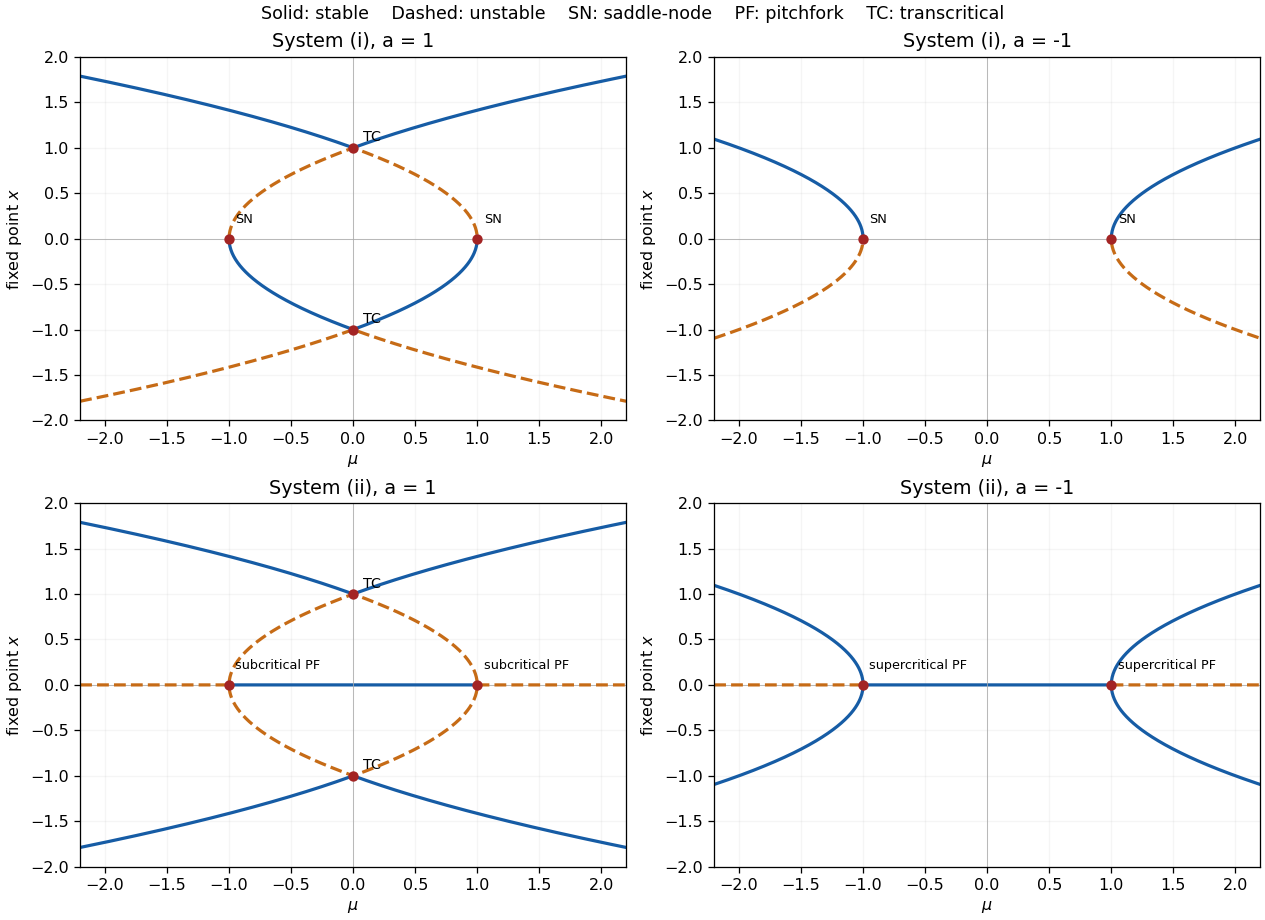
Fixed-point bifurcation diagrams for both scalar systems with positive and negative a; stable branches are solid and unstable branches dashed
. Details. 
Past exam of the mathematics course of the University of Cambridge 2009 ii Paper 2 39B iii Solution Created 2026-09-24 Updated 2026-10-14
The five-point stencil on the forcing satisfiesThus the correction cancels exactly the residual in part (i), leavingThe modified scheme therefore has fourth-order normalized local accuracy, the same improved order as the harmonic-forcing case, now without assuming . It need not have the same leading error constant.
Past exam of the mathematics course of the University of Cambridge 2009 ii Paper 2 39B ii Solution Created 2026-09-24 Updated 2026-10-14
If is harmonic, the leading term vanishes because . Hence , or fourth-order error after dividing by . More explicitly gives , so the leading unnormalized term is .
Past exam of the mathematics course of the University of Cambridge 2009 ii Paper 2 39B i Solution Created 2026-09-24 Updated 2026-10-14
Expand the two central second-difference operators. The given stencil identity yieldsConsequently its unnormalized local residual is . The normalized Laplacian approximation has leading error and is second order. These Taylor statements require the indicated smooth derivatives; boundary accuracy is a separate matter.
Past exam of the mathematics course of the University of Cambridge 2009 ii Paper 2 35D iii Solution Created 2026-09-24 Updated 2026-10-14
Free expansion into vacuum performs no work and receives no heat, so the initial and final internal energies agree. If is temperature independent, the preceding energy expression givesThe gas cools for positive and . Genuine free expansion is irreversible and not quasistatic; the endpoint energy calculation remains valid without the prompt's quasistatic qualification. Use of equilibrium thermodynamic identities only requires the two endpoint states to be equilibrated.
Past exam of the mathematics course of the University of Cambridge 2009 ii Paper 2 35D ii Solution Created 2026-09-24 Updated 2026-10-14
At fixed particle number, the first law and a Maxwell relation give . Substituting the equation of state yieldsThus the attraction term makes the energy increase with volume at fixed temperature, but the constant-volume heat capacity is independent of volume. Its temperature dependence is not determined by the pressure equation alone.
Past exam of the mathematics course of the University of Cambridge 2009 ii Paper 2 35D i Solution Created 2026-09-24 Updated 2026-10-14
The Van der Waals equation modifies the ideal-gas pressure in two ways. Short-range repulsion reduces the volume accessible to the particles from to , while attractive interactions reduce the pressure by . The parameters and therefore encode excluded volume and mean attraction respectively. The equation is a phenomenological approximation, not an exact microscopic equation of state.
Past exam of the mathematics course of the University of Cambridge 2009 ii Paper 2 31B b Solution Created 2026-09-24 Updated 2026-10-14
The exterior characteristics give for and for . In the gap put and . The Inviscid Burgers equation becomes . Matching the increasing states selects the rarefaction wave , soIt is continuous and piecewise smooth at positive times and satisfies the entropy condition. A discontinuous shock joining the same increasing states would be nonentropic.
There are unlisted articles, also show them or only show them.