
Past exam of the mathematics course of the University of Cambridge 2020 ib Paper 1 18C b Created 2026-09-24 Updated 2026-09-24
Past exam of the mathematics course of the University of Cambridge 2020 ib Paper 1 18C a Created 2026-09-24 Updated 2026-09-24
Past exam of the mathematics course of the University of Cambridge 2020 ib Paper 1 17C c Created 2026-09-24 Updated 2026-09-24
Past exam of the mathematics course of the University of Cambridge 2020 ib Paper 1 17C b Created 2026-09-24 Updated 2026-09-24
Past exam of the mathematics course of the University of Cambridge 2020 ib Paper 1 17C a Created 2026-09-24 Updated 2026-09-24
Past exam of the mathematics course of the University of Cambridge 2020 ib Paper 1 16D Solution Created 2026-09-24 Updated 2026-09-29
The electric potential of a point charge at the origin isFor the two charges forming the dipole,The first-order Taylor expansion at large isand therefore, with the electric dipole moment ,to leading order. Taking the interaction of a second dipole with the corresponding electric field gives the stated electric dipole-dipole interaction
Let the lattice spacing be and write the central dipole asIts two horizontal neighbours have moment . For either one, the expression in parentheses, after extracting , isIts two vertical neighbours have moment , and each contributes insteadAdding all four nearest-neighbour interactions and using the Pythagorean trigonometric identity givesThe angle has cancelled, so the energy is independent of .
Past exam of the mathematics course of the University of Cambridge 2020 ib Paper 1 15A Solution Created 2026-09-24 Updated 2026-09-29
A stationary state has the formFor a time-independent quantum observable , the global phases cancel in the expectation value:It is therefore independent of time.
For the infinite square well,The possible energy measurement results arewith respective Born rule probabilities and . Normalization gives .
Past exam of the mathematics course of the University of Cambridge 2020 ib Paper 1 14B Solution Created 2026-09-24 Updated 2026-09-29
Expand in its Fourier sine seriesBy separation of variables, the decaying solution of Laplace equation in each half-strip has th mode proportional to . Continuity at and integration of the equation across the Dirac delta function require the normal-derivative jumpThe jump of is , so
For , its Fourier coefficients areThusTranslation in gives the Dirichlet Green function for an infinite strip with source :
Past exam of the mathematics course of the University of Cambridge 2020 ib Paper 1 13D Solution Created 2026-09-24 Updated 2026-09-29
In polar coordinates,With the change of radial coordinate , the detection functional becomesIt is therefore times ordinary path length in the -plane. The shortest path is the line segment from to , soReturning to gives the logarithmic spiralIts minimum detection probability isThe functional depends only on the geometric path and not its parametrization, so tiptoeing and running give the same probability.
For the improved sensor, omit the irrelevant positive factor and use the LagrangianThe coordinate is cyclic, so its conjugate momentum is conserved. Equivalently,is constant. Because has no explicit time dependence, the associated conservation of energy gives the constantMultiplying by and using gives the required equation
Past exam of the mathematics course of the University of Cambridge 2020 ib Paper 1 12G Solution Created 2026-09-24 Updated 2026-09-29
An analytic branch of a square root determined by the branch isIf and are two such branches, their ratio is analytic and satisfies . Since a domain is connected and takes values in the discrete set , is constant. Thus throughout or throughout .
For , the principal square root isOn , one may instead takeThe respective removed half-axes are their branch cuts.
On , defineIt is analytic there, its square is , andso it is the required branch. Substitution gives, for ,The binomial series yieldshence the first three terms of the Laurent series are
Sinceits residue at zero is . Under the change of variable , the two orientation reversals cancel, and the residue theorem gives
Past exam of the mathematics course of the University of Cambridge 2020 ib Paper 1 11E Solution Created 2026-09-24 Updated 2026-10-14
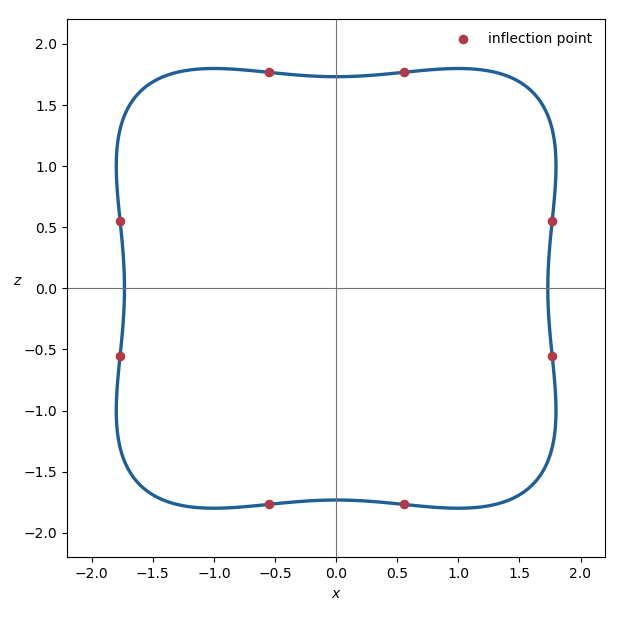
The curve is symmetric in both coordinate axes and under interchange of and . Its shape, including its eight inflection points, is:

Writing , the surface of revolution has equationLetIts gradient isIf this vanished, then and , but at such a point , not five. Hence zero is a regular value, and the regular level set theorem shows that is a smooth embedded surface.
For a surface of revolution, the two principal curvatures are the curvature of the meridian and the normal curvature of a parallel. Along ,so the normal is vertical in the meridian plane and the parallel principal curvature vanishes. Therefore the Gaussian curvature, the product of the principal curvatures, is zero there.
These are not the only zero-curvature points. The meridian itself has inflection points, at which its principal curvature vanishes. Setting and , their positive squared coordinates satisfyBesides interchanging and , the solution is approximatelyEach corresponding meridian inflection point sweeps out another circle on , so does not exhaust the zero set of the Gaussian curvature.
Past exam of the mathematics course of the University of Cambridge 2020 ib Paper 1 10E Solution Created 2026-09-24 Updated 2026-09-29
A function is differentiable at if there is a linear map such thatThe map , which is unique, is the derivative .
The inverse function theorem states that if is continuously differentiable near and is invertible, then restricts to a bijection between neighbourhoods of and ; its local inverse is continuously differentiable, with derivativeIn the normalized case and , continuity of gives a closed ball on whichFor small , define . The mean value inequality makes a contraction mapping with constant . If , thenso maps the ball into itself. The contraction mapping theorem gives a unique fixed point , and the fixed-point equation is precisely . Moreover,so . Thus is a continuous local inverse.
For the polynomial map in the question,The derivative is invertible, so the inverse function theorem supplies some and a continuously differentiable such thatThere can be no inverse on all of , becauseso is not injective.
Past exam of the mathematics course of the University of Cambridge 2020 ia Paper 2 9B b Created 2026-09-24 Updated 2026-09-24
Past exam of the mathematics course of the University of Cambridge 2020 ia Paper 2 9B a Created 2026-09-24 Updated 2026-09-24
Past exam of the mathematics course of the University of Cambridge 2020 ia Paper 2 8D c Created 2026-09-24 Updated 2026-09-24
Past exam of the mathematics course of the University of Cambridge 2020 ia Paper 2 8D b Created 2026-09-24 Updated 2026-09-24
Past exam of the mathematics course of the University of Cambridge 2020 ia Paper 2 8D a Created 2026-09-24 Updated 2026-09-24
Past exam of the mathematics course of the University of Cambridge 2020 ia Paper 2 7D c Created 2026-09-24 Updated 2026-09-24
Past exam of the mathematics course of the University of Cambridge 2020 ia Paper 2 7D b Created 2026-09-24 Updated 2026-09-24
Past exam of the mathematics course of the University of Cambridge 2020 ia Paper 2 7D a Created 2026-09-24 Updated 2026-09-24
There are unlisted articles, also show them or only show them.