
Past exam of the mathematics course of the University of Cambridge 2018 ii Paper 2 8B Solution Created 2026-09-24 Updated 2026-11-05
In Cartesian coordinates the Lagrangian isIntroduce a Lagrange multiplier for . The Euler-Lagrange equations becomeorDifferentiating the constraint twice givesTaking the scalar product of the vector equation with therefore yieldsSubstitution gives
For , the equations have the first integralsWriting and gives and . Hence every trajectory isThese are helices of unit angular frequency about a line parallel to the axis, including circles when and a straight line when .
Past exam of the mathematics course of the University of Cambridge 2018 ii Paper 2 7B Solution Created 2026-09-24 Updated 2026-10-03
Integration by parts is legitimate after symmetrically excluding a neighborhood of zero; the boundary terms vanish because at zero and is bounded at infinity. HenceThe standard Dirichlet integral, obtained by closing the contour for in the upper half-plane and indenting above its pole at zero, isTherefore
Past exam of the mathematics course of the University of Cambridge 2018 ii Paper 2 6C Solution Created 2026-09-24 Updated 2026-10-03
Adding the three equations of the SIRS model givessoAt a fixed point, . The disease-free equilibrium isFor an endemic equilibrium , one has and . Conservation then givesIt exists with positive infected population exactly whenequivalently when the basic reproduction number exceeds one.
Eliminating yieldsAt the endemic equilibrium its Jacobian matrix isIts trace and determinant areTherefore the endemic equilibrium is locally asymptotically stable. It is a stable node whenand a stable focus when the inequality is reversed. Near a node, perturbations are sums of two nonoscillatory decaying exponentials. Near a focus, they execute damped oscillations with decay rate and angular frequency .
Past exam of the mathematics course of the University of Cambridge 2018 ii Paper 2 5J Solution Created 2026-09-24 Updated 2026-10-03
Let and be the residual sums of squares under the restricted model with coefficients and the full model with coefficients. Assuming has full column rank, the nested-model F-test usesUnder the null hypothesis this has the distribution.
Maximizing the Gaussian likelihood over and the unknown variance gives . Thus the likelihood-ratio test statistic isSincewe obtainThe logarithm is strictly increasing, so the two test statistics give exactly the same rejection ordering.
Past exam of the mathematics course of the University of Cambridge 2018 ii Paper 2 4G c Created 2026-09-24 Updated 2026-09-24
Past exam of the mathematics course of the University of Cambridge 2018 ii Paper 2 4G b Created 2026-09-24 Updated 2026-09-24
Past exam of the mathematics course of the University of Cambridge 2018 ii Paper 2 4G a Created 2026-09-24 Updated 2026-09-24
Past exam of the mathematics course of the University of Cambridge 2018 ii Paper 2 40E d Created 2026-09-24 Updated 2026-09-24
Past exam of the mathematics course of the University of Cambridge 2018 ii Paper 2 40E c Created 2026-09-24 Updated 2026-09-24
Past exam of the mathematics course of the University of Cambridge 2018 ii Paper 2 40E b Created 2026-09-24 Updated 2026-09-24
Past exam of the mathematics course of the University of Cambridge 2018 ii Paper 2 40E a Created 2026-09-24 Updated 2026-09-24
Past exam of the mathematics course of the University of Cambridge 2018 ii Paper 2 3H Solution Created 2026-09-24 Updated 2026-10-03
The binary symmetric channel with crossover probability has channel matrixMaximum-likelihood decoding chooses a codeword maximizing , while minimum-distance decoding chooses one minimizing the Hamming distance . For a block of length sent through a binary symmetric channel,When , the final factor decreases strictly with the distance. Thus maximum-likelihood and minimum-distance decoding agree.
For the length-three repetition code , majority decoding is wrong exactly when at least two bits flip. Therefore
Past exam of the mathematics course of the University of Cambridge 2018 ii Paper 2 39C Solution Created 2026-09-24 Updated 2026-10-03
Work in the shock frame. The undisturbed upstream gas enters the stationary discontinuity at speedwhile the downstream gas, which moves with the piston in the laboratory frame, leaves atThe Rankine-Hugoniot conditions for a perfect gas areandEliminating the velocities between these equations gives the perfect-gas density jump
The mass and momentum equations also implysoSubstitution of the density ratio into mass conservation, followed by this momentum relation, givesUsing the adiabatic sound speed therefore yieldsFinally, eliminating from gives the piston-driven normal shock relationFor a compressive shock , the first boxed equation has : the shock propagates supersonically into the undisturbed gas, approaching the sound speed in the weak shock limit .
Past exam of the mathematics course of the University of Cambridge 2018 ii Paper 2 38C Solution Created 2026-09-24 Updated 2026-10-14
Take ; reflection in supplies the result for negative wavenumber. Since each region has uniform base velocity, the perturbation is an incompressible, irrotational flow with a velocity potential satisfying the Laplace equation. Its decaying outer forms areFor a varicose mode of a planar jet, reflection symmetry makes the inner potential proportional to ; for a sinuous mode of a planar jet, it is proportional to .
At the upper interface, the linearized kinematic boundary condition isThe first equation gives . The second givesThe linearized Unsteady Bernoulli equation gives . Applying pressure continuity therefore produces the equal-density top-hat planar-jet dispersion relationSolving the quadratic equation givesEquivalently,The plus sign is the unstable Kelvin-Helmholtz instability branch. In particular, the two modes have exactly the same growth rate,Its limiting forms areThus neither type grows faster in this equal-density idealization, although their phase speeds differ. The unbounded large- growth is the familiar short-wave pathology of an inviscid vortex sheet.
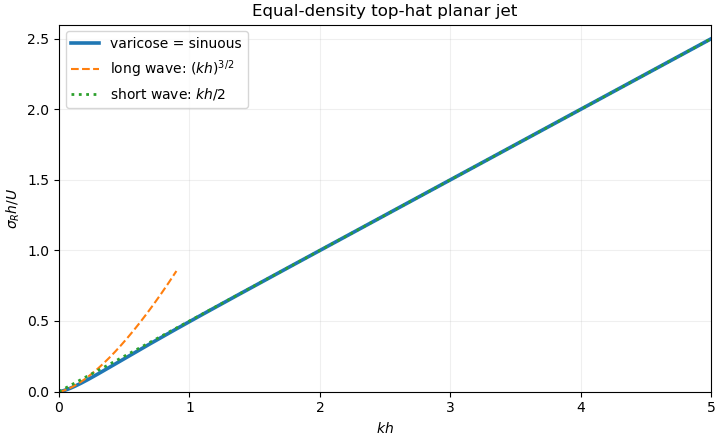
Growth rate of varicose and sinuous planar-jet disturbances
. The two modes have the same dimensionless growth curve, with the long-wave and short-wave asymptotes shown. Details.
Past exam of the mathematics course of the University of Cambridge 2018 ii Paper 2 37E c Created 2026-09-24 Updated 2026-09-24
Past exam of the mathematics course of the University of Cambridge 2018 ii Paper 2 37E b Created 2026-09-24 Updated 2026-09-24
Past exam of the mathematics course of the University of Cambridge 2018 ii Paper 2 37E a Created 2026-09-24 Updated 2026-09-24
Past exam of the mathematics course of the University of Cambridge 2018 ii Paper 2 36A b Created 2026-09-24 Updated 2026-09-24
Past exam of the mathematics course of the University of Cambridge 2018 ii Paper 2 36A a Created 2026-09-24 Updated 2026-09-24
Past exam of the mathematics course of the University of Cambridge 2018 ii Paper 2 35A Solution Created 2026-09-24 Updated 2026-10-14
Label the two atoms in primitive cell by and , with understood modulo because of the periodic boundary condition. Choose the spring between them to have constant . Newton's second law gives
For a longitudinal normal mode, putPeriodicity requires , so . Since the primitive-cell length is , wavevectors differing by describe the same mode, and the first Brillouin zone may be chosen asThe amplitudes obeySetting its determinant to zero gives the alternating-spring chain dispersion relationThe lower sign is the acoustic phonon branch and the upper sign is the optical phonon branch.
At the edge of the Brillouin zone,so the frequency band gap isIt vanishes at , when the apparent two-atom primitive cell can be reduced to one atom.
Near the centre of the Brillouin zone, a Taylor expansion givesandThe group velocity of the acoustic branch at long wavelength is the speed of sound,
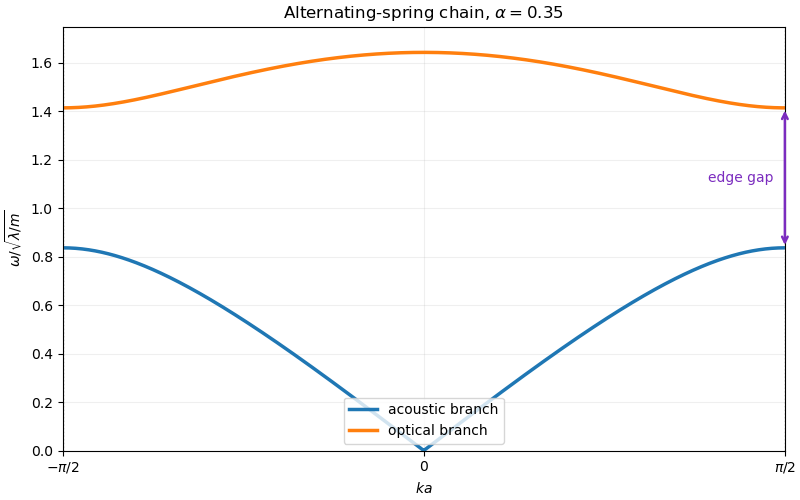
Dispersion relation of the alternating-spring chain
. The acoustic and optical branches for alpha equal to 0.35. The vertical separation at the Brillouin-zone edge is the frequency gap. Details.
There are unlisted articles, also show them or only show them.