
Past exam of the mathematics course of the University of Cambridge 2004 ib Paper 3 22A Solution Created 2026-09-24 Updated 2026-10-14
Let . Direct substitution shows , so the functional annihilates all quadratic polynomials. Taylor's integral-remainder formula isApplying and interchanging the finite evaluations and derivative with the continuous integral gives the Peano kernel representation , whereAll three expressions are nonnegative; the middle quadratic has positive leading coefficient and discriminant . Therefore the best possible norm bound has constant . Evaluate that integral particularly simply by using , for which :It follows thatThe same cubic attains equality, so the constant is sharp, not merely sufficient. This is the sharp Peano bound for an interior three-point first derivative.
Past exam of the mathematics course of the University of Cambridge 2004 ib Paper 3 21C Solution Created 2026-09-24 Updated 2026-10-14
Let the fluid be at rest at infinity, and write its velocity potential as , the angular dependence selected by translation along the polar axis. The separated Laplace equation iswith radial solutions and . Decay at infinity eliminates the former. The no-penetration condition on the moving sphere is , giving . Thus the potential flow around a translating sphere isFor density , integrate its kinetic energy over the exterior. The angular factor satisfies , and . HenceThe added mass of a sphere is consequently . For a heavy sphere, , falling through distance , the net gravitational work after buoyancy is . Its own kinetic energy plus that of the fluid is . Conservation of energy from rest therefore givesThis is the unbounded inviscid-fluid model; walls or viscous dissipation would alter the flow and its energy.
Past exam of the mathematics course of the University of Cambridge 2004 ib Paper 3 20D Solution Created 2026-09-24 Updated 2026-10-14
The scattering interpretation assumes , so is real and . The incoming amplitudes are from the left and from the right; the outgoing amplitudes are . The conserved probability current iswhich gives on the left and on the right. Equality proves . Equal exterior wavenumbers make the flux weights equal.
Continuity of the wavefunction and its derivative at the finite potential steps yields the four relations, with and ,Set . Substituting , and subtracting the last two relations after dividing the fourth by giveswhere . HenceReflection about the barrier midpoint interchanges the left and right incidence problems and, with the chosen phase origins, exchanges and . ThereforeFor incidence from the left alone, the transmission coefficient is the transmitted-to-incident probability flux ratio, . Since , direct calculation givesFor fixed energy inside the barrier range and , , soThis is the thick-barrier quantum tunnelling limit, not a uniform approximation as energy approaches the barrier top while remains small.
Past exam of the mathematics course of the University of Cambridge 2004 ib Paper 3 1E Solution Created 2026-09-24 Updated 2026-10-14
The dual space is , the vector space of real-valued linear maps on , with pointwise addition and scalar multiplication. Choose a basis of . Every has unique coordinates , so defines a linear functional, with .
If , evaluation on gives , proving linear independence. For any , linearity gives , hence . Thus the dual basis spans the dual space as well, proving
Past exam of the mathematics course of the University of Cambridge 2004 ib Paper 3 19B Solution Created 2026-09-24 Updated 2026-10-14
Use the Maxwell curl equationsDot the first with and the second with , then combine them. The identity givesThis proves the Poynting theorem , with the stated energy density and Poynting vector. The last term is work transferred from the electromagnetic field to matter.
For the specified vacuum wave, substitution into the same curl equations gives and . Thus , and for propagation along positive ,Putting ,The equal electric and magnetic contributions account for the factor in . Energy propagates at speed , whose square is ; the reciprocal product is not itself the speed.
Past exam of the mathematics course of the University of Cambridge 2004 ib Paper 3 18D Solution Created 2026-09-24 Updated 2026-10-14
For an integrand with no explicit dependence, the Euler-Lagrange equation is . Differentiate the proposed first integral:Thus is constant along an extremal, the Beltrami identity.
For the optical path the Fermat principle uses the travel-time integrand , in the stated speed units. Its first integral isSet . Then , and integration gives on a positive arch. The symmetric endpoint conditions require and . For and , the resulting ray in an exponential-speed medium isIt is above zero inside the endpoints. Substitution also verifies the Euler-Lagrange equation , so the first-integral construction does not accidentally select a spurious constant-height path.
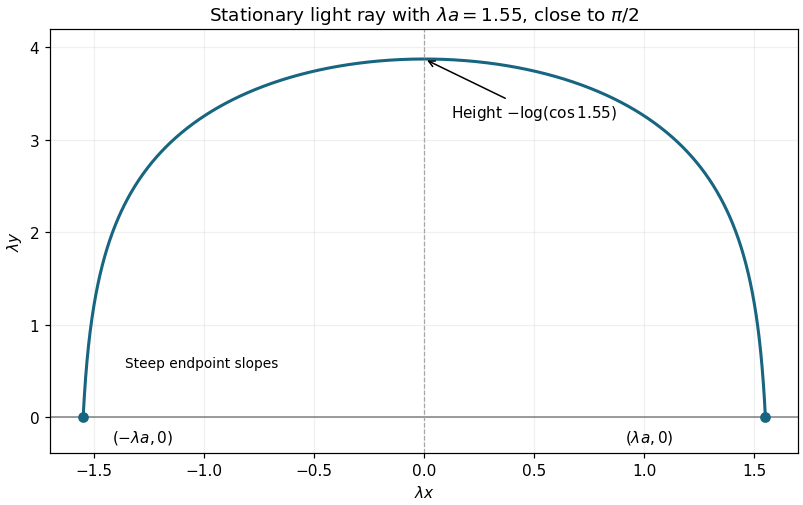

Here . For close to , the endpoint slopes are steep and the central height is large. The travel time evaluates directly toIt tends to as the arch height diverges. Positive is the increasing-speed interpretation needed for a ray arching into ; for the same algebraic expression bends below that region and is not an admissible interior path. At zero the limiting straight boundary path has travel time .
Past exam of the mathematics course of the University of Cambridge 2004 ib Paper 3 17E iii Created 2026-09-24 Updated 2026-09-24
Past exam of the mathematics course of the University of Cambridge 2004 ib Paper 3 17E ii Created 2026-09-24 Updated 2026-09-24
Past exam of the mathematics course of the University of Cambridge 2004 ib Paper 3 17E i Created 2026-09-24 Updated 2026-09-24
Past exam of the mathematics course of the University of Cambridge 2004 ib Paper 3 16F Solution Created 2026-09-24 Updated 2026-10-14
The contraction mapping theorem states: if is a nonempty complete metric space and satisfies for a fixed , then it has exactly one fixed point and the iteration from every starting point converges to it.
To prove existence, choose and let . Induction gives . The triangle inequality and geometric sum then imply, for ,The iterates are a Cauchy sequence; completeness supplies their limit . The contraction is continuous, so . If is another fixed point, forces equality of the points. The same estimate gives geometric convergence from every initial point.
For the particular map, the original PDF gives , which is a closed, complete subset of the real line. For positive , the arithmetic-geometric mean inequality gives , proving . FurthermoreThe mean value theorem therefore gives , a genuine contraction. The fixed-point equation is , and only the positive root belongs to , soThe printed square-root endpoint is essential: the TeX transcription loses it.
Past exam of the mathematics course of the University of Cambridge 2004 ib Paper 3 15G Solution Created 2026-09-24 Updated 2026-10-14
Work on the unit sphere, so side lengths are central angles. Place the right-angle vertex at the north pole and choose perpendicular meridians through it. The other vertices can then be writtenTheir dot product is the cosine of the central angle between them, namely the hypotenuse length . Hence the spherical Pythagorean relation isFor the small triangle let its hypotenuse be . The same formula gives , so . Expanding each cosine about zero yieldsIn particular , and thus . Consequently , the ordinary Pythagorean theorem in the locally flat limit.
Past exam of the mathematics course of the University of Cambridge 2004 ib Paper 3 14F iv Created 2026-09-24 Updated 2026-09-24
Past exam of the mathematics course of the University of Cambridge 2004 ib Paper 3 14F iii Created 2026-09-24 Updated 2026-09-24
Past exam of the mathematics course of the University of Cambridge 2004 ib Paper 3 14F ii Created 2026-09-24 Updated 2026-09-24
Past exam of the mathematics course of the University of Cambridge 2004 ib Paper 3 14F i Created 2026-09-24 Updated 2026-09-24
Past exam of the mathematics course of the University of Cambridge 2004 ib Paper 3 13E iii Created 2026-09-24 Updated 2026-09-24
Past exam of the mathematics course of the University of Cambridge 2004 ib Paper 3 13E ii Created 2026-09-24 Updated 2026-09-24
Past exam of the mathematics course of the University of Cambridge 2004 ib Paper 3 13E i Created 2026-09-24 Updated 2026-09-24
Past exam of the mathematics course of the University of Cambridge 2004 ib Paper 3 12G Solution Created 2026-09-24 Updated 2026-10-14
Let be player two's mixed strategy in Rock paper scissors. The respective expected payoffs from choosing rock, scissors and paper are , and . Thus player two solves the linear programming problemA linear objective on this probability simplex is maximized by a largest-payoff pure response, or by any mixture of tied maximizers. Scissors is never a maximizing response: rock exceeds it by one. Comparing the other two gives according as . ThereforeThe optimal expected payoff is below the tie and above it, with value at the tie.
Past exam of the mathematics course of the University of Cambridge 2004 ib Paper 3 11A Solution Created 2026-09-24 Updated 2026-10-14
Let denote the zero-diagonal matrix with off-diagonal entries appearing in the iteration, and its iteration matrix. Its row sums are three, so . The other eigenvalues are and , where , namely , both of modulus . Thus the spectral radius is .
For , the infinity-norm estimate already gives a contraction, so the iterates converge from every initial vector to the unique solution of . Conversely, two iterates whose initial difference is a nonzero multiple of retain the difference . This fails to decay when , so convergence cannot be guaranteed for arbitrary starts. ThereforeAt the offending mode oscillates; at it is stationary and the coefficient matrix is singular. A specially chosen starting vector can suppress a bad mode, but that is not guaranteed convergence.
There are unlisted articles, also show them or only show them.