
Past exam of the mathematics course of the University of Cambridge 2004 ia Paper 4 12A Solution Created 2026-09-24 Updated 2026-10-14
The moment of inertia of a uniform solid cylinder is taken about its symmetry axis. Write its mass density as . A coaxial shell of radius and thickness has mass . ThusA hollow cylinder would have a different moment of inertia; uniform solid density is the intended assumption.
Let measure the centre's displacement uphill from its initial position, and choose signed angular velocity so that uphill rolling without slipping has . Let be the signed contact force uphill. The translation and rotation equations areThe minus sign in the torque equation follows from the chosen rolling sense: uphill contact force opposes the positive spin. Under rolling without slipping, . Eliminating givesUsing and , the no-slip motion and maximum vertical rise areIndeed the centre turns at , reaching , whose vertical component is the boxed height. Conservation of energy independently gives the same answer from initial kinetic energy .
The available static friction is at most . It can supply the required uphill force exactly when . ThereforeInterpret the stated friction magnitude as limiting static friction and as kinetic friction during slip, with the same coefficient. Take , . In the slipping regime the contact point moves downhill relative to the slope, so kinetic friction acts uphill. To verify this direction rather than assume it unchecked, solve with . Define . The result isThe centre's speed is , with the sign of specifying ascent or descent. The contact point's relative velocity isThus the assumed uphill kinetic friction is consistent throughout both ascent and descent, including when the centre's velocity changes sign. There is no later return to rolling without slipping before reaching the bottom. This is the characteristic slipping solid cylinder on an incline regime.
The centre turns at , givingThe formulas apply up to the positive return time . Substitution into the signed velocity and angular velocity givesThe return spin can have either sign and vanishes at . It reverses when , although the contact point still slips downhill. The unchanged centre speed does not mean that no energy was dissipated: the rotational kinetic energy has decreased. Indeed integrating the frictional power giveswhich agrees with the difference of the initial and final rotational kinetic energies.
Past exam of the mathematics course of the University of Cambridge 2004 ia Paper 4 11A Solution Created 2026-09-24 Updated 2026-10-14
Taking the scalar product of the Lorentz force equation with the velocity givesThe triple product vanishes because the cross product is perpendicular to its first factor. Thus the kinetic energy is constant, even if the magnetic field varies with position: magnetic forces do no work.
In cylindrical coordinates, the radial, angular and vertical equations areFor a nonstationary circular orbit with constant and , the first equation gives . Hence its signed angular velocity is . The sign gives the sense of circulation. The zero root describes a stationary transverse position, not a moving circular orbit. A constant vertical velocity can be superposed to produce a helix.
Define the mechanical angular momentum about the axis by . Multiplying the angular equation by givesFor the inverse-radius magnetic field this becomes . Integrating from an initial radius provesLet and , so that . Since is constant and the total kinetic energy is constant, the transverse speed squaredis also constant. Substituting the angular momentum relation gives the required radial curve:Only the region is accessible. For , as , and its horizontal asymptote is . Its derivative is . Thus, when , it has a single maximum at . The positive roots of are the turning points obtained from .
For nonzero and , write . When , two turning points occur atand the radius is confined between them. At , there is only the finite lower turning point ; tends to zero from above and an outgoing particle reaches arbitrarily large radius. For , only the lower turning point remains and the outgoing radial velocity approaches . The sketch shows these three cases and omits inaccessible negative values of from the physical interpretation.
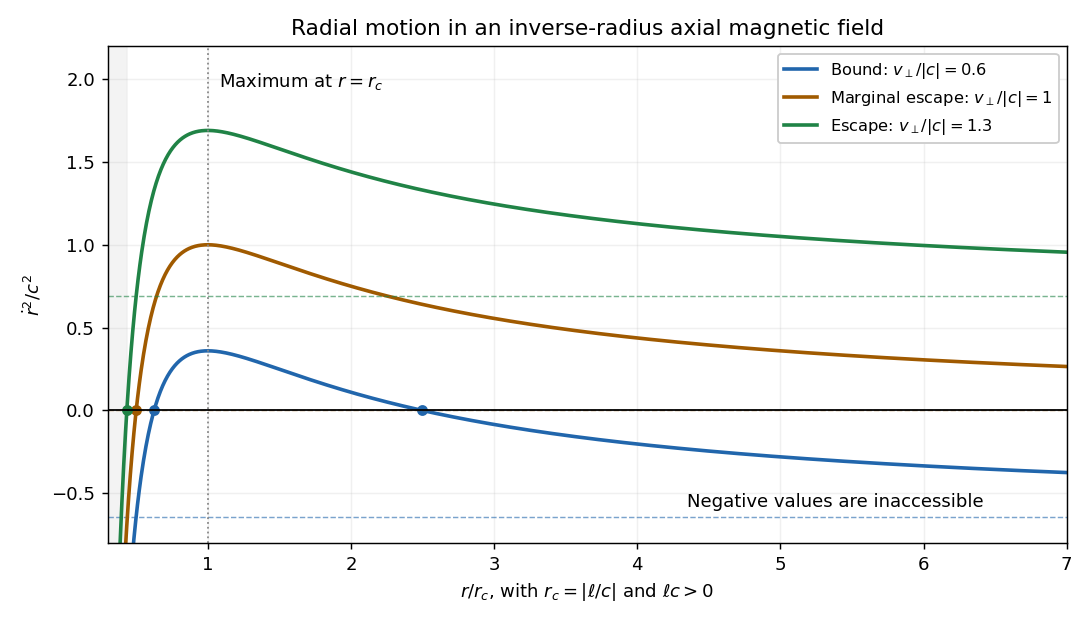

For completeness, if , rises monotonically from to its asymptote; admissible motion then requires and is radially unbound after any inward branch turns. If , is constant; equality gives a circular orbit rather than escape. Above threshold the outgoing branch escapes, whereas an incoming branch reaches the singular axis in finite time and cannot be continued through it without specifying a nonsingular core field. These cases explain why a borderline escape assertion needs an initial-direction qualification.
The transverse escape velocity threshold for radial escape in an inverse-radius axial magnetic field isFor a radial launch at , , and equality permits marginal escape; for , larger transverse speed guarantees radial escape in forward time after any initial inward leg turns. The singular incoming branch is the exception described above. More general launches at equality can instead give the circular exception . A vertical velocity adds to the total speed but cannot pay the transverse escape-energy requirement; if escape merely means unbounded , any nonzero already achieves that. If , transverse motion is force-free and there is no positive escape-speed threshold.
Past exam of the mathematics course of the University of Cambridge 2004 ia Paper 4 10A Solution Created 2026-09-24 Updated 2026-10-14
Write and . The gravitational central force has zero torque, so the specific angular momentumis constant. For a nonradial orbit , motion lies in the plane normal to , and plane polar coordinates give . With and primes denoting derivatives,The radial equation is therefore the Binet equationIts general solution, after choosing the polar origin of angle, isThe origin is a focus of this conic section. To identify which conic section occurs, use the conserved specific energyA bound, nonradial orbit has , hence and is an ellipse. For example, putting , in givesan explicit ellipse equation. This is the intended low, bound Kepler orbit. The inverse-square equation alone does not imply an ellipse: an initially tangential speed larger than gives , and a hyperbolic Kepler orbit. Zero angular momentum instead gives radial motion. Those qualifications are necessary for the elliptic conclusion.
In a circular orbit, centripetal acceleration balances the gravitational acceleration:Here is the positive angular speed; either sense of circulation has this period.
With the stated drag force, use the full angular momentum . Gravitational torque is still zero, while the drag torque isTherefore for constant . Its direction remains fixed, and its magnitude has exponential decay with time constant ; the orbit remains planar although its shape is no longer a fixed ellipse.
Past exam of the mathematics course of the University of Cambridge 2004 ia Paper 3 9C v Created 2026-09-24 Updated 2026-09-24
Past exam of the mathematics course of the University of Cambridge 2004 ia Paper 3 9C iv Created 2026-09-24 Updated 2026-09-24
Past exam of the mathematics course of the University of Cambridge 2004 ia Paper 3 9C iii Created 2026-09-24 Updated 2026-09-24
Past exam of the mathematics course of the University of Cambridge 2004 ia Paper 3 9C ii Created 2026-09-24 Updated 2026-09-24
Past exam of the mathematics course of the University of Cambridge 2004 ia Paper 3 9C i Created 2026-09-24 Updated 2026-10-14
Past exam of the mathematics course of the University of Cambridge 2004 ia Paper 3 8D Solution Created 2026-09-24 Updated 2026-10-14
Expanding the characteristic polynomial along the first column givesFor , solving the two nullspace equations givesThese are all the eigenvalues and eigenvectors, with nonzero vectors understood. The three displayed spanning vectors form an eigenbasis, so is diagonalizable.
At , the sole eigenvalue is three, with algebraic multiplicity three but the same two-dimensional . Thus is diagonalizable exactly when . Indeed, at the exceptional parameter, with and , so its Jordan normal form has one block of size two and one of size one. This illustrates how an eigenvalue collision can destroy diagonalizability without changing the two-dimensional eigenspace.
Past exam of the mathematics course of the University of Cambridge 2004 ia Paper 3 7D Solution Created 2026-09-24 Updated 2026-10-14
Let with , allowing complex eigenvectors. A real symmetric matrix is Hermitian, so is real and is real. For eigenvectors of distinct real eigenvalues , self-adjointness gives , hence . Thus the distinct eigenspaces are orthogonal.
Here , where is the all-ones matrix. Since and vanishes on the plane of coordinate sum zero,Every nonzero vector in the indicated eigenspace is an eigenvector. The repeated eigenvalue three has a two-dimensional eigenspace.
A complex symmetric nilpotent matrix provides the requested counterexample:Its characteristic polynomial is , so its only eigenvalue is zero. It is not diagonalizable: a diagonalizable matrix with only zero eigenvalues would itself be zero. Complex symmetry is weaker than the Hermitian condition .
Past exam of the mathematics course of the University of Cambridge 2004 ia Paper 3 6D Solution Created 2026-09-24 Updated 2026-10-14
A real three-by-three matrix represents a proper rotation in the standard orthonormal basis precisely when and , that is, when . For the supplied integer numerator , direct multiplication gives and , verifying both conditions.
The rotation axis is the eigenspace for eigenvalue one. Solving gives and , sois a unit axis vector; its negative describes the same axis. On its perpendicular plane the rotation matrix has eigenvalues and . The rotation trace formula therefore gives . Since the trace is ,
Past exam of the mathematics course of the University of Cambridge 2004 ia Paper 3 5D Solution Created 2026-09-24 Updated 2026-10-14
Use for the dihedral group of order twelve and write each element uniquely as or , . The classification of subgroups of a dihedral group organizes the complete list: rotational subgroups are cyclic, and a subgroup containing a reflection is generated by its rotational part and one reflection. The individual lists and quotients follow below.
Past exam of the mathematics course of the University of Cambridge 2004 ia Paper 3 4C Solution Created 2026-09-24 Updated 2026-10-14
For a regular space curve parametrized by arc length , its curvature is , where is the unit tangent. Differentiating the given parametrization givesThe curve approaches the origin as ; the origin is a limiting endpoint. Its arc length measured from that endpoint is , soThis is a logarithmic conical helix. Its unit tangent and derivative areConsequently,The infinitely many turns near the limiting origin have finite total arc length, while the curvature diverges there.
Past exam of the mathematics course of the University of Cambridge 2004 ia Paper 3 3C ii Created 2026-09-24 Updated 2026-09-24
Past exam of the mathematics course of the University of Cambridge 2004 ia Paper 3 3C i Created 2026-09-24 Updated 2026-09-24
Past exam of the mathematics course of the University of Cambridge 2004 ia Paper 3 2D Solution Created 2026-09-24 Updated 2026-10-14
The Möbius group consists of maps with , acting on the Riemann sphere . Proportional matrices represent the same map. Thus it is , equivalently after normalizing the determinant. A zero denominator gives the image , while maps to when and stays at infinity when .
Fixing both zero and infinity forces , leaving with . Composition multiplies the parameters, giving a bijective group homomorphism from the multiplicative group of nonzero complex numbers to this pointwise stabilizer.
For the other pair, take , which sends zero to zero and one to infinity. Conjugate the scaling subgroup by this Möbius transformation:Every map fixing zero and one arises this way. Composition again multiplies , proving both subgroups are isomorphic to . This is the Möbius pointwise stabilizer of two points; conjugation changes the selected fixed points without changing its group structure.
Past exam of the mathematics course of the University of Cambridge 2004 ia Paper 3 1D Solution Created 2026-09-24 Updated 2026-10-14
For a subgroup of a finite group , Lagrange's theorem states . Thus a subgroup's order, and in particular the order of a group element, divides .
For , if every element had order one or two, the order of a finite group of exponent two would make a power of two, a contradiction. Hence an element has order five or ten. In the latter case is the cyclic group . Otherwise choose of order five. Its cyclic subgroup has index two and is therefore a normal subgroup.
In the noncyclic case an element outside has order two: its order divides ten, it cannot have order ten, and an element of order five has trivial image in the order-two quotient group . Every element of is then or . Conjugation by restricts to an automorphism of , say . Since , , so or modulo five.
For , the generators commute and has order ten, yielding the cyclic case. For , these are the relations of the dihedral group of the pentagon. The classification of groups of order ten is therefore exactly and , where the subscript on denotes its order. They are not isomorphic because one is Abelian and the other is not.
Past exam of the mathematics course of the University of Cambridge 2004 ia Paper 3 12C Solution Created 2026-09-24 Updated 2026-10-14
For a continuously differentiable vector field on a volume and its boundary, the divergence theorem equates to the outward flux . For the given field, , soOn the sphere, , andThus the surface flux is also , verifying the theorem by explicit calculation.
Apply the product rule to , then apply the divergence theorem. This proves Green's first identity:Swap and and subtract. The gradient products cancel, giving Green's second identity:For uniqueness, set . It is a harmonic function with zero Dirichlet boundary conditions. Under the stated smoothness assumptions, Green's first identity with gives . Thus is constant on each connected component, and its boundary value makes every constant zero. The two solutions agree throughout . This is Dirichlet uniqueness for the Poisson equation. For classical solutions merely continuous up to the boundary and twice continuously differentiable in the interior, the maximum principle for harmonic functions gives the same conclusion without requiring boundary derivatives.
Past exam of the mathematics course of the University of Cambridge 2004 ia Paper 3 11C Solution Created 2026-09-24 Updated 2026-10-14
Choose zero gravitational potential at infinity. Apply superposition to a uniform sphere of positive density and the two voids represented by spheres of negative density. The shell theorem makes every component act as a point mass outside the large sphere. With and ,The volume factors are the cubes of the three radii.
Inside the smaller void, the large sphere and the removed small sphere have interior fields and , where . They combine into the uniform gravitational field in an off-center spherical cavity, . The point is outside the other void's sphere, whose removed mass contributes a repulsive field. ThusAn equilibrium must lie on the line through the two centers. Write with . Its equation is , givingThis point is inside the smaller void, but it is not stable. Let . The field's Jacobian matrix has eigenvaluesThe axial displacement is restoring, while transverse displacements accelerate away from equilibrium. Therefore there is no point in that void where a test particle remains stably at rest. The cavity equilibrium destabilized by a second void is a saddle; existence of a zero force is insufficient for stability.
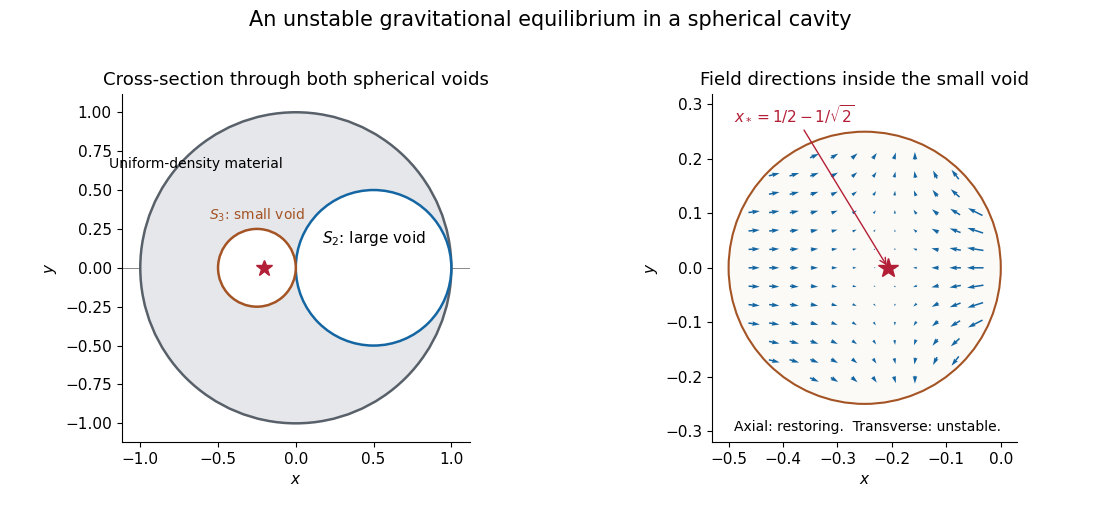
The two spherical voids and the unstable equilibrium inside the smaller void
. Details. 
Past exam of the mathematics course of the University of Cambridge 2004 ia Paper 3 10C Solution Created 2026-09-24 Updated 2026-10-14
An exact differential is a one-form equal to for a single-valued scalar function on the domain. In Euclidean coordinates this means its vector coefficients form . Integrating the first component of with respect to , then matching the other components, givesDifferentiating checks all three components. Since the domain is connected, two such potentials differ only by a constant, so this is the most general potential.
At both specified endpoints the nonconstant terms vanish. The fundamental theorem for line integrals gives zero for the line integral along every path joining the two points.
For the planar field, choose a continuous lift of the polar angle along a curve avoiding the origin. Differentiating the angle givesOn the closed curve the angle increases by times its winding number. ThusThe angle differential is locally exact but not globally exact on the punctured plane: the angle lift need not return to its initial value. This is the nonexact angular one-form, whose nonzero closed-path integral obstructs a global potential.
There are unlisted articles, also show them or only show them.