
Tensile-crack radiation pattern 2026-10-14
For a planar tensile-crack seismic source, is measured from its normal. The P wave displacement is radial with the first displayed amplitude. The S wave displacement is tangential in the plane containing the observation direction and crack normal, with four alternating signed lobes and nodes at the poles and equator. Both radiative fields depend on the opening rate and vanish once opening stops; the static displacement field depends on the final opening.
Close a three-strand planar tangle and evaluate its reduced Kauffman bracket. The basis has the displayed trace values, with the last value also valid for . Writing braid generators as turns knot-polynomial computations into a five-dimensional algebra calculation.
Jones-Wenzl idempotent 2026-10-14
The Jones-Wenzl idempotent has identity-diagram coefficient one, satisfies , and annihilates each adjacent cap-cup generator on either side. With and , , , it is constructed recursively by , where . The required denominators must be nonzero. Its closed bracket trace is .
Choose and , where is continuously differentiable, nondecreasing, equal to on and on . Then and . For with continuous adapted finite-variation , the Itô isometry and Doob L2 maximal inequality give local uniform convergence in probability of the martingale integrals. Dominated convergence against the total-variation measure gives pathwise uniform convergence of the drift integrals. The nondecreasing corrections therefore converge locally uniformly in probability to . A subsequence on one probability-one event shows that the limit is continuous and nondecreasing. Localization removes the deterministic bounds used in the argument.
For ,where the endpoint is used directly if . Put . For , choose and set . Then and , proving the bound. For , take ; the result follows from the already proved boundary case and monotonicity of . This estimate closes the section-by-section induction for the exponential Talagrand convex distance moment.
Let the largest last-coordinate section have probability , and another section probability . Mix mismatch vectors from these two sections with weights . Their squared norm is at most . Hölder's inequality and induction bound that section's exponential integral by . The scalar estimate for Talagrand product induction makes it at most . Average over sections and use with to close the induction.
For the longest increasing subsequence length on a product space of independent coordinates, a witness of length uses only coordinates. Any point with subsequence length at most must differ on at least witness positions. Weights on those positions show . Thus for ,At a median , this gives upper tail and lower tail . Integrating the tails places the mean within of the median, so the natural concentration scale near the mean is . A random permutation is represented by the ranks of independent continuous variables; arbitrary dependent sequences need not obey this conclusion.
Suppose an integer-valued certifiable function is -Lipschitz under one-coordinate changes and a value at least has a certificate of at most coordinates. Any input with value at most must differ on at least certificate positions. Equal weights on those positions bound its Talagrand convex distance from the low-value event. Applying Talagrand's convex distance inequality gives the displayed product bound. For , median tails integrate to , and deviations of order have exponentially small probability.
Use equitable regularity energy with exceptional vertices retained as singleton cells. The refinement variance identity for regularity energy shows that splitting along an irregular pair's witnesses raises energy by more than . More than irregular ordered pairs therefore raise energy by more than when the exceptional set occupies at most half the vertices.
For equalization with a controlled exceptional set, cut each of the at most witness atoms into pieces of size and put leftovers into singleton exceptional cells. This is a refinement, so it cannot decrease energy. At most vertices are lost. Start with enough cells that this loss, over rounds, is at most ; the initial exceptional set uses the other half. The number of cells grows by a bounded recurrence depending only on and the prescribed minimum. Energy lies in , so the process terminates.
Weighted Szemerédi regularity lemma 2026-10-14
For every , all sufficiently large finite graphs admit a set partition into at most nonempty cells, each of size at most , with the displayed ordered irregular-pair weight bound. Start with small cells. Use regularity energy including diagonal rectangles, refine simultaneously by the witness subsets of all irregular pairs, and apply the refinement variance identity for regularity energy. Each failing round raises energy by more than , while energy lies in . The recurrence bounds the final cell count. Equitability is unnecessary for this weighted version.
Coset leader 2026-10-14
A coset leader is a minimum-Hamming-weight word in a coset of a linear code. It represents a most economical error pattern with the associated syndrome. Several leaders can tie; they need not be unique outside the code's guaranteed correction radius.
Use . Two integrations by parts of the anisotropic source give the exact Cosmic microwave background anisotropy amplitude . The emission velocity was eliminated using . The local observer bracket is a monopole plus a dipole and can be discarded only after explicitly restricting to the measured higher angular multipoles. This identity fixes endpoint signs and integral factors without importing a different scalar-metric convention.
Synchronous photon momentum redshift 2026-10-14
For a photon in , the null geodesic condition cancels the homogeneous term in the derivative of . The remaining first-order geodesic equation gives the displayed momentum change. Its direction is constant at zeroth order, so first-order redshift and brightness sources can be evaluated on the unperturbed ray; direction deflection multiplied by an already first-order anisotropy is second order.
For synchronous gauge metric , conserved-background comoving momentum obeys . In the linear Collisionless Boltzmann equation, insert to obtain the displayed source. Using instead reverses both signs; it does not change the physics. The scalar contraction is .
Let be a symplectic orthogonal complement splitting into two symplectic subspaces of dimension two. In symplectic bases, the graph of a function pulls back the symplectic form to . It is a symplectic subspace exactly when . Its symplectic orientation agrees with the orientation transported from exactly when . When , the transverse oriented pair has negative intersection sign, whereas two distinct complex lines in a compatible complex two-space have positive intersection sign.
If is nonempty, bounded and open in standard symplectic Euclidean space, and is a codimension-two symplectic subspace, a linear symplectic change of coordinates makes . Boundedness of the remaining coordinate projection places inside a finite-radius symplectic cylinder. Openness puts a small ball inside it. Monotonicity and normalization of a symplectic capacity give the displayed strict bounds.
Symplectic Gram-Schmidt process 2026-10-14
Construct a symplectic basis two vectors at a time. Choose ; the nondegenerate bilinear form supplies with , and set . For any vector , remove its paired components byThen . Thus, for , the symplectic orthogonal complement gives a direct sum ; its restricted bilinear form remains nondegenerate. Repeat there until no vectors remain, then put all before all . This proves even dimension and existence together. Only the nonzero pairing is divided out, so the construction also works in characteristic two. The pair-splitting argument is described in Bilinear Forms by Keith Conrad (Keith Conrad, Bilinear Forms, §5, proof of Theorem 5.1 and Theorem 5.4).
Four-dimensional symplectic basis change 2026-10-14
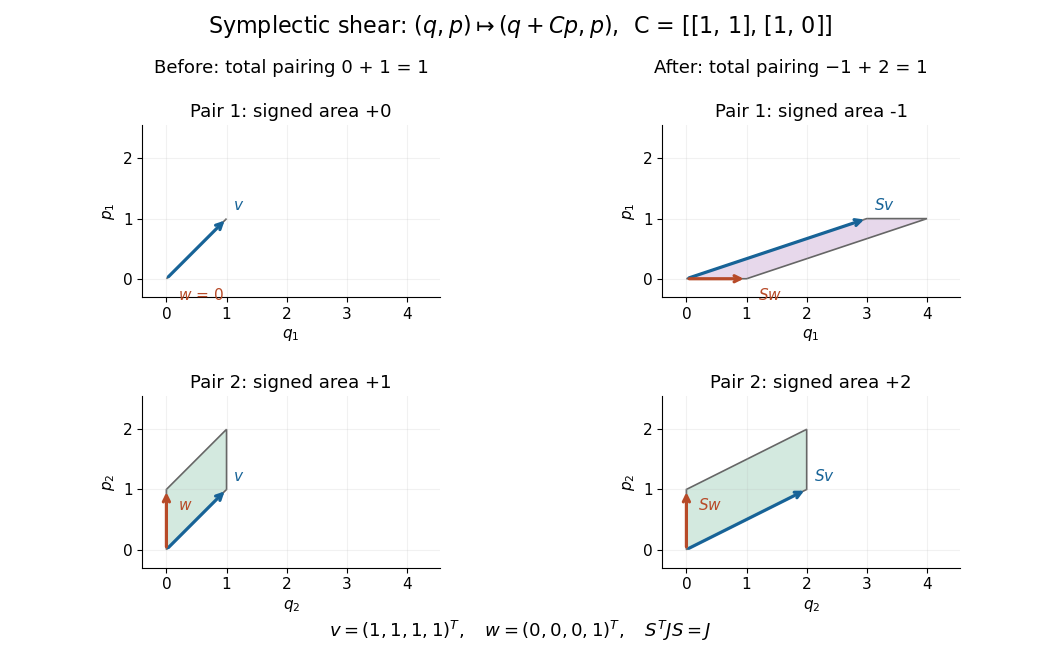
On , use the standard basis and the alternating bilinear form with matrix above for . A second symplectic basis isFor instance, , while and the cross-pairings vanish. The change of basis matrix, whose columns are these new basis vectors in , isThe symmetric matrix makes , so is a symplectic matrix. Explicitly, multiplying the blocks gives a lower-right block ; the other blocks agree with . For a fixed vector, change of basis means , henceTheir symplectic form gives in , and in . The separate coordinate-plane contributions change, but their sum does not.
The same matrix also represents an active symplectic linear map: keeping one basis fixed, it sends to . The following diagram shows this active interpretation over the real numbers. Its preserved total pairing is precisely the test used for linear canonical transformations.

Paired coordinates of a symplectic basis 2026-10-14
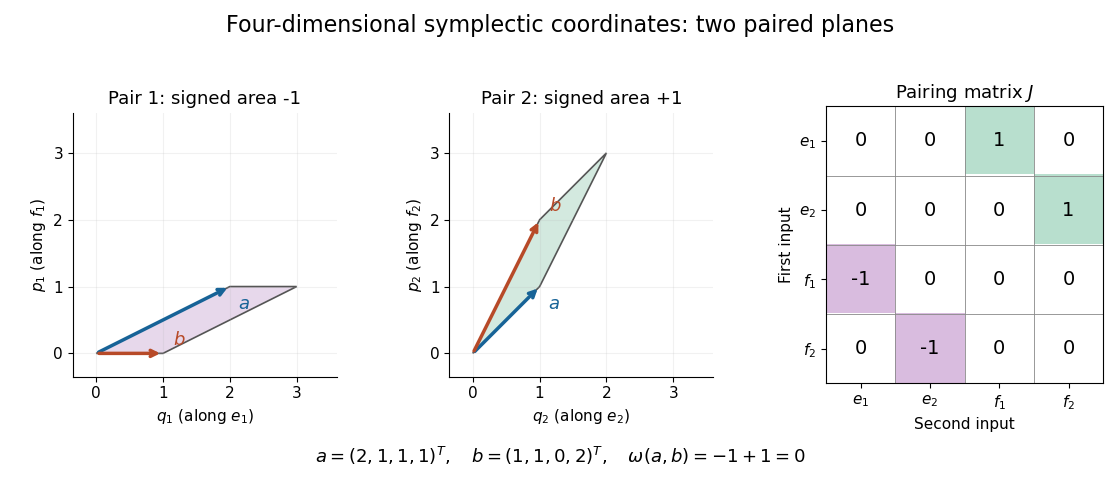
Write vectors in a symplectic basis as and . Their coordinate vectors and the matrix of a bilinear form areHere is the identity matrix, and denotes transpose. The ordering matters: interleaving the basis as instead gives a block diagonal matrix with blocks . Some conventions reverse every , giving instead. Always check the displayed pairing convention.[ref]
Symplectic Geometry. §1.1, p. 83: e-then-f basis and its block matrix; the coordinate formula follows by bilinearity
Over the real numbers, each summand is the signed area of a parallelogram in the coordinate plane. For and , the two signed areas are and , so although the vectors are linearly independent. The cancellation concerns the symplectic form; it does not assert that their dot product vanishes. Over a general field, the same determinant formula is algebraic, without a signed geometric interpretation.

For , represent as . The Tonelli theorem applies to the nonnegative integrand. The inner integral in is , leaving . Substitution and the Euler beta function together with the Gamma reflection formula give the result. The bounds at zero and infinity explain exactly the index range.
There are unlisted articles, also show them or only show them.