
Asphericity from a three-manifold hierarchy 2026-10-14
In an orientable irreducible three-manifold, an incompressible cut is fundamental group-injective by the Loop theorem. Lift a three-manifold hierarchy to the universal cover. The terminal ball pieces are contractible and their gluing surfaces have contractible universal covers. The incidence graph is a tree, by the van Kampen theorem normal form for successive cuts. Finite subtrees are contractible by successively attaching a terminal piece along a contractible intersection. Every sphere map has compact image contained in a finite subtree, so all higher homotopy groups of the universal cover vanish.
Relative boundary rigidity from a hierarchy 2026-10-14
A map between compact connected orientable irreducible 3-manifolds with nonempty boundaries, injective on the boundary and on the fundamental group, is homotopic to a homeomorphism relative to the boundary. The boundary determines degree , and the cover corresponding to the image of the fundamental group consequently has one sheet. Straighten the preimage of an incompressible hierarchy surface, cut both manifolds, and repeat. At the terminal balls, extend the prescribed boundary homeomorphisms by coning. The homotopies and homeomorphisms glue across the straightened surface collars.
For started at a point of radius one, its radial process has the law of the inverse-clock process , where inverts . The logarithmic growth of an exponential Brownian clock with positive drift gives , whereas . Substituting proves the displayed almost sure escape rate and divergence of the radius. Independently, Brownian scaling gives the same rate in probability; if an almost sure logarithmic rate is already known to exist, that identifies its value.
For an -oriented rank- real vector bundle, its Thom class restricts on each fiber to the suspension of the coefficient unit under the oriented identification . Cup product with this class gives the Thom isomorphism. The associated Euler class in a generalized cohomology theory is the pullback along the zero section after forgetting relative supports.
// Target: geometry-and-topology.bigb
Cohomology class of a cooriented submanifold 2026-10-14
An oriented normal bundle of a compact embedded submanifold has a Thom class. A tubular neighborhood and excision identify it with a relative class in . Its image in absolute cohomology is . It restricts to zero off Y and, in an oriented closed ambient manifold, represents the Poincare dual of Y with the normal-first induced orientation.
The logarithmic derivative is periodic under one and decreases by under tau. Integrating around a fundamental cell and applying the argument principle counts exactly one zero, with multiplicity. The displayed zero follows from translating the zero of at . It is consequently simple. For half-integer characteristics only the odd characteristic vanishes at the origin; the other three theta constants are nonzero.
Normal convergence allows termwise differentiation of the defining theta function with characteristics. A tau derivative multiplies a summand by , while its second spatial derivative multiplies it by . This proves the displayed heat equation, linking its lattice-sum construction with diffusion and analytic continuation.
Translation of tau by one gives . Gaussian Poisson summation gives . The square root is the holomorphic branch positive at tau=i. These formulas keep the characteristic phase, which is lost if one states only the transformation of unshifted theta constants.
Jacobi theta duplication identity 2026-10-14
For the binary characteristic convention, each theta function with characteristics has one simple zero per lattice cell. The four zeros of the numerator, at the four half-periods, cancel those of . Their quotient is an entire elliptic function, hence constant. Taking the limit at zero determines the factor one half. The product identity remains valid at the zeros, where the initial quotient requires removable extension.
Period lattice of theta3 over theta4 2026-10-14
Use the radian spatial convention and . Their ratio is unchanged by and changes sign under . The numerator has simple zeros at , while the denominator has simple zeros at . The two sets are disjoint, so any period must lie in , by translating the zero set. The sign rule then gives the displayed exact lattice. Squaring the ratio removes that sign and has precisely the smaller lattice .
Theta constant 2026-10-14
A theta function with characteristics evaluated at spatial argument zero. Its dependence on remains holomorphic. Among the four half-integer characteristic choices, the odd one vanishes identically, whereas the three even constants are nonzero on the half-plane. The zeros of theta functions with characteristics locate their spatial zero away from the origin. Ratios of equal powers of even constants yield the modular lambda function and other modular-invariant functions.
Activity coefficient 2026-10-14
At and , the weak-coupling renormalization-group flow obeys . Integrating gives . The flow reaches order-one coupling at a length whose logarithm is at this order. Restoring the microscopic scale gives the displayed leading exponential correlation length. Higher loops affect its prefactor, and this conclusion does not apply to the compact model with its Berezinskii–Kosterlitz–Thouless transition.
Thermal cutoff of Lyman-alpha line widths 2026-10-14
A purely thermal hydrogen absorption line has velocity-space optical depth proportional to with the displayed width. Additional independent Gaussian broadening contributes positive terms to . Fitting the lower envelope of width against neutral-hydrogen column density, with numerical calibration for density and pressure smoothing, estimates the temperature-density relation of photoionized intergalactic gas. A single broad line only bounds the temperature from above when its nonthermal width is unknown.
Thermal diffusion length 2026-10-14
The thermal diffusion length is the characteristic length over which thermal conduction changes a temperature distribution during time in the constant-thermal diffusivity model. It is a scale, not a sharp front or distance travelled at a constant speed: the heat equation has infinite propagation speed mathematically. Different definitions of penetration depth introduce numerical factors. In particular, the normalized one-dimensional heat kernel has spatial variance , so its root-mean-square width is .
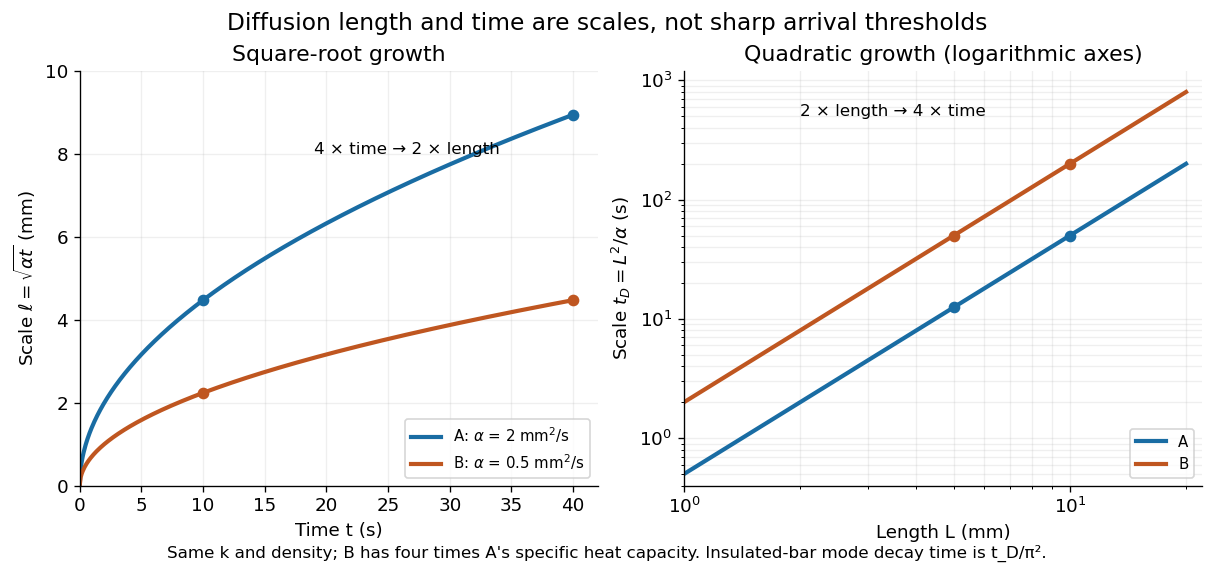
Thermal diffusion length grows as the square root of time; thermal diffusion time grows as length squared
. Original predictions for the two stipulated materials in thermal diffusivity. Left: , with four times the time needed to double length. Right: on logarithmic axes. Equal thermal conductivity with four times the volumetric heat capacity halves the reached length at a given time and quadruples the time at a given length. The scale differs from the insulated-bar decay time by the factor . Details.
At , the model materials have thermal diffusion lengths and . For their thermal diffusion times are and . These values describe the same heat equation as the thermal diffusion rate of a Fourier mode; the different numerical factors come from the definition of the scale.
Thermal conductivity tensor 2026-10-14
The thermal conductivity tensor maps a temperature gradient to the negative heat-flux density. In passive reciprocal conduction it is symmetric positive definite. This permits direction-dependent transport while ensuring positive dissipated energy.
If a line bundle on is trivial on each zero-coordinate face, its First Chern class vanishes: the integral second cohomology consists of single-factor second cohomology and cross-products of first cohomology from pairs, and each summand is detected on a coordinate face. The holomorphic exponential sequence then puts the bundle in . The decomposition of first cohomology, including Dolbeault cohomology, identifies this group with . Triviality on the three coordinate axes makes all three factors trivial. Applying this cube principle to the alternating partial-sum pullbacks proves the usual addition-map Theorem of the Cube.
Arithmetic cube identity for Weil heights 2026-10-14
For a line bundle on an elliptic curve over a number field, the geometric cube identity remains exact as a line-bundle identity. The Weil height machine translates it into the displayed bounded-error identity for a chosen logarithmic height, uniformly on the rational triples. This distinction is essential: arbitrary naive heights do not obey an exact quadratic identity. Dividing the identity for by produces an exact identity for the canonical height of an elliptic curve.
Lie derivative of a covariant tensor field 2026-10-14
For a covariant rank-two tensor field, pull back by the flow of a vector field and differentiate at zero flow time. Differentiating the evaluation point produces the first term above; differentiating the two coordinate Jacobians produces the remaining terms. In particular this formula gives the change in a metric tensor under an infinitesimal coordinate displacement. A perturbation defined relative to a fixed background consequently transforms as in the passive displacement convention. The formula applies to symmetric tensors as well as differential forms; tensor symmetry does not make the antisymmetric differential-form formula its definition.
Decomposition of three SU(2) spinors 2026-10-14
For , put , , and . With and inverse , the two-dimensional alternating identity gives . The inverse decomposition is . The symmetric part is the spin- SU(2) representation, and the two independent contractions are spin- representations. This is the spin coupling underlying ground-state three-quark baryons, before the Pauli constraint on three-quark flavour multiplets is imposed.
// Target: quantum-field-theory.bigb
There are unlisted articles, also show them or only show them.