
Selecting a subsequence is a regular matrix summability method: every row has one entry equal to one, every fixed column eventually vanishes, and all row sums equal one. Every bounded sequence of real or complex numbers has a convergent subsequence by the Bolzano-Weierstrass theorem, so each bounded sequence is summable by some sequence-dependent regular method. The order of the quantifiers matters: no single regular matrix sums all bounded sequences.
For a Gaussian linear model with an intercept and one explanatory variable, and , the regression intercept estimator is normal with variance . The residual variance estimate is independent of the coefficient estimators and has a chi-squared distribution with degrees of freedom. Consequently the displayed statistic has a Student t-distribution under , and a two-sided level- test rejects for .
// Target: mathematical-optimization.bigb
The stationary law is the law of . Let . The Exponential martingale for Brownian motion , stopped on first hitting , is bounded by . On no hitting, the driving path tends to minus infinity. Dominated convergence and optional stopping therefore give . The reflected process started at zero converges to this supremum law: its value at time has the law of the driving path's maximum up to , by reversing the increments. The resulting density is for .
Suppose has analytic near zero, , and a solution , with a positive integer. The indicial roots are . The Abel identity gives . Dividing by gives . Integrating this reduction of order expression from zero, multiplying by , and choosing proves the displayed normalized expansion. The integral's zero constant eliminates the added multiple of . Its nonzero Wronskian proves independence. In this setting the assumed exponent-zero solution prevents a logarithm in the constructed exponent- solution.
The category of rectangular bands is Cartesian closed. For nonempty products , , the exponential is . Also and for nonempty . It has no subobject classifier: the classifier would have two elements, hence would be left-zero or right-zero, while its characteristic maps on a two-by-two product could not single out a one-point subalgebra.
Cut feasibility for a rearrangeable triangle 2026-10-14
The three cyclic versions of this inequality are necessary and sufficient for routing unit calls on a triangle with complete instantaneous rearrangement. Necessity counts endpoint calls through a node cut. For sufficiency, at most one call count can exceed its direct-link capacity, since any two such excesses would violate their common endpoint cut. Route that one excess along the two other links; the two relevant cut inequalities guarantee room there. This gives an exact reduction to a loss network with a virtual resource at each node.
Incoherent two-source Airy profile 2026-10-14
Let measure position along the line joining two mutually incoherent optical point sources in the focal plane, with equal detected radiant fluxes and separation . Extend the even Airy disk profile to signed , and put as in Airy disk normalization and encircled energy. Relative to the peak of one source carrying the pair's total radiant flux, their summed light intensity isThe two-dimensional point spread functions underlying these line profiles all have the same total radiant flux. The line-profile integrals themselves need not equal one.
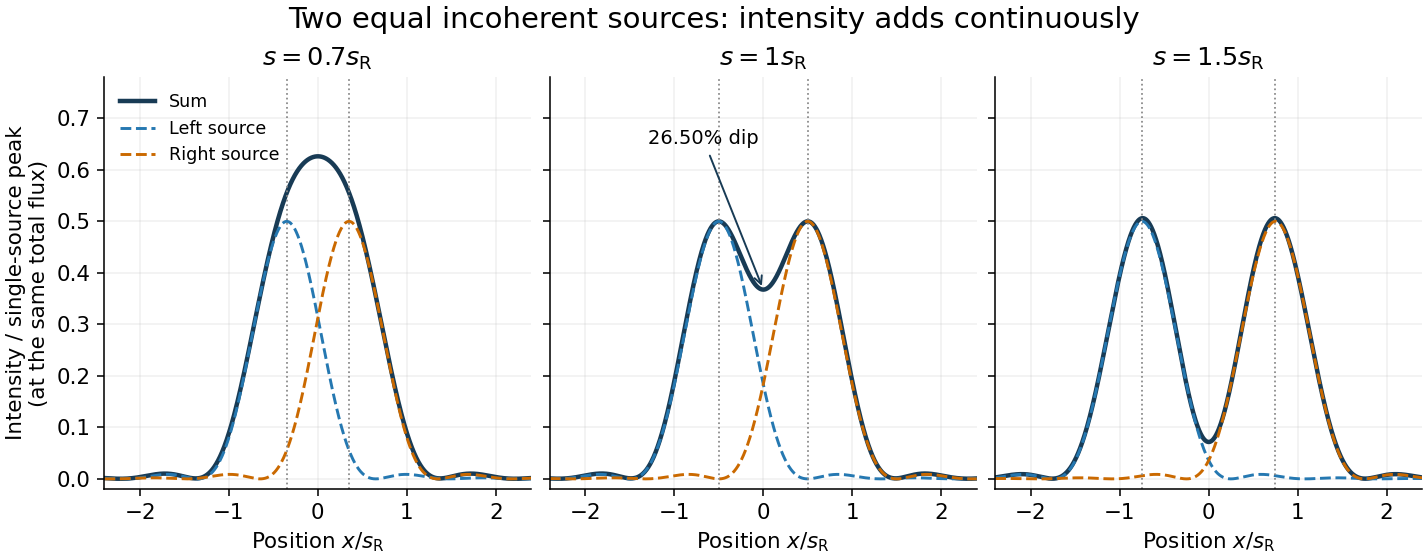

The dashed curves show individual contributions; the solid curve is their sum. All panels use the same brightness scale, and the vertical markers indicate the true source centres. At , the other source contributes zero at each centre, so . At the midpoint,The midpoint is therefore about below the source-centre peak. This is a calculation for this particular Airy disk and equal-incoherent-source convention, not a universal experimental threshold. At the two central peaks merge; at the valley is deeper. Changing separation continuously changes the profile, without a discontinuity at the Rayleigh criterion.
To see how information survives when the central peaks merge, set and . A symmetric Taylor expansion givesThe linear terms cancel because the source positions are symmetric. At the midpoint, the Airy disk derivation gives . Thus a close pair's shape differs from that of one source, but only quadratically at leading order. Detecting this small change becomes sensitive to noise and response calibration. For unequal flux fractions and , the intensity instead becomes ; its valley and peak positions need not match the equal-source example.
Rational homotopy equivalence 2026-10-14
A map between simply connected spaces is a rational homotopy equivalence when it induces isomorphisms in every degree. Equivalently it induces an equivalence of their rationalizations, or a rational homology isomorphism by the rational Whitehead theorem. Spaces have the same rational homotopy type when they are connected by a zigzag of such maps. This is distinct from rational homotopy equivalence of algebraic cycles.
On an irreducible algebraic curve, let be the constant rational-section sheaf and put . Every open subset is quasi-compact, so compatible finite-support families glue with finite support. Its stalk at is the displayed rational-principal-part quotient. A rational section is regular outside finitely many points, making its principal-part map well defined. The resulting sequence is stalkwise exact. Both right-hand sheaves are flasque, and consequently is the cokernel of the global principal-part map and for . The curve and Zariski-topology hypotheses distinguish finite support here from locally finite pole sets in complex analysis.
Elliptic maximal torus 2026-10-14
A rational maximal torus is elliptic when it is contained in no proper rational parabolic subgroup. This definition allows the split central torus of the ambient group; an absolute absence of every split subtorus is not the right condition when the centre is nontrivial.
Least positive Liouville period 2026-10-14
For a nonzero discrete Liouville period group, this is its positive generator. In Euclidean symplectic space, the same group is obtained from signed symplectic areas of disks with boundary on , by the Stokes theorem and contractibility of the ambient space. A product of circles of common radius is a rational Lagrangian submanifold with . Translation changes a primitive only by an exact form and hence leaves the period group unchanged.
Algebraic residue of a rational differential 2026-10-14
At a smooth point with local parameter , expand a rational differential as in the completed local field; its residue is . Formal substitution shows this coefficient is independent of the parameter, in arbitrary characteristic. For a finite separable extension of these local fields, residues commute with the differential trace, with a sum over branches. The monogenic trace formula in the trace-dual module of a finite curve map proves this compatibility by coefficient extraction.
For tangential data with , the harmonic function has zero prescribed data on both axes but a growing nonzero derivative. For normal data with , also has zero prescribed data, and decays at infinity but is singular at the corner. Thus decay of the data, and even decay of the solution gradient, does not alone determine the quadrant representation. Requiring the reflected gradient to decay at infinity and satisfy at the corner removes both examples. Without such conditions, add homogeneous holomorphic terms obeying the reflection parity.
For real harmonic , prescribe on the vertical axis and on the horizontal axis. Their orthogonal derivatives determine the missing gradient components. If use the kernel and use , the clockwise spectra , have the displayed expressions. Their global relation is in the third spectral quadrant.
// Target: analysis.bigb
Massive Rarita-Schwinger constraints 2026-10-14
For with , divergence gives . Gamma contraction then forces , hence . The remaining equation is in a mostly-plus convention. In the rest frame the temporal component vanishes, leaving a spatial vector times an on-shell two-component spinor; its gamma trace removes the spin-one-half sector. The remaining spin-three-halves representation has four physical states, including longitudinal helicities .
Massless Rarita-Schwinger polarization count 2026-10-14
Gauge equivalence permits gamma-trace gauge. The Rarita-Schwinger field equation then gives transversality and a massless Dirac equation for each component. For momentum along the third axis, residual gauge removes the temporal and longitudinal components. The remaining constraint is , with in the two-dimensional kernel of . Spinor helicity is paired with vector helicity of the same sign, leaving only . A Majorana spinor reality condition identifies antiparticles; a Dirac vector-spinor has separate antiparticle modes.
Gamma trace of a vector-spinor 2026-10-14
The gamma trace contracts the vector index of a Rarita-Schwinger field with a gamma matrix, producing an ordinary spinor. In the massive free theory it vanishes by the field equations. In the massless theory a gauge transformation changes it by , allowing a gamma-traceless gauge for propagating modes. Together with transversality this removes the unwanted spin-one-half sector.
Let be a membership structure satisfying extensionality and every pure-membership separation instance, with an external automorphism and domains represented by objects of . Suppose every -subset of is an element of . Interpret NFU on the objects of using the displayed set predicate and membership, with all subset statements evaluated in . Atoms have no members, and extensionality applied to gives extensionality for sets. A stratified formula becomes an ordinary pure-membership formula by sending each variable of type to and restricting its quantifier to . A set predicate on sort means containment in ; adjacent-sort membership is guarded by containment in the lower domain. Separation yields the extension , the closure hypothesis places it in , and is the required untyped set. This proves every comprehension instance. The guard is essential: an object not contained in a lower domain can still have some ordinary members there, which must not become members of a typed atom. Internal ranks with give one instance of these hypotheses; shifted rank objects in an elementary model of an expanded give a consistency proof without assuming Con(ZFC).
Maurey hierarchy of finite sets 2026-10-14
This hierarchy measures the complexity of successive finite selections. Start with . At a successor stage, retain the previous family and allow one smaller integer to be prepended. At a countable limit , choose positive ordinals and admit sets in whose minimum is at least . Each family is hereditary and spreading, has no infinite branch, and its extension-tree rank on every infinite subset is at least . These properties make the hierarchy useful for transfinite constructions of unconditional basic sequences.
If a design matrix has a nonzero null vector , the normal linear model has identical observation distributions at and . Any estimator has the same expectation at those two parameters, and therefore cannot be an unbiased estimator of both coefficient vectors. Full column rank is required for unbiased estimation of the entire unconstrained coefficient vector; identifiable linear combinations can still be estimated without it.
There are unlisted articles, also show them or only show them.