
In a hierarchical Bayesian model, replication conditional on fitted observation-level random effects checks the sampling layer. Replication with fresh random effects drawn from their population law also checks the population mean and variation. To assess a dose-response curve, sample the global parameters from their posterior distribution, draw fresh effects for new plates at each existing dose, and compare replicated means, spreads and trend discrepancies with the observed values. Reusing the fitted plate effects can conceal a misspecified mean curve by reproducing deviations those effects already absorbed.
Base-rate effect in a positive study 2026-10-14
When the prior odds of a real effect are , a study's Type I error is , and its statistical power is , a positive report updates those odds to . This follows directly from Bayes' theorem. A small false-positive rate does not itself make the effect's posterior probability high: the prior odds and power also matter. The posterior exceeds one half exactly when .
Loop group two-cocycle for U(1) 2026-10-14
Write a loop as with smooth real periodic and its mean. For the level-one representation with modes filled below zero and , choose implementers , where increases charge by one, , and . Their product differs from by the displayed two-cocycle. Its phase is bilinear, which verifies the cocycle identity; integer makes it independent of the ambiguity in . Rephasing implementers changes it by a group coboundary.
Let be a real positive-definite matrix and minimize the displayed quadratic function over all of . Its gradient is , so its only stationary point solves the linear system . The matrix is an invertible matrix, making this solution exist and be unique. Completing the square around that solution proves the stronger global statement:The quadratic function is strictly convex, and its level sets above the minimum are translated ellipsoids. Positivity therefore turns solving a linear system into locating the bottom of a bowl.[ref]
Convex Optimization by Stephen Boyd and Lieven Vandenberghe. §3.1.4, Example 3.2, p. 71: a quadratic function is strictly convex exactly when its symmetric coefficient matrix is positive definite
For the opening matrix , take and . Then , , and . Every displacement raises the value by ; along the unit eigenvectors and the increases are respectively and for displacement or .
For a singular positive semidefinite matrix, a solution of is still a global minimizer, but adding any kernel vector gives another. If is outside the image of a linear map defined by , some kernel vector has , and is unbounded below. For an indefinite quadratic form, a negative eigenvalue gives a direction along which the quadratic term tends to regardless of . Thus a stationary point alone does not establish a minimum. The same energy-difference identity extends to the quadratic variational principle for a symmetric positive operator, with additional existence hypotheses in infinite dimension.
For a real positive-definite matrix in finite dimension, write by the spectral theorem for real symmetric matrices. In the coordinates in an orthonormal basis , the positive level set becomesThis is an ellipsoid, with semi-major and semi-minor axes in two dimensions forming an ellipse; each semi-axis has length and direction given by the corresponding eigenvector. In the opening example, the shorter semi-axis is along , while the longer is along . A stiffer direction, meaning a larger eigenvalue, reaches the same energy at a smaller displacement. The ratio of longest to shortest semi-axis is , the square root of the spectral condition number of a positive-definite matrix.[ref]
Convex Optimization by Stephen Boyd and Lieven Vandenberghe. §2.2.2, p. 30, equation (2.3): ellipsoids and semi-axis lengths; the book uses the inverse quadratic coefficient matrix
Strict positivity matters because givesHence a fixed positive level set cannot extend arbitrarily far. The Cholesky decomposition gives another view: , so the ellipsoid is the inverse image of a sphere under an invertible linear map. A singular positive semidefinite matrix has a nonzero kernel; adding a kernel vector preserves its quadratic form, so any nonempty positive level set is unbounded. These statements concern finite dimension; the positive definite symmetric operator entry explains why strict positivity alone need not give a uniform lower bound on an infinite-dimensional Hilbert space.
Vary the coupling in the opening example. The eigenvectors and form a fixed orthonormal eigenbasis, with eigenvalues and . Writing a vector as givesFor , both directions cost energy and is a positive-definite matrix. At , the quadratic form is : the entire line spanned by has zero energy, and is a singular positive semidefinite matrix. At , the flat line is instead spanned by . For , the quadratic form is an indefinite quadratic form; one direction lowers the energy without bound as its displacement grows. At , for instance, while .
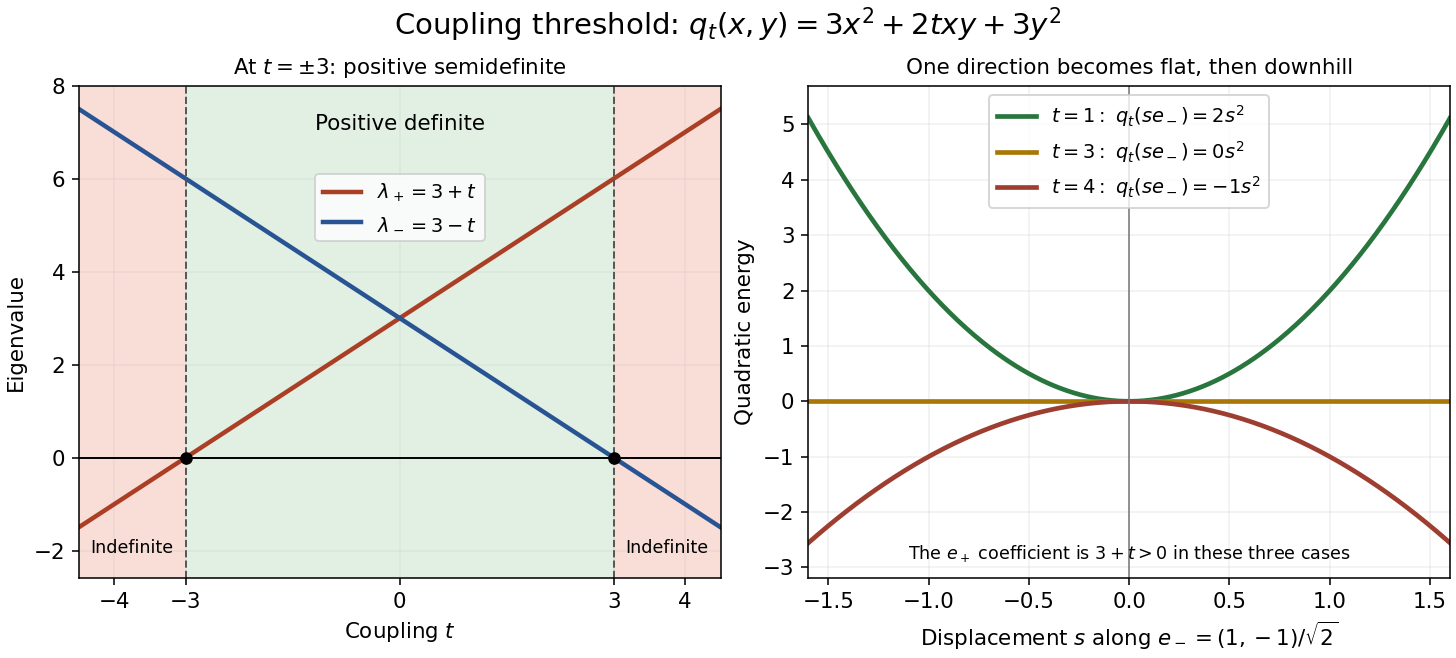
Eigenvalues and directional energies across the positivity threshold
. Details. 
The geometric transition is precise. For , is an ellipse. At , it consists of the two parallel lines , extending freely in the zero-energy direction. For , it is a hyperbola. The boundary case retains nonnegative energy but loses both the bounded positive level sets and the unique zero-energy vector.
Two-by-two positive-definiteness test 2026-10-14
For a real symmetric matrix , completing the square gives, when ,Thus is a positive-definite matrix exactly when and . For necessity, test first, then ; for sufficiency, the displayed two positive squares give the result. These are the first two leading principal minors in Sylvester's criterion. A positive determinant alone is insufficient: has determinant but is a negative-definite matrix.
The eigenvalues provide an equivalent test under the same real-symmetric hypothesis:The spectral theorem for real symmetric matrices supplies coordinates in an orthonormal basis in which . More generally, a complex Hermitian matrix has an orthonormal eigenbasis and , so it is a Hermitian positive-definite matrix exactly when every eigenvalue is positive. This is a short proof outline: test the eigenvectors for necessity, and sum the positive squared absolute values for sufficiency.[ref]
Convex Optimization by Stephen Boyd and Lieven Vandenberghe. Appendix A.5.2, pp. 646–647: symmetric eigenvalue decomposition and definiteness
For a real positive semidefinite matrix, the condition is instead for all vectors, equivalent here to , , and . If , the same completing the square proves this; if , nonnegativity forces and leaves with . Merely replacing the strict inequalities on the leading principal minors by nonstrict ones fails: has both leading principal minors zero yet gives . An indefinite quadratic form takes both positive and negative values; its real symmetric matrix has eigenvalues of both signs.
Take a separated Boolean decomposition . Feed to one independent PR box, obtaining outputs with . Alice forms , Bob forms , and their parities satisfy . Sending the single bit lets Bob compute the answer with certainty. The truth-table decomposition needs at most boxes for input lengths . Each box's local output is uniform, so Bob's uncommunicated output string carries no information about Alice's input; the final parity bit is essential for a general function depending on that input.
Dual Haar measure 2026-10-14
The dual Haar measure is the scale of Haar measure on the Pontryagin dual group compatible with Fourier inversion on a locally compact abelian group. It can be constructed without first assuming inversion: for a compactly supported test function , choose a finite sum of convolution squares with on its support and define . The Bochner consistency identity for convolution squares makes this independent of the choice. Modulation by a character shows is invariant under dual translation; the Riesz representation on compactly supported continuous functions gives the measure. It satisfies and scales reciprocally when is rescaled.
Evaluation is jointly continuous for the compact-open topology on the dual of a locally compact group. One proof uses near any character where the denominator is nonzero, together with norm-continuity of translations. A finite neighbourhood cover of a compact family then gives the displayed uniform convergence. This justifies compact-set-and-integrable-tail estimates even when the group is not metrizable and approximation is indexed by a net.
With independent prior distributions and in a normal distribution regression model, the conditional posterior distribution of has covariance matrix and mean . The conditional posterior distribution of is inverse-gamma distribution . The shape contains no half-dimension contribution from , since its prior distribution is independent of . These conditionals give a two-block Gibbs sampler.
For a compact connected Riemannian manifold with nonnegative Ricci curvature, its finitely generated fundamental group acts freely and properly discontinuously on the complete universal cover. The preceding polynomial growth of properly discontinuous isometry groups bound applies. The degree-one Hurewicz theorem identifies first integral homology with the abelianization of the fundamental group. If its free rank is , this group maps onto . Choosing lifts of a basis gives at least a constant times distinct elements in a word ball of radius a constant times . The upper bound of order forces the displayed inequality.
Expand the isotropic angular factor as . For a polymer scattering function and finite fourth pair moments, the constant double sum gives , and the quadratic sum is determined by the radius of gyration:In the range , this is also approximated by . The coefficient follows from isotropy and the definition of and does not require a Gaussian chain.
For equal oriented Dirichlet boundary data on all three sides and a uniquely solvable elliptic problem, rotation invariance makes their outward normal derivatives equal. Pairing the global relation with its Schwarz conjugation of a spectral function at determines every Fourier coefficient of the common normal trace. The zero mode at follows from zero total flux. At negative parameters, uniqueness and possible removable spectral denominators must be checked rather than assumed.
For an axisymmetric poloidal magnetic field , the ideal magnetohydrodynamic induction equation gives , after fixing the time-dependent additive constant in . A regular axial reference makes the enclosed magnetic flux. This scalar statement of magnetic flux freezing holds even when rotation also produces a toroidal magnetic field.
Lenard-Magri recursion 2026-10-14
Start from a Casimir function of the first Poisson structure. Whenever possible, choose whose first Hamiltonian vector field is minus the second Hamiltonian vector field of . A sequence extending indefinitely is the coefficient sequence of a formal Casimir function for the Poisson pencil. Its functions pairwise commute for both Poisson brackets. Existence at each stage is an additional solvability requirement; compatibility alone does not guarantee it.
Given Gaussian random intercept and random slope , let the conditional incidence rate be . The normal moment-generating function gives the displayed marginal rate, with . Thus the conditional annual rate ratio for a cluster is , whereas the marginal rate ratio also contains covariance and variance terms. Centering at a chosen year makes intercept heterogeneity refer directly to that year.
Gamma random-intercept Poisson model 2026-10-14
Let the positive multiplier have a gamma distribution with mean and variance , and conditionally let the repeated counts be independent with means . Total expectation and variance giveThe Poisson-gamma mixture gives negative-binomial marginal counts of size . Despite the shared multiplier, the marginal correlations generally depend on both marginal means and need not be exchangeable.
The full Poisson deviance is . An unpenalized log-mean intercept has likelihood score , which vanishes at an interior fit. The linear terms then cancel, giving the displayed expression. Without that intercept score equation, discarding the linear terms is not justified. Use the limiting convention .
Write . For small, the cell contribution to the Poisson deviance expands asSumming gives the Pearson chi-squared statistic as the quadratic approximation. The approximation can be inaccurate for sparse expected counts or cells with relative residuals near minus one.
There are unlisted articles, also show them or only show them.