
Non-backtracking random walk 2026-10-14
A non-backtracking random walk remembers its preceding vertex and excludes that neighbor from the next choice. At vertices of degree at least two, it is a Markov chain on directed edges: moves to with probability for each neighbor . Dead ends require an additional convention. An initial vertex without a preceding edge uses the ordinary first-step neighbor distribution.
A small proposal scale increases acceptance while making successive states almost equal. A large scale often proposes low-density states and creates long rejection runs. A pilot comparison can optimize effective sample size of a Markov chain per unit computing time, or expected accepted squared displacement, rather than acceptance alone. Tune on representative functions and then fix the scale for production; an arbitrarily history-dependent adaptation is not automatically a chain with the desired invariant distribution.
To update a positive parameter, a symmetric additive proposal distribution can be generated on the whole real line. Reject nonpositive proposals; accept positive ones using the target density ratio. The off-diagonal proposal remains symmetric. Repeatedly redrawing until the proposal is positive instead truncates and renormalizes the proposal differently at different current states, so a Hastings correction is then required. A symmetric walk in is another valid method, but its transformed target includes the Jacobian determinant factor .
For a conditional count mean , suppose the distribution of is independent of the covariates and has finite . Integrating over gives the displayed logarithmic link function mean: every slope stays unchanged, and only the intercept shifts. This is an exact property of the log link; it does not hold in this form for the logit.
For , the random-cluster measure lies between the two Bernoulli product measures displayed above. The upper Holley condition ratio is . The lower ratio is , because adding an edge reduces the component count by at most one. The comparisons persist under wired limits and give .
Six-vertex monochromatic triangle argument 2026-10-14
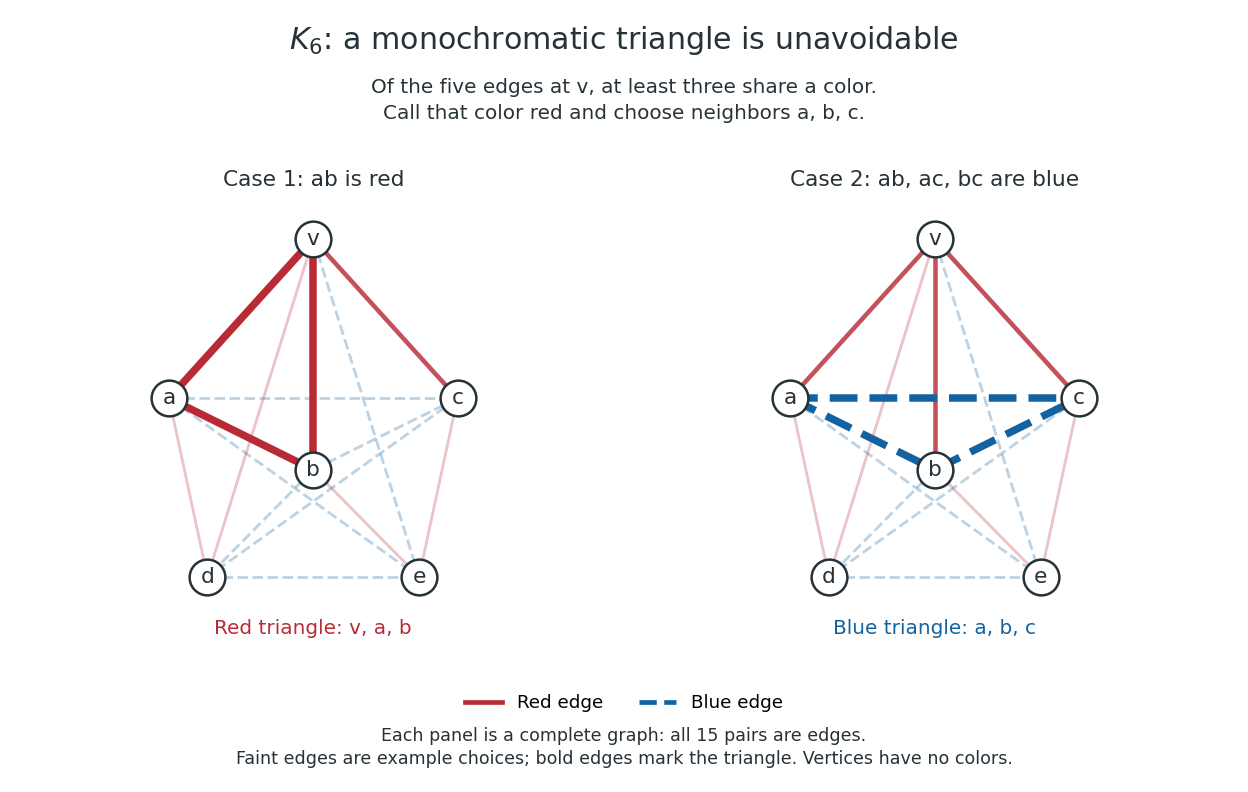
Choose any vertex of a red-blue colored complete graph . Its five incident edges go to the other five vertices. By the pigeonhole principle, at least three have the same color. Call their other endpoints and, after swapping color names if needed, suppose are red.
If any of is red, it completes a red triangle in a graph with . If none is red, all three are blue, so themselves form a blue triangle in a graph. Both possibilities force a monochromatic triangle in a graph. This proves the upper bound for the Ramsey number for triangles using only five incident edges and the three pairs among the selected neighbors; the colors of the other edges cannot defeat the argument.

Five-cycle Ramsey coloring 2026-10-14
Place five labeled vertices around a pentagon. In the complete graph , color the five perimeter edges red and the five diagonals blue. Writing for the unordered pair , the red pairs are , and the blue pairs are . This assigns a color to every pair, including every diagonal.
The red subgraph is the cycle graph ; the blue subgraph is the cycle graph . Neither contains a triangle in a graph. Consequently, none of the ten triples has all three edges red or all three blue, proving the lower bound for the Ramsey number for triangles. Crossings in the drawing are not additional vertices.
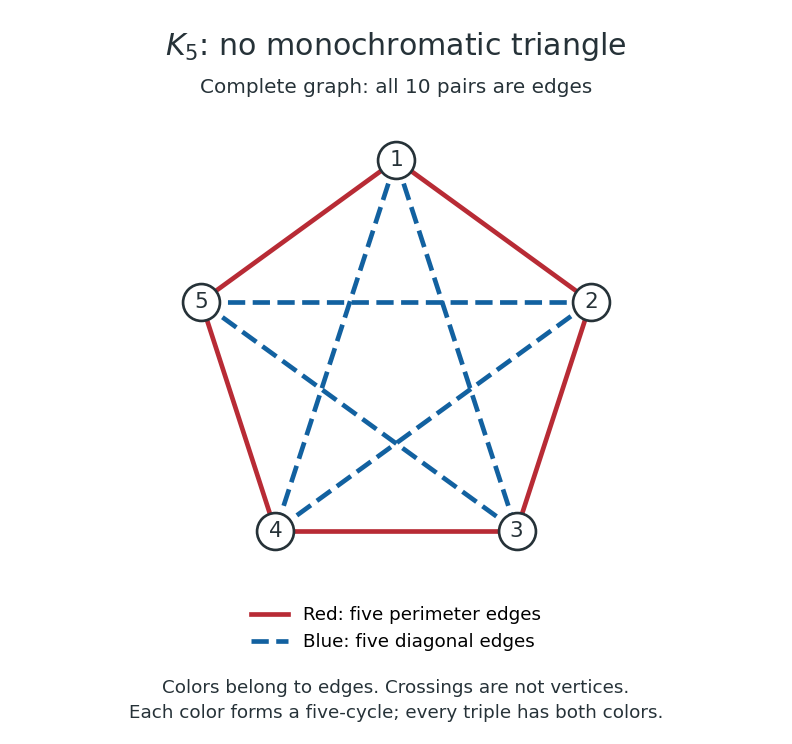
All ten edges of a complete graph on five vertices: red perimeter and blue diagonals avoid monochromatic triangles
. Details. 
Critical point of a rational map 2026-10-14
For a nonconstant rational map, choose local source and target coordinates centred at and . If the local expression is with , its local degree is , and is critical exactly when . This definition covers poles and infinity; a simple pole is not critical merely because the usual finite-coordinate expression is unbounded. Coordinate changes have nonzero first derivatives and leave unchanged.
A ramification point is simple when its analytic ramification index is two. Its contribution to total ramification of a holomorphic map is one. In suitable local coordinates, the holomorphic map is ; two nearby preimages merge there. A ramification point with contributes two even though it is just one point.
Radon-Nikodym density martingale 2026-10-14
For an absolutely continuous change of probability measure, restricting its Radon-Nikodym derivative to the current sigma-algebra gives this nonnegative uniformly integrable martingale. If almost surely, the measures are equivalent on . This finite-horizon equivalence need not imply equivalence on a larger sigma-algebra.
For nonzero integer coefficients , choose a prime number and colour each positive integer by its nonzero leading residue after removing its power of . In a monochromatic zero-sum solution, divide by the least occurring power of . Reduction modulo then makes the sum of the coefficients attached to the least-valuation variables vanish modulo . Its absolute value is less than , so that sum vanishes as an integer. This gives the necessity direction of the one-equation partition regularity criterion without using the general Rado theorem.
Suppose nonzero integer coefficients have a nonempty zero-sum subset , and fix . Put and . A Brauer progression theorem configuration containing a sufficiently long monochromatic progression of step and the point gives a positive solution: take every outside variable equal to , and the inside variables from the progression with offsets , where and the other offsets are zero. Shifting all inside offsets by the same integer keeps their weighted sum unchanged, because . This removes negative offsets while preserving the equation.
Bad barrier array for the Rado order 2026-10-14
The barrier in better-quasi-order theory has shifts for . Map each pair to the corresponding element of the Rado order. Neither clause of holds: the first coordinates differ, and the second coordinate of the first pair equals, rather than precedes, the first coordinate of the second. Thus this array is bad, although the Rado order is a well-quasi-ordering. It separates better-quasi-ordering from well-quasi-ordering.
Let a fixed-mass, fully mixed stellar model evolve by hydrogen burning, with and . Energy conservation gives . The time to reach is therefore . If and the function are common to the population, the integral is constant and . This includes the change of luminosity during fuel depletion rather than replacing the luminosity by its initial value.
At a spherical interface with an insulating exterior, equal magnetic permeability on both sides and no surface current, all components of the magnetic field are continuous. The solenoidal magnetic-field constraint then makes and continuous. A current-free exterior has . For an isolated field decaying at infinity, its degree- spherical harmonic satisfies at a sphere of radius . This boundary condition incorporates the exterior field without setting the radial field to zero.
// Target: fluid-mechanics.bigb
Dyadic Rademacher series 2026-10-14
For independent Rademacher random variables, this series converges absolutely on every sign sequence and has the uniform distribution on . Its first terms are uniform on the midpoints of equal subintervals of , giving weak convergence of probability measures by Riemann sums. The remaining tail has absolute value at most , and its mean square is by independence. Thus convergence is also almost surely and in .
Suppose an -stage Runge-Kutta method has order , an invertible matrix , and . Its stability function is . The adjugate matrix formula gives a rational function with denominator degree and numerator degree at most ; its zero limit at infinity lowers the latter degree to at most . The order of a numerical method gives , identifying the Padé approximant. Uniqueness follows because the cross-multiplied difference of two candidates has degree at most but a zero of order at least , so is identically zero. The A-stability of near-diagonal exponential Padé approximants then proves A-stability, and the zero limit proves L-stability. These conditions identify the stability function; they do not alone claim uniqueness of all entries of the Runge-Kutta method tableau.
Over , quotient the trivial bundle by the tautological bundle. The quotient is a vector bundle because it identifies continuously with the orthogonal-complement bundle via . Its rank is .
Congruence modulo an ideal 2026-10-14
Two elements of a commutative ring are congruent modulo an ideal if their difference lies in that ideal, equivalently if their images in the quotient ring agree. This is an equivalence relation compatible with addition and multiplication. For and , it means every coefficient difference is divisible by .
Let be a chain map between degreewise finitely generated free abelian groups. If its reduction modulo every prime number is a quasi-isomorphism, the mapping cone acyclicity criterion makes acyclic. The short exact sequence of chain complexes implies that multiplication by is an isomorphism on every . These are finitely generated abelian groups. Their free summands would make multiplication by fail to be surjective, and any nonzero finite summand would make it fail to be injective for a prime dividing its order. Thus and is a quasi-isomorphism. Degreewise finite generation is essential to this argument.
There are unlisted articles, also show them or only show them.