
Kernel for density estimation Created 2026-09-24 Updated 2026-10-14
A kernel for density estimation is an integrable function with unit integral. For an ordinary kernel density estimator that is itself a probability density function, takeThus specifies the bump's shape and the smoothing bandwidth specifies its width. The factor preserves area: doubling the smoothing bandwidth doubles the width and halves the height. An even function is a common choice; when its absolute first moment is finite, its mean is zero. Symmetry is useful but is not required for normalization.
The Gaussian density kernel is the standard normal density, . Its rescaled translate is the normal probability density with mean and standard deviation . It is positive everywhere, whereas an Epanechnikov kernel has compact support. With the Gaussian density kernel, the smoothing bandwidth is a standard deviation, not a cutoff beyond which observations have no influence.
The broader convention also allows signed kernels of order ell, such as the flat-top kernel for density estimation, to cancel moments and reduce the bias of an estimator. Their unit integral still normalizes total area, but a resulting kernel density estimator can take negative values and need not be a probability density function. Nonnegativity is therefore an additional condition, not a consequence of unit integral.
Quantifier elimination for dense linear orders without endpoints Created 2026-09-24 Updated 2026-10-06
The theory of dense linear orders without endpoints eliminates quantifiers. A finite partial order isomorphism extends by placing each new point in the corresponding interval or ray.
Asymptotic distribution of the Gaussian sample correlation Created 2026-09-24 Updated 2026-10-07
Linearized free-surface boundary conditions Created 2026-09-24 Updated 2026-10-25
For a small-amplitude surface gravity wave described by velocity potential and surface elevation , linearizing the kinematic boundary condition for a free-surface graph and the Bernoulli equation at the mean surface givesHere is the applied excess pressure above constant atmospheric pressure. With , differentiate the second equation in time and use the first to obtain . These surface conditions apply at finite depth as well as in the deep-water gravity wave limit; depth enters through the bottom condition. The quadratic kinetic energy term is omitted at this order, and surface tension is neglected.
Viscous decay of a deep-water gravity wave Created 2026-09-24 Updated 2026-10-07
For small kinematic viscosity , the mean viscous dissipation per unit horizontal area is . Since the mean wave energy is , the amplitude obeys
Fourier-support almost orthogonality Created 2026-09-24 Updated 2026-09-24
Functions with pairwise disjoint, or uniformly finitely overlapping, Fourier supports are almost orthogonal in by the Plancherel theorem.
Decoupling inequality for the parabola Created 2026-09-24 Updated 2026-09-24
Upper and lower Darboux integrals Created 2026-09-24 Updated 2026-09-29
Damped rational double-barrier phase portrait Created 2026-09-24 Updated 2026-09-24
Forthe mechanical energy isThe origin is a center for and an asymptotically stable equilibrium for , while are saddles. For positive damping, their stable manifolds form the boundary between the basin of the origin and the two escape regions.
Vanishing-viscosity limit Created 2026-09-24 Updated 2026-09-24
A vanishing-viscosity limit studies solutions as the viscosity coefficient tends to zero. Uniform estimates and compactness can make the viscous term disappear weakly while retaining enough strong convergence to pass nonlinear transport terms to an inviscid equation.
Damped-vorticity maximum estimate Created 2026-09-24 Updated 2026-09-24
For a steady damped vorticity equation with , divergence-free transport, and bounded forcing, multiplication by gives . Sending to infinity yields
D'Alembert formula with initial velocity Created 2026-09-24 Updated 2026-10-14
For the wave equation with zero initial displacement and initial velocity , D'Alembert's formula becomesFor this is the original speed-one form when the initial velocity is named . The integral records the total initial kick inside the domain of dependence.
For a computed example, set on and zero elsewhere, with . This discontinuous datum gives a weak solution:At the centre, . For , and , this is at and at . Once , a central plateau occupies . In contrast, central zero region for odd compactly supported initial velocity follows when the full integral of vanishes. Finite propagation speed permits an interior tail; it does not imply the Strong Huygens principle.
Maximal cyclotomic extension Created 2026-09-24 Updated 2026-09-29
For a field inside a fixed algebraic closure, the maximal cyclotomic extension is the union of the fields generated by roots of unity.
Seventh cyclotomic field Created 2026-09-24 Updated 2026-09-24
For a primitive seventh root of unity ,where . Its four intermediate fields correspond to the four subgroups of the cyclic group .
Roots of unity in a rational cyclotomic field Created 2026-09-24 Updated 2026-10-25
Kriz theorem for cyclic transitive point sets Created 2026-09-24 Updated 2026-09-24
Every finite cyclic transitive point set is a Euclidean Ramsey set. In particular every regular polygon is Euclidean Ramsey.
Generator of a group Created 2026-09-24 Updated 2026-10-14
A generator of a group is a single element for which : every group element is an integer power of . A group admitting such an element is a cyclic group. In additive notation, every element must be an integer multiple of .
Distinguish a single generator of a group from a generating set of a group. The Klein four-group needs two elements to generate it, although it has only four elements; no single element visits all four. A cyclic group need not have a unique generator of a group: has and , while the additive integers have and .
Finite subgroup of the multiplicative complex numbers Created 2026-09-24 Updated 2026-09-24
Every finite subgroup of is cyclic. If its exponent is , it is a subgroup of the cyclic group of th roots of unity.
Pancyclic graph Created 2026-09-24 Updated 2026-09-24
Hamilton cycle Created 2026-09-24 Updated 2026-10-14
A Hamilton cycle, also called a Hamiltonian cycle, is a cycle in a graph containing every vertex of the graph. Here the convention is a finite simple graph whose edges are undirected, with . A traversal is a sequencewhere are all the distinct vertices and for . Thus "once" means once before the closing return: the start appears again at the end, and there are exactly traversed edges. The graph may contain additional unused edges.[ref]
Hamilton Cycles. Diestel, Graph Theory, Chapter 10, opening paragraph, printed p. 323: Hamilton cycles, Hamilton paths, and the contrast with Euler tours
A Hamiltonian path visits all vertices once without requiring a return. Removing an edge from a Hamilton cycle gives a Hamiltonian path; a particular Hamiltonian path closes only if its endpoints are adjacent. An Euler circuit instead traverses every edge exactly once and can revisit vertices midway. The two requirements are independent, as these original labelled examples show.
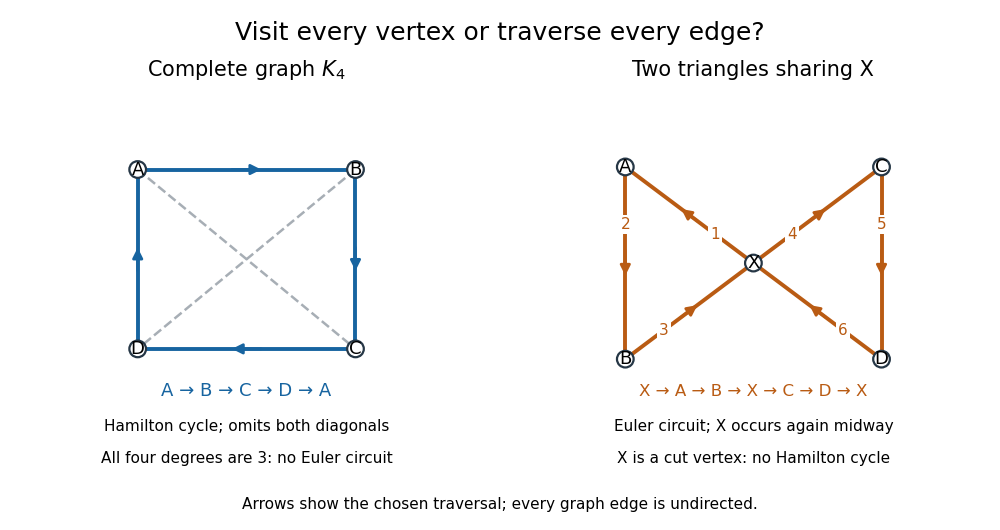
Two graphs separate Hamilton cycle vertex coverage from Euler circuit edge coverage; arrows mark traversal order, not directed edges
. Details. 
For the complete graph , use and , where abbreviates the unordered pair . The route is a Hamilton cycle: it visits every vertex and uses four of the six edges, omitting and . It is not an Euler circuit, and the graph admits no Euler circuit at all: every vertex degree is three, contradicting the Euler circuit criterion. The crossing of the drawn diagonals is not another vertex.
Conversely, take two triangles in a graph sharing only , with and . The route is an Euler circuit, using all six edges once; the vertex degrees are . It cannot be a Hamilton cycle, since occurs midway as well as at the start and end. More strongly, no Hamilton cycle exists: is a cut vertex, and deleting it leaves the two separate edges and . Nevertheless, is a Hamiltonian path, whose endpoints are not adjacent.
There are unlisted articles, also show them or only show them.