A kernel for density estimation is an integrable function with unit integral. For an ordinary kernel density estimator that is itself a probability density function, takeThus specifies the bump's shape and the smoothing bandwidth specifies its width. The factor preserves area: doubling the smoothing bandwidth doubles the width and halves the height. An even function is a common choice; when its absolute first moment is finite, its mean is zero. Symmetry is useful but is not required for normalization.
The Gaussian density kernel is the standard normal density, . Its rescaled translate is the normal probability density with mean and standard deviation . It is positive everywhere, whereas an Epanechnikov kernel has compact support. With the Gaussian density kernel, the smoothing bandwidth is a standard deviation, not a cutoff beyond which observations have no influence.
The broader convention also allows signed kernels of order ell, such as the flat-top kernel for density estimation, to cancel moments and reduce the bias of an estimator. Their unit integral still normalizes total area, but a resulting kernel density estimator can take negative values and need not be a probability density function. Nonnegativity is therefore an additional condition, not a consequence of unit integral.
The triweight kernel is a compactly supported symmetric probability density with variance . Its value and first two derivatives vanish at the support endpoints. Its integrated squared second derivative is , and it minimizes that curvature among twice continuously differentiable densities with zero mean and the same variance, by the triweight density minimizes integrated squared curvature inequality.
Let be the triweight kernel and h a twice continuously differentiable density with matching zero mean and variance. Put and . Two integrations by parts over its support give , using the zero mass and second moment of e. Therefore . The endpoint terms matter because the third derivative jumps there.
The Gaussian density kernel is the standard normal probability density used as a unit-integral kernel for density estimation. Its second moment is one and . Its canonical kernel has scale . It is a function of one smoothing displacement, distinct from the two-argument Gaussian kernel used as a positive-semidefinite kernel.
The Epanechnikov kernel for density estimation is a nonnegative symmetric truncated parabola with integral one, , and . It has the smallest optimized asymptotic mean integrated squared error among nonnegative second-order density kernels, up to rescaling. Its canonical kernel has scale and support .
Fix the second moment . Put and . For every nonnegative unit-integral kernel for density estimation with the same second moment and finite , the mass and second-moment constraints give . Outside , and , so . Expanding the square gives , with equality only when almost everywhere. Since is scale invariant, rescaled Epanechnikov kernels minimize the optimized asymptotic mean integrated squared error over all such second moments. This conclusion concerns nonnegative second-order kernels; signed higher-order kernels obey a different bias expansion.
Choose a real even smooth compactly supported Fourier transform equal to one near zero and let be its inverse Fourier transform. Repeated integration by parts makes a Schwartz function. It is real, integrable and square-integrable, with unit integral. Moment differentiation of the Fourier transform gives for every positive integer . Such a kernel for density estimation therefore satisfies arbitrary finite-order moment cancellation, and necessarily takes negative values. If the transform plateau contains the frequency support of a bandlimited function , the convolution theorem proves .
Let a bounded probability density function have Fourier transform supported in the plateau of a flat-top kernel for density estimation. At fixed smoothing bandwidth one, the convolution theorem gives , so the kernel density estimator is pointwise unbiased. Its variance is at most , and the Cauchy-Schwarz inequality proves the displayed rate. An explicit example is , with value at zero and transform . Direct inverse Fourier integration gives the formula. The function is nonnegative, integrable and has integral one because its transform at zero is one. Compact frequency support also gives bounded derivatives of every order.
For normalized Legendre polynomials, this kernel for density estimation reproduces evaluation at zero on every polynomial of degree below : expand in the orthonormal basis to obtain . Taking monomials proves integral one and zero moments of orders ; compact support gives finite absolute moments. If exact order requires a nonzero moment of order , add . Lower moments remain unchanged. Writing and evaluating the full expansion of at zero shows that the new moment is . A useful three-derivative example is , whose first two moments vanish and whose squared L2 norm is .
Let be real independent and identically distributed random variables with unknown probability density function , let , and choose a nonnegative, unit-integral kernel for density estimation and a smoothing bandwidth . The kernel density estimator isPlace a bump at every observation and add their contributions. Each bump has area , so for every realized statistical sampleThe change of variables is . Summing the unweighted bumps would give area ; summing just would give area . Those raw sums do not have the normalization of a probability density function.
Unlike a histogram, the construction does not require choosing bin origins, and a Gaussian density kernel gives a smooth curve. Its appeal is that identical local contributions can combine into a probability density function with several peaks without first choosing their number. This makes kernel density estimation useful for exploring an unknown probability distribution and estimating interval probabilities, while the smoothing bandwidth controls how much detail is visible.
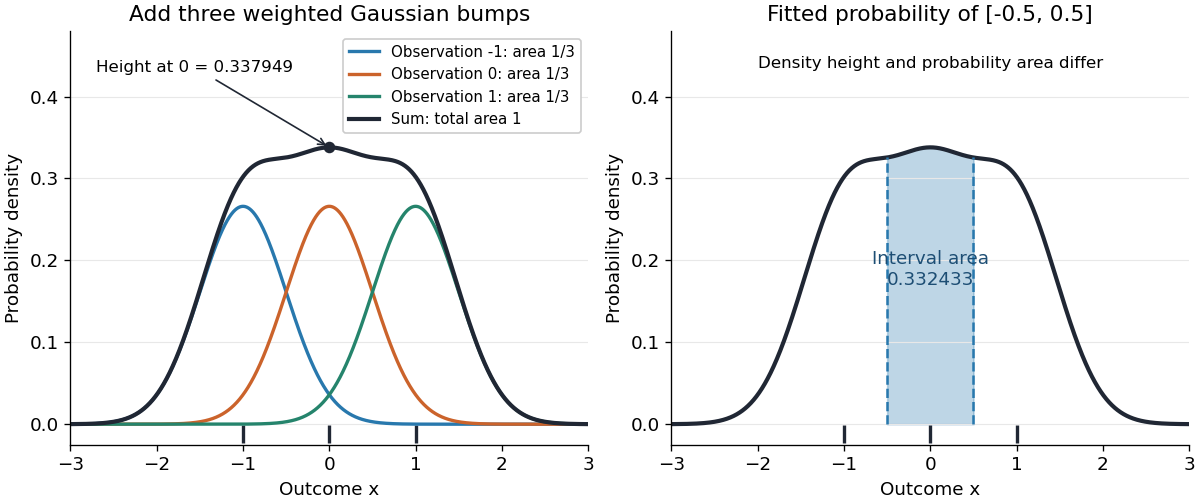

Before the statistical sample is observed, is a random function; afterwards it is a fitted probability density function. It is an estimator of the unknown , not the true probability distribution. For fixed , its expectation is the convolution , generally different from , and repeating the sampling changes the fitted curve. The exact mean integrated squared error of a kernel density estimator separates this smoothing bias of an estimator from sampling variance. Allowing signed kernels of order ell retains the formula but can lose nonnegativity.
Take the realized statistical sample , the Gaussian density kernel and smoothing bandwidth . ThenAt , the three contributions are , , and , because and . Their sum isThis is a probability density function value, not the probability of observing exactly zero. Each of the three component curves has area , despite having a different height at zero.
Let be the cumulative distribution function of the standard normal distribution. The fitted probability of the interval is its area under the kernel density estimator:The shaded area in the diagram is this fitted probability. Its agreement to a few digits with is incidental: the empirical measure gives this interval mass exactly, whereas kernel density estimation redistributes that mass into neighboring intervals.
Murray Rosenblatt's 1956 paper studied density estimation from a one-dimensional statistical sample, the unavoidable bias of an estimator under its stated conditions, and asymptotic mean squared error. It is an early foundation of kernel density estimation. [ref]
https://doi.org/10.1214/aoms/1177728190. Rosenblatt, Remarks on Some Nonparametric Estimates of a Density Function, Annals of Mathematical Statistics 27(3), 832-837 (1956)
. Emanuel Parzen's 1962 paper developed statistical consistency and asymptotic normality for probability density function estimates and studied estimation of the mode. [ref]https://doi.org/10.1214/aoms/1177704472. Parzen, On Estimation of a Probability Density Function and Mode, Annals of Mathematical Statistics 33(3), 1065-1076 (1962)
.The authors' interests help explain the connection with smoothing. In a conversation recorded in 2006 and published in 2009, Rosenblatt recalled that his density estimation work grew out of estimation of the time-series spectral density and emphasized the connection with a smoothed histogram. This is his retrospective account of the motivation. [ref]
https://celebratio.org/Rosenblatt_M/article/891/. Brillinger and Davis, A conversation with Murray Rosenblatt, passage immediately before The Chicago, Indiana and Brown years
. Parzen's original paper lists Stanford University as his affiliation; its opening frames the problem as recovering both a probability density function and its mode from independent and identically distributed random variables. [ref].For independent observations with common density f, the kernel density estimator has mean . Its pointwise variance is . Integrate the variance and add integrated squared bias to get the displayed exact mean integrated squared error, assuming the integrals are finite. Since , this also separates the smoothing bias from the stochastic variance.
For a second-order kernel density estimator, if and , the leading pointwise asymptotic mean squared error is . Differentiation gives the displayed interior optimum. At a zero of , the leading variance term vanishes and this two-term approximation has no positive interior minimizer; at a zero of , a higher-order bias expansion is needed.
For the standard normal density, and . The fifth power of the bandwidth ratio is . Its global minima occur at ; is only the minimum within the interval between the two inflection points. The ratio diverges as approaches either inflection point.
For a nonnegative symmetric unit-integral kernel for density estimation with and , the canonical scaling satisfies . Since and , the unique scale is . Consequently its asymptotic mean integrated squared error is , where is invariant under kernel rescaling. The leading optimal smoothing bandwidth becomes , independent of the kernel shape. Unit second moment is a different normalization and does not have this separation property.
Let the kernel for density estimation have integral one, be bounded and have compact support. For a probability density function with bounded derivative, assume , and . The bias of a kernel density estimator is , negligible on the scale. For , . The centered summands divided by are uniformly small, so the Lindeberg-Feller central limit theorem applies. The condition alone is insufficient: with and a compactly supported kernel, with probability tending to one no observation enters the kernel window, producing a degenerate limit at a point with positive density.
Suppose a probability density function and its third derivative are bounded. A square-integrable unit-integral kernel for density estimation with first two moments zero and has bias of a kernel density estimator at most , by Taylor theorem with Lagrange remainder and moment cancellation. Independence gives variance at most . The Cauchy-Schwarz inequality bounds the expected centred absolute deviation by the square root of this variance. Adding the bias proves the inequality uniformly in . The choice gives expected absolute error .
For an kernel and an independent sample from a density , the centred kernel density estimator hasIndependence removes cross terms and Tonelli theorem integrates the pointwise variance. Young's convolution inequality ensures even without . The Cauchy-Schwarz inequality yields the expected-norm bound .
For a stationary autoregressive process of order one with unit-variance normal distribution marginals and fixed , the Gaussian kernel covariance correction at lag has the displayed form. The difference of two observations has variance , and their characteristic functions reduce the Fourier integral to the difference of two Gaussian integrals. The mean value theorem gives , uniformly over . Thus the integrated variance differs from its independent-sample counterpart by . The marginal bias is unchanged, so this dependence does not alter the leading optimal bandwidth or the mean integrated squared error for a second-order density kernel.
Over a one-dimensional Hölder density class of smoothness , the optimized pointwise mean-squared error has order . A kernel of sufficiently high order balances squared bias against variance .
For a symmetric bandwidth- averaging kernel and a density with bounded first derivative, the interior pointwise bias is at most a constant times . Near a support boundary, an uncorrected symmetric kernel can instead have nonvanishing bias.
If the unknown probability distribution is supported on , an ordinary Gaussian density kernel still puts some fitted probability below zero. For positive observations and the standard normal distribution cumulative distribution function , the displayed formula gives the total leakage. For the statistical sample and smoothing bandwidth , it isThus about of the fitted probability falls outside the known support of a probability distribution, even though the full integral remains one. The leakage panel in smoothing bandwidth shades this area. Simply deleting the negative part leaves area ; renormalizing it makes another probability density function but does not by itself establish that the bias of an estimator has been corrected.
The issue also appears in the expectation of the kernel density estimator. For a nonnegative symmetric kernel for density estimation and a probability density function that is zero for and has a finite positive right-hand limit , assume is bounded. Then, for fixed as ,Half the averaging window lies on the impossible side of the boundary. For example, the rate-one exponential distribution has , so the limiting expected boundary height is , rather than the right-hand height one. This refers to estimating the right-hand limit; changing a probability density function at a single point does not change its probability distribution. Decreasing the smoothing bandwidth narrows the affected region but does not remove this boundary-height error. This is why the interior second-order pointwise bias bound for kernel density estimation cannot be applied across a jump at the boundary.
For a nonnegative symmetric unit-integral kernel for density estimation and , the integral Taylor remainder and Minkowski inequality give . Translation preserves the L2 norm. For a signed kernel the same proof requires the absolute moment .
An uncorrected nonnegative symmetric kernel density estimator can leak an order-one amount across a jump in a probability density function. If its transition region has width proportional to the smoothing bandwidth , the integrated mean squared error includes squared bias of an estimator of order , rather than the order familiar for twice-smooth interior densities. For the unit-width uniform window and the exponential distribution of rate one, the integrated squared bias of an estimator is .
For a density with finitely many jumps at separated points and the unit-width box kernel, take smaller than all consecutive jump spacings. The smoothing bias is supported in disjoint length- neighbourhoods of the jumps. At each jump its two sides form triangles of height , and exact integration givesCombined with the integrated variance of a kernel density estimator, this gives expected error at .
Let a nonnegative kernel for density estimation have integral one, zero first moment and finite second moment . If a probability density function has bounded second derivative, its kernel density estimator has pointwise bias at most . Apply the Taylor theorem with Lagrange remainder to and integrate: the first-order term vanishes and the remainder is bounded by . For , .
Lepski's method compares estimators across an ordered bandwidth grid. It chooses the largest bandwidth whose confidence interval has nonempty intersection with every interval at a smaller bandwidth, thereby adapting to unknown smoothness while controlling excessive undersmoothing.
Differentiating a twice differentiable kernel density estimator twice estimates . Its integrated variance of a kernel density estimator analogue is at most . This explains why derivative estimation requires more smoothing than ordinary density estimation.
The integrated squared second derivative measures a smooth density's curvature in L2. It supplies the leading integrated squared bias constant of a second-order kernel density estimator. For nonzero second moment , the asymptotic mean integrated squared error has bias term , so greater curvature calls for a smaller smoothing bandwidth.
For with a positive, differentiation and change of variables give , while its standard deviation is . Their product D is therefore invariant under scale changes, and translation also leaves it unchanged. Raw integrated squared curvature can be arbitrarily small under dilation even though this dimensionless shape measure is unchanged.
The Nikolsky class consists of functions with square-integrable derivatives whose highest derivative obeys the translation boundwith the corresponding finite-difference definition at integer smoothness.
Articles by others on the same topic
There are currently no matching articles.