
Null curve Created 2026-09-24 Updated 2026-10-14
Light cone Created 2026-09-24 Updated 2026-10-25
The light cone of a spacetime event consists of together with the spacetime events having null separation from it. In the coordinates of an inertial frame centered on , it obeysFor it traces an expanding spherical flash of light, with radius at time ; for it describes possible incoming light rays. A spacetime diagram with one spatial coordinate shows the two lines . The apparent angle uses equal scales for and and is not a separate physical angle.
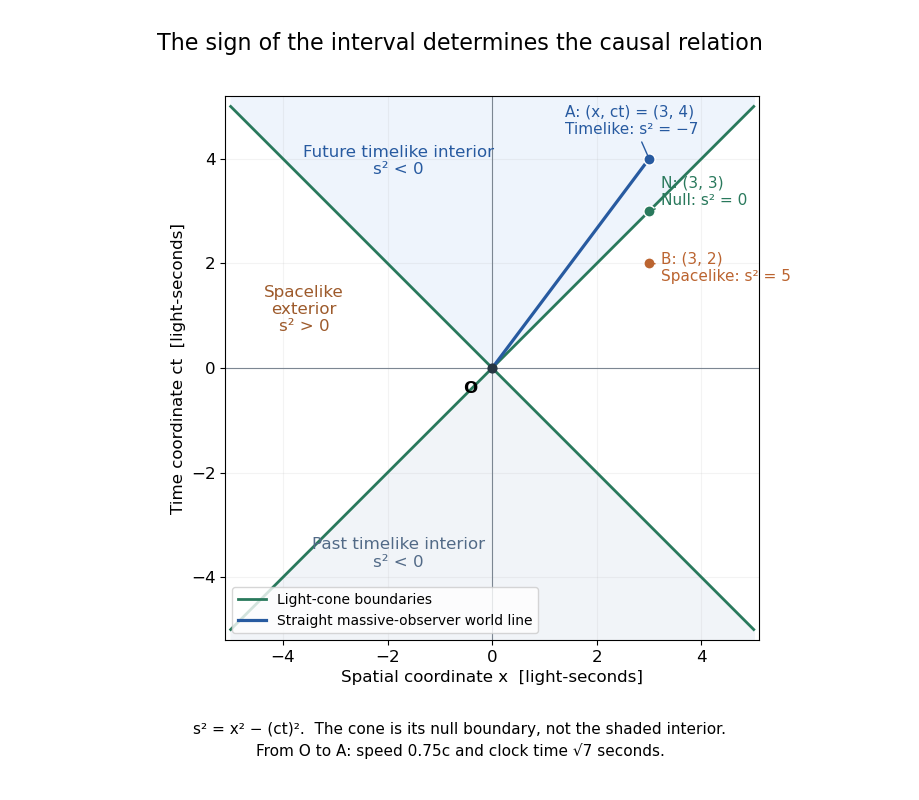
Light-cone boundaries separate timelike, null and spacelike events relative to the origin
. Details. The light cone is the boundary, while its interior has timelike separation from . An outgoing light ray follows the boundary; a future-directed massive observer's world line remains inside it. The exterior has spacelike separation: no signal travelling at or below the speed of light can connect its spacetime events directly to . This separates possible causal influence from merely being assigned a later coordinate time.
In the diagram, is inside the future boundary, is on it, and is outside. Their squared Minkowski intervals are respectively in . Thus occurs later than in the displayed inertial frame while still being unable to receive a light-speed-or-slower signal sent from .
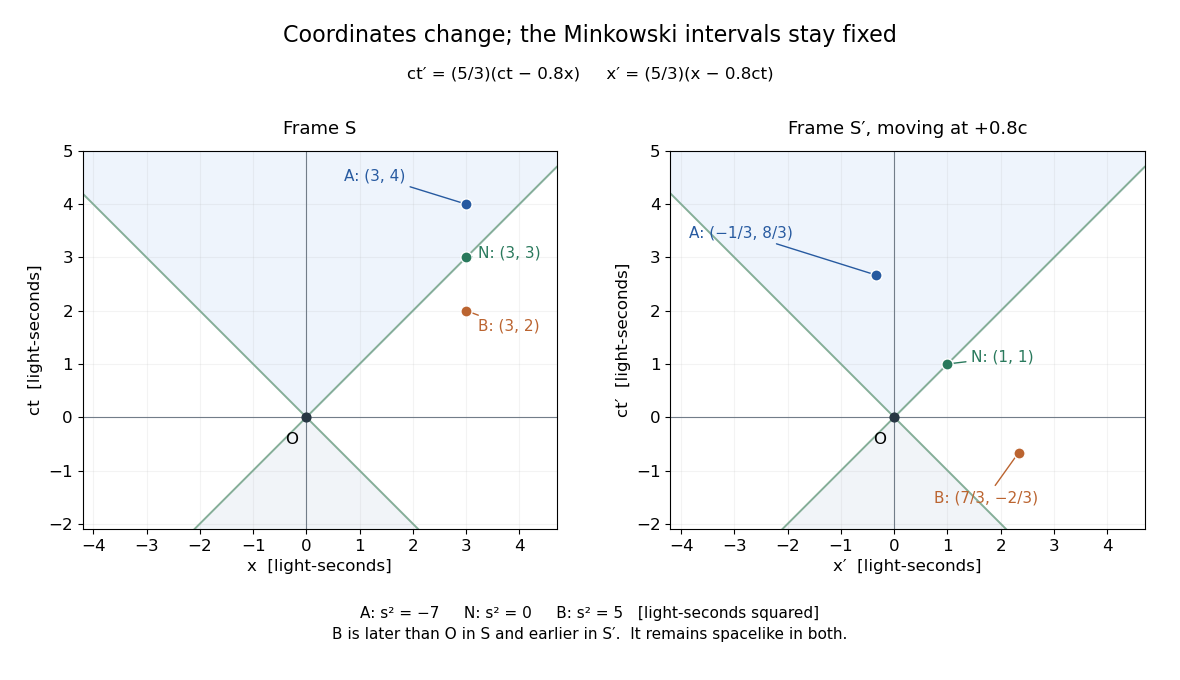
The usefulness is immediate for an experiment: a detector's reading can depend on a source event only if a causal influence can reach it. A Lorentz boost changes coordinates but preserves this classification. For a boost with and Lorentz factor , applying the Lorentz transformation gives, in light-second length units,The corresponding squared Minkowski intervals remain . In particular is now earlier than , which is allowed for spacelike separation; remains later.
Minkowski norm Created 2026-09-24 Updated 2026-10-14
This quadratic form belongs to the geometry of Minkowski spacetime; the spacetime itself is a broader concept than this squared norm.
Minkowski embedding of a real quadratic field Created 2026-09-24 Updated 2026-11-05
For a real quadratic field with embeddings , the imageis a lattice in of covolume , and the product of the two coordinates is the field norm.
Likelihood-ratio criterion for minimal sufficiency Created 2026-09-24 Updated 2026-10-06
Galactic bar Created 2026-09-24 Updated 2026-09-24
The Galactic bar is the elongated central stellar structure of the Milky Way. Extinction-corrected near-infrared standard candles and gas position--velocity maps constrain its distance, orientation, and three-dimensional shape.
Galactic multiwavelength astronomy Created 2026-09-24 Updated 2026-11-05
Galactic multiwavelength astronomy compares observations of the Milky Way in different parts of the electromagnetic spectrum to distinguish its overlapping physical components. The neutral-hydrogen 21-centimeter line traces neutral atomic gas, carbon monoxide spectral lines trace molecular clouds, and infrared emission reveals warm interstellar dust and stars hidden at visible wavelengths. Radio waves from synchrotron radiation trace energetic electrons in magnetic fields, while X-rays reveal hot plasma and compact sources. Maps of the same sky region can therefore test whether a feature is a stellar concentration, an obscuring cloud or shocked gas. Comparing them also requires attention to differing angular resolution and foreground absorption.[ref]
Multiwavelength Milky Way by NASA. Map descriptions: atomic hydrogen, molecular hydrogen, infrared, radio continuum and X-ray images
Interstellar medium Created 2026-09-24 Updated 2026-11-05
The interstellar medium is the gas, interstellar dust, magnetic field and cosmic rays between stars in a galaxy. It is a changing reservoir: molecular clouds supply star formation, while stellar winds and supernova remnants return material and stir or heat it. Different regions occupy different temperature and ionization states, so no single observation measures the whole medium. For example, the neutral-hydrogen 21-centimeter line probes neutral atomic hydrogen, whereas X-rays reveal much hotter plasma. Even neutral atomic gas can occupy cold and warm phases: the heating and cooling balance in the interstellar medium permits both over a restricted range of pressure.[ref]
The Neutral Atomic Phases of the ISM in the Galaxy by Mark G. Wolfire and others. Abstract: cold and warm neutral phases, thermal balance and the pressure range for coexistence
Zweifach--Fung effect Created 2026-09-24 Updated 2026-11-05
The Zweifach--Fung effect, or plasma skimming, is the disproportionate entry of red blood cells into the higher-flow daughter at an asymmetric microvascular bifurcation.
Fahraeus--Lindqvist effect Created 2026-09-24 Updated 2026-11-05
Murray's law Created 2026-09-24 Updated 2026-11-05
Murray's law predicts for an ideal blood vessel whose radius balances pumping power against the cost of maintaining its blood volume. Cecil D. Murray formulated this minimum-cost model in 1926. [ref]
Consider a cylindrical segment of fixed length , prescribed positive volumetric flow rate and constant dynamic viscosity . The Hagen-Poiseuille equation gives pumping power . Adding a maintenance cost per unit volume per unit time givesDifferentiation givesThe pumping term diverges as , while the maintenance term diverges as ; the unique stationary radius is the minimum.
At an ideal bifurcation, conservation of mass for an incompressible flow gives . If the three segments have the same and , their common proportionality constant cancels:Equal daughters therefore have , approximately . This prediction depends on the model: pulsatile inertia, differing maintenance costs and radius-dependent apparent viscosity, including the Fahraeus--Lindqvist effect, can change the optimum.
Hausdorff distance Created 2026-09-24 Updated 2026-10-14
Complete metric space Created 2026-09-24 Updated 2026-09-24
Isolated point Created 2026-09-24 Updated 2026-10-14
A point of a metric space is isolated when some open ball about contains no other point of the space, equivalently when the singleton is open.
Distance to a set Created 2026-09-24 Updated 2026-10-25
For a nonempty subset of a metric space, the distance to a set is . The triangle inequality gives ; swapping proves . Thus it is one-Lipschitz. Its zero set is exactly the closure of : every neighbourhood of meets precisely when this infimum vanishes. For a closed set, zero distance therefore implies membership. When the empty set is allowed, use the convention ; the finite-valued Lipschitz assertion applies to nonempty sets.
Uniform continuity Created 2026-09-24 Updated 2026-10-14
Uniform continuity requires one input tolerance to work at every point of the domain for a chosen output tolerance.
Euclidean distance Created 2026-09-24 Updated 2026-10-14
Triangle inequality Created 2026-09-24 Updated 2026-10-14
A metric satisfies : visiting an intermediate point cannot beat the direct endpoint distance. A norm satisfies the corresponding inequality .
Take , , and . For Euclidean distance, the triangle inequality reads . The direct line segment has metric path length , while the route through has metric path length . For Manhattan distance, the same comparison becomes : both routes are shortest. The line segment and the bent route both become metric geodesics when progress is measured by metric path length. For Chebyshev distance, the direct line segment has metric path length , while the same bent route still costs .
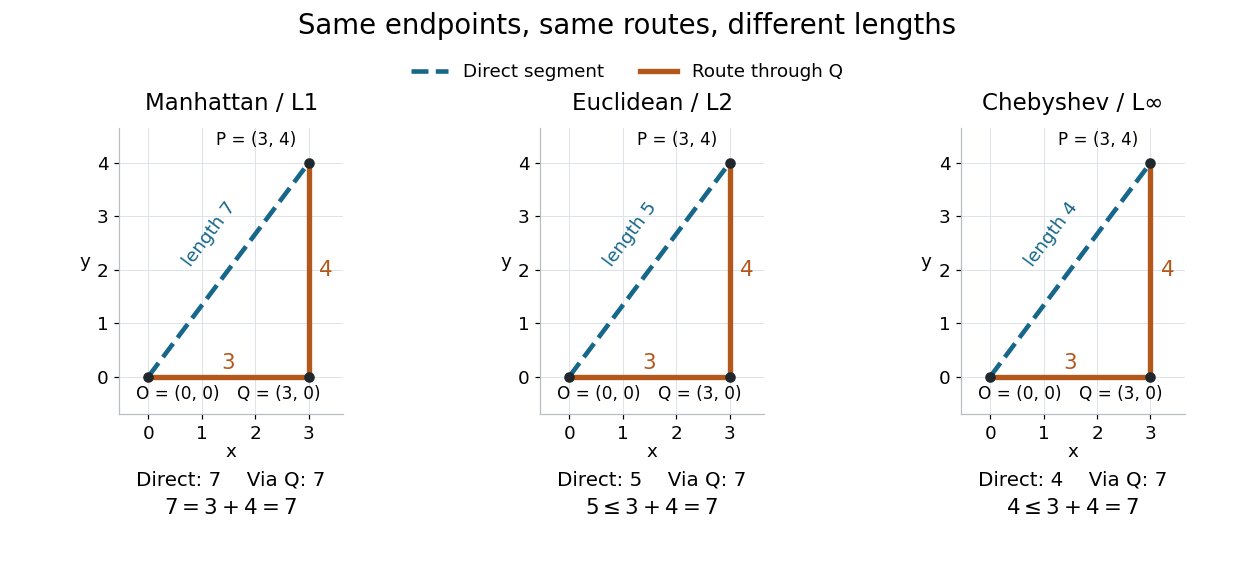


Repeated application of the triangle inequality bounds the endpoint distance by the sum along any finite chain of intermediate points. This explains why metric path length is always at least the distance between endpoints. Equality reveals a shortest route, but its shape and uniqueness depend on the chosen metric.
Completeness Created 2026-09-24 Updated 2026-10-03
Bounded-continuous-function characterization of compact metric spaces Created 2026-09-24 Updated 2026-09-24
A metric space is compact exactly when every continuous function is bounded. For the converse, a noncompact metric space contains a closed discrete sequence; the unbounded function assigning its th point the value extends to by the Tietze extension theorem.
There are unlisted articles, also show them or only show them.