
Conditional likelihood 2026-10-14
A conditional likelihood evaluates the conditional distribution of the observed data given a specified statistic. If that distribution does not involve a nuisance parameter, it permits inference about the remaining parameter without estimating the nuisance parameter. The conditioning statistic need not be ancillary; possible information loss must be assessed within the model. Conditional maximum likelihood maximizes this function.
If a statistic T has marginal density depending on a parameter of interest but not on a nuisance parameter, that density gives a likelihood for the interest parameter. It is obtained by integrating out other observed coordinates. In contrast, profile likelihood maximizes the full likelihood over the nuisance parameter. This sampling-statistic construction is different from Bayesian model evidence, which integrates parameters against a prior. No prior is required for a nuisance-free sampling marginal.
Light-cone super-Virasoro constraints 2026-10-14
On a patch with , use worldsheet diffeomorphisms and worldsheet supersymmetry to fix and . The Virasoro constraints and superconformal current constraints then determine the longitudinal modes by the displayed transverse bilinears. In the Ramond sector, reduction of the fermionic zero modes includes the zero-mode Dirac constraint; fixing only nonzero modes does not complete the reduction. Eight transverse bosons and eight transverse fermions remain in the critical ten-dimensional RNS string.
Small rotation commutator 2026-10-14
Use the cross-product Lie algebra convention , , , so . Put and , using the matrix exponential. The finite group commutator isHere and big O notation refers to any fixed matrix norm. Active rotation matrices act on column vectors from right to left: first rotate about by , then about by , then about by , and finally about by . Swapping and replaces the product by its inverse and changes the leading Lie bracket to .
Writing and , direct matrix multiplication givesFor radians, , whereas . Thus the residual is a positive rotation about to leading order; at finite it also has smaller components. The Lie bracket captures the leading effect of the four moves rather than their entire finite motion. See Etingof, Section 7.2, Proposition 7.11.
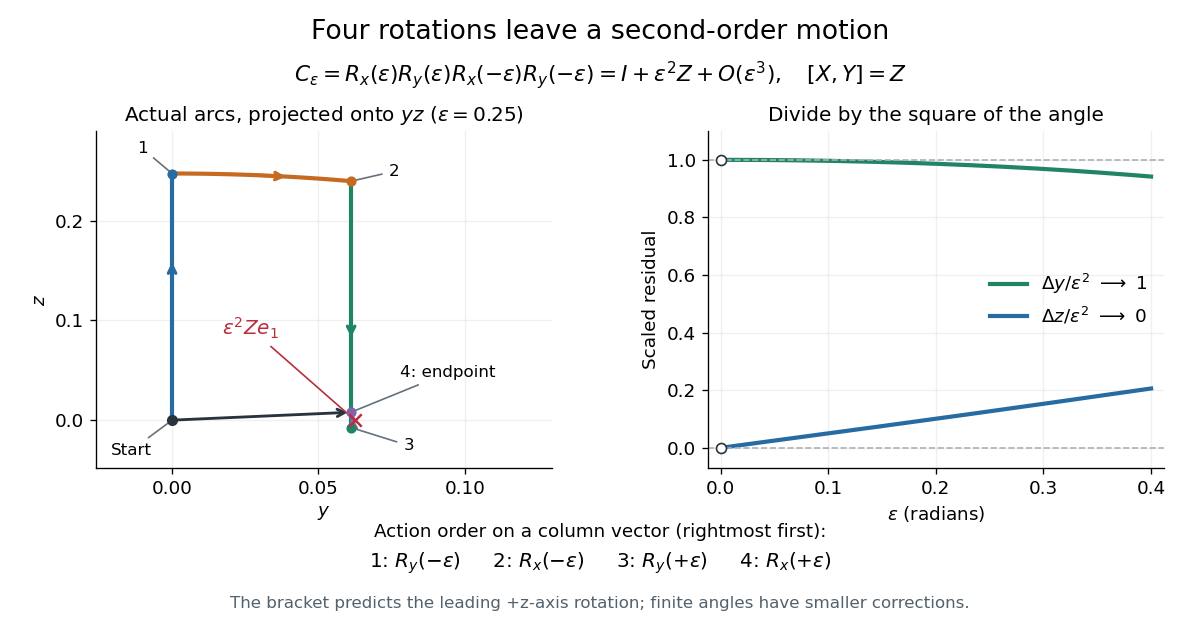

The left panel projects the actual four arcs onto the -plane for ; the start and endpoint are close but distinct. The right panel divides the residual coordinates by , making the limit visible. This is a numerical picture of in the SO(3) Lie algebra.
For a Lie subalgebra , its defining representation is its given action on the vector space . The Lie bracket identity verifies the representation property. For the special linear Lie algebra, diagonal trace-zero matrices have coordinate weights of a representation on the standard basis; for a Special orthogonal Lie algebra, the same action preserves the defining symmetric bilinear form.
The representation ring of finite-dimensional modules for a complex semisimple Lie algebra is the abelian group generated by module classes, with , and multiplication . Weyl complete reducibility theorem makes the classes of irreducible representations a free integral basis. The formal character map identifies this ring with the Weyl group invariant part of the group ring of a weight lattice. Injectivity follows from distinct highest weights; surjectivity follows by subtracting the character with each maximal dominant weight, whose highest-weight coefficient is one, from a Weyl-invariant finite sum.
// Target: semisimple-lie-algebra.bigb
Triple product 2026-10-14
For three vectors in oriented Euclidean three-space, the scalar triple product is and the vector triple product is . The former is their signed volume; the latter is the vector operation appearing in the vector triple product identity.
Genus-one gluing model of a lens space 2026-10-14
The quotient model of a lens space splits into two solid tori. In the boundary angle lattice , choose and . The other meridian is . A second column completing this primitive slope to a determinant-one matrix specifies a gluing map after reversing one boundary-basis convention. Different completions differ by a meridional Dehn twist extending across the second solid torus, so they give the same three-manifold.
Associated Legendre differential equation 2026-10-14
This second-order linear differential equation extends the Legendre differential equation by its order parameter . Its solutions are associated Legendre functions. In a degree-one potential problem, with , two explicit solutions are and . Their Wronskian with respect to is , so the two formulas are not a fundamental pair at or .
On a hemisphere of SU(2) as the three-sphere, write , with real coefficients satisfying . Right multiplication by gives . This right multiplication flow defines left-invariant tangent fields. With the displayed factor , they obey , since . Applying the commutator to and using the Pauli matrix commutator identity gives . The entries of contain every coordinate, so this determines the vector-field identity, not just its action in one isolated representation.
Comparison-adjunction unit criterion 2026-10-14
For inducing , the Eilenberg-Moore comparison functor has a left adjoint exactly when every algebra has a coequalizer of . Transposition identifies maps equalizing this pair with monad algebra morphisms , proving both directions of the criterion. The unit is and satisfies . In the base category, is a split coequalizer of , split by and . Consequently is invertible exactly when is also a coequalizer. The unit is invertible everywhere precisely when preserves all these specified coequalizers; preservation of arbitrary coequalizers is not required.
With signed active covariate columns and their positive-definite Gram matrix , the displayed direction has unit norm and . Thus it makes equal angles with unit-length signed active covariates, and movement along it reduces their signed residual correlations at the common rate . The regression coefficient direction is , with inactive components zero.
Metallicity distribution in a leaky box 2026-10-14
For initially pristine gas, zero bulk mass return, a constant stellar yield and a well-mixed galactic outflow of mass-loading factor , gas conservation gives and metal accounting gives . Consequently with . Since , complete depletion gives a normalized mass-weighted metallicity distribution function and mean stellar metallicity . A time-independent initial mass function makes the distribution of surviving tracers proportional to this distribution; a sample selected by light need not have the same weights.
Lp bound from a tail domination inequality 2026-10-14
Let , , and . Assume the displayed tail inequality and finite positive-threshold superlevel measures. First split at to obtain . Layer cake representation and Tonelli theorem imply . Integrating the original inequality against then gives , with . This is the analytic estimate behind the Doob Lp maximal inequality.
Write the Weierstrass elliptic function as , with , and . Differentiate the Weierstrass elliptic differential equation to obtain . Comparing coefficients of gives the displayed recurrence for . Every denominator is positive, so induction expresses every higher lattice Eisenstein series as a polynomial in with positive rational coefficients on its occurring monomials. In particular and .
Positive bump of an order automorphism 2026-10-14
A positive bump of the real line is an order automorphism whose nonempty support of a permutation is one open interval and which moves every point of that interval to the right. It fixes the complement. Iterating any interior point tends to the right endpoint in positive time and to the left endpoint in negative time.
Order n-transitivity 2026-10-14
An ordered permutation group is order n-transitive if it can send any increasing -tuple to any other increasing -tuple. This compares tuples with the same relative order, unlike unrestricted n-transitive group actions. In the usual transitive chain setting, order two-transitivity implies every finite order-transitivity for a lattice-ordered permutation group.
Holland representation theorem 2026-10-14
Every lattice-ordered group embeds in a lattice-ordered permutation group on one totally ordered set. Choose a value in a lattice-ordered group for each nonidentity element, act on its ordered right cosets, and combine these chains in an order sum. The original element moves its own value's identity coset, making the action faithful. The coset lattice formulas make the embedding preserve both join and meet.
Order-primitive lattice permutation group 2026-10-14
A transitive lattice-ordered permutation group is order-primitive when its only invariant equivalence relations with convex classes are equality and the universal relation. This concerns convex blocks in a chain, rather than arbitrary blocks of a primitive group action.
Let clip the minimum of independent exponential sample means into , with . The rate function under scalar clipping is the minimum cost on this interval. Apply Varadhan's lemma to . On the lower side its objective is increasing; on the upper side its derivative is . Thus the optimum is once , giving the displayed limit. The expectation is of the high power, rather than a power of the mean; the latter has limit .
There are unlisted articles, also show them or only show them.