
Universal property of the Jacobian variety 2026-10-14
For a smooth connected projective curve with chosen basepoint , the Abel map of an algebraic curve sends to . Every morphism to an abelian variety with factors uniquely through a homomorphism . This universal property converts a curve embedded in an abelian variety into a homomorphism from its Jacobian.
Torelli theorem 2026-10-14
A smooth projective curve over the complex numbers is determined up to isomorphism by its Jacobian variety together with its canonical principal polarization of a complex torus. For genus at least three, the branch locus of the theta Gauss map recovers the canonical curve by projective biduality theorem, or recovers the canonical rational normal curve and the branch points of a hyperelliptic curve. In genus two the theta divisor itself is the curve; in genus one the Jacobian variety is the curve after choosing an origin. The polarization is essential data in this statement.
Euler pentagonal identity 2026-10-14
The identity holds for , with both sides locally uniformly convergent. In the character theta proof of the eta product, pair the terms indexed by and and then select ; their Dirichlet character signs are . Removing gives the displayed product identity.
Jacobi cubic product identity 2026-10-14
The odd Dirichlet character modulo four has . The series is therefore times the displayed sum. The character theta proof of the eta product gives , proving the identity.
Jaccard distance 2026-10-14
The dissimilarity is the number of mismatched presences divided by the number of coordinates present in at least one profile. It differs from normalized Hamming distance because coordinates absent from both profiles do not enter its denominator. Define the distance of two empty sets to be zero.
For a regular nonconstant J-holomorphic sphere in a -dimensional target, the parametrized Fredholm index is . Removing the six-dimensional Möbius transformation reparametrization group gives the displayed local moduli dimension. The quotient is a manifold for a simple J-holomorphic sphere and may be an orbifold for a multiple cover with finite stabilizer. In dimension four the formula is .
Gromov compactness for spheres 2026-10-14
For a compact symplectic manifold, smooth convergence of tame almost complex structures and a uniform area bound give a subsequence of J-holomorphic spheres converging, after reparametrization, to a finite tree of J-holomorphic spheres, with convergence smooth away from finitely many bubbling points. The total homology class and symplectic area are preserved. Constant components may be added for stability. In a spherical class which cannot split into two positive-area spherical classes, there is only one nonconstant component.
Measure realization of an Iwasawa algebra 2026-10-14
A p-adic measure gives the compatible finite-quotient elements . The transition maps sum coefficients over fibers. Conversely compatible coefficients define values on cosets, then all clopen sets, and hence integration. Thus the inverse limit Iwasawa algebra is the ring of measures, with multiplication given by convolution of p-adic measures. Completeness of suffices even when its residue field is infinite.
For an L2-bounded continuous martingale and ordered possibly infinite stopping times , interpret the terminal stopped value as . The Doob L2 maximal inequality bounds the expected squared path supremum. Localization of then gives , so this square-minus-bracket local martingale has integrable supremum and is uniformly integrable. Apply the optional stopping theorem to it and to . Expanding makes the cross term vanish conditionally, proving the identity. Bounded -measurable factors can be multiplied into either side.
The Cauchy-Schwarz inequality and Jensen inequality give the displayed estimate, with . No independence between and is required. If for a bounded continuous adapted process, the Itô isometry and the dominated convergence theorem make the right side tend to zero. Time shifting proves recovery of in probability from the ratio of a short stochastic integral to its Brownian increment.
Square-integrable stochastic integrand 2026-10-14
For a zero-starting L2-bounded continuous martingale , the space consists of predictable with , identifying processes equal almost everywhere for the quadratic-variation measure. The finite-horizon version stops the integral at . The Itô integral is the isometric extension from elementary predictable integrands.
// Target: probability-and-statistics.bigb
For deterministic square-integrable , approximate by step functions. Their Itô integrals are sums of independent normal Brownian increments. The Itô isometry gives convergence in , and the variances converge to ; convergence of characteristic functions proves the normal limit. Each linear combination of finitely many such integrals is another deterministic stochastic integral, so they are jointly Gaussian.
For deterministic and bounded continuous drift and volatility, the initial right derivative of the mean is and that of the variance is . The stochastic integral has mean zero and second moment ; the bounded drift contributes only higher-order terms to the variance.
// Target: probability-and-statistics.bigb
Generator of an SDE diffusion 2026-10-14
The Itô formula identifies the operator of an SDE with drift and noise vector fields as the displayed second-order operator. With bounded measurable coefficients, every solution satisfies the true martingale identity for test functions, hence is an L-diffusion in the martingale-problem sense.
// Target: probability-and-statistics.bigb
Couple with and the same initial value. If has Lipschitz constant , the Gronwall inequality gives . Applying the Gaussian maximal bound for Brownian motion coordinatewise in dimension bounds the deviation probability by for . Matching initial values is essential.
Gaussian even-moment pairing count 2026-10-14
For a centered scalar normal random variable of variance , the Isserlis theorem sums complete pairings of factors. The first factor has partners, then choices remain for the first unpaired factor, giving . Odd moments vanish. Summing the moment-generating function gives . This is a scalar formula, not a formula for the length of a vector.
Boyle's law 2026-10-14
Boyle's law states that a fixed amount of substance of an ideal gas at constant absolute thermodynamic temperature has constant product of absolute pressure and total volume:Here is measured relative to a vacuum, not relative to the surrounding atmospheric pressure. Halving the volume doubles the absolute pressure; doubling the volume halves it. A real gas approximately follows Boyle's law when it is sufficiently dilute and far from a phase transition.[ref]
2.1 Molecular Model of an Ideal Gas. §2.1, The Gas Laws, Figure 2.4, and equations 2.1–2.2: fixed temperature and particle number, absolute pressure, and the dilute-gas limit
For an original calculated example, suppose a sealed gas sample has and . After isothermal compression to ,Both states have , since . The volume ratio is dimensionless, so using the same volume units in numerator and denominator leaves the pressure in kilopascals. Although has units of energy, its value is not the compression work: isothermal ideal-gas work involves an integral along the path.
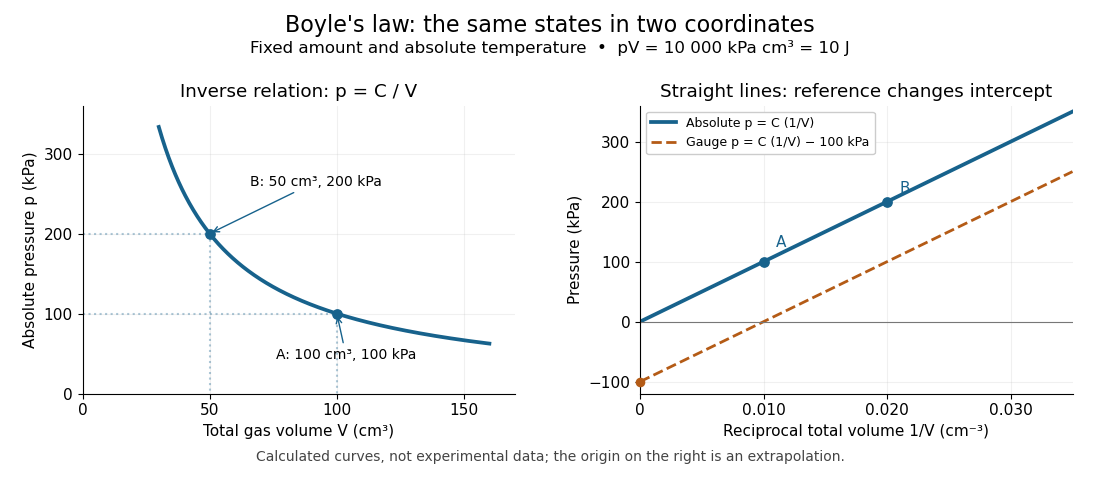
The blue curves show calculated ideal gas states, not measurements. The left panel is a branch of a hyperbola; the right panel plots exactly the same absolute pressures against . The dashed line uses gauge pressure with a stipulated constant atmospheric pressure of . Its displaced intercept explains why absolute pressure in Boyle's law matters.
A short derivation starts from the ideal gas law, . Fixing the amount of substance and absolute thermodynamic temperature fixes , where is the molar gas constant. The microscopic picture in ideal gas pressure from wall collisions is equally appealing: at fixed temperature, the typical particle kinetic energy stays fixed, while compression increases the number density and wall momentum transfer per unit surface area and time. A larger absolute pressure follows without requiring hotter particles.
The constraints are essential. A leak changes the amount of substance. Rapid compression can raise the temperature before heat transfer restores thermal equilibrium, as in the isothermal gas syringe experiment. Molecular size and interactions in a dense real gas invalidate the ideal gas approximation; the Van der Waals equation describes one such correction. Equal endpoint temperatures allow an endpoint test of Boyle's law, but do not establish that every intervening state lies on an isothermal process.
For fixed mass , mass density satisfies , so it is proportional to absolute pressure. In a dilute bubbly flow, Boyle's law allows bubble volume and its contribution to buoyancy to increase as hydrostatic pressure decreases, provided gas mass is retained, dissolution is negligible, and the temperature stays approximately fixed. Its usefulness is that a simple ratio predicts a substantial size change without tracking individual molecules.
Finite-rate isothermal piston model 2026-10-14
Why must a conducting piston move slowly? A simple model couples the first law of thermodynamics to Newton's law of cooling. Assume a fixed amount of ideal gas with uniform temperature and constant whole-sample heat capacity at constant volume , a heat bath maintained at , negligible friction, and mechanically slow motion. Let be the effective thermal conductance, the reciprocal of the thermal resistance, in . ThenPositive heat transfer must offset expansion work to keep near . A finite and nonzero piston speed therefore require a temperature difference. This uniform-temperature model neglects spatial temperature gradients, sensor response, cylinder heat capacity and any change of with piston position; it is an illustrative calculation, not a fit to the isothermal gas syringe experiment.
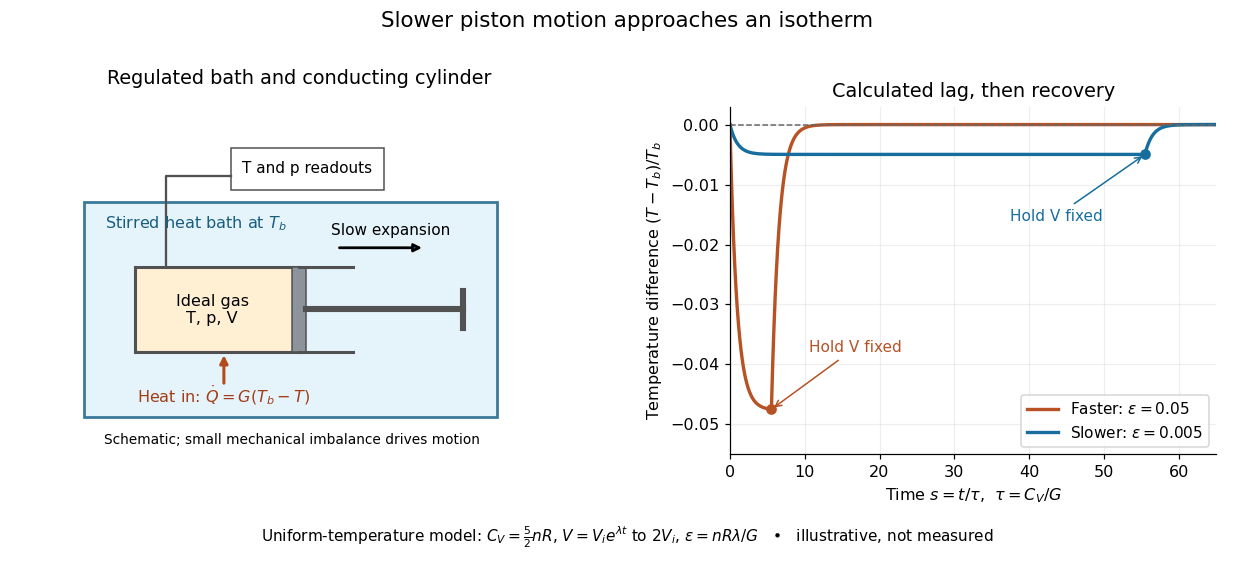
Conducting piston in a thermal bath and modeled temperature lag during expansion
. Details. For a prescribed exponential volume change , define , and . The dimensionless temperature obeys a linear ordinary differential equation with initial value :The plotted expansion uses stipulated and stops at , at . During expansion, the larger produces the larger temperature deficit; once the piston is held fixed, the deficit undergoes exponential decay as . Reducing makes the path more nearly an isothermal process, while increasing its duration. Reversing the piston with produces a temperature excess and outward heat transfer; the small- regime is the intended near-isothermal approximation. Mechanical slowness alone does not ensure sufficient heat transfer.
Isothermal ideal-gas work 2026-10-14
For a reversible thermodynamic process that changes the volume of a fixed amount of ideal gas at absolute temperature , the work done by the gas isHere is the amount of substance, the molar gas constant, the pressure, and the natural logarithm. The ideal gas law supplies ; the integral is the signed area under the pressure-volume curve. Isothermal expansion gives positive work; isothermal compression gives negative work. A convention counting work done on the gas instead has .[ref]
For a calculated example, let , and , . The pressure falls from approximately to , andTraversing the same isothermal process backward changes both transfer signs: . Neither direction changes internal energy of an ideal gas. These stipulated values illustrate the energy balance; they are not experimental measurements.
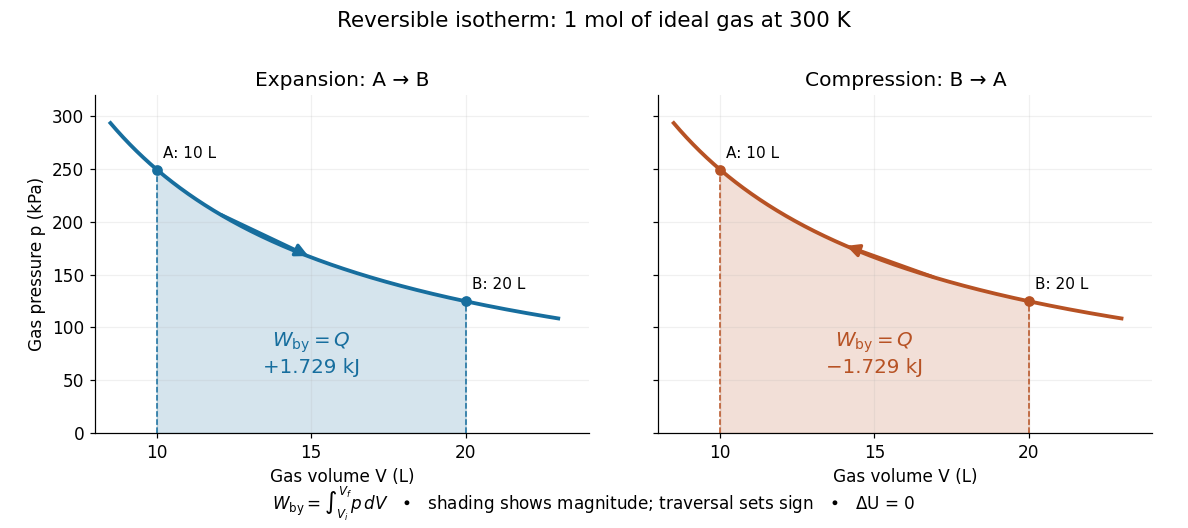


The shaded geometric area is positive in both panels; the direction of the integral supplies the sign of work. Knowing only the two equilibrium endpoints does not justify shading this curve for an irreversible process. For an idealized piston moving against a specified external resisting pressure, boundary work is . Substitution of the equilibrium gas pressure requires the appropriate reversible limit. In free expansion into vacuum, and this boundary work is zero.
Half-turn phase of an SU(2) multiplet 2026-10-14
With positive ladder coefficients, the second-axis half-turn is . Conjugation sends to , making consecutive phases differ by a minus sign. The highest-state rotation formula, expanded through its last nonzero lowering term, fixes the highest-state phase to one.
There are unlisted articles, also show them or only show them.