Cool faint stars lie toward the lower right. Redder color and larger magnitude identify that corner, subject to common extinction and the atmospheric color-temperature relation. A color-magnitude diagram is not a geometrical map of where the stars are located within the cluster.
Hot bright stars lie toward the upper left: smaller means bluer/hotter, and smaller numerical means brighter. The vertical axis is inverted in the original diagram. The plot shows apparent magnitudes, but cluster members at a common distance permit relative luminosity comparisons.
The finite singularities are square-root branch points at . Choose the cut between them and the branch at infinity. The two banks then have values above and below. A counterclockwise loop around the cut traverses its upper bank right-to-left, so its integral is , where is the required real integral. At large radius,
Therefore . Infinity is not another square-root branch point: this branch has an ordinary pole there on its sheet. Small detours about the finite endpoints vanish as their radius to power .
Cauchy's theorem says that a holomorphic function integrates to zero around a closed contour homologous to zero in its domain. Thus deforming one contour into another without crossing a singularity preserves the integral. More generally for a meromorphic , the exact condition is
Equal winding numbers about every singularity are sufficient. They are not necessary for one particular function because residues can cancel; even arbitrary contours have equal integrals for . A topological deformation criterion must not be confused with a necessary condition for accidental equality.
For ultrarelativistic particles with fixed magnet settings, and . Hence the half-trace is
Off-energy motion is stable when , separately in each transverse plane. Where , its first-order phase shift is
For equal opposite strengths,
Thus positive momentum error reduces the focusing and phase advance; negative error moves toward the overfocused unstable boundary. The unexpanded symmetric stability condition is , with , within the ultrarelativistic energy scaling. Its natural chromaticity per cell is . Away from the ultrarelativistic limit replace the displayed first-order energy error by . Linearizing at a stability boundary is singular and needs separate treatment.
For a real uncoupled, lossless transverse map, . Bounded nondegenerate oscillatory motion requires complex-conjugate eigenvalues , equivalently
Its Courant-Snyder parameters give
The positive quadratic form is invariant, so repeating the cell cannot produce secular growth. At trace a nontrivial Jordan block instead produces linear growth; only the exceptional maps remain bounded at those exact boundaries. The criterion must hold in both transverse planes. For the symmetric FODO cell, both traces are , giving
At fixed gradient and magnet length, . If is total energy,
Here , not one of the Courant-Snyder parameters. For ultrarelativistic electrons this becomes , or : higher-energy particles are bent and focused less strongly. If the symbol instead denotes kinetic energy , the coefficient is , approaching in the nonrelativistic limit. Stating the energy convention avoids applying the ultrarelativistic result to a slow beam.
Use transverse coordinates and define a positive signed focal length as focusing in that plane. A thin quadrupole magnet of length and signed gradient has integrated strength ; the electron charge and chosen field orientation are absorbed into the sign of . Its beam transfer matrix is
For total electron energy , , so in the ultrarelativistic limit. The other transverse plane has the opposite signed focal length. A quadrupole magnet therefore focuses one plane while defocusing the other; the longitudinal magnetic field component is negligible in this paraxial idealization.
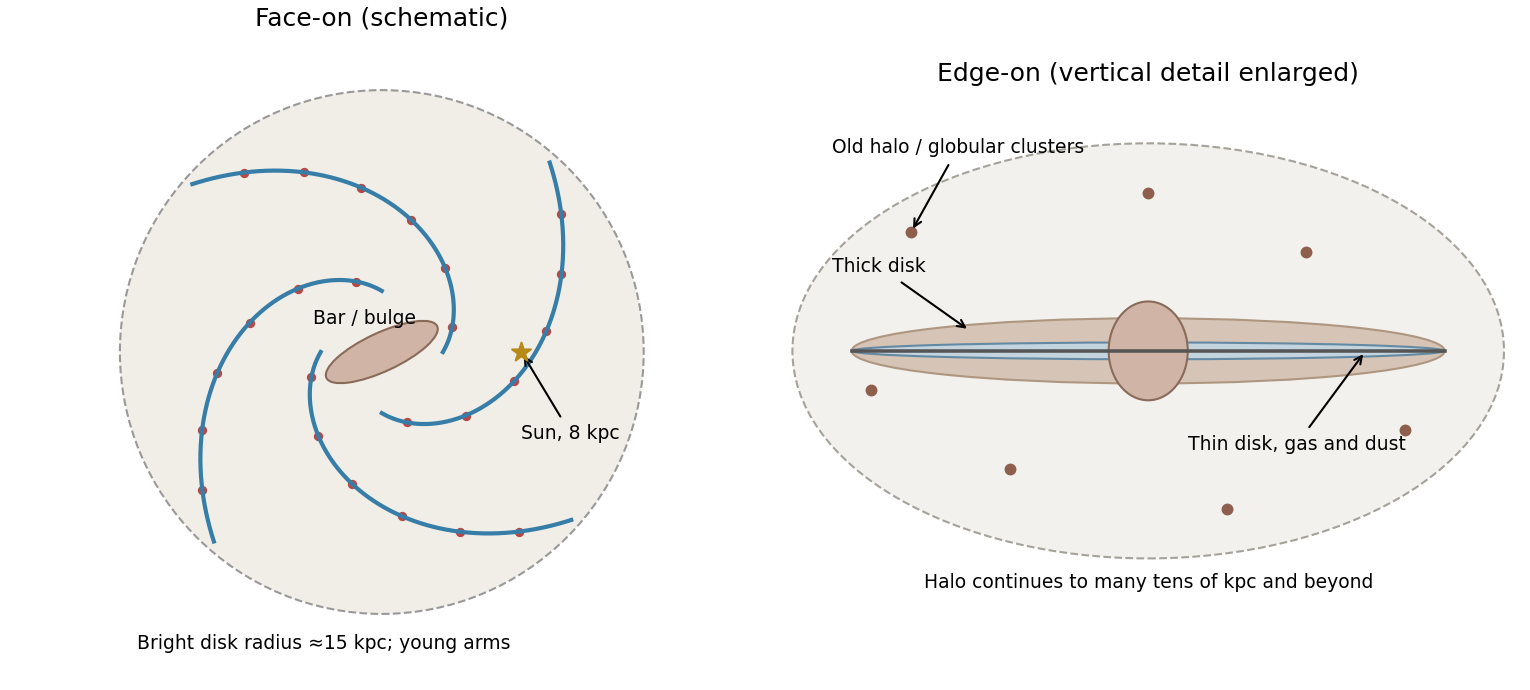
Edge-on, the bright thin galactic disk forms a narrow band, with a central bulge protruding above and below it and a thinner gas-and-dust lane along the midplane. Young stars and H II regions occupy a vertical scale of a few tenths of a kiloparsec or less; a broader old thick disk has scale of order a kiloparsec. These are approximate scale heights, not sharp boundaries. The old stellar halo and globular clusters form a much larger, low-surface-brightness spheroidal component, extending to many tens of kiloparsecs or more. The dark matter halo is inferred dynamically rather than directly visible in such a sketch. The preceding figure is a structural diagram, not an external photograph or a reconstruction of a particular survey.
Face-on, the Milky Way is a barred spiral galaxy: a central bulge and bar of scale a few kiloparsecs lie inside a disk of stellar radius roughly , with spiral arms containing gas, dust, H II regions and young stars. Recent star formation is concentrated in molecular clouds and arm complexes. The Sun lies in the disk about from the centre in the source's convention. Old stars are also present throughout the disk, while the bulge, thick disk and extended stellar halo contain important old populations. Globular clusters occupy a roughly spheroidal halo extending well beyond the bright disk.
Figure 1.
Original schematic face-on and edge-on views of the Milky Way
. The face-on panel labels a barred centre, spiral star-forming regions, the Sun and an approximate 15 kpc bright-disk radius. The edge-on panel separates the thin dusty disk, thick disk, bulge and old halo/globular-cluster population. Halo extent is indicated schematically beyond the plotted field. Details.
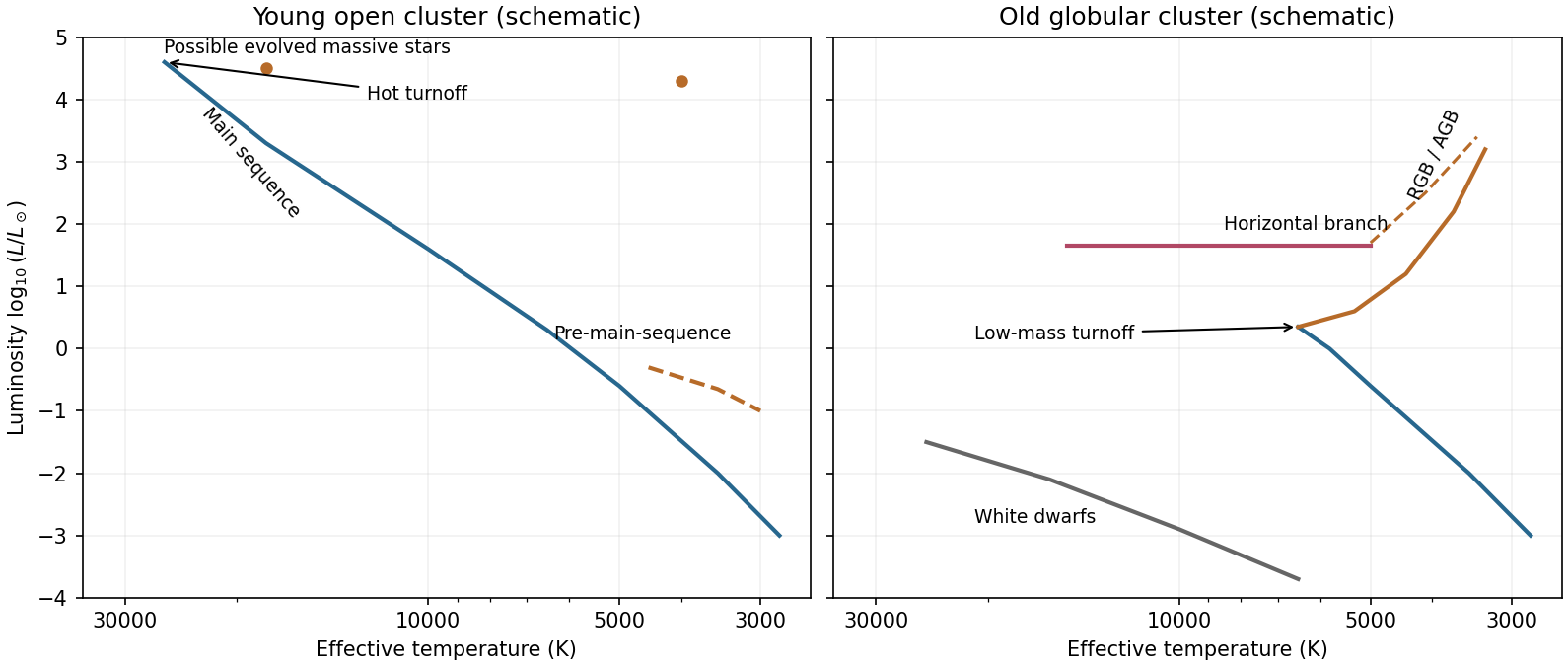
An old globular cluster has lost its original massive main-sequence members. Its main-sequence turnoff lies near a low stellar mass, typically around for an age of order years. The diagram shows a lower main sequence, a subgiant branch, a prominent red giant branch, a horizontal branch of core-helium-burning stars, an Asymptotic giant branch and a faint white dwarf cooling sequence. The preceding schematic labels these features. A few blue stragglers may lie above the old turnoff because interaction or merger rejuvenated them; they do not imply a young age for the bulk population.
For a young open cluster, the Hertzsprung-Russell diagram contains a populated main sequence reaching hot, luminous, high-mass stars, with a high-mass main-sequence turnoff determined by its age. Cool low-mass members may still lie on tracks of pre-main-sequence stars above the lower main sequence. Depending on how young the cluster is, a few evolved blue or red supergiants may already be present; an extremely young cluster need not have any. It lacks the dominant old low-mass red-giant and horizontal-branch populations of an old globular cluster.
Figure 1.
Schematic temperature-luminosity diagrams of young and old star clusters
. Temperature decreases to the right. The young cluster reaches a hot luminous turnoff and contains possible pre-main-sequence stars; the old cluster has a cool low-mass turnoff, red giant and horizontal branches, and a white-dwarf sequence. Curves are illustrative population sketches, not fitted isochrones. Details.
A star burns core hydrogen chiefly by the CNO cycle for about years. It commonly evolves towards a red supergiant, though winds and mixing alter its track. Core helium burning lasts of order years. Continued contraction then permits carbon, neon, oxygen and silicon burning, producing successively heavier nuclei up to an iron-group core. Neutrino cooling makes the advanced phases much shorter: carbon burning can last thousands of years, while the final burning stages fall to years or days, with substantial model dependence.
An iron-group core cannot gain energy by ordinary fusion into heavier nuclei. Electron captures, photodisintegration and loss of pressure support lead to stellar core collapse. A core-collapse supernova can eject the envelope and leave a neutron star; strong fallback or a failed explosion can instead produce a black hole. The massive-star endpoint involves core collapse, rather than the quiet carbon-oxygen white-dwarf cooling of the two lower-mass examples.
A star has a much greater luminosity and exhausts central hydrogen in roughly to years, mainly through the CNO cycle. It crosses the Hertzsprung gap, develops shell hydrogen burning and ignites core helium without the strongly degenerate helium flash of the solar-mass case. Core helium burning lasts roughly years, with possible blue-loop evolution depending on the model.
It subsequently develops a carbon-oxygen core and double-shell burning on the Asymptotic giant branch, with thermal pulses, winds and envelope loss. For ordinary isolated evolution at this mass, the core does not reach sustained carbon ignition and the final remnant is a carbon-oxygen white dwarf. The broad boundary between white-dwarf and core-collapse outcomes depends on composition, overshooting, rotation and mass loss; the quoted mass is comfortably in the usual intermediate-mass regime.
A star spends roughly years on the main sequence, deriving most of its luminosity from the proton–proton chain. After central hydrogen depletion, shell hydrogen burning around a contracting helium core expands it into a red giant. The low-mass helium core becomes electron-degenerate before the helium flash. Subsequent core helium burning by the Triple-alpha process, with alpha capture producing oxygen, lasts of order years.
After central helium exhaustion, hydrogen and helium shells burn around a carbon-oxygen core on the Asymptotic giant branch. Strong mass loss removes the envelope, potentially making a planetary nebula, and the remnant becomes a carbon-oxygen white dwarf. It cools using stored thermal energy and does not ignite sustained carbon burning. Detailed durations depend on composition and mass loss; the nuclear endpoint of the isolated solar-mass model is a white dwarf.
Near a red giant's compact core, intense nuclear burning in a small region can produce a large and a steep required radiative gradient. Where this exceeds the adiabatic gradient, convection transports the released energy and mixes fuel. Core helium burning is a clear example: the strongly temperature-sensitive Triple-alpha process commonly produces a convective burning core; shell flashes can also make convective regions.[ref]
The qualification matters: an inert degenerate helium core and a steady hydrogen-burning shell on the first-ascent red giant branch are not universally convective; conduction or radiation may dominate there. Red giants also commonly have deep convective envelopes. The physical condition is an excessive required radiative gradient, not proximity to the centre alone.
In the Sun's cool outer layers, partial ionization lowers the adiabatic temperature gradient, while large opacity makes radiative transport inefficient. The required radiative gradient
can exceed , so convection carries part of the outward luminosity. The Sun therefore has an outer convective envelope, above its primarily radiative interior. Here is the radiation constant, opacity per unit mass and the enclosed mass and luminosity. Near the visible surface, radiative losses are again important and the flow need not be perfectly adiabatic.
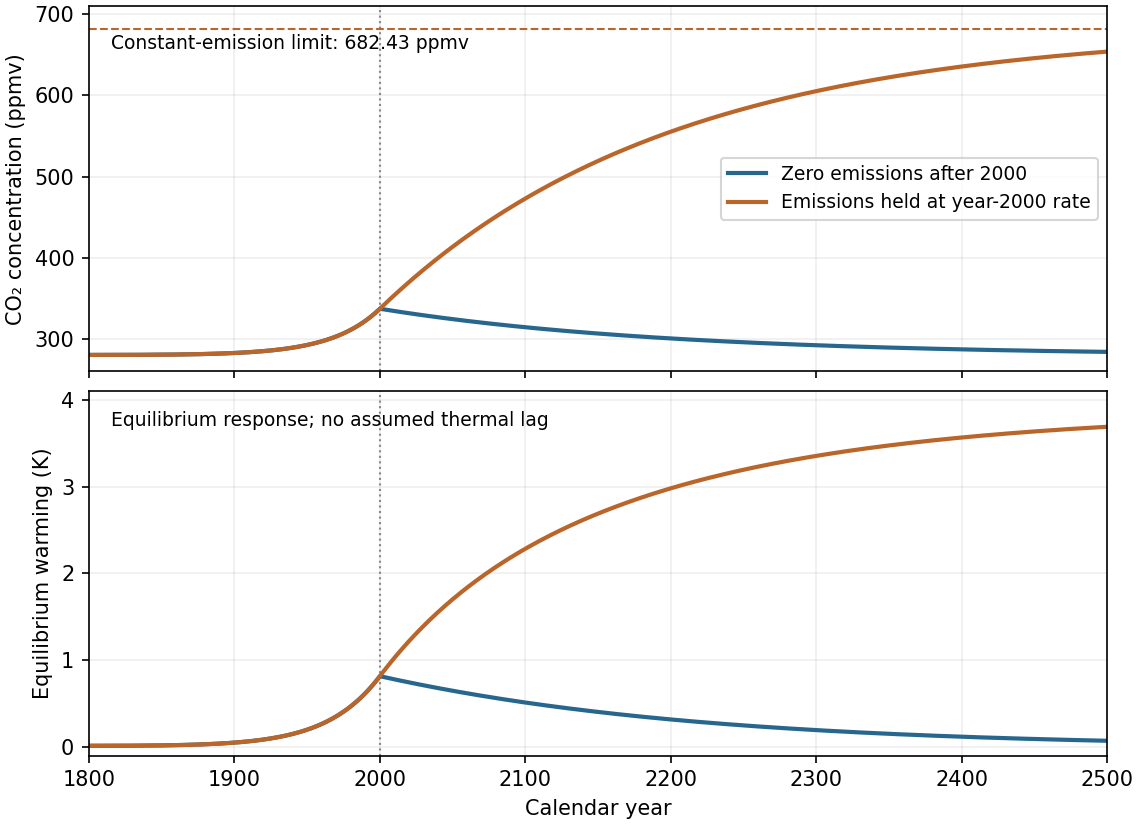
Holding emissions at gives equilibrium concentration
For time since 2000,
It increases monotonically on the same 200-year timescale and reaches about in 2500. The limiting, and hence peak asymptotic, warming is
In 2500 the equilibrium warming is about , still below that asymptote. A stable thermal adjustment much faster than the carbon timescale follows this slow approach with a short lag and has the same limiting warming. These are predictions of the specified linear reservoir model, not a claim that constant real emissions produce a finite universal atmospheric equilibrium.
Let now denote the year 2000 and . When emissions stop, the model gives
The concentration peaks at the switch, then returns exponentially to ; in 2500 it is about . Before 2000 both scenarios share the exponential-emissions trajectory.
Using the specified logarithmic equilibrium warming relative to ,
gives the fast-adjustment peak estimate
An unspecified finite thermal response time below twenty years delays and reduces that peak relative to the instantaneous-equilibrium value; its exact amount cannot be fixed without a response law and a chosen thermal time. The carbon-removal time is much longer, so the warming subsequently declines gradually in this model. Taking the 1800 concentration as the temperature reference instead changes the quoted estimate by only .
Figure 1.
The two specified carbon-emission scenarios from 1800 to 2500
. Both curves share the prescribed emissions growth up to 2000. Zero later emissions give exponential return to 279 ppmv; holding emissions constant gives approach to 682.43 ppmv. The inset-free lower panel shows equilibrium warming rather than an invented thermal adjustment history. Details.
For the quadratic Planck function profile,
The optically thick limit and the instantaneous doubled-abundance result are therefore
The new coefficient is , since at fixed physical temperature. For positive , the outgoing spectral irradiance decreases. The factor differs from the linear case because the temperature-dependent source function curves with depth; doubling abundance does not mean holding its old functional coefficients fixed in the new optical-depth coordinate.

There are unlisted articles, also show them or only show them.