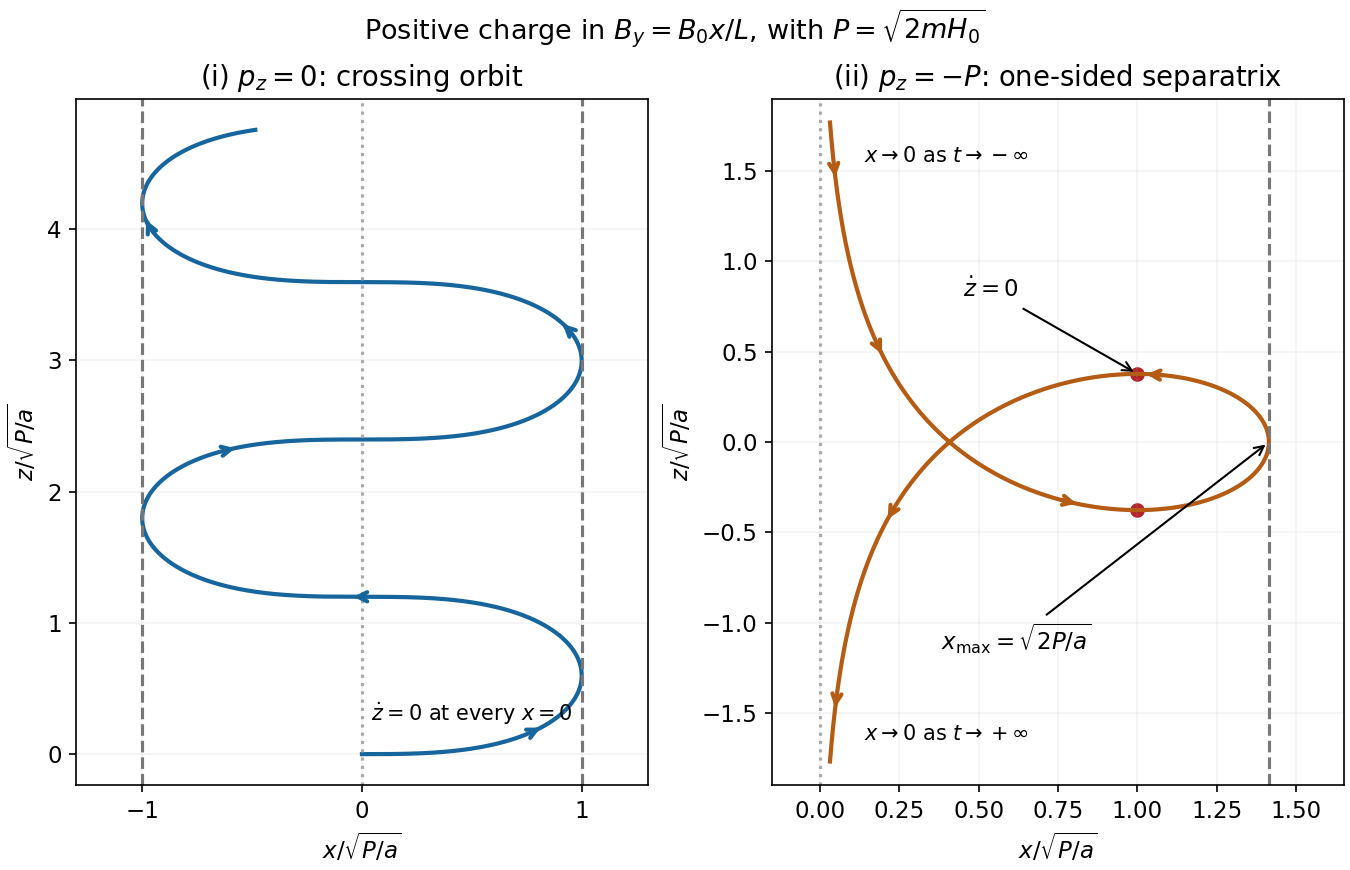
The negative-side orbit is its reflection in x=0. For the positive branch, x rises from zero asymptotically, reaches X2 at u=0, then returns asymptotically to zero. Thus the infimum is zero but it is not attained in finite time on this nontrivial branch. Since z˙=(P/m)(2sech2u−1), the two axial-velocity zeros occur at x=P/a. Motion is toward decreasing z near either asymptotic midplane tail and toward increasing z near the outer excursion. These directions are marked in part i.
The exactly midplane initial state x=0, x˙=0 is a separate straight trajectory with z˙=−P/m; it must not be described asa finite-time crossing of the separatrix.
Here z˙=ax2/m≥0: the orbit always advances toward increasing z, except for instantaneous zeros at each midplane crossing x=0. The transverse motion oscillates between −X and X. At these outer turning points x˙=0 and the trajectory is tangent to the z direction; at the midplane x˙=0 while z˙=0, so the tangent is along x. The sign of the initial x˙ only chooses the phase or reflected trace.
The very strong molecular-weight dependence outweighs the reduction in mass. Treating the two opacitiesas identical would miss a factor two, and using neutral-gas molecular weights would be inconsistent with the stated hot ionized stars.
If one usesa roughly solar luminosityas an illustrative calibration for this roughly solar-mass, solar-central-temperaturereference, the heliumstar would be of order a hundred solar luminosities. That calibration is only approximate because a mostly hydrogen composition with μ≃1/2 is not the actual solar composition.
The zero trace and unit eigenvalues imply equal numbers of +1 and −1eigenvalues, so N is even. A two-dimensional representation is impossible: all four matrices α1,α2,α3,β would be traceless 2×2matrices. Anticommutation gives Tr(AB)=0 for distinct matrices, whereas Tr(A2)=2. They would therefore be four linearly independent members of the three-dimensional complex space of traceless 2×2matrices, acontradiction.
The usual irreducible 3+1 dimensional Dirac representation has N=4. Larger representations can contain multiple copies; the requested lower bound is not itself a proof of irreducibility.
For a nonzero everywhere attractive weak potential, γ<0, the pole has k=iκ with κ=m∣γ∣/ℏ2>0. The exterior waves decay as e−κ∣x∣, giving one shallow bound state to leading weak-coupling order:
The integrated strength has dimensions of energytimeslength. For U=−αδ(x), γ=−α and this is exactly the result in part c. For a regular weak potential the approximationsums the important ratio mγ/(kℏ2) without requiring it to be small, which is why it remains useful beyond the naive first Born expansion at small momentum.
Let λ=mU0a2/ℏ2≪1 and ka≪1. Inside a region of size a, the Schrödinger equation estimates the curvatureas a2ψ′′=O(λ+(ka)2)ψ. Matching to the incoming and reflected waves constrains the slopeas well. To leading order the interior wave has nearly constant value C, while its small accumulated derivative change encodes the potential's integrated strength.
This is not a Born assumption that C is close to one. At very low k the wave can be strongly reflected even by a weak potential, and C can be small. The matching solution in the next part gives C∼k/(k+imγ/ℏ2). It implies a fractional variation across the range of order ka+m∣γ∣a/ℏ2, which is small under the two specified conditions. Thus
At late times C→1/2 and thermal equilibration requires b0C−b1T=0. Hence T(∞)=b0/(2b1). Both t≫k−1 and t≫b1−1 ensure that the exchange and thermal transients have decayed.
Temperature is continuous through an instantaneous carbon injection. With T(0)=0 and C(0+)=1, T˙(0+)=b0. Its initial slope is finite; the emission pulse makes the carbon burden jump but does not give this first-order thermal model an instantaneous temperature jump.
With negligible atmospheric emission, dI/dτ=I. If the warm surface is at τs, I(τ)=Ise−(τs−τ). Irradiance decreases as the beam travels upward to smaller τ, and I(0)=Ise−τs. The positive derivative with respect to downward optical depth is consistent with attenuation, not amplification along propagation.
The Lyman-alpha gap is 3Z2(μ/me)Ry/4, giving λ=4hc/[3Z2(μ/me)Ry]. For heavy lithium nucleus and Z=3, λ≃13.5nm. A specified lithiumisotope would permit the small reduced-mass correction; no isotope is supplied.
Jupiter emits at about 130 K rather than the solar-only estimate around 111 K. Intrinsic heat contributes additional outgoing flux, so σTemit4=Fabsorbed+Finternal. The difference of fourth powers is the relevant energy excess, not their direct temperaturedifference. Cooling and contraction of the interior provide the main physical motivation for including this extra term.
The Moon'smean equatorial temperature near 206 K is well below the approximately 270 K global effective radiative temperature. The surfacehas a large day-night range and finite thermal inertia; ⟨T4⟩1/4 exceeds ⟨T⟩, so comparing those two differently averaged quantitiesas though they were equal is invalid. The discrepancy need not imply a missing atmospheric greenhouse effect on an airless Moon.