
A stable terminal product obeys . Conservation of the number of chain members gives when . Therefore, for distinct nuclear decay constants,Set for an initially absent terminal product. For equal nuclear decay constants,Both expressions have because the intermediate population initially vanishes; their leading growth is . For positive nuclear decay constants, increases monotonically to .
For , differentiate the distinct-nuclear decay constant result:Equating the production and loss terms gives , henceFor positive nuclear decay constants and , this is positive regardless of their ordering. Initially , while at late times; the stationary point is the unique maximum. At that time . If the nuclear decay constants are equal, differentiating gives , also the continuous limit of the expression above.
Past exam of the nuclear and particle physics course of the University of Oxford 2022 3 d i Solution 2026-10-25
For a closed unit-branching radioactive decay chain, the rate equations areThe first gives . Multiply the second by its integrating factor :Integrate from zero to . For ,soThe coefficients can individually be negative; the physical population is nonnegative because the production integral is nonnegative. For equal nuclear decay constants , the finite limit isA sum of two constant-coefficient copies of the same exponential function cannot represent this limit; the factor is essential.
This is the charge-and-parity-conjugate reaction of part (i). There are -channel Z boson and crossed W boson contributions, with all fermion arrows reversed relative to part (i). For matched unpolarized kinematics and negligible CP violation,Combining all four results in the regime specified in part (i),In particular, conjugating both initial particles restores the part-(i) rate; conjugating the neutrino alone does not. Initial spin polarization and energies near a weak-boson mass require a separate comparison.
Both -channel Z boson exchange and -channel annihilation occur. Replacing the incident neutrino by an antineutrino interchanges the two chiral angular weights. In the same contact-interaction regime,At the factor is , between parts (i) and (ii). The comparison is energy dependent outside this regime: near , the annihilation channel has a W boson resonance, and the low-energy formula is inapplicable.
Only -channel Z boson exchange contributes at leading order. A W boson would connect to , rather than to , and therefore does not supply this elastic channel. With the assumptions and normalization of part (i),For the illustrative value , the dimensionless factors in parts (i) and (ii) are and . The electron-flavor reaction is therefore about times as large in this limit. This uses the weak flavour selection in neutrino-electron scattering, not a hypothetical flavor-changing neutral vertex.
Past exam of the nuclear and particle physics course of the University of Oxford 2022 2 f i Solution 2026-10-25
There is a -channel Z boson contribution and a crossed, -channel W boson contribution. The latter pairs the incoming electron neutrino with the outgoing electron, and the incoming electron with the outgoing electron neutrino. Both contribute coherently to the same elastic final state.
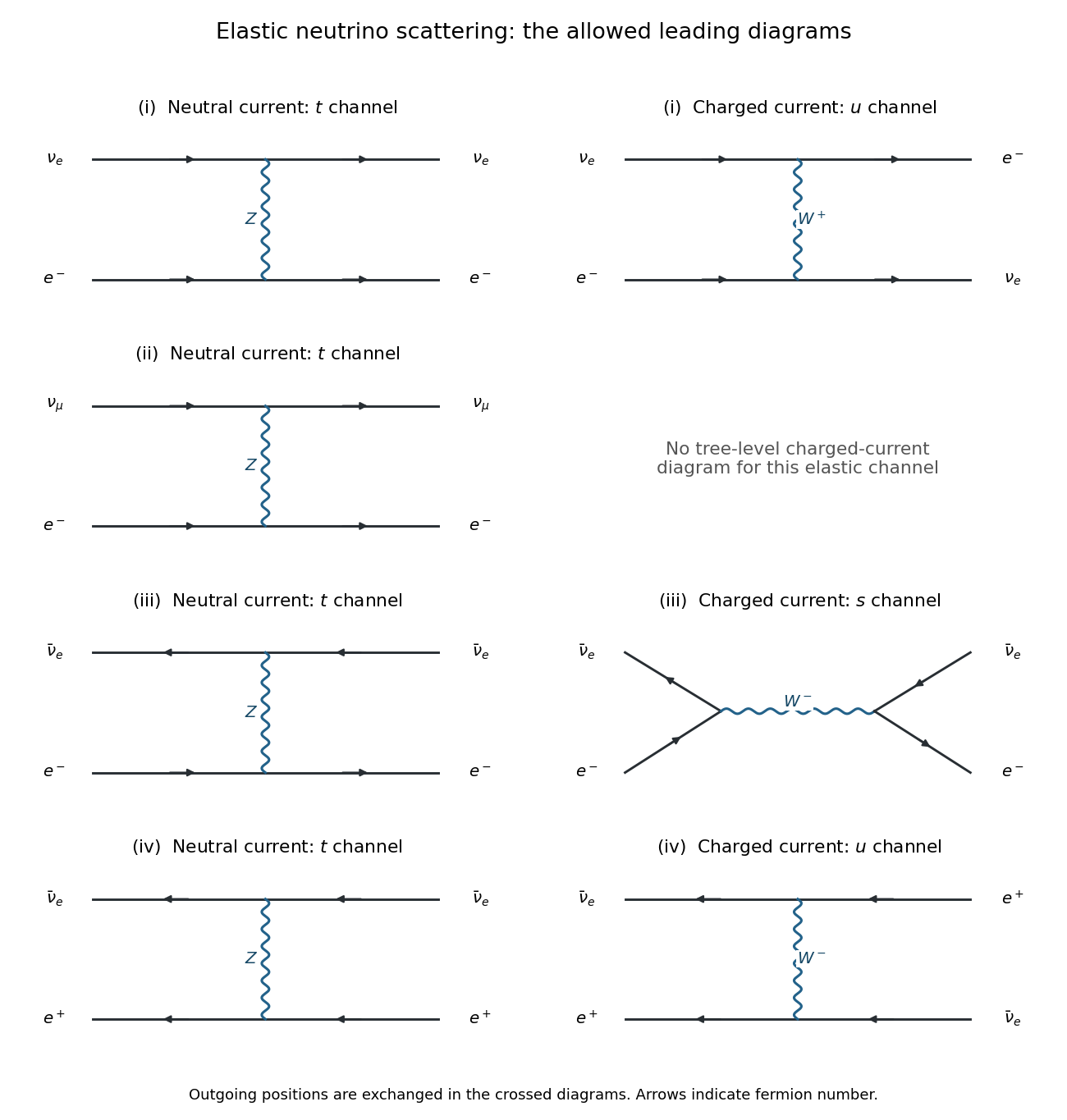

For a concrete comparison, take unpolarized targets, the same Mandelstam invariant in all four reactions, and . In a stationary-electron experiment this includes with . Define , using the weak mixing angle, and . The weak neutral current has chiral couplings , ; the weak charged current shifts by one. ConsequentlyThe factor comes from integrating the opposite-chirality angular weight: in the massless limit . Thus the relative rate depends on the chiral couplings and their interference, rather than simply on the number of diagrams.
Past exam of the nonlinear systems course of the University of Oxford 2023 3 c iii Solution 2026-10-25
The set consists precisely of points whose first positions all lie in . HenceDeleting the first position preserves this condition, proving . For the reverse inclusion, if , take . Then and for every . Thus and . In fact both inverse branches give preimages in . Thereforewhich proves full invariance, not merely forward invariance.
For any infinite symbolic sequence , the itinerary cylinders are nonempty compact nested intervals. The nested interval theorem gives at least one point in their intersection. Every has a unique itinerary because . To justify that the itinerary also determines a unique point, it suffices to show the interval lengths shrink. The fact that logistic inverse branches contract in an angular coordinate works for every ; a direct claim that in the original coordinate would fail for some just above four.
Use the homeomorphism of . The transformed inverse branches areTheir derivatives satisfyThe inequality follows by squaring and using . Thus every length- transformed itinerary cylinder has length at most . Since , its original interval has length at most and shrinks to a point. This gives the claimed one-to-one identification with the one-sided full shift.
Finally part (ii) givesThus acts by the left shift. The identification is a topological conjugacy: matching long prefixes forces closeness by the shrinking estimate, while distinct finite itinerary cylinders are disjoint compact sets and so their inverse coding is continuous. In particular need not be one-to-one on , just as a one-sided left shift has two possible first symbols before any given tail.
Past exam of the nonlinear systems course of the University of Oxford 2023 3 c ii Solution 2026-10-25
Write . Because , taking the image under the same function composition givesThis uses preservation of set inclusion by every function, so decreasing inverse branches cause no difficulty. Since , cancellation of the first inverse branch gives the equality of imagesThese compact intervals are itinerary cylinders: their symbols record successive positions under iteration of a map. In particular,Conversely these three memberships allow successive substitution of the appropriate inverse branches, and therefore characterize exactly.
Past exam of the nonlinear systems course of the University of Oxford 2023 3 c i Solution 2026-10-25
Solving by the quadratic formula givesFor , . On the derivative is strictly positive, while on it is strictly negative. Thus the restrictions are strictly monotonic functions. Their endpoint values areBy continuity and strict monotonicity, each restriction maps its interval bijectively onto , with opposite orientations. The corresponding inverse functions are
Past exam of the nonlinear systems course of the University of Oxford 2023 3 a iii Solution 2026-10-25
Construct one infinite binary sequence by concatenating every binary word of length one, then every word of length two, then every word of length three, and so on, in lexicographic order within each length. Every finite binary word occurs somewhere in .
Given any target sequence and any , choose such that . The word occurs in , beginning after some symbols. Thus agrees with in its first positions, and the prescribed metric givesEvery open open ball about every point therefore meets the forward orbit of . This forward orbit is dense in . The argument identifies finite-prefix cylinder sets as arbitrarily small neighborhoods in this metric; no binary-expansion convention for real numbers is needed.
Past exam of the nonlinear systems course of the University of Oxford 2023 3 a ii Solution 2026-10-25
The space of all infinite binary sequences is uncountable by the Cantor diagonal argument: given any list , the sequence differs from its th entry at position , so it is absent from the list. Part (i) shows that only countably many sequences are periodic. Their complement is therefore uncountable.
Each forward orbit is countable. If there were only countably many nonperiodic forward orbits, their union together with the periodic points would be countable, contradicting the preceding argument. Hence there are uncountably many nonperiodic orbits, rather than merely uncountably many nonperiodic starting points.
One can also exclude eventual periodicity. An eventually periodic sequence is specified by a finite initial word and a finite repeating word, so only countably many exist. Removing all of them still leaves an uncountable set. This proves the assertion even if “nonperiodic” is understood to exclude orbits that eventually enter a periodic orbit.
Past exam of the nonlinear systems course of the University of Oxford 2023 3 a i Solution 2026-10-25
For the left shift, precisely when the binary sequence is obtained by repeating its first symbols. There are exactly such sequences, although some have smaller least period. Hence the set of all periodic sequences is a countable union of finite sets and is at most countable. Passing from periodic points to periodic orbits cannot increase this cardinality.
To prove infinitude, for every integer take the repeated word . Its least period is , because its ones are separated by exactly positions; a smaller positive period would carry a one to a zero. Distinct least periods give distinct periodic orbits. Thus there are countably infinitely many periodic orbits.
Past exam of the non-commutative rings course of the University of Oxford 2023 3 c ii Solution 2026-10-25
In fact , so the quotient module is zero. This requires an argument using left ideals: a left ideal is not generally closed under multiplication on the right.
Write , , so that . The commutator product rule givesBoth and lie in , so their differencebelongs to . Multiplying on the left and subtracting another known element of the left ideal givesBecause the scalar is invertible in , it follows that , and hence . Therefore , giving . We concludeThus the answer is yes for every . All ideal operations in the proof use left multiplication. In particular, simply replacing by the commutative ideal of the associated graded ring would miss the lower-order consequences that force .
Past exam of the non-commutative rings course of the University of Oxford 2023 3 c i Solution 2026-10-25
Use the quotient filtration induced from the order filtration of a Weyl algebra. The key step is to identify the entire associated graded module of the left ideal , rather than merely take symbols of its displayed generators.
For every member of the ordered monomial basis of a Weyl algebra, right multiplication by the pure -monomials givesNo commuting past an is necessary. It follows that is exactly the complex linear span of the basis monomials satisfying eitherIntersecting this linear span with each filtration piece and then taking symbols therefore yields the monomial idealBy b,
To determine its Krull dimension, compute the radical of an ideal:Indeed, lies in the displayed intersection, an intersection of prime ideals. Conversely, and , so both generators of that intersection lie in . The equality of the intersection with follows by factoring out and reducing modulo .
The order characteristic variety of a Weyl algebra module in this case has two irreducible components:They are coordinate affine spaces of dimensions and , respectively, in the coordinates . The Krull dimension is the larger of these component dimensions. ThusIn particular, two displayed generators do not force a drop of two in dimension: their common factor creates the component of dimension .
Past exam of the non-commutative rings course of the University of Oxford 2023 2 a ii Solution 2026-10-25
We first prove that any two nonzero principal left ideals and intersect nontrivially. Suppose instead that . The nonzero left idealsthen form a direct sum. Indeed, take a finite relationIt impliesAs is a noncommutative domain and , this gives . Right cancellation of the nonzero element reduces the remaining relation to one of the same form with one fewer term. Repetition gives , proving the asserted direct sum.
Consequently its finite partial sums give a strictly ascending chain of left ideals, contradicting the ascending chain condition in a left Noetherian ring. Thus whenever . This is the left Noetherian domain Ore lemma.
Now take and . If , choose and . Otherwise chooseSince , the coefficient is nonzero and hence belongs to . This proves the left Ore set condition in all cases.
Past exam of the non-commutative rings course of the University of Oxford 2023 2 a i Solution 2026-10-25
A multiplicative subset is a left Ore set if for every and there are and withEquivalently, the subsets and intersect for each such pair. This is the common-left-multiple condition needed for Ore localization with denominators on the left. In a noncommutative domain, no extra condition concerning annihilation by denominators is needed, since all members of are regular elements of a ring.
Past exam of the non-commutative rings course of the University of Oxford 2023 1 a iii Solution 2026-10-25
Let be any maximal left ideal. If , maximality gives , because the two-sided ideal is in particular a left ideal. Thus for some and . Butis a unit by hypothesis. A proper left ideal cannot contain a unit, since left multiplication by its inverse would put in the left ideal. This contradiction proves for every maximal left ideal , and thereforeTogether with ii, this is the ideal form of the unit criterion for the Jacobson radical.
Past exam of the non-commutative rings course of the University of Oxford 2023 1 a ii Solution 2026-10-25
The Jacobson radical isHere the second intersection ranges over isomorphism classes of nonzero simple modules. For the equality, every nonzero in a simple module gives a surjective module homomorphism , , whose kernel is a maximal left ideal. Conversely, every maximal left ideal gives the simple module . This description by annihilators shows that is a two-sided ideal.
Let and put . If the left ideal were proper, it would lie in a maximal left ideal . Both and would belong to , giving , a contradiction. Therefore there is with .
A left inverse alone need not be a two-sided inverse in a general ring, so one more step is necessary. The equality gives . Applying the same argument to supplies with . Thenand hence . ThusFor the zero ring the conclusion holds directly; the maximal left ideal argument concerns the nonzero case.
Past exam of the non-commutative rings course of the University of Oxford 2023 1 a i Solution 2026-10-25
A left-primitive ideal is a two-sided ideal of the formfor a nonzero simple module on the left. Equivalently, the quotient ring has a faithful module that is a simple module, and is therefore a primitive ring.
To prove that is a prime ideal of a noncommutative ring, let be two-sided ideals with . Since is two-sided, is a submodule of : for , and , one has . If , then , so simplicity gives . Consequentlyand . Thus implies or . Also , since acts as the identity element on the nonzero module . These are precisely the required prime ideal of a noncommutative ring conditions.
There are unlisted articles, also show them or only show them.