
Keep the signs of part i. The tension has horizontal component but still has counterclockwise torque , since it is tangent to the axle. ThusSolving these equations gives the critical pulling angle of a rolling spool lawThe zero-acceleration angle is thereforeAt this angle the line of action of the pull passes through the ground contact, so its torque about that point vanishes. A spool initially at rest stays at rest while the contact constraints hold; one already rolling has zero acceleration, rather than being brought to rest.
For equilibrium the vertical normal force is and . The static friction inequality becomesHence, for ,At this limit the normal force is still nonnegative; for finite and positive it is positive. For , the numerator of is negative. Released from rest, the spool rolls leftward, away from the pulling hand, with counterclockwise rotation, provided the assumed rolling without slipping and ground contact remain possible. The nonzero acceleration is not obtained by assuming that friction simply opposes the centre's motion.
Take rightward translation as positive and counterclockwise angular acceleration as positive. Let denote signed ground friction, positive to the right. The source's lower-tangent winding makes the tension exert counterclockwise torque . For a horizontal pull, translation and rotation obeyThe final relation is the rolling without slipping constraint. Eliminating and givesThus the requested magnitude of static friction isIt acts leftward. Released from rest, the spool accelerates rightward, toward the pulling hand, and rotates clockwise. There is no contradiction between leftward friction and rightward motion: static friction prevents slipping of the contact point, and the horizontal tension is larger than because .
Past exam of the physics 1 paper of the University of Oxford 2019 resit 10 c iii Solution 2026-10-25
For the initial radius to be circular, the radial equation requiresConsider a small radial perturbation at fixed conserved angular momentum . Using and in the radial equation givesConsequently the linearized radial motion is simple harmonic motion:The positive curvature of the effective potential establishes radial stability. This is the small-amplitude limit, not an exact finite-amplitude sinusoid. A perturbation that changes shifts the circular radius; its radial oscillations are about the new radius to the same order. A radial displacement or radial impulse preserving gives the stated oscillations about .
The initial angular momentum is , and the initial total energy isWhen the hanging mass reaches the table, . Conservation of angular momentum fixes the tabletop tangential speed there to . At the limiting case of just reaching, radial velocity is zero. Equating the two energies,yieldsMore generally, the boundary radial kinetic energy isso reaching requires , with equality for just reaching and strict inequality for nonzero outward radial speed at contact. This condition is also sufficient: is strictly convex, and the allowed interval connecting the initial radius to has no intervening higher effective potential barrier. At the threshold the initial radial acceleration is outward and is the outer turning point.
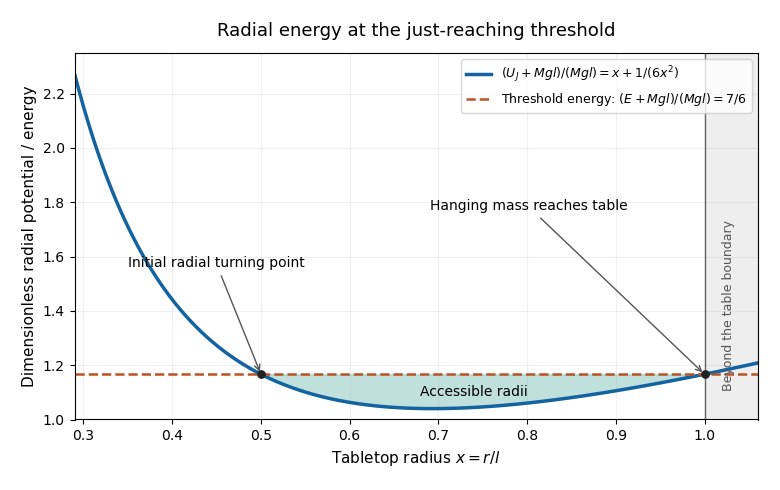
Effective radial potential at the threshold for the hanging mass to reach the table
. The horizontal energy level intersects the effective potential at r/l equal to one half and one. The interval between them is accessible. The curve is shifted by the irrelevant constant Mgl and normalized by Mgl; the physical region ends at r/l equal to one. Details.Initially , and , so the conserved angular momentum is . For , the effective potential contains the centrifugal barrierThe finite conserved energy therefore forbids the hole from being reached:The exceptional case has no centrifugal barrier. Then and ; starting at rest at , the tabletop mass reaches the hole after . The model ends at that event. Thus the usual nonzero initial tangential speed assumption matters.
At the threshold found in i, both products are stationary in the centre-of-momentum frame, so they have the same velocity in the laboratory frame. Take the energetic incident photon along . The total energy is and total momentum is , so the centre-of-momentum frame moves atFor the numerical threshold,This is extremely close to, but strictly below, the speed of light. Each product has energy in the laboratory frame. Above threshold the same ratio of total momentum to total energy determines the motion of the pair's centre-of-momentum frame, but the individual electron and Positron need not have a common velocity.
Let the incident photon energies be and , meeting at angle in the laboratory frame. Add their four-momenta; because each is null, the squared total invariant energy isFor photon-photon pair production, its threshold value is : the electron and Positron have zero relative momentum in their centre-of-momentum frame. The minimum possible occurs for a head-on collision, , soWith and ,The quoted background photon energy is used directly, without substituting a different characteristic value of the cosmic microwave background. A less opposed collision has a higher threshold; parallel photons cannot produce this massive pair.
For the forward ray of i, the ultrarelativistic longitudinal Doppler factor follows from the exact expression in terms of the Lorentz factor:Indeed, for a positive boost. If , the exact formulas and their consistent asymptotic expansions areEquivalently,The printed equality is not exact. For a concrete ultrarelativistic example, gives the correct , whereas . The latter expands as , with the wrong first correction.
One can obtain the printed expression by using but replacing by only its leading approximation . This retains a constant term in the first equation while discarding a same-order term in the second. Thus is admissible only as a leading relative-accuracy estimate, of the same order as ; it is not the stated identity or a correct next-order approximation.
Let move at along relative to . The Lorentz transformation of energy and momentum, from primed to unprimed components, isThe inverse equations have replaced by and the primes interchanged. A photon making angle with in has . Thus its general Doppler factor isThe requested blueshifted expression assumes propagation parallel to the boost, :The propagation-direction assumption matters: for an oppositely travelling photon, , the reciprocal of the displayed factor. Relative frame speed alone does not select the longitudinal relativistic Doppler effect.
Choose particle 1's incoming velocity positive and particle 2's negative. The final particle is stationary, so four-momentum conservation requires zero total incoming momentum:It follows that . Squaring gives , henceThe initial total energy becomes the final rest energy. ThereforeThe extra invariant mass is the incoming kinetic energy retained as internal energy of the merged particle: . It does not violate conservation of energy or four-momentum conservation; the sum of the separate rest masses is not a conserved quantity in an inelastic collision.
For a massive free particle with rest mass and velocity ,The relativistic energy-momentum relation follows directly:This is the squared Minkowski norm of the four-momentum multiplied by . The Lorentz transformation preserves that norm, so it has the same value in every inertial frame. In the particle's rest frame, the momentum is zero and the total energy is its rest energy .
If over the subsequent segment, its slope is a constant and the equation of motion reduces toThere is uniform horizontal acceleration, not generally zero acceleration. Starting that segment at ,For a downhill straight track with , this gives , agreeing with b. Only gives constant horizontal velocity.
The condition must describe an actually straight limiting segment, with bounded velocity, for that subsequent constant-acceleration conclusion. If vanishes only at an isolated inflection point, the boxed expression describes the instantaneous acceleration there; it does not make the rest of the track straight. Likewise, a vanishing alone does not make the product negligible in a limit where diverges.
Model the cart as a particle on a fixed plane curve, remaining constrained to the track. Its vertical velocity is , so its kinetic energy, gravitational potential energy and Lagrangian areConsequently the canonical momentum conjugate to the horizontal coordinate isIt is not simply the horizontal component of the mechanical momentum, because a change in also moves the cart vertically. Differentiate carefully in the Euler-Lagrange equation:Subtracting yieldsThe term involving accounts for the changing track geometry. An independent check is conservation of energy:
Smooth ground, rough cylinder contacts. Write for the tangential contact force magnitude at each upper-to-lower contact. On the top cylinder, its tangential components point upward and outward, while their horizontal components and torques cancel by symmetry. For a lower cylinder, the tangential force has an inward horizontal component and a downward vertical component .
The rolling condition is now at the contact between cylinders, not at the ground. At the initial zero velocity, equality of the tangential contact-point accelerations givesThus gives . The lower cylinder's outward translation equation and the top cylinder's downward equation areUsing gives and henceFor solid cylinders this is . Here the left lower cylinder rotates clockwise while moving left, and the right rotates counterclockwise while moving right. They may slip freely on the smooth ground, so imposing the ground-rolling relation would be incorrect. No slip at the cylinder contacts requires initially.
These are the two cases of the initial acceleration of three stacked cylinders. As a check, as the rotational contribution disappears in both formulas and they approach the smooth-contact release result .
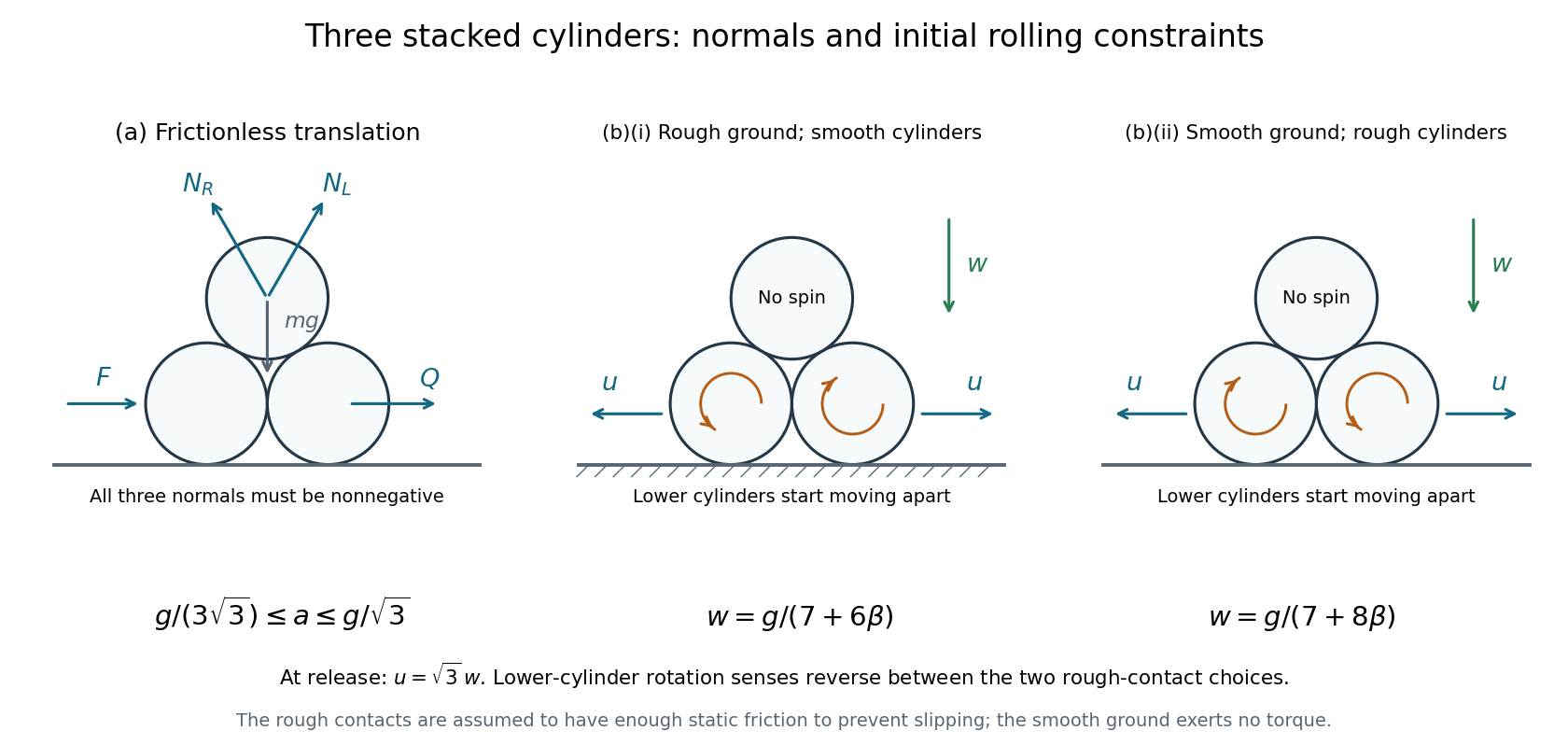


Rough ground, smooth cylinder contacts. Let be either upper-to-lower normal force, and the magnitude of the inward ground friction force on each lower cylinder. Pure rolling on the ground requires . The torque equation about a lower cylinder's centre isThe outward translation equation is , giving . The top cylinder's vertical equation is . Using yieldsFor uniform solid cylinders, and . The left lower cylinder rotates counterclockwise while rolling left; the right rotates clockwise while rolling right.
The assumed no-slip ground contact is possible if its coefficient of static friction satisfies at release. This follows from and ground normal force .
During the photon's runner-frame flight, the tunnel entrance moves left by . It began ahead of the runner by , so at detection it lies behind byDivide this distance into the tunnel by the simultaneously measured tunnel length :The runner is stationary in , but their location relative to the moving tunnel still has this fraction. Omitting the initial entrance gap would incorrectly count the runner's progress from an emission event at which they had not yet entered in this frame. These simultaneous positions give the tunnel photon timing in two inertial frames.
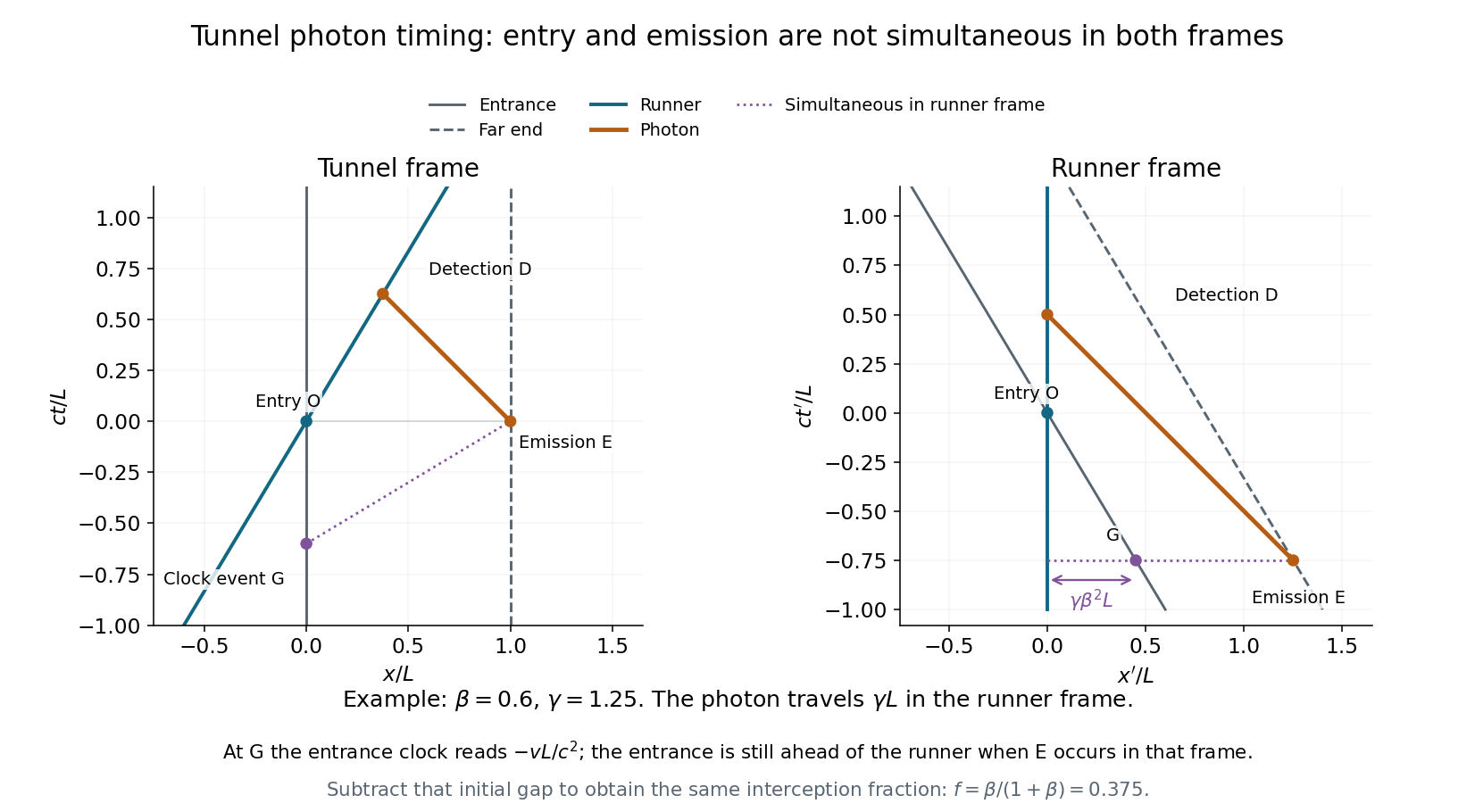
Emission, entry and detection in the tunnel and runner frames
. Original spacetime diagrams for , in units . Event G is on the entrance clock and simultaneous with far-end emission in the runner frame. The runner-frame diagram shows the entrance initially ahead of the runner, and a photon travel distance rather than . Details.
The entrance clock is at . Let be the event on that clock simultaneous with emission in the runner's frame. Since , its reading isThis is the tunnel clock's reading, not the runner-frame coordinate time . It is also not a calculation of what a photograph of that distant clock would show, which would require an additional light-travel condition.
For the general Lagrangian just obtained, the Euler-Lagrange equation givesUsing the small-angle approximation , this is simple harmonic motion with . ThusThe endpoint mass cancels in the light-rod limit. A concrete comparison shows why the finite rod cannot silently be included: the same specified endpoint with gives , distinct from the negligible-rod result. This is a physical pendulum when the rod contributes, and a simple pendulum in the light-rod limit. Both expressions require small oscillation amplitude; the full sine equation remains nonlinear.
There are unlisted articles, also show them or only show them.