
The useful modes are and their charge conjugates. An electron gives an isolated track and localized electromagnetic shower; a muon gives an isolated penetrating track. Both allow a well-calibrated charged-lepton transverse momentum and a missing transverse momentum measurement for the neutrino.
The tau lepton decays before detection, usually adding further neutrinos. Its visible momentum is only part of the original tau momentum, so the simple two-body endpoint is lost. For the direct electron and muon modes, the transverse massalso has an ideal endpoint at and avoids needing the unmeasured neutrino longitudinal momentum. Fits to this distribution or the charged-lepton spectrum determine .
Past exam of the particle physics course of the University of Oxford 2019 1 b ii Solution Created 2026-10-25 Updated 2026-11-05
Initial-state radiation of gluons gives the W boson nonzero transverse momentum. Its transverse Lorentz boost then changes the charged-lepton , washing out the sharp edge and permitting events above it. The recoil must be modelled with quantum chromodynamics and constrained by measured hadronic activity. Independently, the finite W boson decay width spreads its actual invariant mass, also smearing the fixed-mass endpoint. Either is a theoretical broadening mechanism; neither is a detector-resolution effect.
Take an on-shell W boson of fixed mass , zero transverse recoil, negligible charged-lepton mass, and unrestricted angular acceptance. In its rest frame the charged lepton has momentum magnitude . A longitudinal Lorentz boost to the laboratory preserves transverse momentum, soBoth angular roots contribute to the same . Set and . The change-of-variable Jacobian determinant has , and the two-root angular weight is . ConsequentlyThis is the ideal W-decay Jacobian peak. The divergence at the endpoint is integrable; it is a change-of-variable effect, not an infinite decay probability. Reversing the polar axis does not change this transverse momentum density, because the sum of the two roots removes the term odd in .
Past exam of the particle physics course of the University of Oxford 2019 1 a iii Solution 2026-10-25
Let be the angle from the incoming up quark, along the proton direction, to the outgoing charged antilepton in the W boson rest frame. The initial and final spin projections in ii are and . The Wigner small-d matrix therefore givesAfter squaring and normalizing over , the charged-lepton angular distribution isIts integral is one since . The charged antilepton is preferentially emitted toward the antiproton. Measuring the angle from the incoming down antiquark instead replaces by and produces ; the axis convention is part of the answer. Per unit solid angle the normalized density is .
Past exam of the particle physics course of the University of Oxford 2019 1 a ii Solution 2026-10-25
Neglect the participating quark and lepton masses, so that the weak charged current selects a left-helicity and a right-helicity . Choose along the proton beam in the partonic centre-of-momentum frame. Then the up quark moves along with spin projection , while the down antiquark moves along with helicity and also has spin projection along . ThusThe collinear two-body initial state has no orbital projection about its collision axis. In this approximation the produced W boson therefore has the indicated transverse polarization; its longitudinal spin state is absent. The unpolarized hadron beams contain other constituent spin states, but these do not participate in this massless charged-current subprocess.
In the final state the Positron has helicity and the electron neutrino has helicity . Along the outgoing charged-lepton direction their combined angular-momentum projection is , because the oppositely moving neutrino has spin projection on that axis. Finite masses, noncollinear production and sea contributions modify the ideal configuration.
A leading valence-level process is , with the up quark supplied by the proton and the down antiquark by the antiproton. The same Feynman diagram works with replaced by . Both vertices are weak charged current vertices; the production scattering amplitude contains the CKM matrix element or its conjugate according to the chosen fermion-flow convention. The intermediate W boson is produced near its mass shell.
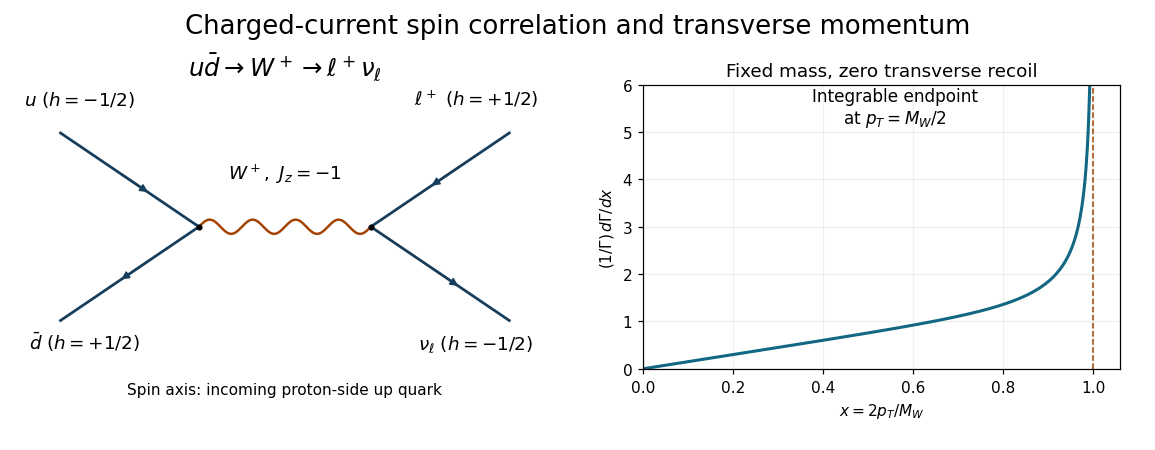
Original charged-current production diagram and the normalized ideal charged-lepton transverse-momentum density. The angular axis is measured from the proton-side incoming up quark.
Details. 
Past exam of the particle physics course of the University of Oxford 2018 4 e ii Solution 2026-10-25
A proton contains up quarks on which the charged current can act:through exchange, weighted by . Spectator quarks complete the hadronic final state. At the exclusive nucleon level the charge assignment is ; at the high momentum transfers specified, the generally dominant description is inclusive with proton structure and hadronic breakup, not an unsuppressed pointlike proton-to-neutron transition. The quark-level diagram in the figure displays this allowed charge flow. The electron's left-chiral selection is the same as in part d.
For an incoming , a putative process would change total electric charge from to zero. It is forbidden: both negative charged leptons would have to emit a , and a single exchanged charged boson cannot connect those two emission vertices. Ordinary elastic scattering remains possible through -channel photon or exchange, shown in the figure, but this is not the charged-current reaction of part d. The neutral-current weak contribution is distinct from the electromagnetic one.
Past exam of the particle physics course of the University of Oxford 2018 3 c iii Solution 2026-10-25
Interference CP violation concerns the relative phase between direct decay and decay after mixing. For a common CP eigenstate final state, it can occur with both and , so neither of the first two mechanisms is needed. In that limit , butproduces different interference terms for and . With ,The term proportional to consequently reverses sign. In the CP-conserving limit, is the real CP parity of the final state in a consistent phase convention. For non-CP-eigenstate final states, compare the full coefficients in CP-conjugate rates rather than imposing this simplified criterion.
Past exam of the particle physics course of the University of Oxford 2018 3 c ii Solution 2026-10-25
CP violation in mixing occurs whenThe flavour-transition probabilities are proportional to for , and for the reverse. Their inequality remains when decay probability amplitudes themselves conserve CP. The coefficients multiplying the mixed-decay terms in the rate equations encode this asymmetry.
Direct CP violation means unequal magnitudes of CP-conjugate decay probability amplitudes:It changes decay probabilities even at , before any mixing. For a common CP eigenstate final state, this reduces to . Usually it requires interfering decay contributions with different weak phases and different strong phases; it is not equivalent to a nonzero weak phase in one isolated probability amplitude.
Neglecting the electron mass in the centre-of-mass kinematics, take , , and . Then and . HenceThe constant Jacobian givesIncluding both Standard Model chiral channels in the contact approximation instead gives . The right-electron term is flat in .
In the electron-rest laboratory frame , the invariant definition immediately givesThis last equality is exact. With electron mass retained in the centre-of-mass relation, the angular formula becomes , approaching the boxed massless relation at high energy.
Assume first an ultrarelativistic charged-current interaction with negligible electron mass in the centre-of-mass spin analysis. Choose the incident antineutrino along . Its right helicity gives spin ; the interacting left-helicity electron moves along and also has spin . The total initial projection is . The final antineutrino and selected electron likewise have total spin along the outgoing antineutrino direction. The spin-one rotation therefore givesAn unpolarized electron target changes the normalization through the spin average, not this selected-current shape. For electron antineutrinos the charged-current diagram is the -channel graph. A contact approximation further requires .
The full Standard Model also has neutral-current exchange. In the contact limit it supplies a right-electron contribution as well as interference in the left-electron channel. With , , the full high-energy shape is proportional to . Thus the pure squared angular form is an explicitly stated charged-current approximation, not an exact prediction for all Standard Model contributions. At momentum transfers comparable to the weak-boson masses, propagators must also be retained.[ref]
Electroweak Model and Constraints on New Physics by J. Erler and A. Freitas (2024). §10.3.1, equation (10.30) and following electron-neutrino charged-current shift: both left- and right-electron weights
Past exam of the particle physics course of the University of Oxford 2016 5 3 c Solution Created 2026-10-25 Updated 2026-11-05
Assuming that the two listed leptonic decay categories exhaust the leptonic modes, the inclusive hadronic branching fraction is . ThusAt the simplest massless quark level, the W boson couples to and in three color charge states, so equal quark and lepton weak coupling constant values predictThis is a rough check of color multiplicity in a decay width and universal weak-current normalization. It is much less precise than the two-lepton ratio because hadronic quantum chromodynamics and electroweak interaction corrections are sizeable: the data require a net correction factor near . They must be included before extracting a quark-to-lepton coupling constant ratio. It would be incorrect to interpret the excess over three directly as a failure of weak universality. The displayed exclusive hadronic modes alone would underestimate the inclusive sum.
The Cabibbo-Kobayashi-Maskawa matrix is the unitary change of basis between down-type quark mass eigenstates and the combinations appearing in the weak charged current. In particular, and production carry and . Exclusive tau lepton decays into a charged pseudoscalar meson giveup to small radiative corrections. The pseudoscalar decay constants specify the vacuum-to-meson axial-current matrix elements, .
The observed branching fraction ratio is , and the kinematic factor is approximately . Hence the directly determined combination isWith an independent, representative lattice input , this becomes , close to the source's rounded expectation . Conversely that expectation and the hadronic input predict a branching fraction ratio near . Without the decay-constant input the table does not isolate a pure Cabibbo-Kobayashi-Maskawa matrix ratio. Setting would give approximately , demonstrating the importance of flavor symmetry breaking.[ref]
Leptonic Decays of Charged Pseudoscalar Mesons in the 2024 Review of Particle Physics. Sections 72.1–72.2, axial-current definition, radiative corrections and lattice decay-constant ratios
Lepton universality means that the weak charged current couples equally to the three charged lepton families after accounting for masses and known radiative corrections. In the ratio of two tau lepton leptonic decay widths, the parent coupling constant, mean lifetime and cancel:The universal prediction is . The measured ratio is , givingif the quoted errors are treated as independent. This is consistent with unity at about standard deviations. An actual precision fit must retain the measured covariance and the small radiative corrections; the rounded table alone does not supply those correlations.
Past exam of the particle physics course of the University of Oxford 2015 7 c iii Solution 2026-10-25
Use a high-multiplicity hadronic mode with only one invisible neutrino, and reconstruct the total visible four-momentum . In the tau lepton rest frame,Fit the endpoint of the hadronic invariant mass distribution, preferably together with its laboratory energy boundary at known beam energy. The two-dimensional boundary uses more information than the single largest observed mass. Detector smearing, unseen neutral products, backgrounds, beam radiation and hadronic spectral modeling must be included. Absence of a displaced endpoint generally sets an upper bound rather than a positive neutrino mass measurement. Strictly the flavour state contains several mass eigenstates; an unresolved endpoint constrains the corresponding weighted mass spectrum.
Past exam of the particle physics course of the University of Oxford 2015 7 c ii Solution 2026-10-25
Write the leptonic partial decay width asHere is defined from muon decay, so the coupling denominator fixes the convention. Measure . The ratio tests after the known phase space and radiative corrections. Comparing with the muon lifetime and the fifth power of the mass ratio tests . Hadronic comparisons such as tau-to-pion versus pion-to-muon decay supply additional universality tests with their own hadronic and electromagnetic corrections.
In , charge and missing four-momentum show an invisible neutral component beyond the visible charged lepton. The distributions are consistent with three-body V-A interaction decay; hadronic modes such as instead have two-body missing-mass kinematics. Production and decay accounting assigns and their antiparticles minus one. Searches for wrong-flavour and neutrinoless channels constrain violations. These observations establish a useful approximately conserved tau-family number in ordinary interactions, rather than proving an exact law from missing energy alone.
To establish that the invisible particle is distinct from and , combine decay evidence with the absence of unsuppressed tau production by conventional electron- and muon-flavour beams, and direct tau neutrino charged current interactions. DONUT observed the short displaced tau lepton decay in nuclear emulsion after a neutrino interaction. [ref]
Observation of Tau Neutrino Interactions by DONUT Collaboration. DONUT first direct tau-neutrino interaction report
Neutrino oscillation means individual family numbers are not exact conserved quantities during propagation, even though they are an excellent approximation for these local decay assignments. Past exam of the numerical linear algebra course of the University of Oxford 2025 3 b iv Solution 2026-10-25
Under the permitted singular value bounds, givesFor the symmetric positive-definite matrix in part (iii), its eigenvalues are the squared singular values of , soApply the supplied conjugate gradient convergence bound to . For and nonzero , the function increases with , givingThus the error in this weighted norm contracts at a guaranteed exponential factor of at most per iteration, up to the prefactor . Here . The Pythagorean identity in part (iii) also identifies with the excess squared linear least-squares problem objective, which consequently decreases by a bound proportional to . For the Euclidean norm, the same eigenvalue bounds give .
For relative accuracy in the -weighted norm, it is sufficient to takeCompute once in operations. Each iteration applies with two dense matrix multiplications and uses further arithmetic operations; when this costs . Hence the total cost isUsing finite termination of the conjugate gradient method in exact arithmetic refines this to . Explicitly constructing first would add setup work and is unnecessary. These accuracy estimates concern relative error; an absolute tolerance replaces by when . If , the initial guess already solves the problem.
As in part 2(b)(v), the Gaussian assumption alone does not make the printed singular value interval a certainty. For example, the event that every entry of has absolute value below a sufficiently small positive number has positive probability and forces , contradicting the asserted lower endpoint. The displayed rate is therefore conditional on the singular-value bounds authorized by the paper. The cost and convergence derivation are exact under that condition; an unconditional probabilistic statement would need an additional failure-probability estimate.
There are unlisted articles, also show them or only show them.