
The multivariable chain rule gives and . Substitution into the differential equation yieldsThe coordinate transformation is invertible exactly when .
At , the integration interval first moves through positive arguments, then crosses zero, and finally contains all of . The result isThe final plateau is the integral of the entire initial velocity profile divided by .
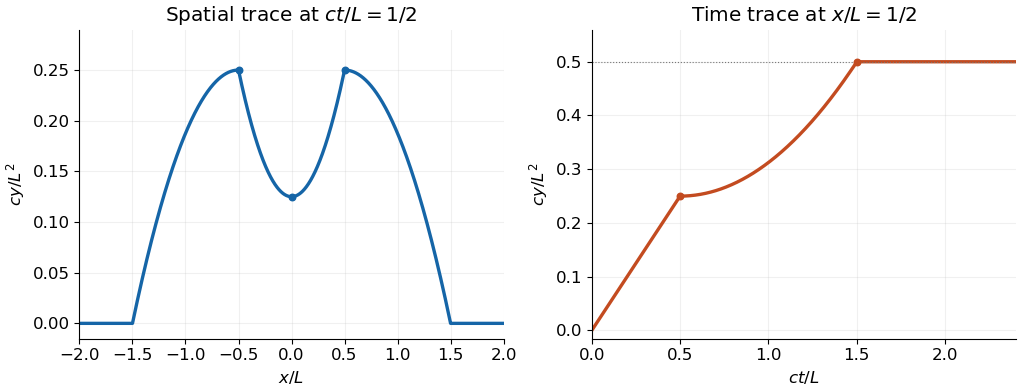
At , the interval of integration has half-width . Evaluating the cumulative integral in part a gives the even functionIt has value at zero and maxima at , then falls to zero at the two wavefronts.
Take the boundary pieces in the orderOn the circular arc , use for . Then and , so its line integral is zero.
On , use , , with decreasing from two to zero. Since and , , giving four. On , use , , with increasing from zero to two. Again , giving minus four. The total is , agreeing with Stokes theorem.
The curl is . For the upward orientation of the paraboloid, the vector surface area element is . Therefore Stokes theorem givesThe upward normal gives the prescribed anticlockwise boundary orientation viewed from above.
Parametrize the surface of revolution byAn oriented vector surface area element isUse the vector field , whose divergence is one. If this parametrization has the outward orientation on an enclosing surface, the divergence theorem givesThe second equality is integration by parts, using the endpoint values. For example this outward convention applies when the positive- branch lies above the negative- branch, for .
The stated regularity and endpoint conditions alone do not guarantee an embedded enclosing surface: branches can cross or coincide. Without an appropriate orientation assumption the flux formula is an algebraic signed volume. If “inside” is defined as the region between the two graph branches for each radius, its nonnegative geometric volume is insteadThis explicitly handles a reversal or change in the order of the two branches.
Take in Green's second identity. Since , , on the unit sphere, and there,The final term vanishes by the divergence theorem, because it equals . ThereforeWe assume sufficient boundary regularity for the stated boundary values and integrals, or use the corresponding trace/limit formulation. This is the equality of volume and surface averages for a harmonic function, since the unit ball and sphere have volume and area .
Apply the divergence theorem to . The product rule givesbecause the two gradient inner products cancel. Also . ThusThis is Green's second identity, under the usual regularity assumptions permitting these derivatives and boundary integrals.
For a bounded region with piecewise smooth boundary and a continuously differentiable vector field on a neighborhood of its closure, the divergence theorem sayswhere is the outward unit normal vector. The left side integrates divergence over the volume; the right side is the outward flux.
The truncated Fourier cosine series gives the better approximation on the closed interval, in the senses of uniform convergence and the asymptotic L2 norm error. To make the comparison precise, let and retain the frequencies , with the constant term also included in .
The cosine Fourier coefficients are . In fact, absolute convergence gives the uniform tail boundFor the Fourier sine series, every Fourier partial sum satisfies . Thusso there is no uniform convergence to on the closed interval. Its odd extension has jump discontinuities, producing the Gibbs phenomenon near the endpoints; its Fourier coefficients decrease only like .
The advantage persists in the L2 norm, which ignores individual endpoint values. By Parseval's identity and Fourier orthogonality,The nonzero odd cosine coefficients and both parity classes of sine coefficients also give matching lower bounds of these orders by comparison with the corresponding p-series. Hence their L2 norm errors decrease respectively like and . This is a comparison of approximation quality in specified norms, not a claim that one finite sum has smaller error at every individual interior point.
For the Fourier cosine series, integration by parts givesand, for ,Only odd Fourier harmonics remain, so
For the Fourier sine series, another integration by parts givesConsequentlyAt and , the Fourier sine series instead has value zero.
To describe the requested graphs precisely, take congruent to modulo . The Fourier cosine series converges to the continuous triangular periodic extensionIts minima occur at the even multiples of , with value , and its maxima at the odd multiples, with value . The Fourier sine series converges toThe jump discontinuities at even multiples of go from to ; those at odd multiples go from to . Each jump is assigned its midpoint, zero, by the Fourier series.
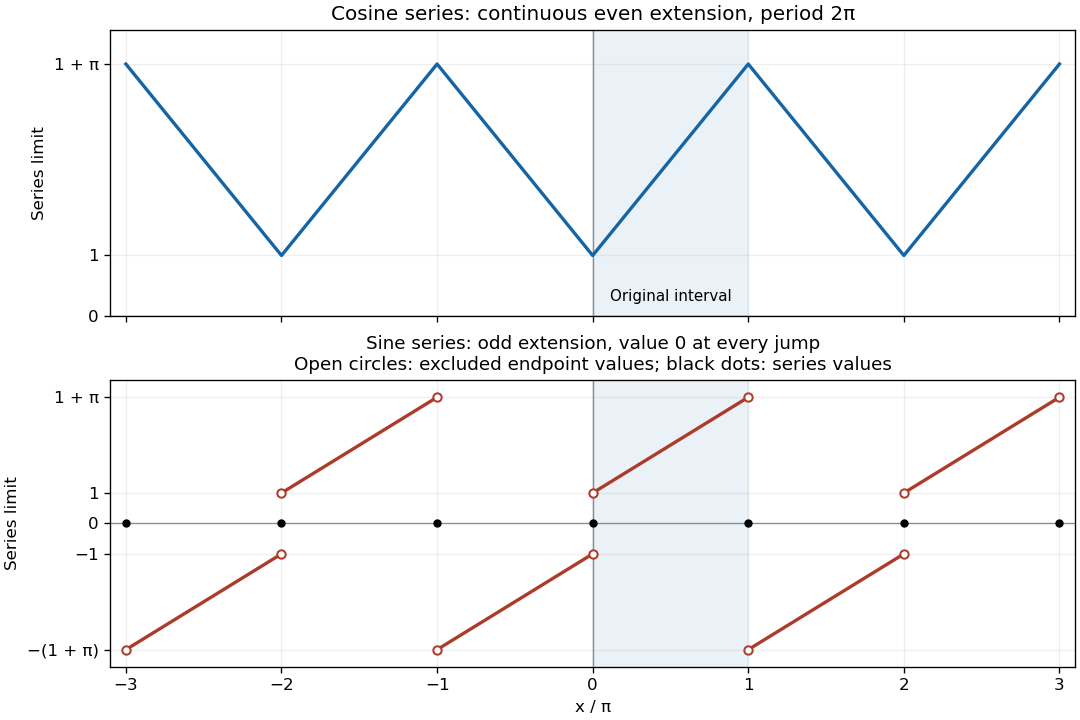


The theorem on pointwise convergence of a piecewise smooth Fourier series gives the average of the two one-sided values of the corresponding periodic extension. Under the usual piecewise smooth interpretation of the paper's derivative assumption, the even extension is continuous at and at the joined endpoints . ThusFor the odd extension, the values on either side of zero are and ; those on either side of are and . ThereforeThe endpoint values are also immediate because each sine term vanishes there. If or is nonzero, the Fourier sine series does not reproduce that endpoint value. Merely assuming that the derivative is locally piecewise continuous in the open interval would be weaker than the usual piecewise smooth hypothesis; the convergence assertion uses the standard endpoint regularity implicit in that hypothesis.
The Fourier cosine series and Fourier sine series use the respective formsTheir Fourier coefficients, obtained from Fourier orthogonality, areIn particular the constant term is . The Fourier cosine series is the Fourier series of the even extension , made -periodic. The Fourier sine series is the Fourier series of the odd extension, equal to for and for , again made -periodic.
Choose the scalar fieldThe allowed vector-valued Stokes identity givesEvery boundary point lies on the unit circle in the -plane, so throughout the boundary. Since the line integral of around a closed curve is the zero displacement,Only the boundary value of this scalar field mattered: the interior of the surface need not be part of a sphere. Either consistent choice of orientation gives the same zero answer.
Use the outward orientation on the unit hemisphere and counterclockwise boundary orientation on the unit circle. With and , the vector line integral isFor the surface integral, and the outward unit normal vector is , since the radius is one. The cross product isThe integral of is zero by reflection symmetry. Using the same spherical polar coordinates as in ii, with , the other component isHenceverifying the vector-valued Stokes identity directly, component by component. The wedge symbol in the paper denotes the cross product here.
Choose the outward unit normal vector on the upper hemisphere. The curl of isIn spherical polar coordinates, putHere and . The surface integral is thereforeThe compatible boundary orientation follows increasing in , . On this circle,Thus the line integral iswhich agrees with the surface integral as required by the Stokes theorem.
Let be a compact, piecewise smooth oriented surface with piecewise smooth boundary, and let be continuously differentiable on an open neighbourhood of . The Stokes theorem statesThe boundary orientation must agree with the chosen unit normal vector by the right-hand rule. For an upward orientation on a horizontal disk, its boundary is traversed counterclockwise when viewed from above. Reversing the orientation reverses both the line integral and the surface integral.
For each of the three constant Cartesian unit vectors , apply the divergence theorem to the vector field . Its divergence is , soThese are precisely the three components ofThus the volume integral of the gradient is the boundary surface integral weighted by the vector surface element . The regularity needed here is that be continuously differentiable on a neighbourhood of the closure of .
One sufficient version of the divergence theorem is the following. Let be a bounded region in with a closed, piecewise smooth surface as its boundary, and let be a continuously differentiable function with values in on an open neighbourhood of the closure of . With the outward unit normal vector,The boundary surface integral is the total outward flux integral. If the boundary has several components, each has the outward orientation relative to the material of ; inner components therefore point into the holes. Edges and isolated vertices may be omitted when assigning the unit normal vector, since they have zero surface area.
There are unlisted articles, also show them or only show them.