
Write the centroid as . The region has reflection symmetry in the -axis: replacing by changes to and preserves and . Thus symmetry in integration givesFor the other first moment of area, use in polar coordinates:Here the last integral has the value allowed in the paper. Dividing the first moment of area by the area found in i givesThe positive vertical coordinate agrees with the fact that the entire region lies above the -axis.
Use polar coordinates with and . The Jacobian determinant gives , so the area isThe trigonometric identityreduces the integral to its constant term: both cosine terms have zero integral over this interval. Therefore
Assume . The velocity in polar coordinates is . HenceTaking the dot product of the conserved Laplace-Runge-Lenz vector with givesConsequently the polar equation of a conic isOnly angles for which the denominator is positive describe the physical trajectory. Its eccentricity is , giving an ellipse, parabola, or hyperbola when this ratio is respectively less than, equal to, or greater than .
If , the angle is undefined, but the same dot product identity gives the circular orbit . If , the trajectory is radial and the displayed division degenerates; for , and on a fixed ray, so the identity does not determine as a function of a varying angle.
With , a gives constant , and the polar coordinates basis satisfies , . Also . Differentiating the proposed Laplace-Runge-Lenz vector therefore givesFor this to vanish for arbitrary , including nonzero , the central force must satisfyAttraction requires . The condition “for any value of ” matters: with alone, the Laplace-Runge-Lenz vector is constant on each radial ray for any central force, so that special case would not determine the force law.
Let . It is a symmetric matrix, and . By the spectral theorem for real symmetric matrices, choose an orthonormal basis of eigenvectors of , with nonnegative eigenvalues .
For each , take the unit parallelogram parametrized by , . Its surface area is . Moreover,The image parallelogram consequently has area . By the assumption this equals for all three pairs, givingNo eigenvalue can be zero. Dividing the equations and using positivity yields . HenceThus testing all surfaces is stronger than necessary: the three unit parallelograms in these principal directions already determine the result. This is the three-dimensional characterization of linear surface-area isometries.
Let parametrize . Then parametrizes its image, with tangent vectors and . An orthogonal matrix preserves dot products, so the Lagrange identity for the cross product gives, for any ,The area element of a surface is therefore the same pointwise before and after applying . Integrating provesThis includes orthogonal transformations with determinant : reversal of orientation does not affect the Euclidean norm in the surface area formula.
The endpoint radii are and , but substituting those two numbers in the finite conical frustum formula is invalid. A rotation about the -axis preserves the horizontal angle between the endpoint position vectors; here and are not parallel. The radius along the generating segment is not linear in height.
Parametrize the actual segment byIts rotated circle at height has radiusThus the rotated image is the surface of revolution . Applying the conical frustum formula to infinitesimal pieces of this radial profile, or directly using the cross product as in ii, gives the surface area of a surface of revolutionTo evaluate it explicitly, put . Then . DefineThe chain rule gives , so the answer isThe positive logarithm arguments make this a real-valued expression. Rotating the segment's endpoints independently into one vertical plane before joining them would instead create a different surface, with surface area .
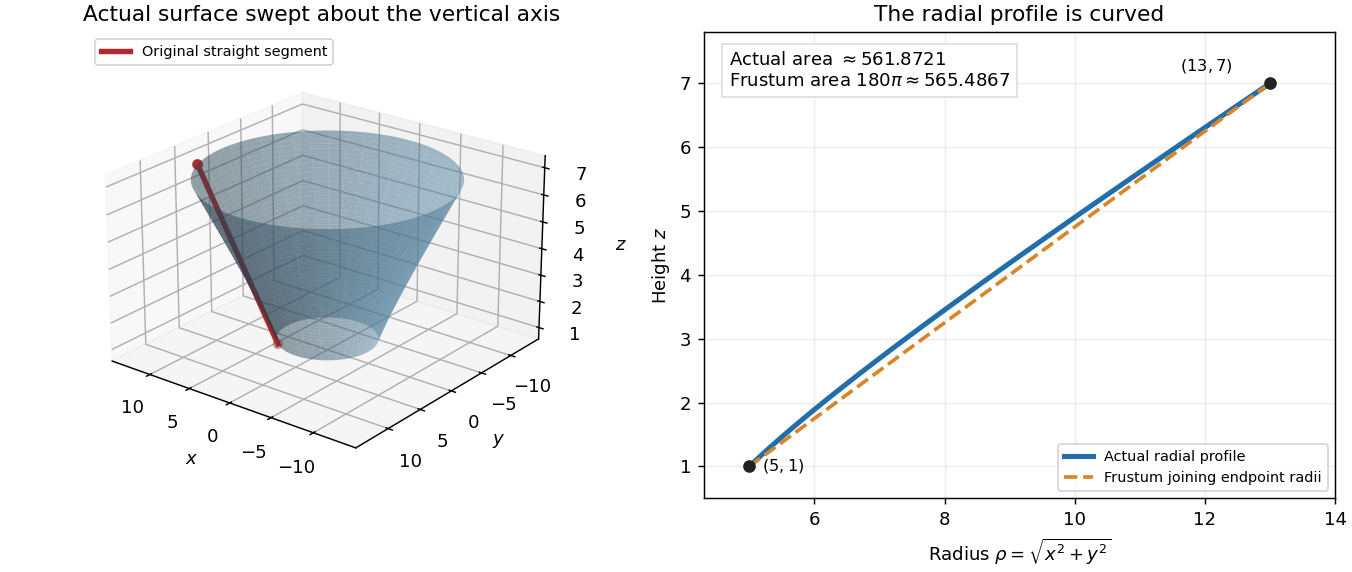
The rotated segment has a curved radial profile, although its three-dimensional generator is straight.
Details. 
For the parametrized surface in i,These tangent vectors are orthogonal, and their Euclidean norms are and , respectively. Their cross product therefore has Euclidean norm . Integration givesThis is the lateral surface area of a conical frustum, with no end disks included.
Interpolate the radius and height byA parametrized surface for the conical frustum isThe strict positivity of gives . Since , the height identifies uniquely; the angle then identifies a point of each circle uniquely modulo . Hence this covers the lateral surface of revolution once. If , it is the lateral surface of a circular cylinder.
Represent the quadratic form by the symmetric matrixThe spectral theorem for real symmetric matrices gives an orthogonal matrix and real eigenvalues such that . In the orthogonal change of coordinates , the equation becomes .
If both eigenvalues are positive, this is an ellipse with semiaxes and . Conversely, a zero eigenvalue makes the set either empty or unbounded along that coordinate, while two negative eigenvalues give the empty set. Opposite signs give an unbounded hyperbola. A negative eigenvalue together with a zero one also gives the empty set. None of those cases is an ellipse. Therefore the exact condition is that be a symmetric positive-definite matrix.
The sum and product of its eigenvalues are its matrix trace and determinant:Two real numbers are both positive precisely when their sum and product are positive. ThusAn orthogonal transformation preserves area. Using i gives the quadratic-form ellipse area
The altitude of a triangle through has equation , and the altitude of a triangle through has equation . Their normal vectors and are linearly independent because the triangle is nondegenerate. Consequently these two lines meet in exactly one point .
Substitute its position vector in the supplied identity. Its first term vanishes by the first altitude of a triangle equation, and its second term vanishes by the second altitude of a triangle equation. HenceThis is exactly the condition that lies on the altitude of a triangle through . The three lines therefore meet in a unique point, the orthocenter. This argument includes right triangles and triangles whose orthocenter lies outside them.
With as in i, the foot of a perpendicular lies strictly between the endpoints precisely when . Since the denominator is positive, this givesEquivalently, both dot productsare positive: the angles of the triangle at and are both less than . If “between” includes the endpoints, replace both strict inequalities by non-strict ones; equality gives or .
Write . Since the triangle is nondegenerate, . Every point on the line has a unique position vector . The condition that is orthogonal to is the dot product equationIts coefficient of is , so it has exactly one solution. The foot of a perpendicular is thereforeThis is the orthogonal projection of onto the line , expressed using the Euclidean norm.
Back-substitute in the Euclidean algorithm to obtain an integer linear combination:Multiplying by gives the particular solution of the linear Diophantine equation. Subtracting it from any other solution and dividing by givesThe integers and are coprime, so divides . Writing forces . Conversely these expressions satisfy the original equation for every integer . Thus all solutions of a linear Diophantine equation here are
The successive division with remainder steps of the Euclidean algorithm areEach step preserves the greatest common divisor by part (a). The final nonzero remainder is , so
A possible center must be a fixed point, so . Let and . The determinant iswhen is not an integer multiple of . The unique center is thereforeThe fixed point equation implies , whenceRelative to , this is precisely a planar rotation through . This also explains the excluded case: when , is a translation, with no fixed point unless .
Write . The sine addition formula and cosine addition formula give . Therefore function composition satisfiesThe resulting angle is real and the new translation vector lies in , so is closed under function composition. Associativity holds because, for any functions and any , both and take to .
The identity element is , since . Every element has the two-sided inverse elementIndeed , and substituting into the composition formula makes the translation vector zero in either order. These verify all the group axioms. Thus is a group under function composition, the special Euclidean group in two dimensions.
There are unlisted articles, also show them or only show them.