
Suppose an arbitrary binary operation makes a group and makes a left group action on . For any group action, each acting element induces a bijection: the function induced by its inverse element is its inverse function.
In particular, the acting element whose underlying integer is must induce a bijection . But its power function isa constant function. This is injective only when all elements of equal . ThereforeThis proves the power-map group action obstruction for every possible ; it never assumes that is ordinary integer multiplication, or that the integer is the acting identity element.
Fix . The integer powers of a group element satisfyFor nonnegative integers these rules follow by associativity and counting factors; negative integers are handled by , and opposite signs by cancellation of adjacent inverse elements. All factors are powers of the same element, so no abelian group assumption is involved.
It follows that is a group homomorphism from the additive group of integers to , andThe homomorphism uses ordinary addition on ; composition of the power functions corresponds to ordinary multiplication of exponents.
Let the finite set contain distinct left cosets. By i, they form a disjoint partition of a set , and by ii each has elements. If is also finite, counting this finite disjoint set union givesThus is a finite group. This is the counting argument behind Lagrange's theorem.
For and , defineIf then , so this function is well defined. Its inverse function is , since successive left translation in a group by and cancels. ThusIn particular every left coset has the same cardinality as .
Each left coset is nonempty, since it contains , and every lies in its own left coset. Suppose and intersect, say with . ThenSince is a subgroup, , and . The reversed relation gives . Thus any two left cosets are either equal or disjoint, and together they cover . Therefore is a partition of a set . No finiteness or normal subgroup assumption is needed.
The shift , , is injective, so . It is not surjective: the least natural number is missing from its image of a function, whether starts at zero or one. For every , the image of a function of is contained in the image of a function of , so .
The identity function belongs to and is its identity element under function composition; any group structure using that operation would have this same identity element. Since has no right inverse element, is not a group under function composition. It is a monoid, since injectivity is preserved by function composition.
An injective function from a finite set to itself is surjective: its image of a function contains as many distinct elements as the entire set, so it cannot omit one. Thus every element of is a bijection, and conversely every bijection is injective. HenceIt is a group under function composition by i.
For any , choose with . By ii, as well. Associativity and the right identity element property now giveThus is also a left identity element. The given binary operation is closed on and associative, is a two-sided identity element, and each has the two-sided inverse element . All group axioms hold, so is a group. This is the one-sided group axioms criterion.
Suppose . Using only associativity and the given right identity element property,Thus is an idempotent element of a semigroup. By i it equals , provingNo left identity element or cancellation law is needed for this deduction.
Suppose . Choose with , using the given right inverse element property. Multiply the idempotent relation on the right by . By associativity and the given right identity element property,Thus the only idempotent element of a semigroup is . This argument uses no cancellation and does not assume a left identity element.
For each , left translation in a group is a bijection, with inverse function . Thus belongs to . For , associativity of the group operation givesHence is a group homomorphism. If , evaluation at the identity element gives . ThereforeThis is the left regular representation used in Cayley's theorem.
For a singleton , the symmetric group contains only the identity function. For a two-element set, it contains the identity function and the transposition exchanging the two elements; the latter squares to the identity function. In both cases all elements commute, so the group is Abelian.
If contains three distinct elements , define the transpositions and , fixing every other element of . They are bijections, even when is infinite. With function composition read from right to left,Thus they do not commute, so the symmetric group is not Abelian. Since is nonempty, this proves
The function composition of two bijections is a bijection, with inverse function . Thus function composition is a binary operation on . It is associative, since both and send to .
The identity function is a bijection and satisfies . Every bijection has an inverse function , itself a bijection, satisfying . These verify all group axioms, so is a group, the symmetric group of .
If every , then each diagonal entry of the Gram matrix is , so its matrix trace is . Using iii and the permitted arithmetic-geometric mean inequality,The bound is attained by any orthonormal family, whose Gram matrix is the identity matrix.
By the spectral theorem for real symmetric matrices, there is an orthogonal matrix such thatFor clarity, the diagonalization can also be justified recursively. The characteristic polynomial has a complex root of a polynomial by the fundamental theorem of algebra. By ii its eigenvalue is real; taking a nonzero real or imaginary part of an associated eigenvector in gives a real eigenvector, which can be normalized. Its orthogonal complement is invariant, because . Restriction to this linear subspace is again symmetric, and induction on dimension gives an orthonormal basis of eigenvectors.
All by ii. The permitted invariance of determinant and matrix trace under change of basis, applied to the diagonal matrix, yields
Symmetry of the real inner product gives . Moreover, i with shows thatso the Gram matrix is a positive semidefinite matrix. To also check reality of every eigenvalue, allow a nonzero vector with . Since is a real symmetric matrix,Here is the conjugate transpose, and cancels the imaginary part. Thusbecause . This proves both that every eigenvalue is real and that it is nonnegative.
Bilinearity of the real inner product gives, for the specified linear combinations,The last equality is the entrywise rule for matrix multiplication, with the transpose of the column vector .
The two-vector Gram matrix isThe upper bound follows because the subtracted square is nonnegative. If either vector is zero, the determinant is zero. Otherwise apply the non-strict version of the calculation in i: with gives . ThereforeEquality on the left holds exactly when the two vectors are linearly dependent; equality on the right holds exactly when they are orthogonal. The Gram determinant measures the squared area of their parallelogram: in the nonzero case, , the square of base times perpendicular height.
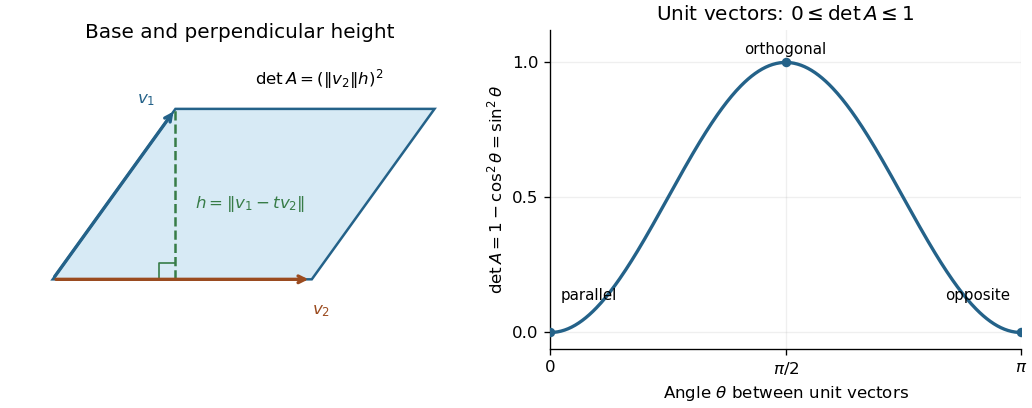
The Gram determinant as squared parallelogram area, and its dependence on the angle between unit vectors
. Details. 
The hypothesis implies , since the zero vector is a scalar multiple of every vector. SetSince is not a scalar multiple of , . Positive definiteness and bilinearity of the real inner product giveMultiplying by and taking square roots proves the strict Cauchy-Schwarz inequalitySince every real number satisfies , this proves, in particular,The argument derives the required inequality directly from the inner product axioms.
Every is a finitely supported sequence, so for a finite set of indices ,Thus is a spanning set. If contained , the displayed expression would give a nontrivial relationamong the distinct vectors of the finite subset of : the coefficient of is . This contradicts the linear independence of . It also covers , whose singleton is not linearly independent. Hence . In particular, is both a basis and a maximal linearly independent subset of .
There are unlisted articles, also show them or only show them.